
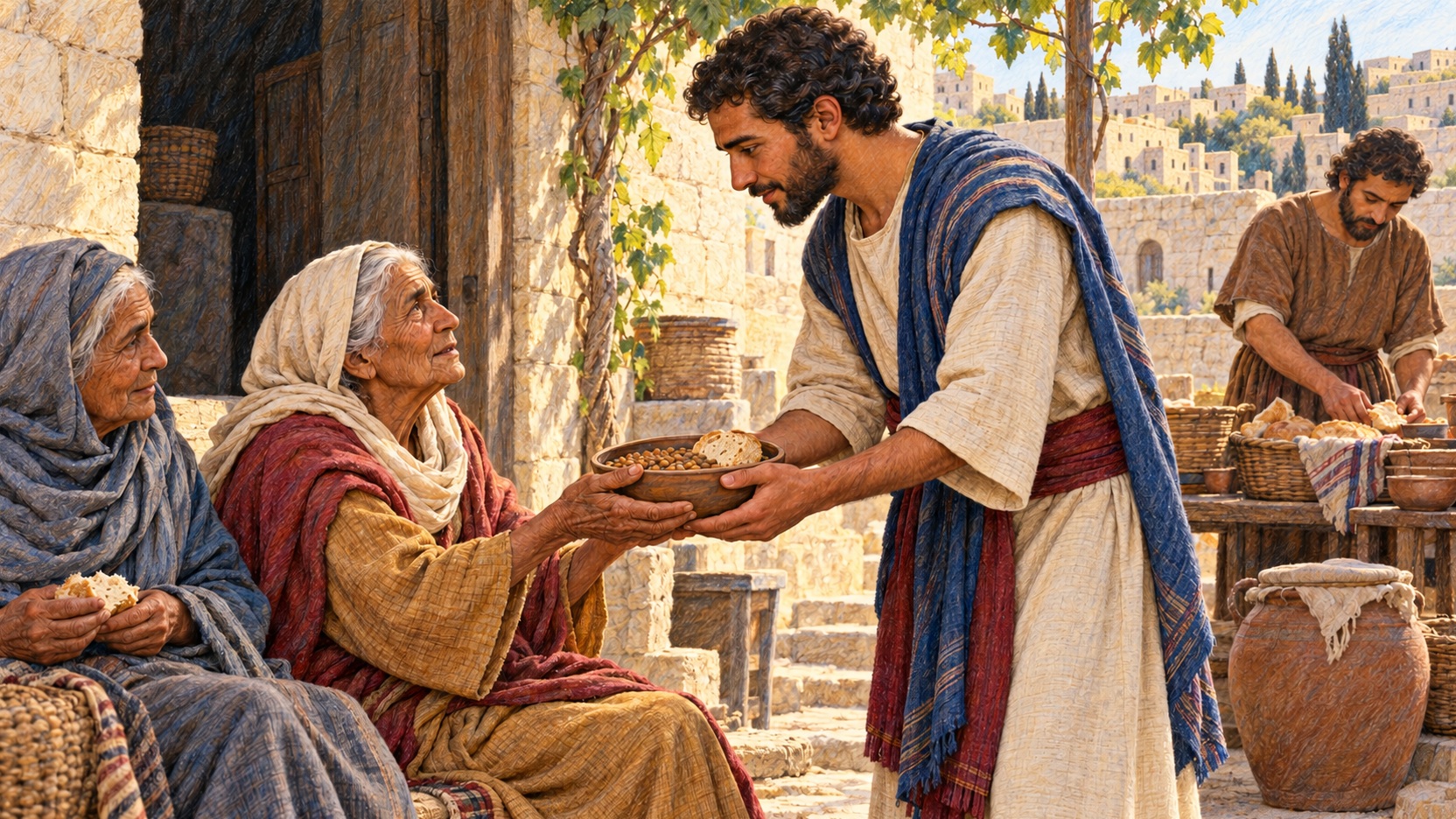
Stephen first appears in Acts because some widows were being overlooked. Before we hear his defense before the council or his prayer beneath the stones, we meet a man the church could trust to help put that neglect right. The man who spoke so firmly before Jerusalem’s leaders had already been willing to serve people who needed a meal.
Stephen’s Witness Begins With Service
Then the twelve summoned the multitude of the disciples and said, "It is not desirable that we should leave the word of God and serve tables. Therefore, brethren, seek out from among you seven men of good reputation, full of the Holy Spirit and wisdom, whom we may appoint over this business; but we will give ourselves continually to prayer and to the ministry of the word."
The Jerusalem church had been sharing its resources to provide for believers in need. As the congregation grew, however, the daily distribution failed some of the people it was meant to help (Acts 6:1). The Hellenists were Jews whose language and background were shaped by the Greek-speaking world; the Hebrews were Jews associated more closely with the local Hebrew or Aramaic-speaking community. Their widows belonged to the same church, but they were not receiving the same care. Luke identifies the neglect without telling us whether it came from prejudice, poor organization, or some other failure.
The apostles took the complaint seriously and gathered the disciples to address it. Their responsibility to prayer and the ministry of the Word required them to entrust the distribution to other capable men. They asked the congregation to choose seven men of good reputation, full of the Holy Spirit and wisdom. Once the men were chosen, the apostles prayed and laid hands on them (Acts 6:5-6). This public delegation provided for the widows while allowing the apostles to continue the work Christ had entrusted to them.
Waiting on tables was not beneath a spiritual man. Handling food, money, and people’s needs called for honesty and sound judgment, especially where a cultural division had already exposed a weakness in the congregation. Stephen’s reputation had to be known by the people choosing him. A claim to be Spirit-filled would have been a poor substitute for being trustworthy with someone else’s provision.
The seven men have Greek names, which fits the setting of the complaint, though a Greek name alone does not establish a man’s background. Luke specifically identifies Nicolas as a proselyte from Antioch, a Gentile who had converted to Judaism. The church chose men capable of addressing the need rather than dismissing the people who raised it.
These men are often called the first deacons, although Acts does not explicitly give the seven that title. Their service provides a reasonable connection with that later office: recognized, qualified men accepted responsibility for practical care. It also fits the wider apostolic teaching that authoritative church office belongs to qualified men. Both the apostles’ teaching and the seven men’s care required spiritual faithfulness. By assigning distinct responsibilities, the church could attend to both needs.
Luke then reports that the Word spread, the number of disciples increased greatly, and many priests became obedient to the faith (Acts 6:7). The congregation had addressed an internal failure while continuing to teach the gospel. Stephen was already serving within that church when his public witness brought him into conflict with opponents of Christ.
Wisdom, Signs, and False Accusations
And Stephen, full of faith and power, did great wonders and signs among the people. Then there arose some from what is called the Synagogue of the Freedmen (Cyrenians, Alexandrians, and those from Cilicia and Asia), disputing with Stephen. And they were not able to resist the wisdom and the Spirit by which he spoke.
Stephen did great wonders and signs, though Luke does not describe the individual miracles. He also reasoned with men associated with the Synagogue of the Freedmen, a name referring to formerly enslaved people or their descendants. Cyrene, Alexandria, Cilicia, and Asia identify connections with Jewish communities outside Judea. Luke’s wording has been understood to describe either one synagogue with several regional groups or more than one synagogue. In either case, these men disputed with Stephen and could not withstand the wisdom and Spirit by which he spoke.
Stephen’s Greek name and the setting suggest that he, too, belonged to the Greek-speaking Jewish community. These men were disputing among fellow Jews about Jesus, the law, and the temple. Saul came from Tarsus in Cilicia, which makes a connection with these debates possible. We should leave that as a possibility, since Acts first names him at Stephen’s death and does not identify him as one of the debaters.
Unable to answer Stephen, his opponents induced men to accuse him of blasphemy. They stirred up the people, elders, and scribes, seized him, and brought him before the council, the Sanhedrin. This was Jerusalem’s ruling religious council, before which Peter and John had already appeared. The witnesses charged Stephen with speaking against Moses and God, the holy place and the law. They also claimed he taught that Jesus would destroy the temple and change the customs Moses had delivered (Acts 6:11-14).
Luke calls these witnesses false. A false accusation can distort something a person really said as well as invent something he never said. Jesus had foretold the temple’s destruction, and in John 2 He spoke of the temple of His body. He also taught that He came to fulfill the law. Stephen may have explained what Christ’s coming meant for the temple and Mosaic customs, but Luke does not give us that earlier teaching. We cannot reconstruct it by treating his accusers’ charges as a reliable transcript.
As the council looked at Stephen, they saw his face as the face of an angel (Acts 6:15). Luke describes a striking appearance without explaining precisely how his face looked. It may remind us of Moses’ shining face after meeting with God, although Luke does not say Stephen’s face shone. The council saw this appearance in the very man being accused of speaking against God.
Stephen’s answer would show how false that charge was. He affirmed God’s covenant with Abraham, Moses’ divine commission, the law, the tabernacle, and Solomon’s temple. Then he used those same Scriptures to confront the leaders’ disobedience. Their rejection of the promised Messiah continued the resistance they condemned in their ancestors.
Stephen Answers From Israel’s History
And he said, "Brethren and fathers, listen: The God of glory appeared to our father Abraham when he was in Mesopotamia, before he dwelt in Haran, and said to him, 'Get out of your country and from your relatives, and come to a land that I will show you.' Then he came out of the land of the Chaldeans and dwelt in Haran. And from there, when his father was dead, He moved him to this land in which you now dwell. And God gave him no inheritance in it, not even enough to set his foot on. But even when Abraham had no child, He promised to give it to him for a possession, and to his descendants after him."
Stephen addressed the council as brethren and fathers, then began with the God of glory appearing to Abraham in Mesopotamia. God had called their father before he lived in the promised land and long before a temple stood in Jerusalem. He promised Abraham the land and foretold both his descendants’ affliction and their deliverance (Acts 7:6-7). Abraham did not yet possess the inheritance or have a child to receive it, but God had committed Himself to fulfill His word.
Stephen was not canceling the land promise. He was reminding the council that the God who made it had been at work before the institutions they were defending existed. Circumcision marked His covenant with Abraham, whose descendants included Isaac, Jacob, and the twelve patriarchs (Acts 7:8). Yet those patriarchs had themselves rejected the brother through whom God would preserve their lives.
"And the patriarchs, becoming envious, sold Joseph into Egypt. But God was with him and delivered him out of all his troubles, and gave him favor and wisdom in the presence of Pharaoh, king of Egypt; and he made him governor over Egypt and all his house."
Joseph’s brothers sold him because they were envious, but God was with him in Egypt. God gave him wisdom and favor before Pharaoh, and Joseph became the means of providing food when famine struck. On the brothers’ second visit, Joseph made himself known, and the family came to Egypt (Acts 7:11-14). The brother they had rejected was the one through whom they received help.
I see a pattern here that prepares us for Stephen’s charge concerning Jesus. God had worked through Joseph for the good of the very brothers who rejected him. Stephen does not explicitly call Joseph a type of Christ, a person whose life foreshadows Him, but the resemblance helps us follow his argument. The leaders could not assume that their rejection of Jesus proved He had no authority from God.
Stephen gives a count of seventy-five relatives (Acts 7:14), while Genesis 46:27 gives seventy in the Hebrew text. The ancient Greek form of Genesis gives seventy-five and includes additional descendants in Joseph’s household, as the NET translators’ notes explain. That ancient reckoning helps account for the larger number in Acts. I retain the Masoretic text, the traditional Hebrew text, as the basis for the Old Testament and accept Luke’s record as inspired and without error. We should acknowledge the different counts carefully rather than dismiss either passage. Stephen’s purpose here is to explain how God brought Jacob’s family into Egypt through Joseph.
"Now when he was forty years old, it came into his heart to visit his brethren, the children of Israel. And seeing one of them suffer wrong, he defended and avenged him who was oppressed, and struck down the Egyptian. For he supposed that his brethren would have understood that God would deliver them by his hand, but they did not understand."
As the time for God to fulfill His promise drew near, Israel multiplied in Egypt. A later king oppressed them and ordered their infants exposed to death. Moses was born into that danger and cared for at home before Pharaoh’s daughter raised him as her own son. He received an education in Egyptian wisdom, but the Israelites were his own people (Acts 7:17-22). At forty, he went to visit them, saw an Israelite being mistreated, and killed the Egyptian who was oppressing him.
Stephen explains that Moses supposed his brethren would understand God was delivering them through him. That expectation does not make the killing righteous. Exodus records that Moses concealed the body, and his intervention the following day exposed how little his people recognized his authority. When he tried to stop two Israelites from fighting, the aggressor challenged his right to rule and referred to the Egyptian’s death. Moses fled to Midian, where he lived as a stranger and had two sons (Acts 7:26-29).
Moses spent another forty years away from Egypt before God sent him back. He would return with a commission the Lord gave him in the wilderness:
This Moses whom they rejected, saying, 'Who made you a ruler and a judge?' is the one God sent to be a ruler and a deliverer by the hand of the Angel who appeared to him in the bush. He brought them out, after he had shown wonders and signs in the land of Egypt, and in the Red Sea, and in the wilderness forty years. "This is that Moses who said to the children of Israel, 'The LORD your God will raise up for you a Prophet like me from your brethren. Him you shall hear.'"
The Angel of the Lord appeared in the burning bush and spoke as the God of Abraham, Isaac, and Jacob. Moses had to remove his sandals because he was standing on holy ground (Acts 7:30-34). This is a Christophany, an appearance of the eternal Son before He became man. The Messenger’s identification as God establishes who He is; it does not mean every angel mentioned elsewhere in Scripture is Christ.
The Lord had seen His people’s oppression and heard their groaning. He sent back the very Moses whose authority had been challenged, appointing him as ruler and deliverer. Moses then led Israel out with wonders and signs in Egypt, at the Red Sea, and during their forty years in the wilderness. His people’s rejection had not canceled God’s commission. Stephen was preparing the council to face the same problem in their rejection of Jesus.
Moses himself had foretold a Prophet like him, whom the people were to hear. Jesus is that promised Prophet, so honoring Moses required listening to the One he announced. Stephen also called the words Moses received living oracles, God’s living revelation entrusted to Israel (Acts 7:38). He was defending Moses’ testimony before men who claimed to uphold it while refusing its fulfillment in Christ.
Israel’s refusal to obey Moses continued after the exodus. While he was on the mountain, their hearts turned back toward Egypt, and they asked Aaron to make gods to lead them. They made a calf and rejoiced in the work of their own hands. Stephen then drew on Amos to connect that rebellion with Israel’s later worship of the heavenly host and the judgment of exile (Acts 7:39-43). He was tracing a persistent course across Israel’s history, not placing every act mentioned by Amos within the same wilderness generation.
We must hear that rebuke in its actual setting. Stephen was a Jew speaking from Israel’s Scriptures to Jewish leaders; Jesus, the apostles, the prophets, and the thousands of Jewish believers in Acts belonged to the same people. This passage gives Gentiles no excuse for contempt toward Jews. It exposes the danger of resisting God’s word while claiming the standing of His covenant people. Stephen next turned from Israel’s response to Moses to the sanctuary God had appointed.
God Is Not Confined to the Temple
"However, the Most High does not dwell in temples made with hands, as the prophet says: 'Heaven is My throne, And earth is My footstool. What house will you build for Me? says the LORD, Or what is the place of My rest? Has My hand not made all these things?'"
The tabernacle was made according to the pattern God gave Moses and accompanied Israel through the wilderness into the land. Stephen acknowledged its divine origin, David’s favor with God, and Solomon’s building of the temple (Acts 7:44-47). His answer gave the council no grounds to accuse him of treating Israel’s worship as a human invention. The question was whether they were obeying the God who had given it.
Solomon’s temple could not contain its Maker. Stephen quoted Isaiah: heaven is God’s throne, and earth is His footstool. The Lord had appeared to Abraham in Mesopotamia, preserved Joseph in Egypt, and spoken to Moses in the wilderness. His presence and authority had never depended on the Jerusalem building. Possessing that temple could not excuse the council’s disobedience to Him.
Jesus had already confronted people who relied on their religious standing while resisting God’s messengers. They honored the prophets’ tombs and insisted they would never have helped their ancestors kill them. Jesus exposed the contradiction between that claim and their treatment of those He was sending (Matthew 23:29-36):
"O Jerusalem, Jerusalem, the one who kills the prophets and stones those who are sent to her! How often I wanted to gather your children together, as a hen gathers her chicks under her wings, but you were not willing! See! Your house is left to you desolate; for I say to you, you shall see Me no more till you say, 'Blessed is He who comes in the name of the LORD!'"
Jesus named Jerusalem’s killing of the prophets and its refusal to be gathered to Him. He warned that its house would be left desolate, a judgment fulfilled when the temple was destroyed in AD 70. That destruction would confirm His warning rather than show that God’s word had failed.
As Stephen addressed the council, that refusal continued. The leaders heard him describe their ancestors’ rejection of God’s servants, yet they would not receive the testimony concerning Jesus. Stephen ended his defense by confronting them with their own part in that rebellion. Luke then describes his death:
The Heavens Open and Stephen Dies
and they cast him out of the city and stoned him. And the witnesses laid down their clothes at the feet of a young man named Saul. And they stoned Stephen as he was calling on God and saying, "Lord Jesus, receive my spirit." Then he knelt down and cried out with a loud voice, "Lord, do not charge them with this sin." And when he had said this, he fell asleep.
Stephen’s charge of being stiff-necked and uncircumcised in heart and ears drew on the language of Israel’s prophets. Their outward covenant sign of circumcision had not made them willing to hear God. They claimed to honor the law received through angels, yet they had betrayed and murdered the Just One foretold by the prophets. His severe accusation followed the evidence he had presented from the Scriptures (Acts 7:51-53).
Stephen’s hearers had resisted the Holy Spirit’s testimony and were responsible for doing so. Calvinists acknowledge that people can resist the preached gospel and some work of the Spirit. They distinguish those from an effectual call, an inward work by which God brings those He has chosen for salvation willingly to faith. The Westminster Confession, chapter 10 teaches that distinction. I reject the restriction of God’s saving call to those selected beforehand who alone can respond. Scripture presents His grace as genuinely offered to all, with a call people can refuse. Stephen’s charge fits that understanding, although this verse alone does not answer every argument about effectual calling. These men were accountable for refusing God’s appeal through the testimony they received.
Their response shows what that resistance looked like. They were cut to the heart, but reacted with rage (Acts 7:54). In Acts 2, convicted hearers had asked what they should do and received Peter’s call to repent. Here the council gnashed their teeth at Stephen and turned against him. The contrast warns me that being disturbed by God’s word is not the same as yielding to it.
While his hearers raged, Stephen looked into heaven, full of the Holy Spirit, and saw God’s glory and Jesus standing at God’s right hand (Acts 7:55-56). He identified Jesus as the Son of Man, recalling Daniel 7 and Jesus’ own testimony before the council. The crucified Jesus whom these leaders had rejected was alive and glorified, with divine authority.
Other passages describe Christ seated at God’s right hand, expressing His established authority and completed sacrifice. Luke does not explain why Stephen saw Him standing. Jesus may have been receiving Stephen or honoring his testimony, or standing as a witness or in judgment; those explanations remain interpretations of His posture. We can be certain that Stephen saw the living Lord at God’s right hand without claiming to know more than Luke tells us.
The announcement of that vision brought a violent response. His hearers cried out, stopped their ears, rushed at him together, and cast him outside the city to stone him (Acts 7:57-58). Rome governed Judea, but Luke records no orderly capital proceeding or formal verdict here. He describes a crowd acting in fury. The men who refused to hear Stephen’s testimony were killing him.
As the stones struck him, Stephen called directly on the Lord Jesus to receive his spirit. Then he knelt and asked the Lord not to charge his killers with this sin. He entrusted himself to Christ as the divine Lord who could receive him at death. Luke describes Stephen’s bodily death as falling asleep; his spirit went to Christ while his body awaited resurrection.
Stephen’s two requests recall Jesus’ words at the cross. Luke had recorded the Lord asking forgiveness for His executioners (Luke 23:34) and entrusting His spirit to the Father:
And when Jesus had cried out with a loud voice, He said, "Father, 'into Your hands I commit My spirit.'" Having said this, He breathed His last.
Jesus prayed to the Father; Stephen prayed to Jesus, recognizing Him as the Lord into whose care he was going. Stephen’s plea echoed the mercy Jesus had shown His executioners. Stephen had spoken frankly about betrayal and murder, and his prayer did not withdraw that charge. He asked for mercy while leaving judgment with the Lord, refusing personal vengeance even as they killed him.
Stephen is commonly called the first Christian martyr: the first believer whose death for his witness to Christ is recorded after Pentecost. The Spirit who gave him wisdom and courage did not spare him a violent death. We have no right to blame a faithful believer’s suffering on deficient faith or promise that obedience will always provide an escape. Nor does Stephen’s death mean that every courageous sermon must lead to martyrdom. His experience calls us to trust the Lord’s care even when faithfulness brings danger.
Persecution Scatters the Witness
Now Saul was consenting to his death. At that time a great persecution arose against the church which was at Jerusalem; and they were all scattered throughout the regions of Judea and Samaria, except the apostles. And devout men carried Stephen to his burial, and made great lamentation over him. As for Saul, he made havoc of the church, entering every house, and dragging off men and women, committing them to prison. Therefore those who were scattered went everywhere preaching the word.
Devout men buried Stephen and made great lamentation over him. Their grief belonged alongside their faith. Knowing that a believer is with Christ does not make his murder easy to bear or make the loss of his company unreal. The church had lost a man who served its widows and taught the Scriptures with wisdom.
The persecution that followed drove believers from Jerusalem into Judea and Samaria, while the apostles remained in the city. Those who scattered continued preaching the Word. Philip proclaimed Christ in Samaria, where his message and signs brought great joy (Acts 8:5-8). The mission Jesus had announced in Acts 1:8 was extending beyond Jerusalem through people who had been forced from their homes.
The attackers remained responsible for their violence, yet God brought good from the displacement they caused. Their attempt to suppress the gospel sent believers into other communities where they continued to proclaim it. Stephen’s death and the scattering are part of the advance we follow through the book of Acts. We can recognize what God accomplished without calling the persecution itself good.
Saul had guarded the killers’ clothes and consented to Stephen’s death. He then ravaged the church, entering homes and dragging men and women off to prison. Later, the risen Christ confronted him on the Damascus road, and he became a believer. Years afterward, Paul recalled his part in Stephen’s killing while recounting a vision he had received during an earlier visit to Jerusalem:
So I said, 'Lord, they know that in every synagogue I imprisoned and beat those who believe on You. And when the blood of Your martyr Stephen was shed, I also was standing by consenting to his death, and guarding the clothes of those who were killing him.'
In that earlier temple vision, Jesus told Paul to leave Jerusalem and sent him to the Gentiles (Acts 22:17-21). Paul’s recollection shows that he had not forgotten his part in Stephen’s death. It does not tell us that Stephen’s death had secretly softened him; his immediate response had been to intensify the persecution. Acts identifies Christ’s appearance on the Damascus road as the decisive intervention. Saul’s conversion on the road to Damascus displays the grace of the Lord whose witness he had helped kill.
Stephen’s service to the widows gives us a place to begin examining our own responsibilities. A church can be busy and growing while vulnerable members are overlooked. When someone says people are being neglected, we need to listen, find out what has happened, and put any failure right. Differences of language or background can make a person’s needs easier to miss. Men entrusted with responsibility need the character to address the failure, even when defending the existing arrangement would be easier.
Stephen’s defense before the council also calls for more than admiration of a courageous speaker. He knew the Scriptures well enough to answer the charges, trace God’s dealings with Israel, and expose the leaders’ refusal to hear. Raising our voices, insulting someone, or provoking a needless quarrel cannot replace that knowledge. We need to understand what God has said before claiming to speak boldly for Him. The same Scriptures also give us the standard for testing claims of miraculous power rather than accepting an impressive claim on its own.
We need those same Scriptures to correct us as well as help us answer other people. A church building, a respected tradition, or a denomination’s sound teaching in the past cannot establish our present faithfulness. We can praise Stephen and still behave like his accusers when someone shows us an unwelcome truth from Scripture. The Holy Spirit strengthened him to speak and confronted his hearers through that testimony. When He exposes our own sin, we need to repent rather than silence the person who has shown us our fault.
Stephen prayed for mercy for his killers, and we need to take that seriously when other people wrong us. Mercy does not require surrendering lawful protection or pretending wrongdoing is harmless. A Christian may report a crime, seek protection, and tell the truth about an abuser without seeking personal revenge. Stephen named the sin and entrusted judgment to Jesus even as he asked for mercy. His example gives us no reason to conceal evil or deny its seriousness.
My Final Thoughts
Stephen could entrust himself to Jesus because the living Lord had accomplished what no servant could. Jesus is the eternal Son, fully God and fully man, born of a virgin and without sin. He willingly offered Himself to be slain as the perfect sacrifice for our sins. Wicked men tortured and killed Him; His perfection gave His sacrifice its worth. Through His shed blood and death, He completed the atoning work before His burial, and He rose bodily from the grave. The Father did not punish, curse, abandon, strike, bruise, or pour wrath on Jesus. Father, Son, and Holy Spirit remained united in the work of our redemption.
Christ died for the whole world, and His offer of salvation is genuine even though people can refuse it. Everyone who repents and believes in Him is forgiven and justified, declared righteous before God. The believer is born again as a new creation, indwelt and permanently sealed by the Holy Spirit. We neither earn salvation nor keep ourselves saved by our performance. That security gives no license for lawlessness, and a Christian label alone cannot establish that someone has been born again. The new life God gives changes our response to Him and produces obedience as its fruit.
I want to remember the widows when I think of Stephen standing before the council. His faithfulness in caring for them belongs with his courage in answering the charges and his mercy toward his killers. He served the same Lord in each responsibility, and that Lord received him when his service cost his life. Whether I am helping someone whose needs have been overlooked or answering opposition to Christ, I want to obey Him with the honesty, care, and dependence on His Spirit that Stephen showed.