
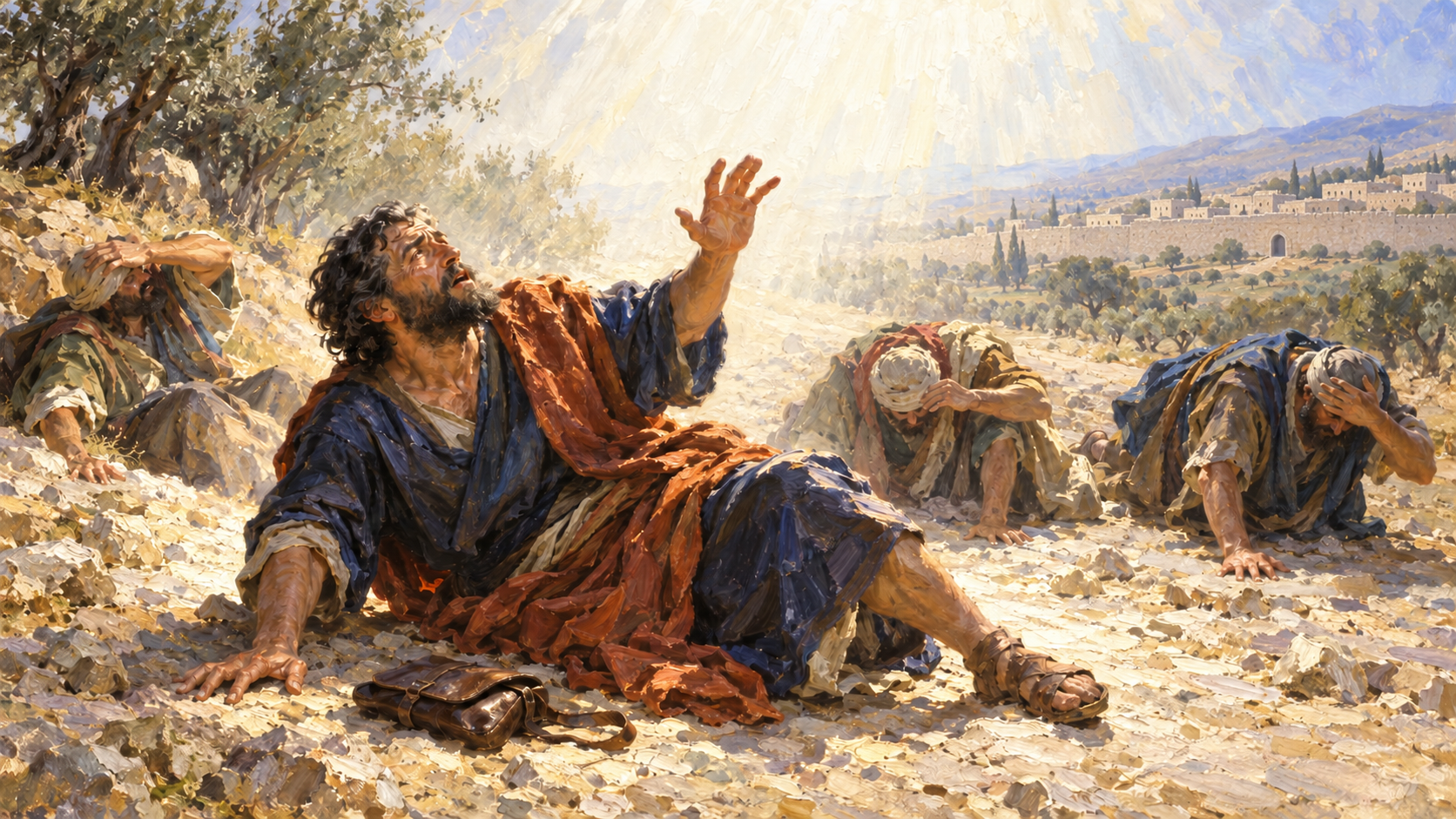
Saul was not traveling to Damascus because he had questions about Jesus. He was going there with authority to arrest Jesus’ disciples and bring them back in chains. The risen Lord confronted him as a persecutor and brought him into the fellowship he had set out to destroy. As I follow his conversion, I see both the seriousness of his guilt and the mercy of Christ, whose saving power does not depend on every believer having an experience as dramatic as Saul’s.
Saul Thought His War Against Jesus Served God
Saul was born in Tarsus of Cilicia, belonged to Benjamin’s tribe, and possessed Roman citizenship from birth. He was brought up in Jerusalem and educated under Gamaliel in the strict observance of his fathers’ law. He knew rigorous Jewish life and could work in the Greek-speaking world. Those advantages would later serve his ministry, but they had not given him spiritual life.
Before Damascus, he used his education, discipline, and influence against Christ. Paul later named those credentials when explaining what he had once counted as gain. His zeal had expressed itself in persecution, and his public record under the Law had not supplied the righteousness he needed before God.
though I also might have confidence in the flesh. If anyone else thinks he may have confidence in the flesh, I more so: circumcised the eighth day, of the stock of Israel, of the tribe of Benjamin, a Hebrew of the Hebrews; concerning the law, a Pharisee; concerning zeal, persecuting the church; concerning the righteousness which is in the law, blameless. But what things were gain to me, these I have counted loss for Christ. Yet indeed I also count all things loss for the excellence of the knowledge of Christ Jesus my Lord, for whom I have suffered the loss of all things, and count them as rubbish, that I may gain Christ and be found in Him, not having my own righteousness, which is from the law, but that which is through faith in Christ, the righteousness which is from God by faith; that I may know Him and the power of His resurrection, and the fellowship of His sufferings, being conformed to His death, if, by any means, I may attain to the resurrection from the dead.
Paul did not mean that he had been sinless. He could meet the standards by which his religious life was admired while remaining an enemy of the Messiah. After meeting Christ, he gave up confidence in his own righteousness and sought the righteousness God gives through faith.
He also admitted that he had thought it necessary to oppose Jesus of Nazareth. That makes sincerity a poor defense for his conduct. A person can be morally certain and still be wrong, and religious conviction can make him more dangerous when it persuades him that cruelty serves God. I need truth to correct my confidence rather than assume that strong conviction makes my judgment trustworthy.
Acts introduces Saul at Stephen’s death. Stephen testified that he saw Jesus standing at God’s right hand; the enraged men drove him outside the city and stoned him. Saul stood beside the clothes laid down by the witnesses.
When they heard these things they were cut to the heart, and they gnashed at him with their teeth. But he, being full of the Holy Spirit, gazed into heaven and saw the glory of God, and Jesus standing at the right hand of God, and said, “Look! I see the heavens opened and the Son of Man standing at the right hand of God!” Then they cried out with a loud voice, stopped their ears, and ran at him with one accord; and they cast him out of the city and stoned him. And the witnesses laid down their clothes at the feet of a young man named Saul. And they stoned Stephen as he was calling on God and saying, “Lord Jesus, receive my spirit.” Then he knelt down and cried out with a loud voice, “Lord, do not charge them with this sin.” And when he had said this, he fell asleep.
Now Saul was consenting to his death. At that time a great persecution arose against the church which was at Jerusalem; and they were all scattered throughout the regions of Judea and Samaria, except the apostles. And devout men carried Stephen to his burial, and made great lamentation over him. As for Saul, he made havoc of the church, entering every house, and dragging off men and women, committing them to prison.
Saul consented to the killing. He then entered houses and dragged men and women to prison. In his later testimony, he described punishing believers in synagogues, trying to compel blasphemy, casting his vote against people put to death, and pursuing disciples into foreign cities. Acts does not say that he personally carried out an execution, but his participation in deadly persecution was deliberate and culpable.
Stephen prayed that the Lord would not charge his killers with their sin. He was not told that Saul would later be converted, yet Saul would receive the mercy for which Stephen prayed. Forgiveness would bring this guilty man into the fellowship he had tried to destroy. It would not make his violence less wicked.
The Risen Jesus Stopped Saul and Sent Ananias
Saul obtained letters from the high priest to the synagogues at Damascus, a major Syrian city beyond Judea. He intended to bind followers of “the Way,” an early description of Jesus’ disciples, and bring them back to Jerusalem. Near Damascus, at midday, a light brighter than the sun surrounded him and his companions.
Then Saul, still breathing threats and murder against the disciples of the Lord, went to the high priest and asked letters from him to the synagogues of Damascus, so that if he found any who were of the Way, whether men or women, he might bring them bound to Jerusalem. As he journeyed he came near Damascus, and suddenly a light shone around him from heaven. Then he fell to the ground, and heard a voice saying to him, “Saul, Saul, why are you persecuting Me?” And he said, “Who are You, Lord?” Then the Lord said, “I am Jesus, whom you are persecuting. It is hard for you to kick against the goads.” So he, trembling and astonished, said, “Lord, what do You want me to do?” Then the Lord said to him, “Arise and go into the city, and you will be told what you must do.” And the men who journeyed with him stood speechless, hearing a voice but seeing no one. Then Saul arose from the ground, and when his eyes were opened he saw no one. But they led him by the hand and brought him into Damascus. And he was three days without sight, and neither ate nor drank. Now there was a certain disciple at Damascus named Ananias; and to him the Lord said in a vision, “Ananias.” And he said, “Here I am, Lord.” So the Lord said to him, “Arise and go to the street called Straight, and inquire at the house of Judas for one called Saul of Tarsus, for behold, he is praying. And in a vision he has seen a man named Ananias coming in and putting his hand on him, so that he might receive his sight.” Then Ananias answered, “Lord, I have heard from many about this man, how much harm he has done to Your saints in Jerusalem. And here he has authority from the chief priests to bind all who call on Your name.” But the Lord said to him, “Go, for he is a chosen vessel of Mine to bear My name before Gentiles, kings, and the children of Israel. For I will show him how many things he must suffer for My name’s sake.” And Ananias went his way and entered the house; and laying his hands on him he said, “Brother Saul, the Lord Jesus, who appeared to you on the road as you came, has sent me that you may receive your sight and be filled with the Holy Spirit.” Immediately there fell from his eyes something like scales, and he received his sight at once; and he arose and was baptized. So when he had received food, he was strengthened. Then Saul spent some days with the disciples at Damascus.
Jesus asked, “Saul, Saul, why are you persecuting Me?” Saul had been attacking disciples, but the Lord identified their suffering as persecution directed against Himself. Christ’s union with His people is real without making the church divine or merging believers into His person. The people Saul treated as enemies belonged to the Lord who now addressed him from heaven.
When Saul asked who was speaking, the answer was “I am Jesus.” The crucified Nazarene was alive. Saul’s campaign rested on a judgment about Jesus that he could no longer defend. The Lord compared his resistance to kicking against goads, the pointed prods used to guide livestock. An animal that kicked against the prod injured itself; Saul’s opposition to Christ was likewise doing him harm. Faced with the Lord he had opposed, he asked what he should do.
He had expected to lead prisoners out of Damascus; his companions instead led him into the city by the hand. For three days he could not see and neither ate nor drank. His helpless arrival shows how completely the encounter had overturned his plans. During those three days he prayed and waited for the Lord’s direction. His fasting did not pay for his sins; he needed mercy from the One who had confronted him.
Meanwhile, Jesus sent Ananias to the house of Judas on Straight Street. Ananias knew Saul’s reputation and explained his concern: this man had harmed the saints and arrived with authority to arrest them. Jesus answered by telling him what He had chosen Saul to do. He would bear Christ’s name before Gentiles, kings, and Israel, and learn how much he must suffer for it.
Ananias obeyed and addressed him as “Brother Saul.” He did not have years of changed conduct to examine, but he had the Lord’s explicit instruction. He welcomed Saul because Christ had sent him, even though the danger he had described was real.
Saul received his sight and was filled with the Holy Spirit before being baptized. Acts 22 records Ananias telling him to arise, be baptized, and wash away his sins, calling on the Lord’s name. I understand that appeal through Scripture’s teaching that Christ cleanses sinners and salvation is received by faith. Saul called on the Lord to save him; baptism confessed his cleansing and identification with Jesus.
The water did not create his faith. His response to Jesus, obedience to His direction, prayer, and Ananias’ greeting all belong before the baptism. These details fit a man who had already turned to Christ, rather than someone made spiritually alive by water. Baptism was a commanded response to salvation, and we should obey that command without making it the cause of new birth.
The Three Acts Accounts Describe One Real Encounter
Ananias’ words appear in Paul’s later testimony as well as in Luke’s account of the conversion. Reading the three Acts accounts together fills out both the encounter and the calling that followed it. Luke narrates the event in Acts 9, and Paul recounts it in Acts 22 to a hostile Jewish crowd after Roman soldiers rescued him from a temple riot. He begins with their shared heritage, his training under Gamaliel, and Ananias’ good reputation among the Jews in Damascus. They listen until he speaks of Jesus sending him to the Gentiles.
“I am indeed a Jew, born in Tarsus of Cilicia, but brought up in this city at the feet of Gamaliel, taught according to the strictness of our fathers’ law, and was zealous toward God as you all are today. I persecuted this Way to the death, binding and delivering into prisons both men and women, as also the high priest bears me witness, and all the council of the elders, from whom I also received letters to the brethren, and went to Damascus to bring in chains even those who were there to Jerusalem to be punished. “Now it happened, as I journeyed and came near Damascus at about noon, suddenly a great light from heaven shone around me. And I fell to the ground and heard a voice saying to me, ‘Saul, Saul, why are you persecuting Me?’ So I answered, ‘Who are You, Lord?’ And He said to me, ‘I am Jesus of Nazareth, whom you are persecuting.’ “And those who were with me indeed saw the light and were afraid, but they did not hear the voice of Him who spoke to me. So I said, ‘What shall I do, Lord?’ And the Lord said to me, ‘Arise and go into Damascus, and there you will be told all things which are appointed for you to do.’ And since I could not see for the glory of that light, being led by the hand of those who were with me, I came into Damascus. “Then a certain Ananias, a devout man according to the law, having a good testimony with all the Jews who dwelt there, came to me; and he stood and said to me, ‘Brother Saul, receive your sight.’ And at that same hour I looked up at him. Then he said, ‘The God of our fathers has chosen you that you should know His will, and see the Just One, and hear the voice of His mouth. For you will be His witness to all men of what you have seen and heard. And now why are you waiting? Arise and be baptized, and wash away your sins, calling on the name of the Lord.’ “Now it happened, when I returned to Jerusalem and was praying in the temple, that I was in a trance and saw Him saying to me, ‘Make haste and get out of Jerusalem quickly, for they will not receive your testimony concerning Me.’ So I said, ‘Lord, they know that in every synagogue I imprisoned and beat those who believe on You. And when the blood of Your martyr Stephen was shed, I also was standing by consenting to his death, and guarding the clothes of those who were killing him.’ Then He said to me, ‘Depart, for I will send you far from here to the Gentiles.'”
In Acts 26, Paul speaks while in Roman custody before King Agrippa, who knew Jewish customs and disputes. He explains his former Pharisaic convictions and insists that his message agrees with Moses and the prophets. This account gives particular attention to the commission Christ entrusted to him.
“Indeed, I myself thought I must do many things contrary to the name of Jesus of Nazareth. This I also did in Jerusalem, and many of the saints I shut up in prison, having received authority from the chief priests; and when they were put to death, I cast my vote against them. And I punished them often in every synagogue and compelled them to blaspheme; and being exceedingly enraged against them, I persecuted them even to foreign cities. “While thus occupied, as I journeyed to Damascus with authority and commission from the chief priests, at midday, O king, along the road I saw a light from heaven, brighter than the sun, shining around me and those who journeyed with me. And when we all had fallen to the ground, I heard a voice speaking to me and saying in the Hebrew language, ‘Saul, Saul, why are you persecuting Me? It is hard for you to kick against the goads.’ So I said, ‘Who are You, Lord?’ And He said, ‘I am Jesus, whom you are persecuting. But rise and stand on your feet; for I have appeared to you for this purpose, to make you a minister and a witness both of the things which you have seen and of the things which I will yet reveal to you. I will deliver you from the Jewish people, as well as from the Gentiles, to whom I now send you, to open their eyes, in order to turn them from darkness to light, and from the power of Satan to God, that they may receive forgiveness of sins and an inheritance among those who are sanctified by faith in Me.’ “Therefore, King Agrippa, I was not disobedient to the heavenly vision, but declared first to those in Damascus and in Jerusalem, and throughout all the region of Judea, and then to the Gentiles, that they should repent, turn to God, and do works befitting repentance. For these reasons the Jews seized me in the temple and tried to kill me. Therefore, having obtained help from God, to this day I stand, witnessing both to small and great, saying no other things than those which the prophets and Moses said would come– that the Christ would suffer, that He would be the first to rise from the dead, and would proclaim light to the Jewish people and to the Gentiles.”
These are accounts for different audiences, not three identical transcripts. All describe a persecutor confronted by the risen Jesus and called to bear His name. Acts 26 gives a fuller summary of Christ’s commission, while Acts 9 supplies the encounter with Ananias and the instruction he delivered. I understand Paul’s summary as bringing the calling together without recounting every stage through which it was confirmed. Christ was its source, including what He directed Ananias to tell Saul.
The commission extended beyond one sermon. Saul would testify about what he had seen and what Christ would reveal afterward. Through that witness, people would turn from darkness to light, from Satan’s power to God, and receive forgiveness and an inheritance through faith. His later mission grew from the Lord’s calling, rather than a career he invented after an unusual experience.
Two differences in the descriptions deserve careful attention. Acts 9:7 says the companions heard a voice without seeing anyone. Acts 22:9 says they saw the light but did not hear the voice of the One speaking to Saul. I understand them to have perceived the sound without comprehending the message. Seeing the light without seeing a person is not itself a discrepancy.
Both hearing passages use akouo, which can describe hearing and can also include understanding what is heard. The Greek noun translated “voice” has different grammatical endings in the two verses. Those endings do not establish a rule that one always means sound and the other always means comprehension. I take the distinction from the accounts read together: the companions witnessed the event, while Saul received the intelligible message addressed to him.
Acts 9 also describes the men standing speechless, while Acts 26 says everyone fell to the ground. They may describe successive moments: falling when the light appeared and standing afterward in stunned silence. Luke does not tell us exactly when each man stood again, so I would offer this as a reasonable reconciliation rather than claim that every movement is recorded.
Grace Turned the Persecutor Into a Public Witness
Whatever questions we bring to the descriptions of the encounter, the accounts agree about Saul’s changed allegiance. After food restored his strength, he stayed with the Damascus disciples and began preaching that Jesus is the Son of God. His listeners knew why he had come. A confession made among people who expected him to arrest Christians could hardly remain private.
Immediately he preached the Christ in the synagogues, that He is the Son of God. Then all who heard were amazed, and said, “Is this not he who destroyed those who called on this name in Jerusalem, and has come here for that purpose, so that he might bring them bound to the chief priests?” But Saul increased all the more in strength, and confounded the Jews who dwelt in Damascus, proving that this Jesus is the Christ. Now after many days were past, the Jews plotted to kill him. But their plot became known to Saul. And they watched the gates day and night, to kill him. Then the disciples took him by night and let him down through the wall in a large basket. And when Saul had come to Jerusalem, he tried to join the disciples; but they were all afraid of him, and did not believe that he was a disciple. But Barnabas took him and brought him to the apostles. And he declared to them how he had seen the Lord on the road, and that He had spoken to him, and how he had preached boldly at Damascus in the name of Jesus. So he was with them at Jerusalem, coming in and going out. And he spoke boldly in the name of the Lord Jesus and disputed against the Hellenists, but they attempted to kill him. When the brethren found out, they brought him down to Caesarea and sent him out to Tarsus. Then the churches throughout all Judea, Galilee, and Samaria had peace and were edified. And walking in the fear of the Lord and in the comfort of the Holy Spirit, they were multiplied.
Saul reasoned that Jesus was the Christ, not merely that he had seen a remarkable light. The Scriptures he had known while opposing Jesus now supplied the grounds of his proclamation. His preaching provoked hostility, and disciples eventually lowered him in a basket through the wall to escape a plot against his life.
When he reached Jerusalem, the believers were afraid and did not believe he was a disciple. Their memories of his persecution had not disappeared. Barnabas brought him to the apostles and gave an account of Christ’s appearance and Saul’s bold preaching. Truthful testimony helped the church receive the man Christ had forgiven.
Saul spoke boldly in Jerusalem and disputed with the Hellenists, the Greek-speaking Jews. When they too attempted to kill him, the brothers brought him to Caesarea and sent him to Tarsus. Acts then describes peace, strengthening, and growth among the churches in Judea, Galilee, and Samaria. The man who had terrorized them was no longer conducting the persecution.
He would suffer repeatedly in his own ministry: beatings, imprisonment, stoning, shipwreck, hunger, and sleeplessness. The study on the life of the apostle Paul follows that service. None of his suffering paid for what he had done. It expressed a changed allegiance as he continued serving the Lord he had once opposed.
Barnabas helped fearful people understand what had happened, and Saul’s conduct continued to confirm his new allegiance. The church could receive him as a brother while allowing trust to grow through truthful testimony and faithful conduct. Someone who has injured others should not use forgiveness to insist that their fear is unreasonable.
Not everyone receives Paul’s office or comes to faith through circumstances like his. Quiet conversions rest on the same risen Savior. What a testimony needs to establish is whom the person now trusts and how Christ has given him new life, rather than whether he can match someone else’s dramatic experience.
Paul Was Called as an Apostle, Not Renamed by Jesus
To understand the years between the Damascus encounter and Saul’s first visit to Jerusalem as a believer, we need Galatians 1. Acts condenses this period under its reference to many days. Paul explains that he went to Arabia, returned to Damascus, and visited Peter after three years.
But I make known to you, brethren, that the gospel which was preached by me is not according to man. For I neither received it from man, nor was I taught it, but it came through the revelation of Jesus Christ. For you have heard of my former conduct in Judaism, how I persecuted the church of God beyond measure and tried to destroy it. And I advanced in Judaism beyond many of my contemporaries in my own nation, being more exceedingly zealous for the traditions of my fathers. But when it pleased God, who separated me from my mother’s womb and called me through His grace, to reveal His Son in me, that I might preach Him among the Gentiles, I did not immediately confer with flesh and blood, nor did I go up to Jerusalem to those who were apostles before me; but I went to Arabia, and returned again to Damascus. Then after three years I went up to Jerusalem to see Peter, and remained with him fifteen days. But I saw none of the other apostles except James, the Lord’s brother. (Now concerning the things which I write to you, indeed, before God, I do not lie.) Afterward I went into the regions of Syria and Cilicia. And I was unknown by face to the churches of Judea which were in Christ. But they were hearing only, “He who formerly persecuted us now preaches the faith which he once tried to destroy.” And they glorified God in me.
Paul’s purpose was to establish that he received his gospel from Jesus Christ, not by borrowing it from Jerusalem’s leaders. Three years before the Jerusalem visit does not mean three uninterrupted years in Arabia. He does not say where in Arabia he stayed or how long he remained there. Nor does he describe a private three-year course designed to duplicate the Twelve’s time with Jesus.
The risen Lord revealed the gospel to him and gave him apostolic authority. That did not prevent him from studying Scripture, living among disciples, and working with fellow servants. Revelation from Christ and real relationships within His church were not competing sources of loyalty.
Paul’s account explains where his gospel came from, but it gives no support to the familiar claim that Jesus renamed him on the Damascus road. Acts continues calling him Saul after his conversion, including when the Holy Spirit set him apart with Barnabas at Antioch.
Now in the church that was at Antioch there were certain prophets and teachers: Barnabas, Simeon who was called Niger, Lucius of Cyrene, Manaen who had been brought up with Herod the tetrarch, and Saul. As they ministered to the Lord and fasted, the Holy Spirit said, “Now separate to Me Barnabas and Saul for the work to which I have called them.” Then, having fasted and prayed, and laid hands on them, they sent them away. So, being sent out by the Holy Spirit, they went down to Seleucia, and from there they sailed to Cyprus. And when they arrived in Salamis, they preached the word of God in the synagogues of the Jews. They also had John as their assistant. Now when they had gone through the island to Paphos, they found a certain sorcerer, a false prophet, a Jew whose name was Bar-Jesus, who was with the proconsul, Sergius Paulus, an intelligent man. This man called for Barnabas and Saul and sought to hear the word of God. But Elymas the sorcerer (for so his name is translated) withstood them, seeking to turn the proconsul away from the faith. Then Saul, who also is called Paul, filled with the Holy Spirit, looked intently at him and said, “O full of all deceit and all fraud, you son of the devil, you enemy of all righteousness, will you not cease perverting the straight ways of the Lord? And now, indeed, the hand of the Lord is upon you, and you shall be blind, not seeing the sun for a time.” And immediately a dark mist fell on him, and he went around seeking someone to lead him by the hand. Then the proconsul believed, when he saw what had been done, being astonished at the teaching of the Lord.
Acts 13:9 says “Saul, who also is called Paul.” A Jewish man with Roman citizenship could bear both a Semitic name and a Roman name. Luke begins using Paul during this mission into Gentile settings; he does not describe Jesus giving him a new name, or the meeting with Sergius Paulus as a renaming.
His apostleship, however, did come directly from Jesus Christ. An apostle is a sent representative, and the New Testament sometimes uses sending language broadly. Paul’s calling carried the authority of the risen Lord who appeared to him and commissioned his witness. Antioch’s later sending recognized work God had already assigned; it did not create his apostolic authority through a church vote.
Peter, James, and John recognized his gospel, and he wrote inspired Scripture. He was nevertheless distinct from the Twelve. Nothing in his calling requires us to regard Matthias’ appointment as a mistake. Paul himself distinguishes Christ’s appearance to him from the earlier resurrection appearances.
For I delivered to you first of all that which I also received: that Christ died for our sins according to the Scriptures, and that He was buried, and that He rose again the third day according to the Scriptures, and that He was seen by Cephas, then by the twelve. After that He was seen by over five hundred brethren at once, of whom the greater part remain to the present, but some have fallen asleep. After that He was seen by James, then by all the apostles. Then last of all He was seen by me also, as by one born out of due time. For I am the least of the apostles, who am not worthy to be called an apostle, because I persecuted the church of God. But by the grace of God I am what I am, and His grace toward me was not in vain; but I labored more abundantly than they all, yet not I, but the grace of God which was with me. Therefore, whether it was I or they, so we preach and so you believed.
He called himself one born out of due time and unworthy to be an apostle because he had persecuted the church. That admission did not make Christ’s forgiveness incomplete or cancel the authority Christ gave him. Paul could confess his guilt, labor through grace, and give God the credit without presenting his service as compensation.
Paul’s Conversion Keeps Christ and His Gospel at the Center
Paul described his earlier conduct as blasphemy, persecution, and insolence. His statement that he acted ignorantly in unbelief explained his condition; it did not declare him innocent.
And I thank Christ Jesus our Lord who has enabled me, because He counted me faithful, putting me into the ministry, although I was formerly a blasphemer, a persecutor, and an insolent man; but I obtained mercy because I did it ignorantly in unbelief. And the grace of our Lord was exceedingly abundant, with faith and love which are in Christ Jesus. This is a faithful saying and worthy of all acceptance, that Christ Jesus came into the world to save sinners, of whom I am chief. However, for this reason I obtained mercy, that in me first Jesus Christ might show all longsuffering, as a pattern to those who are going to believe on Him for everlasting life. Now to the King eternal, immortal, invisible, to God who alone is wise, be honor and glory forever and ever. Amen.
Christ made Paul an example of His longsuffering, His patience toward sinners. A clean past could never have qualified this man for salvation. Yet Paul also speaks of people believing for everlasting life, so the passage does not promise universal salvation regardless of faith. Mercy reached a guilty man who trusted Christ and then served Him.
I can hope for a sinner’s salvation without presuming that he will receive the offer. No one is beyond Christ’s ability to save, but people can resist His genuine grace. Saul’s conversion calls us to respond in repentance and faith, not postpone responding because God was patient with him. The study on God’s grace considers His freely given mercy and its transforming work.
The gospel that brought Saul to faith also changed how he understood the Law and the Prophets. He had known those Scriptures while rejecting their Messiah. After Damascus, he used them to show that Jesus is the Christ, explaining His suffering and resurrection through their promises, covenants, sacrifices, and kingship. That did not require abandoning their literal history or treating Israel as merely an allegory.
Fulfillment in Christ did not cancel God’s promises concerning Israel. Paul continued teaching about the nation, its fathers, and covenants whose fulfillment still lies ahead. The God who acted in that history sent the promised Son.
Paul went on to write inspired New Testament Scripture, teaching churches how the promises of God are fulfilled in Christ and how believers should live. I believe he authored Hebrews, bringing his writings to fourteen books; their final authority rests on divine inspiration rather than on the human author’s identity.
Across those writings, the message remained Christ crucified and risen. As the study on the gospel explains, Paul proclaimed that Christ died for our sins according to the Scriptures, was buried, and rose bodily on the third day. The One who appeared to Saul had already given His life for sinners and risen from the dead. His identity and finished work explain why Saul’s conversion offers hope to other guilty people.
Jesus is the eternal Son, fully God and fully man, born of a virgin and entirely without sin. Wicked men physically tortured and punished Him before killing Him. He willingly bore that real punishment for our sins in His innocent body, shedding His blood and dying. His saving work was complete before His burial and bodily resurrection. The Father did not punish or curse Jesus, nor did He abandon Him. He did not strike or bruise Him or pour wrath on Him.
Salvation is in Christ’s blood and is received by grace through faith. No missionary labor could repay Saul’s debt or make his persecution harmless. Repentance turns from rebellion, and faith rests in Christ; good works grow from the life He gives. They do not purchase it.
Christ died for the whole world, and His offer of salvation is genuine, though people can resist and reject it. Everyone who repents and believes is forgiven and justified, declared righteous before God. The believer is born again and made new, indwelt and sealed by the Holy Spirit in eternal security. That assurance gives no permission for lawlessness, and a superficial profession does not prove genuine new birth.
I need to examine my confidence in religious knowledge as honestly as my need for mercy over a sinful past. Saul’s training did not keep him from opposing the Lord, and sincere effort could not give him spiritual life. After receiving grace, he prayed, welcomed Ananias, was baptized, joined the disciples, and confessed Christ publicly. Those were fitting responses to salvation, not additions to the Savior’s completed work.
A person who has injured others should also confess honestly and make restitution where possible. The wrong does not become good because Christ forgives it. As trust is rebuilt, we can acknowledge the harm without treating forgiveness as uncertain. Paul’s example teaches us to tell the truth about both guilt and pardon, while keeping our testimony directed toward the Lord who saves.
My Final Thoughts
The risen Jesus stopped a man whose religious zeal had turned him against the Lord he thought he served. He forgave Saul without concealing his guilt and gave him a new allegiance, a place among the disciples, and work to do. Sincerity and credentials could not save him, and later service could not earn what he received by grace.
Saul’s conversion gives me reason to hope for people whose past seems to rule out change. We should neither minimize their wrongdoing nor treat it as greater than Christ’s mercy. Whatever circumstances bring someone to faith, the Savior remains the center of the testimony and the One our lives should continue to confess.