
People sometimes point to the Spirit’s departure from Saul as a warning that a Christian can lose the Holy Spirit. I understand why that passage raises the question, but Saul was Israel’s king, and the passage concerns God’s rejection of his kingship. Before we apply his experience to a born-again believer, we need to read it alongside Jesus’ promise that the Spirit would remain with His people forever.
Before comparing those passages, we need to establish who the Spirit is. Genesis presents Him at work in creation, long before Israel’s kings or the outpouring at Pentecost.
In the beginning God created the heavens and the earth. The earth was without form, and void; and darkness was on the face of the deep. And the Spirit of God was hovering over the face of the waters.
The Creator did not arise from matter or become part of the universe, and the universe He made is not divine. Genesis describes His deliberate work: the earth was unformed and unfilled, then God formed it and filled it with life. His Spirit was personally involved in that good work before sin entered the world. We shouldn’t speak as though He first became active when people needed forgiveness.
The Hebrew word ruach can mean spirit, wind, or breath, depending on its context. Here Genesis names the Spirit of God, whom the rest of Scripture reveals as personal and divine. We should not reduce Him to an impersonal wind simply because the word can have that meaning elsewhere.
Not a Force
When Barnabas and Saul were sent into missionary service, the Holy Spirit directed the church to set them apart for the work He had called them to do (Acts 13:2). Later, He forbade Paul and his companions to preach in Asia and did not permit them to enter Bithynia (Acts 16:6-7). They were responsible to follow His instructions, even when that meant changing where they intended to go.
The Spirit also teaches Christ’s truth, testifies about Him, and intercedes for believers. We can lie to Him and grieve Him because we are dealing with a Person who knows us. I cannot treat Him as a power to harness through the right technique while disregarding what He has said.
He is fully God as well. When Peter confronted Ananias in Acts 5, he accused him of lying to the Holy Spirit and then explained that he had lied to God. The Spirit is named alongside the Father and Son in baptism and the apostolic blessing; He is not a created messenger occupying some lesser rank.
So when I speak of indwelling, I mean that God Himself takes residence in His people. He hasn’t merely handed us an ability to use when it suits us. We belong to Him, and His presence reaches into how we live and whom we obey. He is the same divine Person throughout Scripture, but His ministry develops as God brings His promises concerning Christ and the New Covenant to fulfillment.
The Old Testament does not describe the permanent indwelling of every believer in the same way the New Testament does after Christ’s finished work and Pentecost. We should not take that to mean the Spirit never worked within an Old Testament believer. We need to consider what each passage actually describes, including the assignments for which God equipped His servants.
Bezalel, for example, was commissioned to help construct the tabernacle. He needed the understanding and craftsmanship to make what God had specified.
And I have filled him with the Spirit of God, in wisdom, in understanding, in knowledge, and in all manner of workmanship.
God did not treat skilled workmanship as unspiritual. The care required to make the tabernacle was part of Bezalel’s service to the Lord. Still, Exodus is explaining how God equipped him for that commission. The word filled does not, by itself, establish that this passage describes the permanent indwelling promised to every New Covenant believer.
Coming Upon for a Task
Gideon had questioned how he could deliver Israel from Midian, pointing to his family’s weakness and his own low standing (Judges 6:15). Yet God had called him to that task, and the Spirit enabled him to summon men to follow him.
But the Spirit of the LORD came upon Gideon; then he blew the trumpet, and the Abiezrites gathered behind him.
In Samson’s case, the Spirit’s empowering work included extraordinary physical strength. Judges 14 describes what happened when a lion came against him.
And the Spirit of the LORD came mightily upon him, and he tore the lion apart as one would have torn apart a young goat.
Reading that encounter alongside the rest of Samson’s life, we cannot mistake his strength for God’s approval of everything he did. His disobedience had devastating repercussions. The strength God supplied for an encounter with a lion was not the same thing as the mature character described by the fruit of the Spirit in Galatians 5.
I think we need to be frank about this when evaluating a ministry. If a teacher is dishonest or mistreats people, his ability to hold an audience does not excuse his conduct. We should not rationalize his behavior because his work appears successful. A spiritual gift does not put anyone above the need to repent.
Saul, too, had been equipped by the Spirit for his role as king. But he repeatedly disobeyed God, and he admitted to Samuel that he had feared the people and obeyed them (1 Samuel 15:24). God rejected him from the kingship, and the next chapter records the Spirit’s departure.
But the Spirit of the LORD departed from Saul, and a distressing spirit from the LORD troubled him.
God was withdrawing the empowering presence associated with Saul’s royal service. The chapter places this immediately after David’s anointing, when the Spirit came upon the man chosen to succeed him. We are reading about a rejected king, not a New Covenant Christian being unsealed. Saul’s eternal condition is a further question that this verse alone doesn’t settle.
David’s plea in Psalm 51 also belongs to that Old Covenant setting. After committing adultery with Bathsheba and arranging Uriah’s death, he asked God for the cleansing he could not give himself.
Do not cast me away from Your presence, And do not take Your Holy Spirit from me.
David had seen Saul’s decline and had no reason to think being king put him beyond God’s judgment. He asked for the joy of salvation to be restored and looked ahead to teaching transgressors God’s ways (Psalm 51:12–13). He wanted to be useful in God’s service again, and he knew he needed mercy.
We should take his sin and repentance seriously without using his prayer to overturn what Christ later promised His people. Neither Saul’s office nor David’s office made disobedience harmless. But their experiences do not teach that the Spirit abandons every Christian who stumbles. The New Testament gives believers a definite promise about His abiding presence.
The Promised Indwelling
Centuries before Jesus spoke to His disciples about the Helper, Ezekiel addressed Israel’s need for cleansing and restoration. God’s people already had His commands and had repeatedly refused to obey them. Through Ezekiel, God promised to change them inwardly.
I will give you a new heart and put a new spirit within you; I will take the heart of stone out of your flesh and give you a heart of flesh. I will put My Spirit within you and cause you to walk in My statutes.
God was promising to change the people who had refused Him, rather than simply send them a clearer set of instructions. A heart of flesh, in this comparison, is responsive to Him instead of stubbornly unyielding. His own Spirit would dwell within them and enable the obedience His commands required. We cannot reduce New Covenant life to learning better advice and making a more determined attempt to follow it.
Joel described how broadly God would pour out His Spirit.
And it shall come to pass afterward That I will pour out My Spirit on all flesh; Your sons and your daughters shall prophesy.
The surrounding verses include the old and young, as well as male and female servants. A person’s age or low standing would not disqualify him from receiving what God promised. The outpouring would extend beyond a few prominent leaders. Joel was not saying that every human being would automatically be saved or indwelt; Scripture still calls people to repent and believe.
Jesus later explained how the Spirit would care for His disciples after His departure. On the night before the cross, He promised that the Father would give them another Helper.
And I will pray the Father, and He will give you another Helper, that He may abide with you forever, the Spirit of truth.
John uses the Greek word parakletos for Helper. It can describe an advocate or someone who comes to another’s aid; Comforter and Counselor also convey aspects of that help in context. Jesus was assuring His disciples of the Spirit’s personal ministry, and He expressly said that the Spirit would remain with them forever.
Jesus went on to say, “He dwells with you and will be in you.” The disciples already knew the Spirit’s presence and activity, but Jesus spoke of an indwelling still to come. Before the outpouring at Pentecost, He would die, rise bodily, and ascend to the Father.
Jesus even told them that His departure would be to their advantage because He would send the Helper.
Nevertheless I tell you the truth. It is to your advantage that I go away; for if I do not go away, the Helper will not come to you.
That was a remarkable assurance to men who would no longer have His visible company. The risen and ascended Christ would continue His ministry through the Spirit. He was not leaving His disciples to fend for themselves.
Pentecost and the New Covenant
After His resurrection, Jesus instructed the disciples to remain in Jerusalem and wait for the Father’s promise.
for John truly baptized with water, but you shall be baptized with the Holy Spirit not many days from now.
In Acts 1:8, Jesus also spoke of the Spirit coming upon these disciples and giving them power to testify about Him. So coming upon cannot be a label reserved exclusively for Old Testament kings and judges.
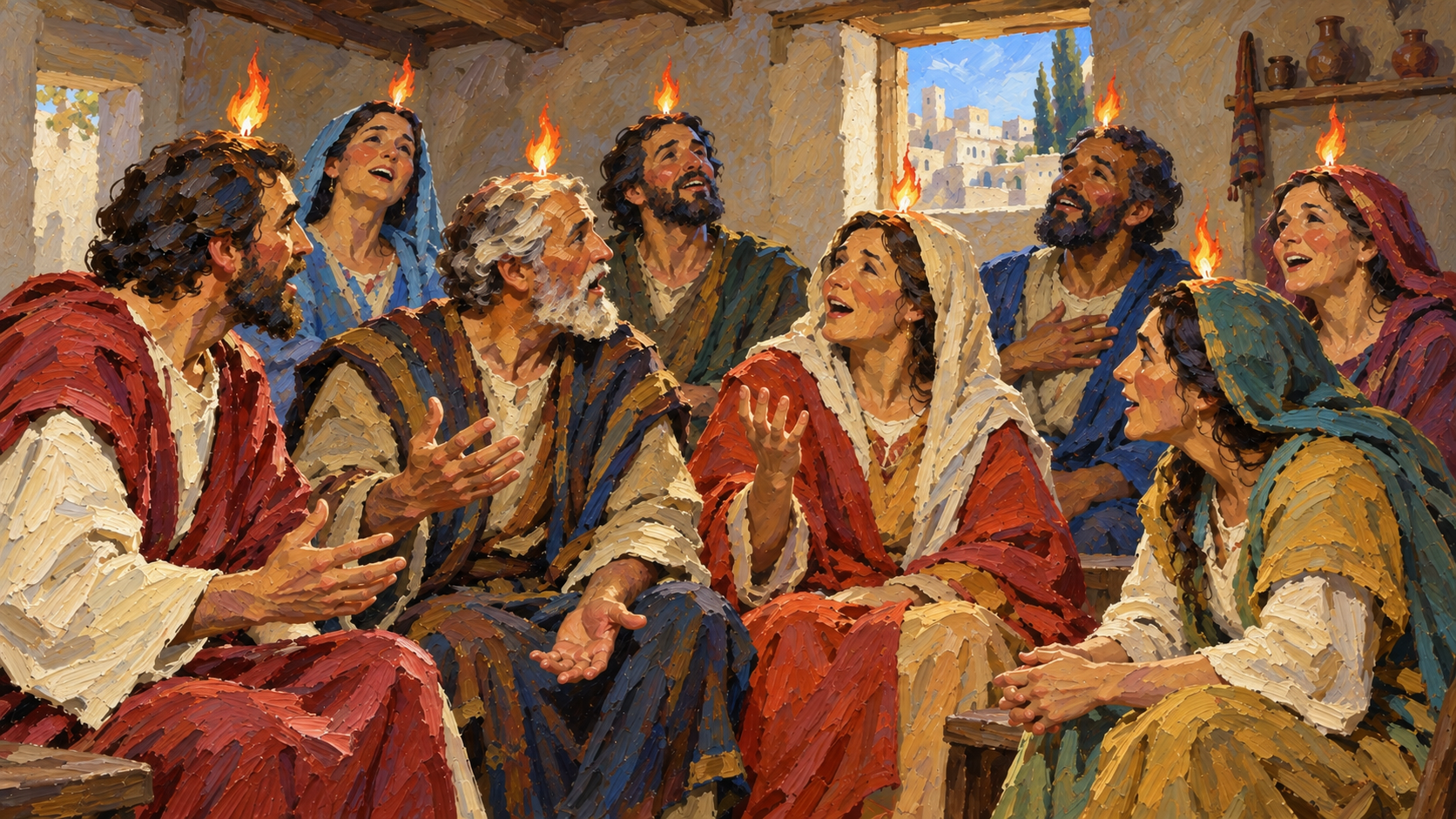
Acts 2 records the outpouring at Pentecost. Peter appealed to Joel to explain what was happening, and the church began bearing public witness to the risen Christ by the Spirit’s power. This was the public arrival of what Jesus had promised, far more than a day when the disciples felt unusually confident.
We also need to distinguish baptism with the Spirit from water baptism and repeated filling. In 1 Corinthians 12:13, Paul includes all believers as baptized by one Spirit into one body. He is not describing a second level of salvation reserved for Christians who can reproduce Pentecost’s signs. Water baptism follows salvation and pictures our identification with Christ; it does not cause the Spirit to enter someone.
Acts records historical turning points as well as ongoing patterns of service. I cannot tell someone who has repented and believed that he is still waiting for the Spirit simply because he has not reproduced every feature of Pentecost. The New Testament letters explain what is true of everyone who belongs to Christ.
Paul makes that plain in Romans 8. There is no category here for a genuine Christian who has yet to receive the Holy Spirit.
Now if anyone does not have the Spirit of Christ, he is not His.
The same chapter connects His presence with life and adoption into God’s family. He bears witness that we are God’s children and enables us to put sinful deeds to death. A believer receives assurance from Him, but also the help needed to stop yielding to sin. He is personally at work within us, rather than merely marking us from the outside.
Paul also reminds the Corinthian church that God has made His dwelling among them.
Do you not know that you are the temple of God and that the Spirit of God dwells in you?
Here he addresses the church together; in 1 Corinthians 6:19, he applies temple language to the believer’s body. Indwelling does not make us divine. It means we belong to God, who has a claim on how we live. If I am indulging sexual sin or stirring up hostility among believers, I need to repent instead of making excuses about it being my private business.
God brings us into that relationship through Jesus Christ, His eternal Son, who became fully man without ceasing to be fully God. He was virgin-born and lived without sin, yet willingly endured the torture and death wicked men inflicted on His innocent body. He bore that punishment for our sins, and His shed blood and death accomplished our redemption before His burial and bodily resurrection.
Christ died for the whole world, and God’s offer of salvation is genuine, though people can resist and reject it. Those who repent and believe are forgiven and made new. The Spirit indwells them, and their security rests in what God has done, rather than their ability to maintain a particular feeling or experience. A Christian label alone does not establish that someone has genuinely been born again.
Paul explains the Spirit’s seal by describing what happened when the Ephesians heard and believed that gospel.
In Him you also trusted, after you heard the word of truth, the gospel of your salvation; in whom also, having believed, you were sealed with the Holy Spirit of promise, who is the guarantee of our inheritance.
The Greek verb sphragizo means to seal. The Spirit identifies believers as God’s own, and He is Himself the pledge of the inheritance God has promised them. Paul tells us how long that seal lasts when he warns believers against grieving the Spirit.
And do not grieve the Holy Spirit of God, by whom you were sealed for the day of redemption.
He seals us for the day of redemption, not merely until our next failure. Yet Paul gives that assurance while confronting real sins. In the surrounding passage, he tells the person who has been stealing to work honestly so that he can help someone in need (Ephesians 4:28). The Spirit’s seal gives me no cover for continuing to defraud someone. I need to confess and turn from sin, knowing that I am grieving the Spirit who dwells in me.
The fact that the Spirit dwells in every true believer does not mean every believer yields to His direction. Indwelling describes His settled presence; filling concerns His governing and empowering work as we depend on Him. Paul therefore gives Christians this command:
And do not be drunk with wine, in which is dissipation; but be filled with the Spirit.
He contrasts drunkenness with the Spirit’s influence over our conduct, then describes worship from the heart and thanks offered to God the Father. He also calls believers to submit to one another out of reverence for God (Ephesians 5:19–21). Being filled affects how we serve and treat people, as well as how we worship.
Acts 4:29–31 gives us an example of believers being filled again. After Peter and John were threatened for preaching Christ, the gathered believers asked God for boldness to continue. They were filled with the Spirit and spoke God’s word boldly. They were not being converted again or recovering an indwelling presence they had lost; God was equipping them to obey Him under pressure.
So we should not force upon, in, and filled into rigid categories that ignore their context. The Spirit who permanently indwells us also empowers us for service. I can depend on His abiding presence while asking God for the help I need to carry out an assignment.
The Spirit also provides gifts for that service, distributing them according to His own will. Paul says that all believers were baptized into one body, but does not say they all speak in tongues (1 Corinthians 12:13, 29-30). No single gift is a test that every saved person must pass. Nor should a claim to prophecy or impressive public teaching exempt anyone from examination by Scripture.
The believer who helps a struggling family or shows mercy to someone in need also serves the church. Those entrusted with leadership or giving remain accountable to God’s Word just as a public teacher does. We should not overlook less conspicuous service, or assume that someone who has a useful gift must therefore be mature.
In 1 Thessalonians 5:19-22, Paul joins his warning against quenching the Spirit with instructions not to despise prophecies, but to test what is presented and hold to what is good. I reject the hyper-charismatic practice of accepting spiritual claims without testing them, and I also reject cessationism, the teaching that the Spirit’s miraculous gifts have ceased. The Spirit of truth does not contradict the Word He inspired. His work glorifies Christ and builds the church; an impressive claim must still be judged by that standard.
The same Spirit who equips us for service also produces fruit in our character. Paul calls us to walk in dependence on Him so that we do not keep yielding to sinful desires.
Walk in the Spirit, and you shall not fulfill the lust of the flesh.
If I snap at someone who has inconvenienced me, being busy with ministry does not excuse it. The Spirit produces gentleness and self-control, so I need to acknowledge that impatience and change how I speak. Walking in the Spirit includes how we treat people when there is no audience to impress.
My Final Thoughts
I can ask God to equip me for work I cannot manage in my own strength without treating the Spirit as absent until I feel something. He already dwells in every genuinely born-again believer, and His seal lasts to the day of redemption. When I resist His direction, I need to confess and turn from that disobedience. His faithfulness gives us every reason to trust Him and no excuse to disregard the Word He has given.