
People tried to seize or kill Jesus several times before the crucifixion, and the Gospels identify different people in those encounters. I want to follow what each group did and why the attempt failed. The accounts show Jesus continuing His ministry until He willingly gave His life, while holding His opponents responsible for what they chose. They give us no grounds for passing that guilt on to an ethnicity or to later generations.
We Must Name the People the Gospels Name
The crowd in Nazareth came from Jesus’ hometown synagogue. Elsewhere, Pharisees plotted with Herodians, men associated with Herod’s political order. Chief priests and members of Jerusalem’s council organized opposition, while temple officers and hostile crowds tried to seize Him. These groups sometimes cooperated, but they were not one indistinguishable body acting in every scene.
John sometimes calls an opposing group “the Jews.” The context tells us whether he is describing authorities, festival leaders, particular questioners, or a crowd. Jesus was Jewish according to the flesh, and John and the other apostles were Jewish too. John’s Gospel also repeatedly describes Jewish people believing in Jesus. We would misread him if we took an expression for opponents in one encounter as a description of every Jewish person’s response.
I need to name the people Scripture names. A person’s ancestry does not make him guilty of someone else’s crime, and there is no biblical basis for antisemitism. Contempt for Jewish people cannot be justified from an account about particular leaders or crowds opposing the Messiah who came through Israel.
We also need to distinguish a plot or attempted stoning from the final execution. Some opponents tried to throw Jesus from a hill or stone Him. Crucifixion, however, was a Roman sentence authorized by Pontius Pilate and carried out by Roman soldiers. Pilate repeatedly declared that he found no fault in Jesus, yet sent Him to the cross. Accurate responsibility includes that Roman decision as well as the actions of the people demanding it.
Attempts in Nazareth and Disputes Over the Sabbath
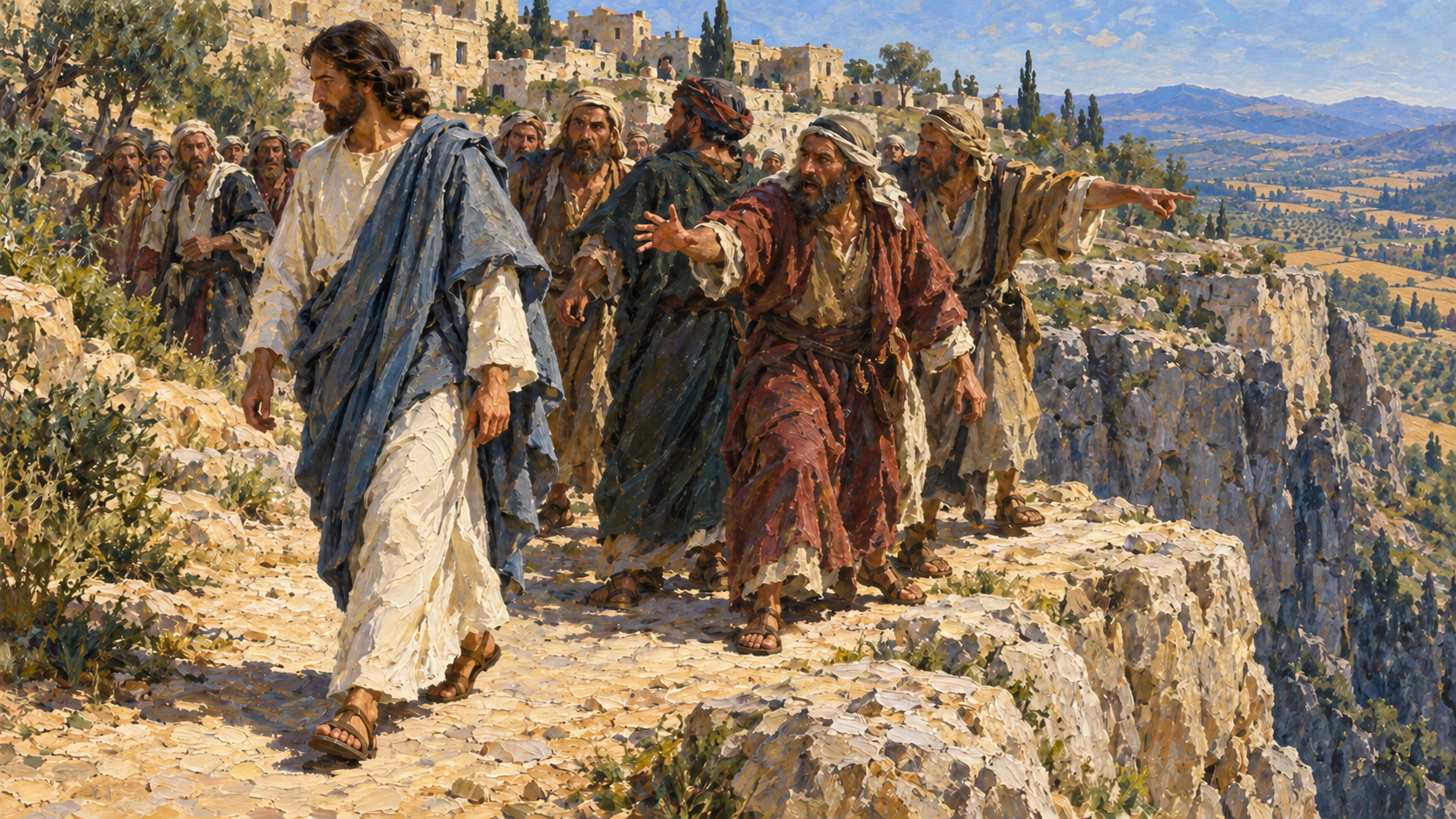
The first attempt on Jesus’ life that Luke records took place in Nazareth, where He had grown up. The people heard His gracious words before trying to kill Him, so we need to follow how their response changed.
So He came to Nazareth, where He had been brought up. And as His custom was, He went into the synagogue on the Sabbath day, and stood up to read. And He was handed the book of the prophet Isaiah. And when He had opened the book, He found the place where it was written: “The Spirit of the LORD is upon Me, Because He has anointed Me To preach the gospel to the poor; He has sent Me to heal the brokenhearted, To proclaim liberty to the captives And recovery of sight to the blind, To set at liberty those who are oppressed; To proclaim the acceptable year of the LORD.” Then He closed the book, and gave it back to the attendant and sat down. And the eyes of all who were in the synagogue were fixed on Him. And He began to say to them, “Today this Scripture is fulfilled in your hearing.” So all bore witness to Him, and marveled at the gracious words which proceeded out of His mouth. And they said, “Is this not Joseph’s son?” He said to them, “You will surely say this proverb to Me, ‘Physician, heal yourself! Whatever we have heard done in Capernaum, do also here in Your country.'” Then He said, “Assuredly, I say to you, no prophet is accepted in his own country. But I tell you truly, many widows were in Israel in the days of Elijah, when the heaven was shut up three years and six months, and there was a great famine throughout all the land; but to none of them was Elijah sent except to Zarephath, in the region of Sidon, to a woman who was a widow. And many lepers were in Israel in the time of Elisha the prophet, and none of them was cleansed except Naaman the Syrian.” So all those in the synagogue, when they heard these things, were filled with wrath, and rose up and thrust Him out of the city; and they led Him to the brow of the hill on which their city was built, that they might throw Him down over the cliff. Then passing through the midst of them, He went His way.
Jesus read Isaiah’s promise and announced that it was being fulfilled in their hearing. The people marveled at His words, yet also questioned Him as Joseph’s son. He anticipated their demand that He perform in Nazareth the works they had heard about in Capernaum, and warned that a prophet is not accepted in his own country.
His examples came from their own Scriptures. Elijah had been sent to a widow in Sidon during the famine, and Elisha had cleansed Naaman, a Syrian, while many lepers remained in Israel. God had shown mercy beyond Israel’s borders. Familiarity with Jesus and descent from Israel gave His hometown no right to dictate how He must act. The warning exposed the danger of knowing who had grown up among them while refusing to receive Him as God’s messenger.
At that point the congregation became furious, drove Him out, and led Him to a cliff to throw Him down. Luke says Jesus passed through them and went His way. He does not tell us how that happened. The crowd may have recoiled before His authority, or confusion or another circumstance may have opened the way. An openly miraculous escape is possible too. We cannot settle the manner from the description, but their intent is clear: they tried to kill Him and failed.
Mark describes another synagogue encounter in which a man with a withered hand became the focus of a Sabbath dispute.
And He entered the synagogue again, and a man was there who had a withered hand. So they watched Him closely, whether He would heal him on the Sabbath, so that they might accuse Him. And He said to the man who had the withered hand, “Step forward.” Then He said to them, “Is it lawful on the Sabbath to do good or to do evil, to save life or to kill?” But they kept silent. And when He had looked around at them with anger, being grieved by the hardness of their hearts, He said to the man, “Stretch out your hand.” And he stretched it out, and his hand was restored as whole as the other. Then the Pharisees went out and immediately plotted with the Herodians against Him, how they might destroy Him.
Jesus’ opponents watched for a healing so they could accuse Him. He brought the man forward and asked whether the Sabbath permitted doing good or evil, saving life or killing. They remained silent, and He looked at them with anger and grief over their hard hearts before restoring the man’s hand.
The Pharisees then went out and plotted with the Herodians to destroy Him. The religiously strict Pharisees and the politically connected Herodians found common ground in opposing Jesus. His question had exposed what their response now confirmed: they opposed an act of mercy on the Sabbath while arranging to kill the One who had performed it.
Jesus had not made compassion a violation of God’s command. The Sabbath prohibited ordinary labor; it did not require Him to leave a suffering man unaided. His opponents’ interpretation had brought them into conflict with the Lord of the Sabbath Himself. I need to consider that danger when I apply rules to other people. A rule that serves my control while setting aside what God actually requires cannot be defended merely by calling it strict obedience.
The dispute recorded in John 5 took place in Jerusalem after Jesus healed a man at Bethesda and told him to take up his bed and walk.
For this reason the Jews persecuted Jesus, and sought to kill Him, because He had done these things on the Sabbath. But Jesus answered them, “My Father has been working until now, and I have been working.” Therefore the Jews sought all the more to kill Him, because He not only broke the Sabbath, but also said that God was His Father, making Himself equal with God.
The opposition intensified when Jesus spoke of His Father’s continuing work and His own. His hearers understood that He was making Himself equal with God.
Jesus did not withdraw that claim. In the teaching that follows, He says the Son gives life, receives the same honor as the Father, and executes judgment. John describes the Sabbath charge against Him, but that does not require us to accept His opponents’ interpretation as correct. The sinless Son had not disobeyed God’s law; He had challenged the authority of people who claimed to enforce it.
His identity explains why the dispute reached so much further than a disagreement over Sabbath practice. The eternal Son had authority to judge their interpretation, give life, and require honor. Defending their religious position by rejecting Him put these opponents against the God they claimed to serve.
Jesus’ Divine Claims Brought Stones and Attempted Arrests
John later describes Jesus teaching publicly in Jerusalem while rulers sought His death and the crowds disagreed about Him. He continued speaking about His identity and the Father who had sent Him.
Now some of them from Jerusalem said, “Is this not He whom they seek to kill? But look! He speaks boldly, and they say nothing to Him. Do the rulers know indeed that this is truly the Christ? However, we know where this Man is from; but when the Christ comes, no one knows where He is from.” Then Jesus cried out, as He taught in the temple, saying, “You both know Me, and you know where I am from; and I have not come of Myself, but He who sent Me is true, whom you do not know. But I know Him, for I am from Him, and He sent Me.” Therefore they sought to take Him; but no one laid a hand on Him, because His hour had not yet come. And many of the people believed in Him, and said, “When the Christ comes, will He do more signs than these which this Man has done?”
Some Jerusalem residents were puzzled that a man the rulers wanted dead could still teach openly. They wondered whether the rulers had recognized Him as the Christ. Others objected that they knew where Jesus came from, while many believed because of His signs. The crowd itself was divided; it cannot be treated as a single group rejecting Him.
When Jesus testified that He knew the One who sent Him, people sought to take Him, but no one laid a hand on Him because His hour had not yet come. In John, that hour concerns His coming death and glorification, including His resurrection. His opponents could not bring it forward by threatening Him. This does not mean the people surrounding Him had ceased to make choices: leaders planned, officers acted or hesitated, and hearers believed or resisted. God carried out His purpose while those people remained responsible for their responses.
Jesus continued His mission without allowing threats to silence Him or treating an unnecessary confrontation as proof of courage. Later encounters brought more explicit claims and another attempt to kill Him.
Jesus answered, “If I honor Myself, My honor is nothing. It is My Father who honors Me, of whom you say that He is your God. Yet you have not known Him, but I know Him. And if I say, ‘I do not know Him,’ I shall be a liar like you; but I do know Him and keep His word. Your father Abraham rejoiced to see My day, and he saw it and was glad.” Then the Jews said to Him, “You are not yet fifty years old, and have You seen Abraham?” Jesus said to them, “Most assuredly, I say to you, before Abraham was, I AM.” Then they took up stones to throw at Him; but Jesus hid Himself and went out of the temple, going through the midst of them, and so passed by.
Jesus distinguished Abraham’s beginning from His own eternal existence. He did not say, “Before Abraham was, I was.” He said, “I AM.” His hearers took up stones because they recognized a claim far greater than having lived for a long time. A mere man claiming that divine identity would be committing blasphemy; Jesus spoke as the eternal Son, fully God and fully man.
He hid Himself and left the temple. John does not explain whether the escape involved a visible miracle, so I would neither insist that Jesus became invisible nor rule out an extraordinary act. What the passage does establish is that He escaped without retracting His claim. The attempt failed, and His ministry continued.
My sheep hear My voice, and I know them, and they follow Me. And I give them eternal life, and they shall never perish; neither shall anyone snatch them out of My hand. My Father, who has given them to Me, is greater than all; and no one is able to snatch them out of My Father’s hand. I and My Father are one.” Then the Jews took up stones again to stone Him. Jesus answered them, “Many good works I have shown you from My Father. For which of those works do you stone Me?” The Jews answered Him, saying, “For a good work we do not stone You, but for blasphemy, and because You, being a Man, make Yourself God.” Jesus answered them, “Is it not written in your law, ‘I said, “You are gods”‘? If He called them gods, to whom the word of God came (and the Scripture cannot be broken), do you say of Him whom the Father sanctified and sent into the world, ‘You are blaspheming,’ because I said, ‘I am the Son of God’? If I do not do the works of My Father, do not believe Me; but if I do, though you do not believe Me, believe the works, that you may know and believe that the Father is in Me, and I in Him.” Therefore they sought again to seize Him, but He escaped out of their hand.
In John 10, Jesus promises His sheep eternal life and says they will never perish. They are secure in His hand and in the Father’s hand. He then declares, “I and My Father are one.” His opponents again take up stones and state their charge plainly: He, being a Man, is making Himself God.
Jesus answers from Psalm 82. I understand the reference to people called gods there as language used of human judges who received God’s word. If Scripture could use that language, these hearers needed better grounds for charging the One whom the Father sanctified and sent with blasphemy. Jesus did not reduce Himself to the level of those judges. He pointed to His works and reaffirmed that the Father is in Him and He is in the Father. They tried to seize Him, and He escaped.
The Father and Son are distinct Persons who share the one divine nature. That is part of the doctrine of the Trinity, the one God existing in three Persons. Jesus was not claiming to be the Father, and He was not denying His deity to avoid the stones. His promise of eternal life rests on the divine authority His opponents refused to recognize.
The Raising of Lazarus Turned Opposition Into a Council Plot
After Jesus raised Lazarus, the chief priests and Pharisees gathered a council to decide what to do. Their discussion acknowledged His signs while treating His growing following as a threat.
Then many of the Jews who had come to Mary, and had seen the things Jesus did, believed in Him. But some of them went away to the Pharisees and told them the things Jesus did. Then the chief priests and the Pharisees gathered a council and said, “What shall we do? For this Man works many signs. If we let Him alone like this, everyone will believe in Him, and the Romans will come and take away both our place and nation.” And one of them, Caiaphas, being high priest that year, said to them, “You know nothing at all, nor do you consider that it is expedient for us that one man should die for the people, and not that the whole nation should perish.” Now this he did not say on his own authority; but being high priest that year he prophesied that Jesus would die for the nation, and not for that nation only, but also that He would gather together in one the children of God who were scattered abroad. Then, from that day on, they plotted to put Him to death. Therefore Jesus no longer walked openly among the Jews, but went from there into the country near the wilderness, to a city called Ephraim, and there remained with His disciples.
Many of the Jewish mourners who witnessed Lazarus being raised believed in Jesus. Others went to report what had happened to the Pharisees, although John does not give each reporter’s motive. The council’s own words are clearer: they acknowledged that Jesus performed many signs and feared that continued belief in Him would bring Roman intervention.
Their fear concerned both “our place and nation.” The word place is commonly understood as a reference to the temple, as the NET translators’ note explains. The temple, national survival, and their own position of authority were closely connected concerns. They anticipated a Roman response to a popular movement around Jesus and proposed killing Him as their solution. Political anxiety could not make that solution righteous.
Caiaphas argued that it was expedient for one man to die rather than for the nation to perish. He was advocating a killing to preserve political security. John explains that his words also prophesied something beyond his calculation: Jesus would die for the nation and gather God’s scattered children into one. God used the high priest’s statement to announce the saving purpose Caiaphas did not understand.
From that day the council plotted Jesus’ death, and He withdrew to Ephraim with His disciples. He was moving purposefully toward the appointed Passover, rather than surrendering Himself to an earlier attack. His withdrawal also warns me against confusing courage with remaining exposed to every threat. Continuing the work He had been given sometimes involved leaving the place where people sought to seize Him.
When Jesus was back in Jerusalem in the days before His crucifixion, He confronted the leaders through a parable about a vineyard and its tenants.
Jesus said to them, “Have you never read in the Scriptures: ‘The stone which the builders rejected Has become the chief cornerstone. This was the LORD’s doing, And it is marvelous in our eyes’? “Therefore I say to you, the kingdom of God will be taken from you and given to a nation bearing the fruits of it. And whoever falls on this stone will be broken; but on whomever it falls, it will grind him to powder.” Now when the chief priests and Pharisees heard His parables, they perceived that He was speaking of them. But when they sought to lay hands on Him, they feared the multitudes, because they took Him for a prophet.
In the vineyard parable, tenants mistreated the owner’s servants and killed his son. Israel’s rejection of prophets provided the background, while the chief priests and Pharisees recognized that Jesus was speaking against them. They wanted to seize Him but held back because the people regarded Him as a prophet. Here Matthew gives a specific reason why an arrest did not happen: they feared the crowd.
The rejected stone would nevertheless become the chief cornerstone. The leaders’ rejection could not overturn Jesus’ identity or His kingdom. I do not read His judgment on these unfaithful leaders as canceling God’s promises to Israel, much less as permission to hate later generations. Unbelief brings judgment, while believing Jews and Gentiles receive the same salvation through the Messiah.
Now it came to pass, when Jesus had finished all these sayings, that He said to His disciples, “You know that after two days is the Passover, and the Son of Man will be delivered up to be crucified.” Then the chief priests, the scribes, and the elders of the people assembled at the palace of the high priest, who was called Caiaphas, and plotted to take Jesus by trickery and kill Him. But they said, “Not during the feast, lest there be an uproar among the people.”
Jesus told His disciples that He would be delivered up and crucified at Passover. Meanwhile, chief priests, scribes, and elders met at Caiaphas’s residence and planned to take Him by deception. They wanted to avoid an uproar during the feast. Judas later gave them an opportunity to seize Him at night, away from the crowds who heard Him teach.
Jesus knew what they were planning and willingly went toward the death He had foretold. That knowledge did not make Him the author of their crime, and the Passover fulfillment did not make His killers agents administering a just punishment. He was the sinless Lamb whose blood would bring deliverance. Their falsehood and violence remained wrong even while God accomplished salvation through what they did.
Jesus Gave Himself When His Appointed Hour Came
Jesus had already explained His willing death in His earlier teaching about the Good Shepherd. That teaching helps us understand why He finally submitted to arrest: He submitted because He had chosen to give His life, with authority to take it again.
I am the good shepherd; and I know My sheep, and am known by My own. As the Father knows Me, even so I know the Father; and I lay down My life for the sheep. And other sheep I have which are not of this fold; them also I must bring, and they will hear My voice; and there will be one flock and one shepherd. “Therefore My Father loves Me, because I lay down My life that I may take it again. No one takes it from Me, but I lay it down of Myself. I have power to lay it down, and I have power to take it again. This command I have received from My Father.”
The words “No one takes it from Me” do not deny the physical actions of those who arrested and killed Him. The Gospels name the officers, rulers, and soldiers involved. Jesus meant that none of them could force Him into a death He had not freely accepted. He could prevent an arrest, as the earlier encounters show, but He had come to give His life for the sheep. His bodily resurrection would follow that chosen death.
Willing surrender and human responsibility therefore belong together. The Son chose to suffer for others; the people who inflicted that suffering chose cruelty. He would die in the manner and at the hour He accepted, rather than at the Nazareth cliff or under stones in the temple. John shows that willing authority again when the arresting party finally reaches Him.
When Jesus had spoken these words, He went out with His disciples over the Brook Kidron, where there was a garden, which He and His disciples entered. And Judas, who betrayed Him, also knew the place; for Jesus often met there with His disciples. Then Judas, having received a detachment of troops, and officers from the chief priests and Pharisees, came there with lanterns, torches, and weapons. Jesus therefore, knowing all things that would come upon Him, went forward and said to them, “Whom are you seeking?” They answered Him, “Jesus of Nazareth.” Jesus said to them, “I am He.” And Judas, who betrayed Him, also stood with them. Now when He said to them, “I am He,” they drew back and fell to the ground. Then He asked them again, “Whom are you seeking?” And they said, “Jesus of Nazareth.” Jesus answered, “I have told you that I am He. Therefore, if you seek Me, let these go their way,” that the saying might be fulfilled which He spoke, “Of those whom You gave Me I have lost none.” Then Simon Peter, having a sword, drew it and struck the high priest’s servant, and cut off his right ear. The servant’s name was Malchus. So Jesus said to Peter, “Put your sword into the sheath. Shall I not drink the cup which My Father has given Me?”
Judas knew the garden because Jesus often met there with His disciples. He arrived with officers and a detachment of troops carrying lights and weapons, but Jesus stepped forward and identified Himself. When He answered, the armed party drew back and fell to the ground. He then required them to let His disciples go. The Good Shepherd was protecting His own even while yielding to arrest.
Peter drew a sword and cut off Malchus’s right ear. Jesus told him to put the weapon away and spoke of drinking the cup the Father had given Him. That cup was the suffering and rejection He had accepted, including the torture and death wicked people would inflict. It was not the Father’s wrath against His Son. Peter could not advance the saving work by fighting to prevent the surrender Jesus had chosen.
After His arrest, Jesus was brought before the religious authorities and then before Pilate, the Roman governor. John records the governor’s part in the punishment and final sentence.
So then Pilate took Jesus and scourged Him. And the soldiers twisted a crown of thorns and put it on His head, and they put on Him a purple robe. Then they said, “Hail, King of the Jews!” And they struck Him with their hands. Pilate then went out again, and said to them, “Behold, I am bringing Him out to you, that you may know that I find no fault in Him.” Then Jesus came out, wearing the crown of thorns and the purple robe. And Pilate said to them, “Behold the Man!” Therefore, when the chief priests and officers saw Him, they cried out, saying, “Crucify Him, crucify Him!” Pilate said to them, “You take Him and crucify Him, for I find no fault in Him.” The Jews answered him, “We have a law, and according to our law He ought to die, because He made Himself the Son of God.” Therefore, when Pilate heard that saying, he was the more afraid, and went again into the Praetorium, and said to Jesus, “Where are You from?” But Jesus gave him no answer. Then Pilate said to Him, “Are You not speaking to me? Do You not know that I have power to crucify You, and power to release You?” Jesus answered, “You could have no power at all against Me unless it had been given you from above. Therefore the one who delivered Me to you has the greater sin.” From then on Pilate sought to release Him, but the Jews cried out, saying, “If you let this Man go, you are not Caesar’s friend. Whoever makes himself a king speaks against Caesar.” When Pilate therefore heard that saying, he brought Jesus out and sat down in the judgment seat in a place that is called The Pavement, but in Hebrew, Gabbatha. Now it was the Preparation Day of the Passover, and about the sixth hour. And he said to the Jews, “Behold your King!” But they cried out, “Away with Him, away with Him! Crucify Him!” Pilate said to them, “Shall I crucify your King?” The chief priests answered, “We have no king but Caesar!” Then he delivered Him to them to be crucified. Then they took Jesus and led Him away.
Pilate had Jesus scourged, and Roman soldiers crowned Him with thorns, mocked Him, and struck Him. The governor then repeatedly declared that he found no fault in Him. When chief priests and officers demanded crucifixion, their accusation concerned His claim to be the Son of God. Political pressure followed: releasing a man presented as a rival king could be portrayed as disloyalty to Caesar. Pilate finally handed the innocent Jesus over for crucifixion.
Jesus had told Pilate that his authority could have no power against Him unless it had been given from above. That did not excuse the sentence. Jesus also spoke of the greater sin of the one who delivered Him over, distinguishing guilt without declaring Pilate innocent. Particular religious leaders pressed for the execution, and a Roman governor authorized Roman soldiers to carry it out. Neither side’s responsibility disappears because the other side also sinned.
Scripture Assigns Responsibility Without Ethnic Blame
After the resurrection and Pentecost, the Jerusalem believers themselves faced threats from the authorities. Their prayer looked back at those who had opposed Jesus.
So when they heard that, they raised their voice to God with one accord and said: “Lord, You are God, who made heaven and earth and the sea, and all that is in them, who by the mouth of Your servant David have said: ‘Why did the nations rage, And the people plot vain things? The kings of the earth took their stand, And the rulers were gathered together Against the LORD and against His Christ.’ “For truly against Your holy Servant Jesus, whom You anointed, both Herod and Pontius Pilate, with the Gentiles and the people of Israel, were gathered together to do whatever Your hand and Your purpose determined before to be done. Now, Lord, look on their threats, and grant to Your servants that with all boldness they may speak Your word, by stretching out Your hand to heal, and that signs and wonders may be done through the name of Your holy Servant Jesus.” And when they had prayed, the place where they were assembled together was shaken; and they were all filled with the Holy Spirit, and they spoke the word of God with boldness.
The Jerusalem church prayed about Christ’s death in the light of Psalm 2. They named Herod and Pontius Pilate, Gentiles and people of Israel, among those gathered against God’s holy Servant. Local leaders pressed their case, Judas betrayed Jesus, false witnesses lied, crowds demanded His death, and soldiers inflicted the punishment. The prayer names responsibility across these groups rather than assigning the crucifixion to one ethnicity.
It also says that those opponents did what God’s hand and purpose had determined beforehand. I understand this as God foretelling and directing the outcome without planting malice in their hearts or approving their crimes. He could accomplish His saving purpose through their actions without becoming the One who tortured His Son. The believers making this prayer were themselves under threat, yet they asked for boldness to preach. They did not ask for permission to retaliate against a people.
Earlier, at Pentecost, Peter had joined God’s determined purpose with the guilt of those who crucified Jesus.
“Men of Israel, hear these words: Jesus of Nazareth, a Man attested by God to you by miracles, wonders, and signs which God did through Him in your midst, as you yourselves also know– Him, being delivered by the determined purpose and foreknowledge of God, you have taken by lawless hands, have crucified, and put to death; whom God raised up, having loosed the pains of death, because it was not possible that He should be held by it.
Jesus was delivered according to God’s determined purpose and foreknowledge, yet the hands that crucified Him were lawless. Judas’s betrayal, Pilate’s sentence, and the soldiers’ violence did not become righteous because God knew and used what would happen. God then raised Jesus, because death could not hold Him.
The saving sacrifice was complete through Christ’s shed blood and death before His bodily resurrection. Wicked men physically tortured and killed Him under an unjust sentence, and He willingly bore that real punishment for our sins in His innocent body. The Father did not punish or curse Jesus, abandon Him, strike or bruise Him, or pour wrath on Him. The Father sent and raised the Son, while wicked people inflicted what the Son chose to endure.
Caiaphas had wanted a death that would preserve political order. God’s purpose went far beyond that calculation: the sinless Messiah gave Himself for Israel and the whole world. His blood provides forgiveness for everyone who believes. Peter preached that forgiveness to Jewish hearers in Jerusalem, calling them to repent. The apostles’ response to the crucifixion was to offer grace to the people before them, rather than pass guilt down through their ancestry.
Matthew records the crowd saying, “His blood be on us and on our children.” Those words could not make unborn descendants morally guilty of an act they had not chosen. Within weeks, the apostles preached forgiveness in Jerusalem and thousands of Jewish hearers believed. Paul longed for Israel’s salvation and taught that the Gospel is for the Jew first and also for the Greek. Using the crowd’s words to condemn later generations contradicts the way the apostles proclaimed Christ.
Antisemitism contradicts that Gospel. We must not use these accounts to insult Jewish neighbors, repeat slurs, or excuse violence against them. People living now did not take part in the ancient trial. At the same time, refusing ethnic blame does not require hiding what particular leaders and crowds did. We can name their actions truthfully while recognizing that people from every nation need Israel’s Messiah.
that if you confess with your mouth the Lord Jesus and believe in your heart that God has raised Him from the dead, you will be saved. For with the heart one believes unto righteousness, and with the mouth confession is made unto salvation. For the Scripture says, “Whoever believes on Him will not be put to shame.” For there is no distinction between Jew and Greek, for the same Lord over all is rich to all who call upon Him. For “whoever calls on the name of the LORD shall be saved.”
The same Lord is rich to all who call on Him. Transferring blame to another person or people cannot save me; I must respond to Christ myself. Paul directs us to confess Jesus as Lord and believe that God raised Him from the dead. The offer is for Jew and Gentile alike, and truthful witness empowered by the Spirit should be our response to those who oppose Him.
My Final Thoughts
I see particular people choosing wickedly in these encounters, including Roman authorities who carried out an unjust sentence. I also see the eternal Son continuing His work until He willingly gave His life. God’s purpose and Christ’s surrender did not make the attackers’ cruelty righteous, and their guilt cannot be inherited by an ethnicity. We should face what happened honestly and make the same offer the apostles made: forgiveness through the crucified and risen Messiah for everyone who believes.