
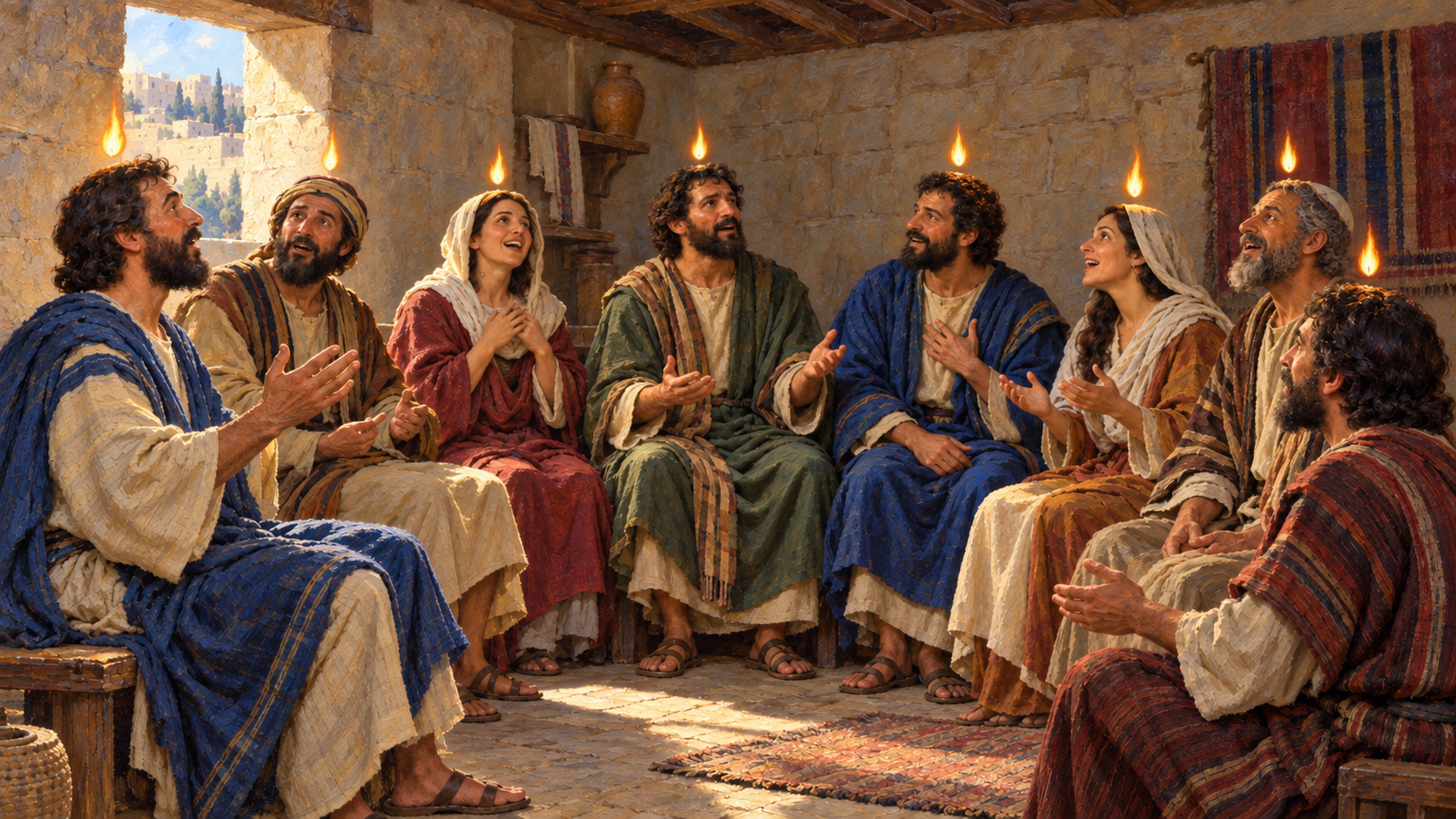
What were the tongues that looked like fire at Pentecost? Acts 2 describes a visible sign followed by languages people could understand. I want to follow that connection into Peter’s preaching and the life of the new church. What happened there grew out of Jesus’ promise to send the Spirit.
Pentecost Was Christ Keeping His Promise
By Pentecost, Jesus had died on the cross and risen bodily from the dead. His apostles had seen Him alive, and before His ascension He had told them to remain in Jerusalem and wait for the Father’s promise. After receiving His command, they watched Him ascend. What followed at Pentecost was connected to all of this, rather than an isolated burst of religious excitement.
And being assembled together with them, He commanded them not to depart from Jerusalem, but to wait for the Promise of the Father, “which,” He said, “you have heard from Me; for John truly baptized with water, but you shall be baptized with the Holy Spirit not many days from now.”
But you shall receive power when the Holy Spirit has come upon you; and you shall be witnesses to Me in Jerusalem, and in all Judea and Samaria, and to the end of the earth.
Jesus promised the Spirit’s power so His followers could bear witness to Him. Their witness would begin in Jerusalem and spread through Judea and Samaria to the end of the earth, which is the path Acts follows. That helps me understand what the signs on Pentecost were for. They gave unmistakable evidence that the risen Christ had poured out the Spirit and begun the public mission He promised. The church was being equipped to make Him known, not invited to remain absorbed in the signs.
Pentecost was a feast on Israel’s calendar after Passover, associated with harvest and firstfruits. I notice how that setting fits the events in Acts. Jesus, the true Passover Lamb, had been crucified and had risen. After His ascension, the Spirit was poured out at Pentecost, and Peter’s sermon was followed by the first great harvest of gospel converts. The feast’s history helps us understand the fulfillment taking place.
The apostles waited together in prayer and obedience, but they did not produce what happened next or arrange a spectacle. The Spirit came from heaven at God’s appointed time. I should neither explain away those extraordinary signs nor treat them as the result of a technique people can repeat whenever they choose.
Wind, Fire, and Spirit-Given Speech
Luke describes a sound from heaven filling the house where the believers had gathered. Then a visible sign appeared and rested on each of them. As they were filled with the Holy Spirit, He gave them speech. Following that sequence helps us connect the signs with the Spirit’s promised arrival and the witness that followed.
When the Day of Pentecost had fully come, they were all with one accord in one place.
And suddenly there came a sound from heaven, as of a rushing mighty wind, and it filled the whole house where they were sitting.
Then there appeared to them divided tongues, as of fire, and one sat upon each of them.
And they were all filled with the Holy Spirit and began to speak with other tongues, as the Spirit gave them utterance.
People could hear and see what happened, so this was far more than a private feeling among the believers. The sound drew a crowd in Jerusalem, and those who came recognized their own languages in what was spoken. The visible sign rested on each person, rather than hanging over the room as a vague cloud. The same Spirit filled them all, and the sign rested on each person. No single religious figure was the sole focus.
I notice that all of them spoke as the Spirit gave them utterance. Pentecost empowered a people for witness, rather than making one person the center of a performance. Those many voices did not bring competing messages. The hearers were directed to God’s mighty works, and Peter proclaimed the one risen Lord. Each person’s empowerment served Christ’s mission.
Luke describes a sound as of a rushing wind and visible tongues as of fire. I need to keep those comparisons in view. He does not say the Holy Spirit became air or that ordinary flames burned on the apostles’ heads. The supernatural appearance resembled tongues and fire without consuming them, so the sign does not give us a physical definition of the Spirit.
Matthew uses similar language when he records Jesus’ baptism. The Spirit’s visible descent could be compared to a dove without making the Holy Spirit a bird.
When He had been baptized, Jesus came up immediately from the water; and behold, the heavens were opened to Him, and He saw the Spirit of God descending like a dove and alighting upon Him.
In Acts 2:3, Luke uses the Greek phrase glossai hosei pyros. The word glossai can mean tongues or languages, while Hosei marks a comparison with the meaning “as” or “as if.” Those words help us understand his description accurately: the believers saw a sign resembling divided tongues of fire. The connection with speech follows in the next verse, when the Spirit gave them other tongues. What they saw suited the mission being announced, rather than providing empty theater.
Why Did the Sign Look Like Fire?
Fire carries several meanings across Scripture, so we should not force every passage into one narrow idea. It can mark God’s holy presence, as it did when the Angel of the LORD appeared to Moses in the burning bush. The pillar of fire showed God’s guidance. Fire from the LORD could show His acceptance of a sacrifice, while other passages use fire in connection with judgment. God’s Word itself is compared to fire because of its living force and holy authority.
And the Angel of the LORD appeared to him in a flame of fire from the midst of a bush. So he looked, and behold, the bush was burning with fire, but the bush was not consumed.
Then the fire of the LORD fell and consumed the burnt sacrifice, and the wood and the stones and the dust, and it licked up the water that was in the trench.
“Is not My word like a fire?” says the LORD, “And like a hammer that breaks the rock in pieces?”
The voice of the LORD divides the flames of fire.
Long before Pentecost, God had taught His people to associate fire with His presence and holiness. It had expressed His approval and His judgment, and Jeremiah connected fire with the power of His Word. That background helps me understand why the sign in Acts 2 suited what was about to happen. People on whom it rested would soon declare God’s mighty works.
The sign did not destroy the apostles. It marked them for holy witness through the Spirit’s power, as they spoke of God’s saving work and exposed sin. Peter’s sermon called the crowd to account for rejecting Jesus and then pointed them to the risen Christ. In that preaching, we can see why fire suited both the Spirit’s holiness and the force of the Word He enabled them to speak.
Luke does not explain every visual feature of the sign, so I would be careful not to turn its details into a code for new doctrines. The fire-like appearance rested on each believer, and when they were filled with the Spirit, they immediately spoke as He enabled them. God’s holy presence was connected with their mission to proclaim His works.
The Other Tongues Were Real Languages
The speakers were Galileans, yet visitors from many places heard the languages in which they had been born. Luke repeats that fact in several ways, making clear that recognizable speech was central to the miracle.
And when this sound occurred, the multitude came together, and were confused, because everyone heard them speak in his own language.
Then they were all amazed and marveled, saying to one another, “Look, are not all these who speak Galileans? And how is it that we hear, each in our own language in which we were born?”
We hear them speaking in our own tongues the wonderful works of God.
These were intelligible human languages that allowed people to understand what was being said. God gathered Jews and proselytes from many places and enabled them to hear His mighty works in words they knew. I see the purpose of the miracle in that communication. The gospel of Jesus Christ would reach beyond one city or ethnic boundary as the risen Lord was proclaimed to the nations.
Luke names the peoples and regions to make that spread concrete. The crowd included Parthians, Medes, and Elamites. Some had come from Mesopotamia, Cappadocia, Pontus, Asia, Egypt, and Libya. Visitors from Rome stood with Cretans and Arabs. The sound from heaven drew them together, and the Spirit-given speech crossed the boundaries between their languages.
God’s power enabled the gospel to cross the divisions between human languages. Pentecost did not erase every earthly result of Babel or make the listeners one ethnic group. Luke describes their differences without pretending they had vanished, yet they heard one testimony about God’s mighty works in languages they already knew.
When I consider spiritual gifts, the understandable speech at Pentecost gives me something definite to work with. The Spirit made God’s works known in words the hearers recognized and opened the way for Christ to be preached. They could respond with repentance and faith. Acts 2 therefore cannot honestly be used to defend confusion or make disorder proof of spirituality.
Peter Opens Scripture and Preaches Christ
The crowd’s amazement did not explain what they had witnessed. Peter turned to Scripture and told them this was what God had spoken through Joel. He did not ask them to trust the experience merely because it felt powerful. He showed them how God’s Word explained God’s work.
But this is what was spoken by the prophet Joel: “And it shall come to pass in the last days, says God, That I will pour out of My Spirit on all flesh; Your sons and your daughters shall prophesy, Your young men shall see visions, Your old men shall dream dreams.”
At Pentecost, God fulfilled His promise to pour out His Spirit. Peter explained the sign and then preached Jesus of Nazareth, rather than making the apostles’ experience the center of his sermon. Jesus had been crucified by lawless hands, raised bodily from the dead, and exalted to God’s right hand.
Therefore being exalted to the right hand of God, and having received from the Father the promise of the Holy Spirit, He poured out this which you now see and hear.
Therefore let all the house of Israel know assuredly that God has made this Jesus, whom you crucified, both Lord and Christ.
The coming of the Spirit proved that the crucified and risen Christ was reigning and had poured out what the people could see and hear. Jesus first died for sins and rose bodily from the dead, then ascended and received the promise from the Father. Pentecost belongs with that work purchased by His blood. I cannot follow Peter’s sermon and make Pentecost a reason to turn attention away from Jesus.
The signs led into the gospel without replacing preaching or repentance. After the Spirit was poured out, Peter explained what had happened from Scripture and proclaimed Christ. His hearers came under conviction and asked what they must do, so he called them to repent. Thousands received the word.
Acts 2 continues describing the church after the visible signs ended. Those who received the word remained in the apostles’ doctrine and shared life with one another, breaking bread and praying together. Their worship combined reverence with gladness, and generosity changed how they cared for each other. As they praised God, the Lord continued adding people to the church. I don’t want to pass over that ordinary faithfulness while concentrating on the extraordinary sign. Pentecost formed a people who lived under the Word.
The converts’ response keeps the event from becoming a lesson about spiritual technique. They did not leave Jerusalem trying to produce another fire-like appearance. Instead, Luke carries us from an extraordinary moment into the steady life of a church. The Spirit’s power does more than create amazement; He gathers people around Christ and teaches them to remain faithful.
I become concerned when a claimed movement of the Spirit leaves people fascinated with manifestations but careless about Christ. Setting Scripture aside or ignoring repentance departs from what we see in Acts 2, and so does treating holiness as unimportant. The Spirit drew the crowd and empowered witnesses who directed them to Jesus. Keeping people’s attention on manifestations misses that purpose.
What Pentecost Means for the Church Today
Acts 2 gives us reason to expect the Holy Spirit to work with power and to test spiritual claims by Scripture. I do not believe we have to choose between a hyper-charismatic view and cessationism. We have no permission to deny His present work or speak as though His gifts and power have disappeared. At the same time, spiritual language cannot make manipulation or false prophecy acceptable. Calling disorder and spectacle the Spirit’s work does not make them holy.
Paul’s teaching in 1 Corinthians 12 through 14 helps us understand how gifts should function in the church. The same Spirit distributes them for the good of the body, so love must govern their use and the gathered church must be built up. Speech needs to be understood or interpreted. Following those instructions honors the Spirit who inspired them, rather than quenching Him.
Paul says a manifestation is given “for the profit of all,” which means it should serve others rather than elevate the person who receives it. That helps me understand why faith in the Spirit’s power belongs with intelligibility and order. If no one can understand what is said, the church is not being built up. A meeting that celebrates confusion also contradicts the peace God says should mark His churches. Discernment protects the purpose God gave the gifts instead of opposing them.
But the manifestation of the Spirit is given to each one for the profit of all.
For God is not the author of confusion but of peace, as in all the churches of the saints.
The apostles received holy boldness to speak clearly about Christ, which shows us the purpose of the tongues as of fire. Their words served the hearers and called sinners to repentance. The Spirit empowered them to bear witness, rather than seek personal attention.
The fire-like sign was connected with holiness and proclamation, so I would not reduce Pentecostal fire to emotional intensity. The Spirit purifies His people and sends them to speak. He does not create an appearance of holiness through noise while leaving sin untouched. When He fills believers, He makes them witnesses to God’s mighty works and directs sinners to the crucified and risen Christ.
I believe the church should therefore remain both open and discerning. We should pray for boldness and depend upon the Spirit instead of trusting human strength. At the same time, we should refuse pressure to imitate whatever draws attention. The Spirit who came at Pentecost is holy, and His gifts serve truth. His work agrees with the written Word and builds up the body of Christ.
Related studies examine the Holy Spirit being like the wind, the Person of the Holy Spirit, the Spirit’s indwelling and coming upon, the gifts of the Holy Spirit, and the Trinity.
My Final Thoughts
The tongues as of fire were a real supernatural sign, but the sign always served the message. The Spirit gave understandable speech so people from many nations could hear God’s mighty works, and Peter used that opening to preach the crucified and risen Christ. I do not want to chase the appearance of fire while missing the holy witness it marked. We should welcome the Spirit’s power, test every claim by the Word He inspired, and seek the boldness to make Jesus known clearly.