
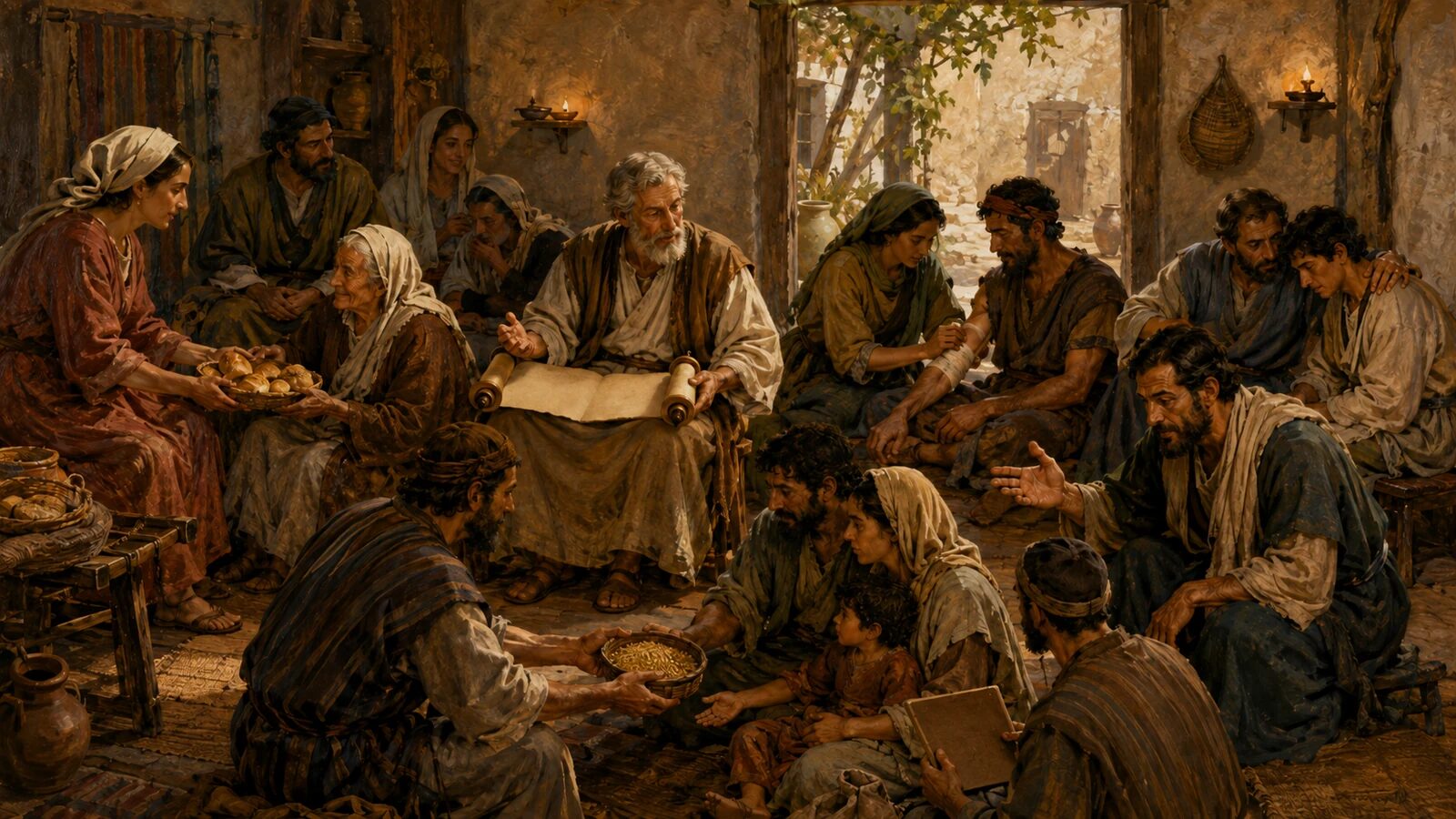
Having a spiritual gift does not make someone spiritually mature. Paul acknowledged the gifts God had given the Corinthians, but he still had plenty to correct in their congregation. I need to remember that before I become impressed with a person’s ability or dismiss someone whose service attracts little attention. Scripture teaches us to use what God has given for the good of His people, and it tells us how to examine claims made in His name.
Gifts Are Grace for One Body
Before Paul discusses particular gifts in Romans 12, he appeals to God’s mercy and calls believers to present their bodies as a living sacrifice. Their minds need to be renewed so their thinking and conduct are no longer shaped by the world around them. Serving God begins with that response to His mercy, and Paul immediately addresses how they regard themselves.
For I say, through the grace given to me, to everyone who is among you, not to think of himself more highly than he ought to think, but to think soberly, as God has dealt to each one a measure of faith.
A person can become proud of his place in the church just as readily as his position anywhere else. If people regularly come to me for help understanding Scripture, I may begin to assume I have very little to learn from them. Paul calls for an honest assessment of ourselves because none of us can supply everything the church needs. He explains our relationship through the different parts of a body.
For as we have many members in one body, but all the members do not have the same function, so we, being many, are one body in Christ, and individually members of one another.
A teacher still needs encouragement and sometimes correction. A generous giver may need someone to care for him when he is struggling. We belong to one another, so receiving help is part of church life as much as offering it. I cannot treat other believers as unnecessary because their contribution differs from mine.
Paul goes on to describe “gifts differing according to the grace that is given to us” in Romans 12:6. The Greek word charisma refers to a gift of grace, a gracious enablement. Whatever we have received, we did not create the grace that equips us. That leaves us no reason to boast, and another person’s gift need not make us resent our own place.
The gifts Paul names in Romans 12:6–8 reach into ordinary church life. Ministry includes meeting practical needs, while teaching helps people understand God’s Word. Exhortation means urging someone to respond to the truth; that may require encouragement or a frank warning, depending on what the person needs. Prophecy must remain accountable to faith and what God has revealed. Being confident about an impression does not give someone permission to announce whatever he pleases in God’s name.
Paul is equally concerned with how the work is done. Giving is to be sincere. If I offer financial help and then expect the recipient to support my opinions in return, I am using his need to gain control over him. Leadership requires diligence, which means giving the work steady attention instead of enjoying the title while neglecting the people. Mercy is to be shown cheerfully; someone who needs care should not be made to feel guilty for receiving it.
Paul takes up the same subject in 1 Corinthians 12–14, but there he also has to correct a congregation that had become divided and disorderly.
Building the Church Toward Maturity
In Corinth, believers who shared in the Spirit’s gifts had divided around favorite teachers and were taking one another to court. The congregation had tolerated serious sexual sin, while differences in wealth and status had marred the Lord’s Supper. Some still thought in ways shaped by their former idolatry. Paul confronted those failures rather than commending their conduct simply because they had remarkable abilities.
When he turns to spiritual gifts in chapter 12, he states what the Spirit intends them to accomplish.
But the manifestation of the Spirit is given to each one for the profit of all.
The congregation is supposed to benefit from what has been given. If a ministry makes one person look important while leaving people confused about Scripture or dependent on his approval, it has departed from Paul’s instructions. I would look at whether believers are being strengthened in the truth before drawing conclusions from the size of an audience.
Paul also identifies who decides how the gifts are distributed.
But one and the same Spirit works all these things, distributing to each one individually as He wills.
The Holy Spirit exercises His own will in giving them. He is a divine Person, so we cannot treat Him as a supply of abilities to order according to our ambitions. Nor can we demand someone else’s gift as though He made a mistake in distributing them. The study on the person of the Holy Spirit examines who He is and His work among believers.
In that same chapter of 1 Corinthians, Paul explains that members who seem weaker are necessary, and he calls for honor toward those who receive less recognition. The eye cannot tell the hand, “I have no need of you” (1 Corinthians 12:21). A public speaker depends on people whose work he may scarcely notice. If his prominence persuades him that everyone else is dispensable, he has badly misunderstood his place in the body.
Ephesians 4 gives particular attention to people entrusted with leadership and teaching. Christ gives them to the church so that other believers will be equipped to serve.
And He Himself gave some to be apostles, some prophets, some evangelists, and some pastors and teachers, for the equipping of the saints for the work of ministry, for the edifying of the body of Christ.
The saints are meant to do the work of ministry as they are equipped. A congregation that remains dependent on one personality has missed that purpose, however capable the person may be. Paul describes believers growing beyond the spiritual childhood that leaves them vulnerable to every wind of doctrine. Good teaching should help them recognize error and serve others, rather than keep them unable to function without the teacher.
We also need to distinguish a spiritual gift from a church office and from natural ability. Someone may be gifted to teach without holding the authoritative teaching office of elder. Pastors and elders must be biblically qualified men whose doctrine, character, and households can be examined. The foundational apostles were personally commissioned witnesses of the risen Christ; a modern ministry title cannot confer their authority. Natural talent may be useful, but it does not establish a person’s qualifications or prove that the Spirit approves of his conduct.
Those qualifications govern who should hold an office. They do not relieve the rest of the church of the responsibility to serve. Peter addresses every believer who has received a gift.
As each one has received a gift, minister it to one another, as good stewards of the manifold grace of God.
A steward manages something entrusted to him by its owner. He is accountable for how he uses it. A speaker therefore needs to handle God’s words carefully instead of passing off personal opinions as divine instruction. Someone serving should depend on the strength God supplies, remembering whom the work belongs to when it becomes tiring or goes unnoticed. Peter gives the purpose in 1 Peter 4:11: God is to be glorified through Jesus Christ in all things.
We do not need public recognition before we can take that responsibility seriously. A believer who is struggling may need encouragement now, and practical work may be going undone while people wait for a more prominent opportunity. If God has given us a way to help, we can begin with the people and responsibilities already before us.
Love, Character, and Order
Paul places 1 Corinthians 13 between his explanation of gifts and his instructions for using them in the gathering. He considers tongues, prophecy, supernatural knowledge, sacrificial giving, and even faith powerful enough to move mountains. None of it excuses a failure to love the people we claim to serve.
And though I have the gift of prophecy, and understand all mysteries and all knowledge, and though I have all faith, so that I could remove mountains, but have not love, I am nothing.
I cannot point to a person’s gift as a defense of cruelty or persistent pride. Paul had already confronted the Corinthians’ fleshly behavior, and their abilities did not make it acceptable. Someone may explain Scripture with remarkable clarity and still need to repent of how he treats his family or the congregation. We need to deal with the misconduct rather than excuse it because people find his ministry useful.
Galatians 5 describes the fruit the Spirit produces: love, joy, peace, patience, kindness, goodness, faithfulness, gentleness, and self-control. Giftedness and character are not interchangeable. We should look for the fruit of the Spirit in a person’s life as well as faithful use of his abilities.
In a church service, love also requires us to consider whether the congregation can understand what is being said. Paul’s instructions about tongues address that responsibility, but Acts 2 gives us an earlier example of the gift itself. At Pentecost, people from many nations heard the disciples speaking in their own languages.
And when this sound occurred, the multitude came together, and were confused, because everyone heard them speak in his own language.
The miracle served the gospel as it began to reach the nations. When Paul addresses tongues in 1 Corinthians 14, he likewise insists that the gathered church benefit from what is spoken. He gives specific instructions for that setting.
If anyone speaks in a tongue, let there be two or at the most three, each in turn, and let one interpret. But if there is no interpreter, let him keep silent in church, and let him speak to himself and to God.
Two or at most three may speak, each in turn, and someone must interpret. Without an interpreter, the speaker is to remain silent in the church. These directions allow people to understand what is said so they can be edified, or built up in the faith. If someone refuses to follow them, claiming that the Spirit made him speak does not excuse the refusal. The apostolic instructions govern the gathering even when a speaker feels strongly compelled to say something.
Paul also limits the number of prophetic speakers and directs others to judge what is said. The congregation must have an opportunity to listen and weigh it. A claimed prophetic word does not give anyone authority to introduce new doctrine or put himself beyond correction. The Spirit of truth will not contradict Scripture or authorize manipulation.
Paul’s statement that “God is not the author of confusion but of peace” belongs to these instructions for worship. I would not use it to condemn every spontaneous moment in a service. But if someone insists that questioning his revelation amounts to opposing God, he is refusing the very examination Paul required.
Do Gifts Operate Today?
I am neither hyper-charismatic nor cessationist. I do not accept every claimed manifestation as genuine, and I do not believe the miraculous gifts ceased with the apostles. Counterfeit gifts need to be exposed, and exploiting people through prosperity spectacles deserves a plain rebuke. Exposing that misconduct, however, does not establish that the Spirit has stopped giving gifts.
Believers still need His help as they teach, pray, give, lead, and show mercy. God also remains able to heal and work miracles according to His will. We can ask Him to intervene without pretending that we control what He will do.
At the same time, we should recognize the particular setting of the apostolic signs. As the gospel entered new places and the church’s foundation was laid, God confirmed the message through extraordinary works. Paul describes this confirmation in Hebrews.
God also bearing witness both with signs and wonders, with various miracles, and gifts of the Holy Spirit, according to His own will.
Those signs bore witness to the gospel God had revealed. A modern claim to a miracle does not give its messenger the foundational authority of the apostles, and no sign authorizes him to invent doctrine. Recognizing that early purpose does not require us to deny that God still answers prayer, opens opportunities for the gospel, and strengthens His people.
God may heal directly, and His provision can also come through ordinary care. We should pray expectantly and be honest about what has happened. If a sick person has not improved, pressuring him to say he has been healed only adds deception to his suffering. It is also reckless to blame him for not having enough faith when Scripture describes faithful believers who endured terrible affliction. No claimed gift gives anyone the right to exploit that distress or intimidate people into donating money.
Testing Claims and Avoiding Common Errors
Testing a spiritual claim is a responsibility God gives the church. We are not required to surrender our judgment because someone speaks confidently in His name.
Beloved, do not believe every spirit, but test the spirits, whether they are of God; because many false prophets have gone out into the world.
Paul gives a similar command while warning believers against quenching the Spirit.
Do not quench the Spirit. Do not despise prophecies. Test all things; hold fast what is good.
To hold fast to what is good, we have to distinguish it from what is false. Accepting every claim ignores the instruction to test, while dismissing everything ignores the warning against despising what God gives. We need to compare what is taught with Scripture, examine whether it honors Christ, and consider whether its use strengthens the church within biblical order.
The messenger’s conduct deserves scrutiny too. Is he willing to receive correction and remain accountable to qualified church leadership? Is money handled openly? If a leader relies on secrecy and intimidation to prevent reasonable questions, his claims of spiritual authority should not protect him from examination. People in the congregation need to be able to raise a concern without being threatened for doing so.
If someone says a Christian must speak in tongues to prove he is saved, the problem goes beyond disorder in a service. He is adding a requirement to the gospel. No particular gift, whether tongues, healing, or something else, establishes spiritual superiority or saves a sinner. Salvation depends on Christ’s finished work, which the Spirit applies to those who believe.
Jesus is the eternal Son, fully God and fully man. He was virgin-born and completely sinless, yet wicked men physically tortured, punished, and killed Him. He willingly endured that real punishment for our sins in His innocent body, shedding His blood and dying for us. His saving work was finished through His blood and death; He was then buried and rose bodily from the grave. The Father did not punish, curse, abandon, strike, bruise, or pour wrath on Jesus.
Christ died for the whole world and genuinely offers salvation, although people can resist and reject Him. Everyone who repents and believes is born again, indwelt by the Holy Spirit, and sealed as eternally secure in Christ. Regeneration means actual new birth, so calling ourselves Christians does not establish that we have received it. We should see evidence of the new creation in how we live, although our obedience does not earn salvation or amount to sinless perfection. Eternal security gives no permission for lawlessness.
The Spirit’s indwelling and seal belong to every true believer, while He distributes gifts differently among them. Paul’s question in 1 Corinthians 12:30 assumes that not all believers speak in tongues. We cannot make that gift a requirement for everyone who belongs to Christ. The study on His indwelling and coming upon explains the distinction between His presence in believers and other aspects of His ministry.
My Final Thoughts
I want to use what God has entrusted to me without resenting another believer’s place or becoming impressed with my own. That means being willing to serve when the work receives little recognition and accepting correction when I need it. A gift does not exempt anyone from loving the people he serves or obeying the Word he teaches.
We can protect people from false claims and still ask God to work powerfully among us. Paul tells us to test what we hear and hold fast to what is good, so discernment should help us recognize and welcome the Spirit’s work. I do not want a preoccupation with spectacular gifts to keep us from using what God has already entrusted to us.