
Idolatry can sound like a sin that belongs to ancient temples, but Scripture brings it much closer to home. What makes a carved image an idol, and how can money, approval, or even a good gift become one too? The answer depends on what receives the worship that belongs to God and what governs our trust and obedience.
What the Bible Means by Idolatry
Idolatry appears in Jacob’s household before the Law of Moses explains its danger. The prophets repeatedly condemn it, and Israel’s kings are judged in part by how they respond to false worship. Jesus confronts it too, and the apostles warn churches against it. Revelation includes idolaters in its final judgments. I cannot read that continuing witness and dismiss idolatry as an ancient mistake people outgrow through education. It is rebellion in the heart, a turning from the living God to something He created.
An idol is a false object of worship. It may be a carved image or a household god, though people have also worshiped heavenly bodies and sought help from dead ancestors. Even an invented idea of God can take His place. Political power and money can receive that devotion, just as pleasure, success or self can become the thing around which someone builds a life. Whatever form it takes, something created receives reverence or trust that belongs to the Creator. It then shapes what the worshiper loves and fears.
We need to keep both the outward act and the heart’s devotion in view. Calling idolatry an inward attitude does not excuse the use of carved images, devotional objects or religious symbols as mediators of worship. Those are still literal idols. But a person does not need a statue to commit this sin. The New Testament calls covetousness idolatry because a desire can rule the heart in a way that belongs only to God.
Understanding the original words helps us see why worship is central to these passages. In Exodus 20:4, the Hebrew word translated “carved image” is pesel. It describes an image cut or shaped for religious use. The New Testament word eidololatria, translated “idolatry,” means service or worship of an idol. These meanings do not settle every question apart from context, but they help us recognize the consistent concern: something other than God is receiving religious devotion.
When God called Jacob back to Bethel, Jacob told his household to put away their foreign gods. They were preparing to return to the place where God had met him.
And Jacob said to his household and to all who were with him, “Put away the foreign gods that are among you, purify yourselves, and change your garments.”
Jacob’s family owed covenant loyalty to the God who had kept His promise. They could not prepare to meet Him while clinging to rival objects of worship and trust. Genesis 35 refers broadly to foreign gods rather than using the word teraphim. Rachel had already taken her father’s household idols in Genesis 31, and Judges 17–18 describes a private shrine built around images. Each account shows people wanting the comfort of religion on their own terms.
God had truly spoken to Jacob, yet idols remained in his household. That makes me stop and think about the difference between being religious and belonging to the Lord. These people were not atheists. Their objects were part of their worship and identity, and they looked to them for household protection. God still required them to put those gods away. He calls us to belong to Him, not to give Him a place alongside other spiritual options.
The first two commandments make that exclusive claim unmistakable. The first forbids rival gods, while the second forbids images made for worship. A person may worship a false god or claim to worship the true God through a man-made image, but Scripture forbids both.
You shall have no other gods before Me.
You shall not make for yourself a carved image: any likeness of anything that is in heaven above, or that is in the earth beneath, or that is in the water under the earth; you shall not bow down to them nor serve them. For I, the LORD your God, am a jealous God.
God commanded skillful artwork for the tabernacle, including the cherubim above the mercy seat, so the second commandment cannot be a ban on every work of art. The distinction is in the words “you shall not bow down to them nor serve them.” We may not turn an image into a visible point of access to divine power.
Israel tried to excuse that very thing at Sinai. Aaron made the golden calf and connected it with a feast to the LORD, but God judged the act as grave sin.
And he received the gold from their hand, and he fashioned it with an engraving tool, and made a molded calf. Then they said, “This is your god, O Israel, that brought you out of the land of Egypt!”
God had revealed Himself through His word, and Israel was to trust what He said. Making a visible representation of their Deliverer did not become acceptable because they called it a help to worship. An image can be carried and decorated, then hidden or displayed whenever its owner chooses. That invites people to act as though they can manage divine power. But materials such as wood and stone, metal and paint are themselves created things. Neither our imagination nor our rituals can contain the Creator.
The Lie Held in an Idol
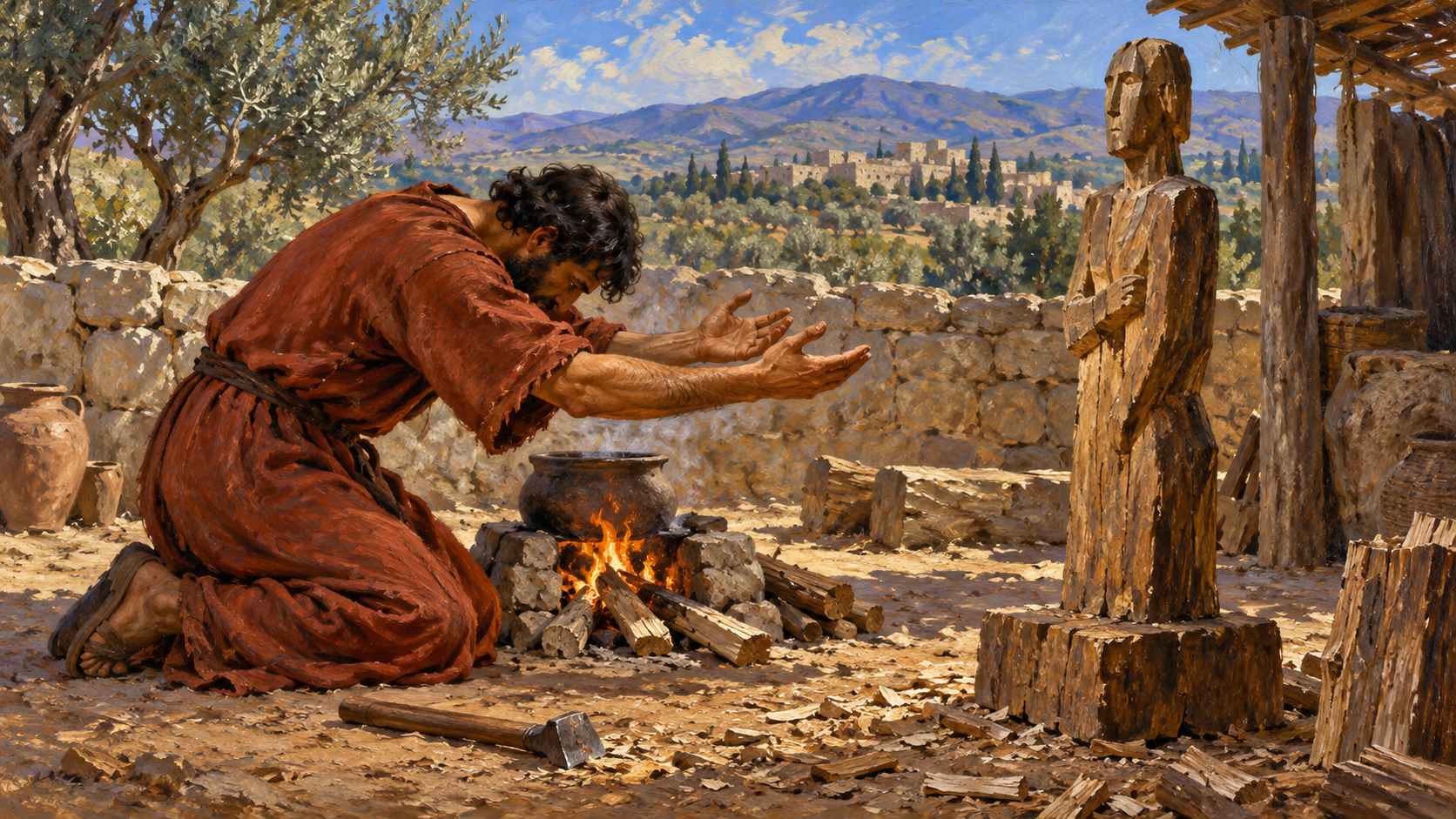
Isaiah pictures a man cutting down a tree and using some of its wood to warm himself and cook his food. He shapes the rest into a god and bows before it. That contrast explains why the prophets mock idols. Their mockery is holy rather than cruel, exposing the absurdity of worshiping something human hands have made.
He burns half of it in the fire; with this half he eats meat; he roasts a roast, and is satisfied. He even warms himself and says, “Ah! I am warm, I have seen the fire.” And the rest of it he makes into a god, his carved image. He falls down before it and worships it, prays to it and says, “Deliver me, for you are my god!”
He feeds on ashes; a deceived heart has turned him aside; and he cannot deliver his soul, nor say, “Is there not a lie in my right hand?”
Isaiah asks, “Is there not a lie in my right hand?” The question should make me consider what the worshiper is actually holding. The idol looks like a presence, but it has no life and cannot see or hear. It cannot answer prayer or forgive sin, much less save anyone from judgment. It also teaches a lie about God, as though He could be replaced or controlled, confined to one place or approached through a human invention. A person who accepts that lie begins to prefer visible religious control to obedient faith.
Jeremiah describes people who fear signs in the heavens and tremble before lifeless gods they have decorated. Those images can neither help nor harm them. He calls them futile works and errors, not lesser gods with a little of the Lord’s power.
They are upright, like a palm tree, and they cannot speak; they must be carried, because they cannot go by themselves. Do not be afraid of them, for they cannot do evil, nor can they do any good.
They are futile, a work of errors; in the time of their punishment they shall perish.
Psalm 115 warns that people who make idols become like them. I need to take seriously what worship does to the worshiper. Devotion to a lifeless god dulls the heart spiritually, and a false god shapes a false conscience. People train their hearts around a lie until they can no longer hear and respond rightly to the living Lord.
Covenant Betrayal and Idols of the Heart
God often describes His covenant with His people in the language of marriage. He is faithful to them and claims their exclusive loyalty. His jealousy expresses righteous love, not insecurity or pettiness. He will not treat betrayal as harmless or bless His people while they give themselves to rivals.
When the LORD began to speak by Hosea, the LORD said to Hosea: “Go, take yourself a wife of harlotry and children of harlotry, for the land has committed great harlotry by departing from the LORD.”
Hosea’s painful prophetic sign helps us understand why God treats false worship as betrayal. Israel had departed from the Lord to pursue other lovers and even credited Baal with gifts God Himself had given. This was covenant unfaithfulness, not a harmless cultural habit.
For she did not know that I gave her grain, new wine, and oil, and multiplied her silver and gold, which they prepared for Baal.
The gifts themselves deepen the betrayal. A person can use God-given breath to chant before a false god and the strength He supplies to bow before an image. Even His gifts of gold and silver can be turned into objects of false worship. I find that hard to ignore: the idolater depends on God’s mercy every moment while denying Him the glory.
Speaking about God or attending services does not make divided worship holy. If I am trusting something else in His place, familiar Christian words do not change my loyalty. The Lord commands wholehearted love, so I cannot reserve part of my devotion for a rival and still call that faithfulness to Him.
You shall love the LORD your God with all your heart, with all your soul, and with all your strength.
The New Testament also addresses idolatry within the heart. A desire can begin to rule us even when no visible idol stands before us. That is why Paul tells believers to put to death the sins of the old life, including covetousness, “which is idolatry.”
Therefore put to death your members which are on the earth: fornication, uncleanness, passion, evil desire, and covetousness, which is idolatry.
Covetousness gives desire authority over us. Desire insists, “I must have this,” and makes the desired thing a master that promises what only God can finally give. A person begins to draw an identity from it and look to it for a kind of salvation it cannot provide. That does not mean every desire is sinful. God created hunger and affection, and He allows us to enjoy His gifts. The sin begins when we refuse His rule and put the gift above Him.
Work can take God’s place, and so can our devotion to marriage or children. Ministry can become a way of establishing our worth instead of serving Christ. Money may seem to offer security, while a good reputation gives us approval to build an identity around. Some people live for pleasure, others for control or political power. Personal freedom can become something we refuse to surrender. These things are not all evil, so we need to ask what place they occupy. Are we giving one of them the trust that belongs to God or protecting it at the cost of obedience?
Romans 1 explains what happens beneath all these forms of idolatry. Fallen people exchange God’s glory for an image and His truth for the lie. They turn from the Creator to serve something He made.
Professing to be wise, they became fools, and changed the glory of the incorruptible God into an image made like corruptible man, and birds and four-footed animals and creeping things.
Who exchanged the truth of God for the lie, and worshiped and served the creature rather than the Creator, who is blessed forever. Amen.
That word exchange helps me understand why rejecting God is never a neutral choice. The heart does not remain empty when it turns from Him. Something else takes the place that belongs to the true God.
John’s warning to believers belongs here too. He has written to them about eternal life in the Son of God, yet he ends his first letter by telling them to keep away from idols.
Little children, keep yourselves from idols. Amen.
John is addressing people who have been saved by Christ and are indwelt by the Holy Spirit. They are secure in Him, but that security does not remove their responsibility to reject idols. I cannot use eternal security as permission to make peace with sin.
Idols, Demons, and Honest Discernment
In 1 Corinthians, Paul says an idol is nothing in the world. He means there is no true god living behind the carved image. Neither Zeus nor Baal nor Artemis is God, and a statue has no divine life or power.
Therefore concerning the eating of things offered to idols, we know that an idol is nothing in the world, and that there is no other God but one.
That does not make idolatrous worship spiritually harmless. Demons can stand behind false worship and receive what people offer.
Rather, that the things which the Gentiles sacrifice they sacrifice to demons and not to God, and I do not want you to have fellowship with demons.
I can take both passages seriously without treating them as a contradiction. The idol itself is nothing as a god, yet worship offered through it can become fellowship with demons. That is why Paul refuses any attempt to join the Lord’s table with such fellowship.
You cannot drink the cup of the Lord and the cup of demons; you cannot partake of the Lord’s table and of the table of demons.
We have no reason to fear a carved object as though it were a god, but its lifelessness does not excuse false worship. That worship teaches lies about God and reshapes the conscience as it joins people to rebellion. We need to leave it behind and remain faithful to the Lord.
To recognize idolatry in our own lives, we can begin by asking what receives our worship. An object or image must not receive reverence that belongs to God. The same question applies to a person or tradition, or even an entire religious system treated as a mediator between the soul and God. Praying or bowing to it reveals that misplaced reverence, as does carrying it for protection or using it to seek favor. Scripture’s warning applies to these practices.
Trust gives us another test. Where does my heart run for safety and identity? Where do I expect lasting hope? Money can promise security, while approval offers a sense of worth. Control becomes an idol when surrender to God feels unbearable. Pleasure becomes one when obedience is sacrificed to desire. Even ministry can take this place when public usefulness becomes more precious than fellowship with Christ.
Obedience often exposes the answer most clearly: what command of God am I willing to ignore so that I can keep this thing? A desire that demands disobedience is no longer living under God’s rule. It is trying to rule. A relationship is being placed above Christ when keeping it requires compromise with sin. If a tradition must be defended against Scripture, that tradition has become the master.
We need to name the particular loyalty we are protecting. Israel despised other nations’ gods while clinging to its own high places, and Christians can reject obvious pagan worship while excusing greed or pride. Hidden loyalties may grow around entertainment and politics, or around bitterness, celebrity influence and religious nostalgia. Scripture exposes what we would rather leave unexamined. I need to ask what I actually trust and serve, not only what I say I worship. What am I afraid of losing, and what would I disobey God to keep?
Christ and True Worship
The answer to idolatry is not an empty life without worship. God calls His people away from idols and back to Himself. Jesus answered Satan’s temptation by quoting the command to worship and serve God alone.
Then Jesus said to him, “Away with you, Satan! For it is written, ‘You shall worship the LORD your God, and Him only you shall serve.'”
The command to worship God alone exposes every false lord. Jesus is the only true Mediator, so no image or ritual object can bring sinners to God. A saint or angel cannot take His place, and turning to an ancestor gives us no other road to the Father. Neither can a charm, shrine or human system provide one. The eternal Son became fully man and lived without sin. He shed His blood for sinners and died, then rose bodily. His finished work reconciles us to the Father.
True worship centers on God as He has revealed Himself. The Father seeks people who worship in spirit and truth.
But the hour is coming, and now is, when the true worshipers will worship the Father in spirit and truth; for the Father is seeking such to worship Him.
The Holy Spirit indwells believers and turns their hearts from dead idols to the living God. Scripture governs how we worship and keeps us from inventing our own way of gaining access to Him. Repentance may require throwing away an object, but it also means turning from false gods to the Lord. Having received Christ by faith, we refuse every false mediator. I need to apply that same repentance to covetousness instead of covering it with religious words. We are to put it to death and learn to say with the psalmist that the Lord is our portion.
For further study, see A Complete Bible Study on Idolatry, A Bible Study on Covetousness, A Bible Study on Elijah at Mount Carmel, and A Bible Study on the Unknown God in Paul’s Sermon.
My Final Thoughts
After working through these passages, I do not think we can keep idolatry safely confined to ancient statues. A carved image is truly an idol when it is used for worship, but Scripture also reaches into the heart and exposes any desire or created gift that takes God’s place. The idol promises control or satisfaction, yet it leaves us holding a lie. Jesus Christ alone brings us to the Father, and He is worthy of the undivided trust that no object or desire can bear. The warning to keep ourselves from idols should make us examine what we actually serve. Wherever we find a rival, we should turn from it and worship the living God in spirit and truth.