
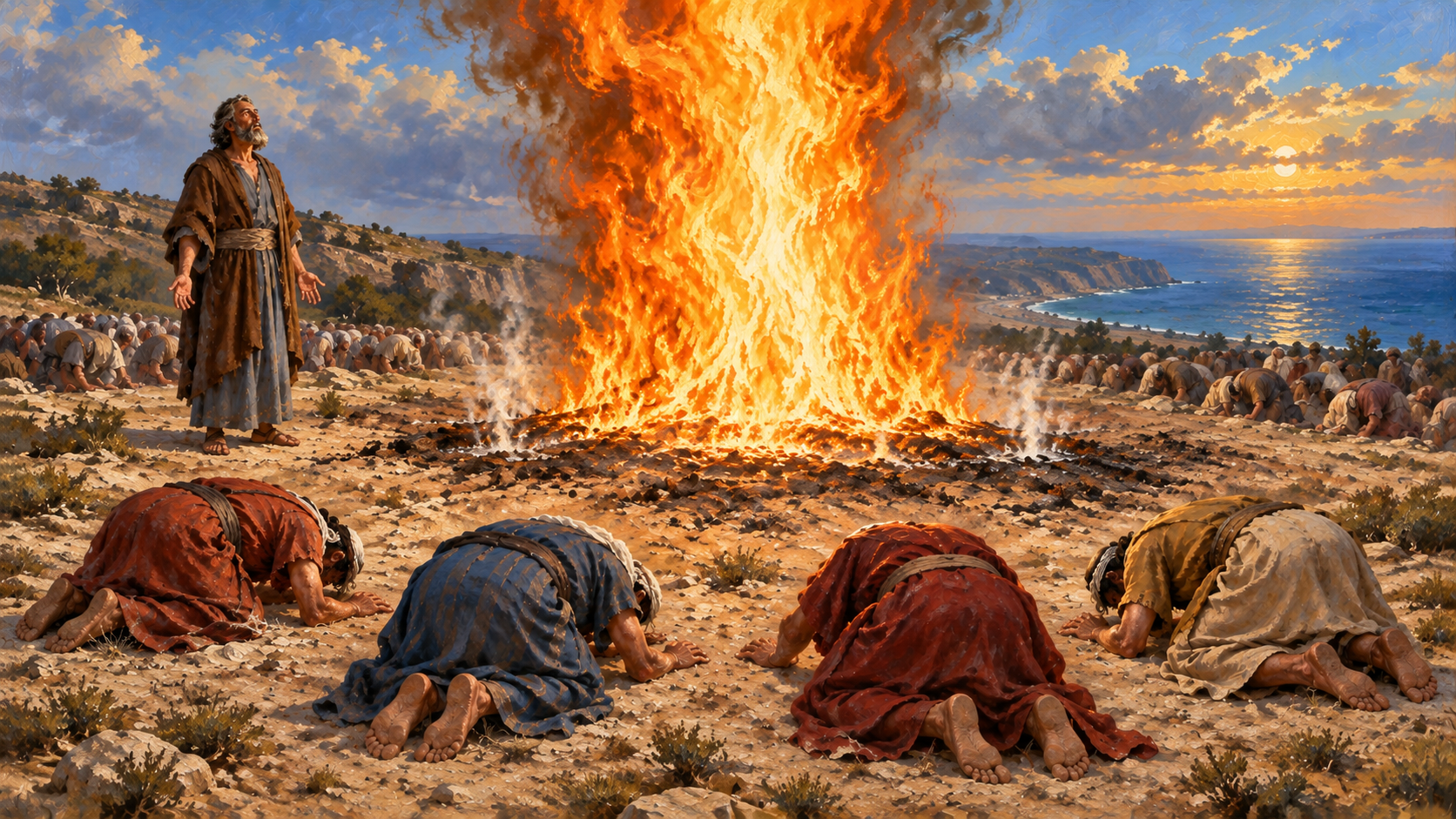
Why did Elijah gather Israel on Mount Carmel and ask God to answer with fire? Elijah was not staging a dramatic contest to draw attention to himself. Israel had tried to hold on to the LORD while serving Baal, and God confronted that divided loyalty so His people could turn back to Him.
Israel’s Apostasy Brought Covenant Drought
Before we reach Mount Carmel, we need to understand what had happened under King Ahab. Israel was sinking deeper into covenant rebellion. Ahab had married Jezebel, the Sidonian king’s daughter, and given Baal worship the throne’s support. He built a temple and altar for Baal in Samaria, then made a wooden image connected with Asherah worship.
Scripture gives us a blunt judgment of the king who led Israel into this darkness.
And Ahab made a wooden image. Ahab did more to provoke the LORD God of Israel to anger than all the kings of Israel who were before him.
Israel’s sin at Carmel was far more serious than simply losing interest in religion. The nation had the law of Moses and remembered the exodus. Its people knew God’s covenant name and had heard His prophets, yet Ahab and Jezebel openly promoted Baal. Mixing his worship with the worship of the LORD betrayed the covenant. We should not treat that as a harmless choice between religious preferences.
Baal was supposed to control storms and rain and bring fertility to the land. I can see why the drought confronted those claims so directly. God withheld the very blessings Baal’s worshipers expected their god to provide. If Baal could send rain and make the land fruitful, he had years to show it. His silence became part of God’s message to Israel.
Jezebel’s promotion of Baal had the resources and power of the throne behind it. Royal money supported the worship, and official prophets served at public altars. This went far beyond a private idol in one home. The prophets of the LORD were hunted, so Obadiah hid one hundred of them in caves and kept them alive with bread and water. That intimidation helps us understand the severity of the confrontation.
Elijah first appeared with a word of judgment, telling Ahab there would be no dew or rain except at his word. He could speak so boldly because he stood as a servant before the living God. His authority came from the LORD, not from the force of his personality.
And Elijah the Tishbite, of the inhabitants of Gilead, said to Ahab, “As the LORD God of Israel lives, before whom I stand, there shall not be dew nor rain these years, except at my word.”
The drought lasted three years and six months, as Jesus says in Luke 4:25 and James confirms in James 5:17. It devastated the land, but it was not random cruelty. Deuteronomy 11:16-17 had warned Israel that heaven would be shut if the people turned aside to serve other gods. Elijah’s drought fit that covenant warning. God was exposing idolatry and calling His people back before they went farther into ruin.
The drought went on too long to dismiss as a brief change in the weather. Season after season, Baal failed to do what his worshipers claimed he could do, while Elijah’s warning remained true. Dew and rain would return only at the LORD’s word. The empty fields were already showing Israel what the fire would later make plain on Carmel: their covenant God lives, and the idol does not.
I see mercy in God’s decision to confront Israel while there was still time to repent. These were people who bore His name, and He was calling them back through judgment. That is why I cannot read Carmel as entertainment for a crowd or a way for Elijah to make a reputation for himself.
Elijah Called Israel to Stop Faltering
After many days, the LORD sent Elijah back to Ahab with the promise of rain. When Ahab saw him, he called him the troubler of Israel. He blamed the messenger for exposing the nation’s sin instead of recognizing the rebellion that had brought the drought. His accusation revealed how unwilling he was to face that guilt.
And he answered, “I have not troubled Israel, but you and your father’s house have, in that you have forsaken the commandments of the LORD and have followed the Baals.
Elijah rejected Ahab’s accusation because the drought had come through the rebellion of Ahab’s house, not through wrongdoing by the prophet. They had forsaken the LORD’s commands and followed the Baals. I need to remember that distinction when truth makes me uncomfortable. God’s word exposes sin so repentance can begin; the message is not the cause of the trouble it reveals.
Elijah called for Israel to gather at Mount Carmel with the four hundred fifty prophets of Baal and the four hundred prophets of Asherah who ate at Jezebel’s table. The confrontation had to be public because the apostasy was public. Israel could no longer act as though Baal and the LORD could share the nation’s worship.
And Elijah came to all the people, and said, “How long will you falter between two opinions? If the LORD is God, follow Him; but if Baal, follow him.” But the people answered him not a word.
The word translated falter carries the idea of limping or wavering between sides. Israel still used religious language, but the people were trying to move between two loyalties instead of following the LORD firmly. Elijah called that divided worship what it was: rebellion. It was no kind of balance between equally valid choices.
If the LORD is God, His people must follow Him. They could not keep His covenant name for comfort while turning to Baal for rain and fruitfulness. Elijah would not let them treat Him as one option among many, and he wanted more than the right words in reply. They needed to abandon the idol and give the LORD their loyalty.
The people could not defend Baal, yet they would not answer the call to follow the LORD. Their silence helps me understand why a public test was needed. The problem was not merely a lack of information. They were unwilling to choose the God who had already made Himself known to them. That is what makes their silence painful to read.
The test was simple: two bulls would be prepared, and each side would call upon its god. Baal’s prophets would call on Baal, while Elijah would call on the name of the LORD. The God who answered by fire would be shown as God, and the people agreed that this was a fair test.
Baal Was Silent While Elijah Repaired the Altar
Baal’s prophets went first, crying from morning until noon, “O Baal, hear us!” They leaped around the altar without getting an answer. Scripture repeatedly tells us that no voice came. Nothing responded to all their effort.
At noon Elijah mocked Baal and told the prophets to cry louder. Perhaps their god was meditating or busy. He might have gone traveling or been asleep and in need of waking. Elijah was exposing the emptiness of a false god. I would not turn his mockery of an idol into permission to be cruel toward weak or hurting people.
The prophets intensified their ritual. They cut themselves until their blood flowed, then continued raving until the time of the evening sacrifice. Still nothing came.
And when midday was past, they prophesied until the time of the offering of the evening sacrifice. But there was no voice; no one answered, no one paid attention.
I notice how much Baal’s prophets did without receiving any answer. Their noisy, emotional worship cost them blood as well as effort, but intensity could not give their god life. Baal could neither heal the wounds they inflicted nor hear their pleading. Having prophets and rituals did not change his inability to respond.
Baal’s name commonly means “lord” or “master.” Canaanites worshiped him as a storm and fertility deity. On Carmel, the LORD challenged those claims where Baal was supposed to be strong. Yet he could provide neither rain nor fire, and he could not make the land fruitful. He showed no power at all.
Elijah called the people near and repaired the LORD’s broken altar before he prayed. That broken altar showed how Israel had neglected worship of the LORD and given its place to Baal. Elijah began by restoring what had been abandoned. The people needed to return to God on His terms, rather than watch another performance.
Elijah used twelve stones, one for each tribe descended from Jacob. Genesis 35:10-12 records God naming Jacob Israel and reaffirming His covenant promises. Those twelve stones bring that history into view even though the kingdom was politically divided. God had not forgotten His covenant people. Their identity came from Him, not from Ahab or Jezebel or the divided monarchy.
After preparing the sacrifice, Elijah ordered water poured over it three times until the offering was soaked and the trench filled. Humanly speaking, it could not be lit. No hidden flame or dry brush could account for fire on that altar, and there was no room for a clever trick. If fire fell, everyone would know God had acted.
Water was precious after years of drought, yet Elijah poured it over the sacrifice. That helps me see the depth of Israel’s need. Rain could sustain them for a time, but it could not save people who continued worshiping Baal. They needed the LORD Himself, who rules both rain and fire and calls human hearts back to Him.
The repaired altar and its twelve stones pointed Israel back to the covenant, while the soaked sacrifice left no room for human trickery. Elijah was restoring what had been broken and showing the whole nation where it belonged. He offered no new religious technique. Even being impressed by a miracle would not be repentance; Israel needed to return to the God who had named them and accept His word as the authority over their worship.
Elijah Prayed and the Fire of the LORD Fell
Baal’s prophets had spent hours crying and leaping around the altar. When no answer came, they cut themselves and continued their frantic ritual. Elijah then offered a brief prayer. I would not conclude that short prayers are always faithful or long prayers are wrong. His prayer differed because he was acting according to God’s word as His servant. He wanted the LORD to receive the glory, rather than calling attention to himself through a powerless religious frenzy.
And it came to pass, at the time of the offering of the evening sacrifice, that Elijah the prophet came near and said, “LORD God of Abraham, Isaac, and Israel, let it be known this day that You are God in Israel and I am Your servant, and that I have done all these things at Your word. Hear me, O LORD, hear me, that this people may know that You are the LORD God, and that You have turned their hearts back to You again.”
In the NKJV, LORD in small capitals represents YHWH, God’s covenant name. Elijah was not calling Israel toward generic religion. He addressed the God of Abraham, Isaac, and Israel, the One who had revealed Himself and made covenant with this people.
Elijah asked that the LORD be known as God in Israel, identifying himself as a servant who had acted at God’s word. He then asked God to answer so the people would know that He had turned their hearts back. The prayer consistently directed attention to the LORD rather than Elijah.
Elijah wanted the people restored to God, not merely persuaded that he had won an argument. I hear mercy in his request for their hearts to turn back. The miracle would show them who the LORD is and bring them back to the One they had forsaken. It was neither entertainment nor proof that Elijah could command heaven.
God answered immediately. The fire of the LORD fell and did far more than light damp wood.
Then the fire of the LORD fell and consumed the burnt sacrifice, and the wood and the stones and the dust, and it licked up the water that was in the trench.
Fire consumed the sacrifice and everything connected with the altar. Even the stones and dust were consumed, along with the water in the trench, leaving no room to doubt God’s answer. The people who had said nothing when Elijah challenged their divided loyalty now spoke plainly.
Now when all the people saw it, they fell on their faces; and they said, “The LORD, He is God! The LORD, He is God!”
The people’s confession answered Elijah’s question about whom they would follow. Baal had remained silent while his prophets injured themselves, but the LORD answered Elijah’s prayer. The lifeless idol could send neither rain nor fire, and it could reveal no truth. The LORD alone is God, and falling before Him was the right response.
Elijah’s courage deserves our attention, but I cannot explain Carmel by admiring his boldness alone. Everything he said and did depended on the LORD. He could face Ahab and the false prophets because God had spoken, and he could pray for fire because he had acted at God’s command. The account directs us to the God he served.
Elijah specifically said that he had done these things at God’s word. That keeps me from treating Carmel as permission to demand miracles or arrange public tests God has not commanded. Faith responds to what the LORD has said with trust and obedience. It does not stage a spectacle and insist that He endorse it.
Covenant Judgment Fell and Rain Returned
After Israel confessed the LORD as God, Elijah ordered Baal’s prophets seized. They were taken to the Brook Kishon and executed. I find this part of the account difficult, but understanding it requires us to keep Israel’s covenant law in view rather than leave the judgment out.
Deuteronomy 13:1-5 commanded Israel to put away false prophets who tried to lead the nation after other gods. The men at Carmel had publicly served the idolatry promoted by Ahab and Jezebel. Elijah’s command was not personal revenge. It was covenant judgment under the order God had given Israel.
We need to keep that covenant setting clear. The church does not carry out Israel’s Mosaic civil penalties, so Christians cannot use this event to justify private violence. We expose false teaching through Scripture and address it through biblical church discipline. Our calling is to bear gospel witness, not kill opponents. We can take false worship seriously without making Carmel a pattern for violence in the church.
Then Elijah told Ahab that he heard the sound of abundant rain. He went to the top of Carmel, bowed low, and prayed. His servant looked toward the sea repeatedly. On the seventh look, a small cloud like a man’s hand rose from the water. Soon the sky grew black, the wind came, and heavy rain fell.
The fire can draw our attention away from the small cloud, but the return of rain also testified against Baal. The LORD restored what He had withheld through the drought after exposing the false god’s powerlessness. Elijah prayed before the sky filled with clouds because he already had God’s promise. He kept watching until the first sign appeared.
James 5:16-18 points to Elijah when teaching believers about effective prayer. James says Elijah had a nature like ours, so we should not think he was made differently from other believers. He prayed earnestly, and God answered according to His will and word.
James’s use of Elijah helps me read his life without imagining he was beyond ordinary human weakness. His fear and discouragement in 1 Kings 19 make that weakness plain, yet James still points us to his prayer. Elijah’s strength came from the living God who hears His servants and does what He has promised, not from natural greatness of his own.
The hand of the LORD then came upon Elijah, and he ran ahead of Ahab to Jezreel. The drought that marked the chapter’s opening had ended in rain. Israel had confessed the LORD as God and witnessed covenant judgment, while the prophet Ahab had accused was visibly strengthened by the LORD.
Carmel calls for more than admiration of a brave prophet. To apply this account faithfully, we need to understand God’s command and Israel’s covenant setting instead of simply copying Elijah’s actions. The chapter reveals the LORD’s glory and calls divided hearts to repent.
You can continue this subject with A Complete Bible Study on Baal in the Bible, A Complete Bible Study on the Life of Elijah, A Complete Bible Study on Prayer, and A Complete Bible Study on Idolatry.
My Final Thoughts
At Carmel, we see the living God refusing to abandon a divided people without first calling them back. That mercy draws my attention beyond Elijah’s courage to the LORD he served. Baal could not answer all the religious noise, while Elijah prayed according to God’s word and sought His glory. God exposed the lie and accepted the sacrifice, turning hearts back before He sent the rain. He has now revealed Himself fully in Jesus Christ, the true Son who shed His physical blood for sinners and rose bodily. He reigns forever, and the call of Carmel still reaches us: stop limping between loyalties and confess that the LORD alone is God.