
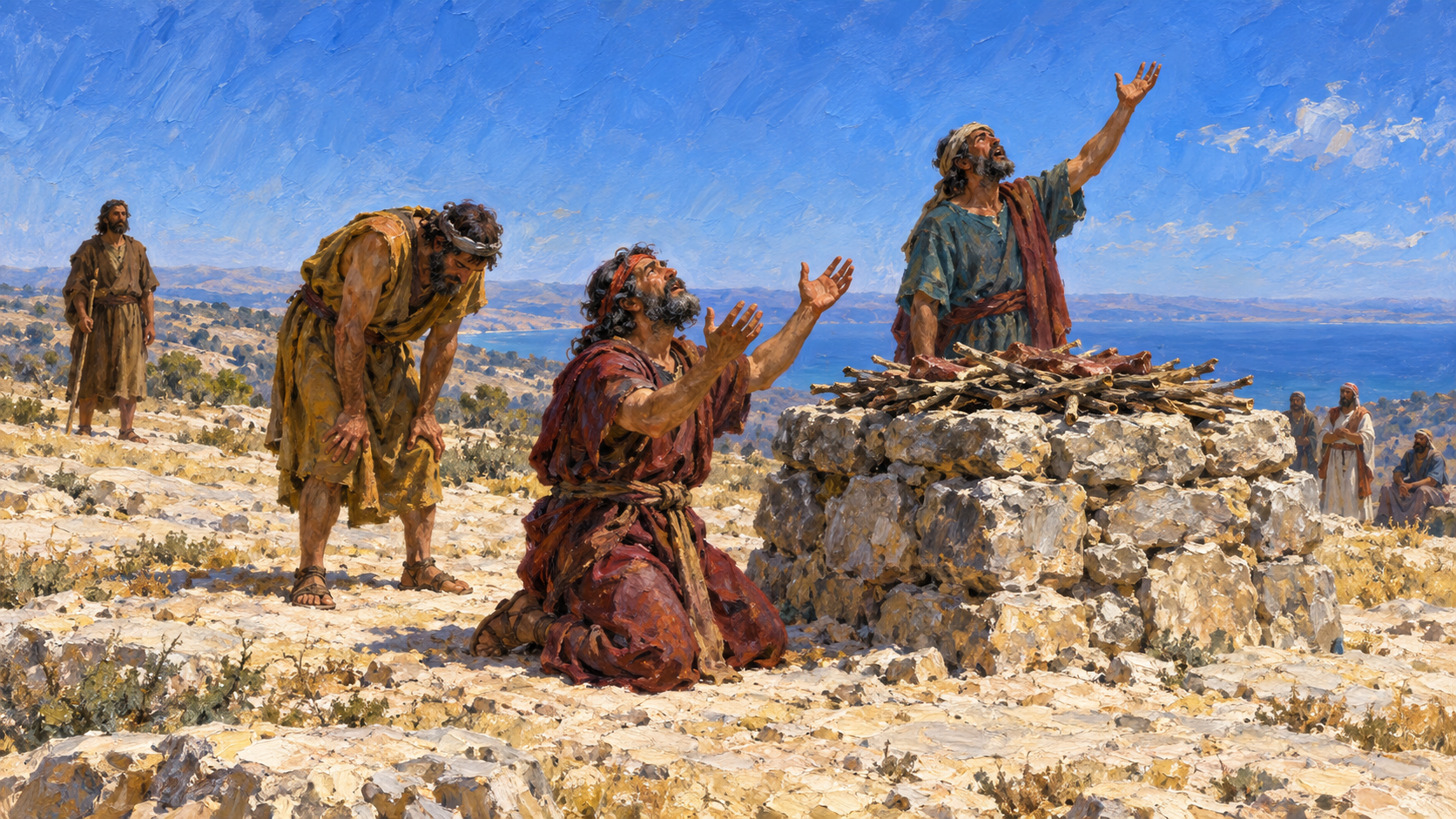
Israel repeatedly turned to Baal even though the LORD had delivered them from Egypt and made a covenant with them. I want to understand that betrayal in the circumstances Scripture describes. Baal worship offered the prospect of rain, fruitful land, and acceptance among neighboring peoples. Those promises could appeal to a household worried about its next harvest, but trusting Baal meant giving another master the worship and confidence that belonged to God.
Baal Worship Was a Fight Over Who Gives Life
The Hebrew word baal can mean lord, master, owner, or husband. Its use in an ordinary relationship does not automatically refer to idolatry; the context determines what it means. The title was also attached to a false god and local forms of his worship. When Scripture speaks of “the Baals,” it can refer to those local forms, titles, or shrines. We should not assume every appearance of the word names a pagan deity, or conclude that an ordinary meaning makes Baal worship acceptable.
Baal was especially associated with storms and the rain on which agricultural fertility depended. The Metropolitan Museum’s account of Canaanite religion describes that association in the material from Ugarit. This background helps explain why drought was such a direct exposure of Baal’s supposed power. The god credited with making the land fruitful could not give rain when the LORD withheld it.
Israel’s relationship with the LORD made the choice especially serious. He had rescued them, revealed Himself to them, and forbidden them to serve other gods. Their covenant was a binding relationship with obligations, not an arrangement they could put aside whenever another religion seemed useful. The prophets described their pursuit of other gods as adultery because they were betraying the God to whom they belonged.
Why Israel Kept Turning to Baal
A promised harvest could sound more practical than a demand for exclusive faithfulness, particularly when a family feared drought or famine. Food depended on the land producing a crop. Worship directed toward securing rain therefore concerned the household’s survival as well as its religious life. These circumstances help explain the temptation without excusing the decision to forsake the LORD.
Israel also lived among peoples who served other gods. Marriages and political alliances could bring pagan worship into a household or royal court, while trade and ordinary social ties could add pressure to conform. What God had forbidden could begin to look normal simply because the surrounding people accepted it. Loyalty to the LORD required Israel to trust Him even when that loyalty kept them from fitting in.
The LORD also demanded more than a ceremony. His people were to turn from sin, do right toward others, and worship Him according to His word. Ritual could be used as an attempted substitute for that obedience. A worshiper might imagine that the right offering would secure prosperity while he continued living as he pleased. That is one reason I take these passages seriously: a religious practice can feel useful precisely because it leaves a cherished sin undisturbed.
Then the children of Israel did evil in the sight of the LORD, and served the Baals; and they forsook the LORD God of their fathers, who had brought them out of the land of Egypt; and they followed other gods from among the gods of the people who were all around them, and they bowed down to them; and they provoked the LORD to anger. They forsook the LORD and served Baal and the Ashtoreths.
Judges calls their worship evil and repeatedly says they forsook the LORD. The God they abandoned was the One who had brought their fathers out of Egypt. They were not searching for a God who had never made Himself known; they followed and bowed to the gods of the people around them after receiving His deliverance and instruction.
The resulting pattern runs through Judges. Israel’s rebellion brought oppression, they cried out, and God raised a deliverer. After relief came, the people returned to their former ways. Serving Baal did not make the nation secure. It drew them away from the LORD whose provision and protection they needed. The study on idolatry examines that transfer of worship and trust more broadly.
We can recognize similar choices without calling every modern temptation “Baal”. Family affection, useful work, and lawful government are good things in their proper place. But if I excuse dishonesty to gain wealth, defend sexual sin because I want its pleasures, or disobey God to retain someone’s approval, I am giving something else authority over my obedience. The desire for political power or personal influence can demand the same compromise. Occult practice involves a more direct appeal to forbidden spiritual powers. These are not all literally Baal worship; the connection is our willingness to seek life and blessing from another master on terms God has forbidden.
The Drought and Mount Carmel Exposed Baal
Under Ahab, Baal worship gained the open support of Israel’s throne. The king’s marriage to Jezebel, daughter of Ethbaal, king of the Sidonians, brought that influence into the royal household. Ahab then made provision for Baal worship in the capital itself.
And it came to pass, as though it had been a trivial thing for him to walk in the sins of Jeroboam the son of Nebat, that he took as wife Jezebel the daughter of Ethbaal, king of the Sidonians; and he went and served Baal and worshiped him. Then he set up an altar for Baal in the temple of Baal, which he had built in Samaria. And Ahab made a wooden image. Ahab did more to provoke the LORD God of Israel to anger than all the kings of Israel who were before him.
The altar and temple in Samaria gave the rebellion royal backing and a public place in national life. Jezebel promoted Baal worship and persecuted the LORD’s prophets. Ordinary Israelites therefore faced more than the example of pagan neighbors; the king and queen were helping establish the worship God had forbidden.
Elijah’s first recorded announcement to Ahab was that there would be neither dew nor rain except at his word. The prophet was speaking as the LORD’s servant, not claiming a private ability to control the weather. God had already warned Israel through Moses that serving other gods would bring a closing of the heavens and the loss of rain (Deuteronomy 11:16–17). This drought carried out a particular covenant warning Israel had received.
The judgment also exposed the false promise under which Baal was worshiped. If he supplied rain and fruitful harvests, why could he not provide what the land now lacked? As brooks dried and the drought continued, the supposed giver of agricultural life could do nothing. I see mercy in God’s refusal to let His people remain unchallenged in their deception, although the judgment itself involved real suffering. He was confronting their rebellion and calling them back to the One who actually supplied their needs.
And Elijah came to all the people, and said, “How long will you falter between two opinions? If the LORD is God, follow Him; but if Baal, follow him.” But the people answered him not a word.
At Mount Carmel, Elijah required the people to face the choice they had avoided. He did not present the LORD and Baal as two legitimate gods from whom Israel could select the more useful one, or ask them to add the LORD to their existing worship. If the LORD was God, they were to follow Him. Their silence left their divided allegiance exposed.
Baal’s prophets called on him from morning until noon and leaped around their altar. There was no voice and no answer. Elijah then mocked the explanations a worshiper would need to invent for a god who could not respond.
And so it was, at noon, that Elijah mocked them and said, “Cry aloud, for he is a god; either he is meditating, or he is busy, or he is on a journey, or perhaps he is sleeping and must be awakened.”
His mockery targeted Baal’s claim to be a god. Perhaps he was occupied, away, or asleep; none of those explanations could turn the silence into divine power. When Elijah’s turn came, he prayed to the LORD God of Abraham, Isaac, and Israel. He asked God to make known that He was God in Israel, that Elijah was His servant, and that He was turning the people’s hearts back again.
The LORD answered by fire, consuming the sacrifice, wood, stones, dust, and water. The people fell on their faces and confessed, “The LORD, He is God! The LORD, He is God!” Baal had been unable to answer, while the LORD had made His power plain. The rain returned afterward, as 1 Kings 18:41–45 records. James 5:17–18 later reminds us that Elijah had a nature like ours and prayed earnestly. The answer came from God, not from a special power in Elijah’s personality. The Life of Elijah follows the prophet’s ministry more fully.
The people had initially answered Elijah with silence, even though the covenant already told them whom to worship. I can avoid obedience in a similar way by speaking as though I am still deciding a question Scripture has already answered. Asking an honest question is different from refusing to act on an answer I already have.
The public confession at Carmel did not end Jezebel’s opposition. After she threatened his life, Elijah fled. In 1 Kings 19, he told the LORD that he alone was left. God answered that seven thousand in Israel had not bowed to Baal. The LORD knew the faithful people Elijah could not see.
Paul quotes God’s answer in Romans 11: “I have reserved for Myself seven thousand men.” He uses it to explain the remnant according to the election of grace, the people God preserves by His gracious work. Their refusal to bow was real obedience, but Paul did not credit their endurance to a superior ability to save themselves. God’s grace sustained them. We can remain faithful when false worship enjoys public approval without imagining that we stand by our own strength or that God has lost sight of His people.
Destroying One Idol Is Not the Same as Wholehearted Faith
Baal worship nevertheless continued in Israel. Second Kings 10 records Jehu gathering Baal’s worshipers and prophets, killing them, breaking down the sacred pillar, and demolishing the temple. The site became a refuse dump, and Scripture says Jehu destroyed Baal from Israel. This account of an Israelite king does not commission Christians to spread faith by killing people.
Scripture also refuses to treat Jehu’s destruction of Baal worship as proof of wholehearted faithfulness. He retained the sins of Jeroboam, including the golden calves, and did not take care to walk in the LORD’s law with all his heart. His zeal against Baal left another form of idolatry in place. We should assess him by the whole account rather than assume opposition to one obvious evil proves obedience in everything else.
I need to examine the same selectiveness in my own repentance. Denouncing a sin I find objectionable does not excuse the one I still find useful. If I am willing to defend a familiar compromise while condemning someone else’s rebellion, my opposition to their sin has not answered God’s call to turn from my own.
The Prophets Exposed the Horror of Covenant Betrayal
Jehu’s purge concerned the northern kingdom of Israel. Jeremiah later confronted people in Judah who burned incense to Baal while claiming the protection of the LORD’s temple.
Will you steal, murder, commit adultery, swear falsely, burn incense to Baal, and walk after other gods whom you do not know, and then come and stand before Me in this house which is called by My name, and say, “We are delivered to do all these abominations”?
Jeremiah confronted people who combined Baal worship and moral rebellion with confidence in the LORD’s temple. They stole, murdered, committed adultery, and swore falsely, then entered the house called by His name as though being there guaranteed their safety. They wanted the benefit of belonging to God while refusing His authority over their conduct. The building could not make that hypocrisy into faithfulness.
Jeremiah also identified the child sacrifice practiced at the high places of Baal.
They have also built the high places of Baal, to burn their sons with fire for burnt offerings to Baal, which I did not command or speak, nor did it come into My mind.
These were sons burned as offerings, not merely symbols or unusual religious language. The LORD declared that He had neither commanded nor spoken such a thing. The practice was a horror He rejected. A religious purpose could not make the killing righteous, however sacred the worshipers claimed their offering to be.
Hosea 2:8 had earlier exposed another part of the betrayal in Israel. The LORD had given Israel grain, new wine, oil, silver, and gold, yet the people prepared His gifts for Baal. They credited and served a false provider with what the true Provider had already supplied.
If I use my ability to speak or write to deceive people, or my influence to promote false worship, I am misusing a gift God gave me. Breath, intelligence, work, relationships, and opportunity do not become evil because we can abuse them. I need to put them to a use consistent with obedience rather than thanking God for an opportunity and then using it to defy Him.
An Idol Is Nothing, but False Worship Is Not Harmless
First Corinthians 8 says an idol is nothing in the world and there is no other God but one. Baal was never a real deity competing with the LORD. An image has no divine life or authority and cannot save the person who worships it. Paul nevertheless treats participation in pagan sacrifice as spiritually serious.
Rather, that the things which the Gentiles sacrifice they sacrifice to demons and not to God, and I do not want you to have fellowship with demons.
The absence of a real god behind the idol does not make the worship harmless. Demons receive and exploit worship directed toward false gods, and Paul refuses to let believers participate in it. They cannot share the cup of the Lord and the cup of demons. The study on demons examines the spiritual beings involved in that rebellion.
I should therefore neither fear Baal as a rival god nor treat idolatry and occult practice as innocent ceremonies. Blending false worship with devotion to the Lord does not remove the offense. Israel’s experience already showed why. Although baal could be an ordinary title, serving the Baals meant forsaking the LORD; it was not another acceptable way to worship Him. Carmel exposed the difference between their objects of worship.
The LORD who gives life has also provided the Savior Baal could never be. Jesus Christ is the eternal Son, fully God and fully man, our only Savior and Mediator, the One through whom we can be reconciled to God. Wicked men physically tortured and punished Him, and He willingly bore the punishment for our sins in His innocent body. He shed His blood and died, completing His saving work through that blood and death before His bodily resurrection.
The Father did not punish, curse, abandon, strike, bruise, or pour wrath on Jesus. Christ was buried and rose bodily from the grave. He saves all who repent and believe in Him. We cannot cleanse our guilt through another master or cover rebellion with religious activity; we need the forgiveness He provides.
My Final Thoughts
I do not read about Baal as though Christians have discovered a forgotten god we must now fear. I read about people who gave a false master the trust and worship owed to the LORD. Their desire for provision and acceptance did not excuse that betrayal, and I need to remember it when obedience threatens something I want to keep. Elijah’s question calls for more than agreement that the LORD is God. If He is God, we need to follow Him, receive His gifts gratefully, and use what He gives in obedience to Him.