
Elijah appears in Scripture without a long introduction and immediately stands before one of Israel’s most wicked kings. Who was this prophet, and what can his life teach us about serving the living God when a whole nation has become comfortable with idols? To answer that, we need to follow Elijah through both his public victories and the private weakness that came afterward.
The main account runs from 1 Kings 16 through 2 Kings 2. Malachi 4, Luke 1, Matthew 17, Romans 11, James 5, and Revelation 11 then help us understand how the rest of Scripture remembers Elijah. Reading these passages together keeps us from treating him as a flawless hero or reducing his life to a religious slogan.
Before Elijah confronted Israel on Carmel, he had depended on God for food during the drought. The LORD sent him first to the ravens at Cherith and then to the widow at Zarephath, whose son He raised. After the child was raised, Elijah returned to Israel for the confrontation on Carmel. There God exposed Baal and turned the people’s attention back to Himself. Yet Elijah later collapsed in fear and traveled to Horeb, where God corrected his belief that he was alone and gave him Elisha as a successor. I want to keep that whole course of his life in view as the New Testament helps us understand his ministry in relation to Christ.
Ahab, Baal, and the Word of the Living God
Elijah appeared during one of the darkest periods in Israel’s history. The nation had split into two kingdoms. David’s descendants ruled Judah in the south from Jerusalem, while other dynasties ruled the northern kingdom usually called Israel in Scripture. Ahab ruled that northern kingdom from Samaria, and his evil surpassed that of every king who had ruled there before him.
Ahab married Jezebel, whose father Ethbaal ruled the Sidonians, and followed her into Baal worship. With the royal household’s organized support, idolatry was promoted publicly and enforced aggressively. We need to remember why this could not be treated as a harmless private preference. Israel belonged to the LORD by covenant. He had delivered His people from Egypt and given them His law before planting them in the land. That law warned against following other gods, and the political separation from Judah had not released the northern kingdom from its responsibility to Him.
Baal was promoted as a storm and fertility god who supposedly supplied rain, so his worshipers looked to him for crops and material abundance. Elijah’s announcement of drought directly challenged that claim. God did not meet Baal as an equal on neutral ground. If the LORD withheld rain, the idol could not supply what its worshipers expected.
Scripture introduces Elijah as a Tishbite from Gilead without telling us much else about his background. We aren’t told how he was trained or how he gained access to Ahab’s court. What gives his words authority is the God who sent him, rather than an impressive set of credentials.
Elijah’s sudden appearance before Ahab presents him as a man sent by God, but his boldness did not make him self-sufficient. He prayed earnestly, depending on the LORD who supplied the power and gave his words authority. The prophet who stood before a king still had to learn that dependence in private. Even after calling down fire, he would run in fear. I can understand why James describes him as a man with a nature like ours.
And Elijah the Tishbite, of the inhabitants of Gilead, said to Ahab, “As the LORD God of Israel lives, before whom I stand, there shall not be dew nor rain these years, except at my word.”
1 Kings 17:1, NKJV
Elijah stood physically before Ahab, yet he said he stood before the LORD God of Israel. His wording sounds like that of a servant attending a king and living under his command. Ahab wore the crown in Samaria, but Elijah answered to a higher throne. His courage came from knowing whom he served, not from enjoying conflict. God had given him a true word, and the king’s anger could not overturn God’s authority.
Remembering whom Elijah served makes me think about where my own courage should come from. I don’t need to perform for people or work myself into anger to speak the truth. I can speak humbly because the authority belongs to God’s word. Elijah’s confidence rested in the living God rather than the force of his personality.
Elijah’s Hebrew name, Eliyahu, is commonly understood to mean “My God is Yahweh” or “Yahweh is my God.” That confession of allegiance fits the question his ministry confronted: who is truly God? Israel was not lacking religion. It was mixing worship of the LORD with worship of rivals. Understanding his name helps us recognize that conflict, though I would not use it to make claims beyond what the text says.
Elijah’s warning of drought followed what God had already said through Moses. He was announcing the enforcement of Israel’s covenant rather than introducing new theology. The LORD had warned what would happen if His people turned to other gods.
Take heed to yourselves, lest your heart be deceived, and you turn aside and serve other gods and worship them, lest the LORD’s anger be aroused against you, and He shut up the heavens so that there be no rain, and the land yield no produce, and you perish quickly from the good land which the LORD is giving you.
Deuteronomy 11:16-17, NKJV
The drought brought judgment for Israel’s rebellion, but there was mercy in exposing Baal’s lie before it completely destroyed the nation. Idols promise life and may offer a feeling of security or an illusion of control over the future. Baal could deliver none of it. The heavens and every field belonged to the LORD, so Elijah’s announcement held because the living God stood behind it.
Cherith, Zarephath, and Hidden Dependence
After Elijah spoke to Ahab, the LORD sent him away to hide by the Brook Cherith. I might expect such public courage to lead to a larger platform, but God directed him into obscurity.
Then the word of the LORD came to him, saying, “Get away from here and turn eastward, and hide by the Brook Cherith, which flows into the Jordan. And it will be that you shall drink from the brook, and I have commanded the ravens to feed you there.”
1 Kings 17:2-4, NKJV
At Cherith, God protected Elijah while teaching him to depend on Him. Before standing before Israel on Carmel, the prophet received his daily bread in a hidden place. His public courage would be supported by what he learned there in private.
I notice that God used ravens to feed Elijah even though they were unclean birds under the Law. His holiness had not changed, and His law was not careless. His provision was not limited to the means people would choose. God’s provision may humble His servant and look strange to those watching.
Each morning and evening the ravens brought bread and meat, while the brook supplied water. Elijah had no storehouse and no guarantee that the brook would last for years. He received what he needed day by day. That helps me understand how faith learns obedience: receiving enough for today still leaves me dependent on God tomorrow.
The time at Cherith prepared Elijah for Carmel by teaching him that he could not create the result. His part was to listen to the LORD and obey, receiving what only God could provide. That private dependence keeps public service from becoming a performance centered on the servant.
When the brook dried up, Elijah was still obeying God. I need to remember that before treating a lost means of provision as proof of disobedience or rejection. Sometimes God brings one provision to an end because He is directing His servant toward the next place of obedience.
God next sent Elijah to Zarephath in Sidon, the same region Jezebel came from. The location was deliberate. Although she had become Baal’s chief promoter in Israel, the LORD provided for His prophet in the region associated with Baal’s strength. The idol could not defend its supposed territory against Him.
Then the word of the LORD came to him, saying, “Arise, go to Zarephath, which belongs to Sidon, and dwell there. See, I have commanded a widow there to provide for you.”
1 Kings 17:8-9, NKJV
Elijah arrived to find a widow gathering sticks for what she believed would be her last meal. With only a handful of flour and a little oil, she appeared to have nothing to offer him. Her need was desperate, yet this was the person God had sent him to.
Elijah told her not to fear because the LORD God of Israel had promised that her flour and oil would last until He sent rain. She would receive daily provision, not luxury, in a place where Baal was powerless. As at Cherith, God spoke and His servant responded before seeing how the provision would come. I cannot turn that into a way of controlling God. It shows me what trusting Him involves when obedience feels costly and the visible supply seems too small.
The widow was a Gentile outside Israel in Sidonian territory. Jesus later referred to her when He rebuked Nazareth’s unbelief in Luke 4. That helps me see how far God’s mercy reached without forgetting that He remained the God of Israel. Israel’s unbelief could not confine Him, and neither a national border nor a false god’s claim to a region could prevent Him from acting.
Then the widow’s son died, bringing grief into the house where God had provided each day’s food. She expressed her grief honestly. Elijah carried the child to the upper room and cried out to the LORD for his life, depending on God again after announcing the drought and receiving His provision.
And he stretched himself out on the child three times, and cried out to the LORD and said, “O LORD my God, I pray, let this child’s soul come back to him.” Then the LORD heard the voice of Elijah; and the soul of the child came back to him, and he revived.
1 Kings 17:21-22, NKJV
The LORD heard Elijah’s prayer and restored the child’s life. Elijah had no independent power over death. Through that answer, God confirmed His word, and the widow confessed that Elijah was a man of God who spoke the LORD’s truth.
The Hebrew word translated “soul” is nephesh, which can refer to life, a person, or the living self according to context. Here in 1 Kings 17, the child’s life returned and he revived. Understanding the word in that setting keeps us focused on God’s authority over life and death. I would not import the Greek idea of an inherently immortal soul into it or use it to argue for soul sleep.
Mount Carmel and the End of Divided Worship
After many days, the LORD sent Elijah back to Ahab during a severe famine. Ahab accused him of troubling Israel, but Elijah refused the charge. The nation’s trouble came from Ahab abandoning the LORD’s commands and following the Baals, rather than from the prophet who delivered God’s word.
On Mount Carmel, Elijah confronted Israel with its divided loyalty. The people were trying to worship the LORD while continuing to worship Baal. Whatever we remember about the fire, we need to understand why the nation was gathered there. God was calling His people to decide whom they would follow, not providing religious entertainment.
And Elijah came to all the people, and said, “How long will you falter between two opinions? If the LORD is God, follow Him; but if Baal, follow him.” But the people answered him not a word.
1 Kings 18:21, NKJV
The Hebrew verb translated “falter” is pasach, which can describe limping, hesitating, or moving unevenly. Elijah used that picture to describe Israel’s unstable loyalty, as though the nation were limping from one side to the other. I cannot call that careful balance when God’s word exposes it as unfaithfulness to His covenant.
The people gave no answer. Divided worship may have felt comfortable or familiar, allowing them to keep old habits without admitting they had turned from the LORD. Elijah’s question left them without that excuse. If the LORD was God, they had to follow Him. There was no faithful middle ground.
Elijah and Baal’s prophets would each prepare a sacrifice without lighting it. The One who answered with fire would show that He was God. Baal’s prophets cried out from morning until noon, leaping around the altar and cutting themselves with increasing intensity. Yet nothing happened. No voice answered because no one was listening.
Elijah’s words against Baal are sharp, but the idol’s silence is the main point. Religious frenzy cannot create reality, and sincerity cannot turn an idol into the living LORD. Baal does not answer because Baal is not God.
Elijah repaired the LORD’s altar with twelve stones, calling Israel back to the God of Abraham, Isaac, and Israel. The political division had not broken God’s covenant claim on the nation. All twelve tribes still belonged under His authority.
And it came to pass, at the time of the offering of the evening sacrifice, that Elijah the prophet came near and said, “LORD God of Abraham, Isaac, and Israel, let it be known this day that You are God in Israel and I am Your servant, and that I have done all these things at Your word. Hear me, O LORD, hear me, that this people may know that You are the LORD God, and that You have turned their hearts back to You again.”
1 Kings 18:36-37, NKJV
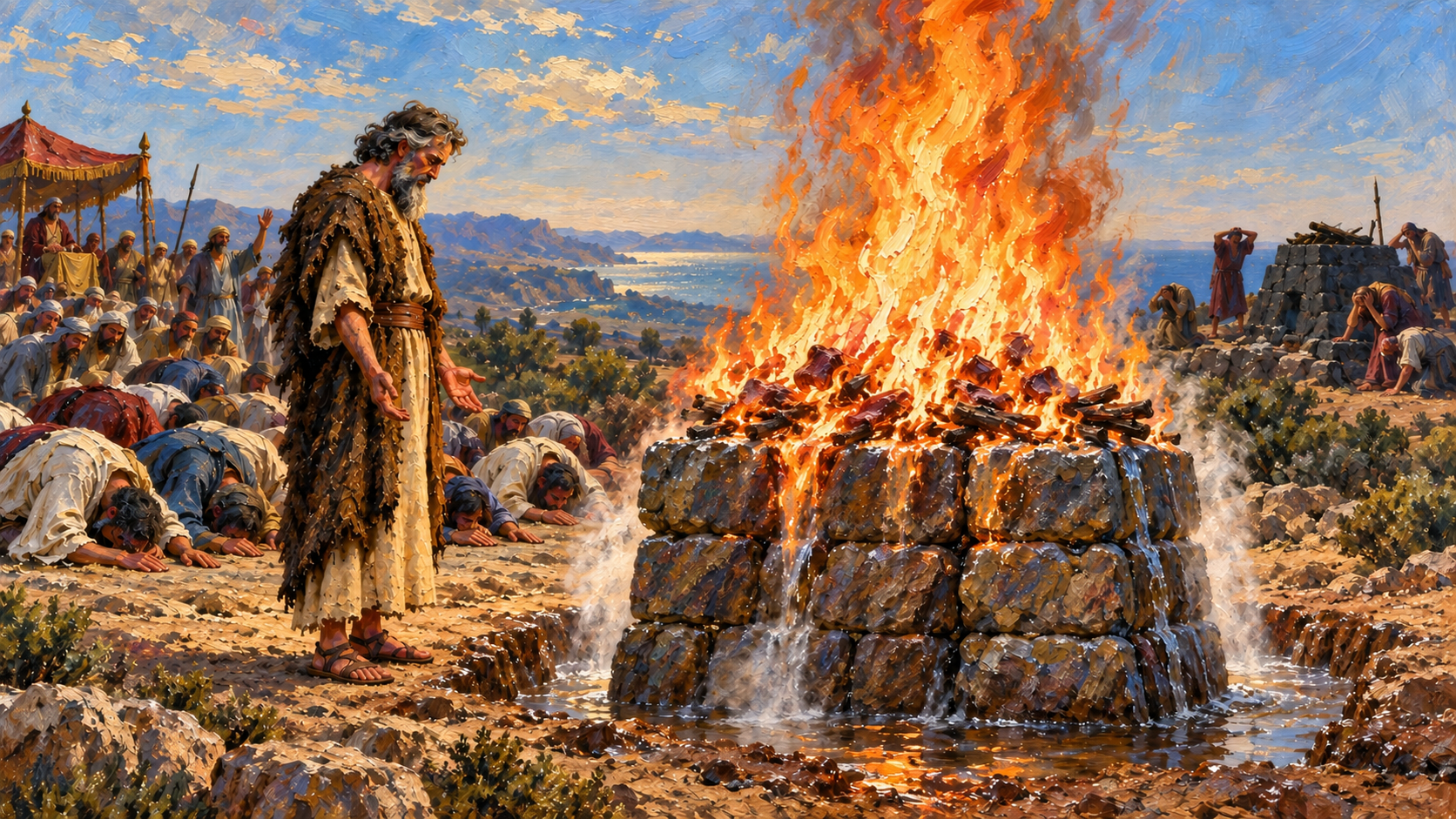
Elijah’s short prayer asked God to reveal Himself to Israel and confirm that His servant had acted at His word. He was not seeking fame. The fire consumed the sacrifice with the wood beneath it, then even the stones and surrounding dust before the water disappeared. The people fell on their faces and confessed that the LORD alone was God.
Elijah’s request explains what he wanted the answer to accomplish: “that this people may know that You are the LORD God, and that You have turned their hearts back to You again.” I don’t see him competing to prove he had stronger spiritual gifts than Baal’s prophets. He was asking God to regain the attention of His covenant people. The fire exposed Baal’s lie and confirmed Elijah’s message, calling Israel back to the LORD they had forgotten.
James 5 uses Elijah’s prayer to teach earnest dependence on God. Elijah could neither produce the fire nor control the rain. He prayed according to the word he had received, and the LORD acted. That helps me keep prayer in its proper place. I come as a servant to the One who rules, without performing for others or trying to force His hand.
This is also why Elijah’s humanity should encourage us without turning his experience into a formula. James does not promise that every believer can announce a national drought or call down fire. He shows that earnest prayer is offered by ordinary people who depend upon the same living God. A broader study of that dependence is available in Prayer in the Bible.
After the LORD answered by fire, Elijah ordered Baal’s prophets to be seized and executed. We need to understand that judgment within Israel’s Old Testament covenant and national life. These prophets were leading God’s covenant people into rebellion against Him, so they were not treated as harmless private teachers.
Deuteronomy had already warned Israel about false prophets and idolatry. Elijah’s action is neither personal revenge nor a pattern for church practice. The church is not the civil government of Old Testament Israel, so Christians do not carry out civil penalties against false teachers. Instead, Scripture is used to test doctrine, and the church rejects teaching that contradicts it. Faithful leaders protect the flock by telling the truth, while believers answer error by continuing to proclaim the gospel.
Modern discomfort should not make us soften what the passage says about idolatry. False worship destroys because it lies about God and corrupts those who embrace it. Carmel displays God’s mercy by exposing Baal’s emptiness before the whole nation. It also shows His seriousness in judging the prophets who had led Israel into darkness.
After Carmel, Elijah prayed and the rain returned. The LORD had shown His authority over both fire and rain, neither of which Baal could control. When James recalls this, he makes clear that Elijah belonged to the same humanity as we do.
Elijah was a man with a nature like ours, and he prayed earnestly that it would not rain; and it did not rain on the land for three years and six months. And he prayed again, and the heaven gave rain, and the earth produced its fruit.
James 5:17-18, NKJV
James directs my attention to God hearing and answering an ordinary man’s prayer. Elijah did not possess a higher kind of humanity. Knowing that helps me understand what followed when Jezebel threatened him.
Fear, Horeb, and the Preserved Remnant
When Jezebel heard what had happened on Carmel, she vowed to have Elijah killed. The man who had confronted Ahab and Baal’s prophets became afraid and fled south through Judah into the wilderness. Sitting under a broom tree, he asked God to take his life. Scripture does not present that request as spiritual maturity. Fear and disappointment had narrowed his view after the public victory, and he was now isolated and physically exhausted.
An angel gave Elijah food and water and let him sleep, then fed him again before he continued his journey. I notice how practical God’s care was. He dealt with Elijah as a whole person whose exhaustion and physical weakness were real. Isolation often makes fear worse, and a worn servant may need rest and food before he can hear correction clearly.
God’s care for Elijah should make me take a suffering person seriously. Rather than shame him or leave him alone, I should respond with compassion.
God’s patience did not excuse Elijah’s unbelief, but neither did He discard His servant because he was afraid. He sustained Elijah before questioning his perspective. After correcting him, the LORD gave him a new assignment and sent him forward.
Elijah traveled to Horeb, the mountain of God where Moses had received the Law. The LORD asked him, “What are you doing here, Elijah?” Elijah answered by describing his zeal and Israel’s abandonment of the covenant. The nation had torn down God’s altars and killed His prophets, and he believed he was the only one left.
A powerful wind tore at the mountain, followed by an earthquake and then fire. Scripture says the LORD was not in any of those dramatic signs. After them came a still small voice.
and after the earthquake a fire, but the LORD was not in the fire; and after the fire a still small voice.
1 Kings 19:12, NKJV
The Hebrew phrase qol demamah daqqah describes a sound or voice of thin quietness, emphasizing the restraint after those dramatic signs. I understand that quietness in light of the word God had already given Elijah. His ministry had depended on God’s word from the beginning, so this phrase does not teach us to place private impressions above Scripture. At Horeb, the LORD showed that His work was not confined to public signs. He could quietly correct and comfort His servant before directing his next steps.
Elijah believed he was alone, but God had preserved seven thousand in Israel who had not bowed to Baal. Paul uses this in Romans 11 to explain that God preserves a remnant by grace. Discouragement can leave a tired servant judging everything by what he can see, while God knows far more than that limited view allows.
Yet I have reserved seven thousand in Israel, all whose knees have not bowed to Baal, and every mouth that has not kissed him.
1 Kings 19:18, NKJV
Elijah’s weakness does not cancel his faithfulness, and his faithfulness does not make him self-sufficient. Scripture lets us see the whole man under the care of the living God. The prophet who prayed boldly on Carmel is the same man who reached Horeb exhausted and afraid.
The seven thousand make me cautious about judging God’s work only by what I can see publicly. Elijah had heard Israel’s confession on Carmel, yet afterward he felt that nothing lasting remained. God answered without flattering him or agreeing with his despair. He had preserved people Elijah could not see, and His purpose went beyond what the prophet knew. His faithfulness did not depend on Elijah’s emotional state.
Elisha, Wicked Kings, and Elijah’s Departure
God had more work for Elijah beyond the broom tree and Horeb, including calling Elisha to follow him. Elijah threw his mantle over the younger man, who became his follower. By bringing Elisha alongside him, God showed that the work would continue beyond Elijah’s strength and earthly life.
Elijah had felt abandoned, but God showed him a preserved remnant and now raised up a successor. The prophet was neither alone nor responsible for carrying the work forever. Elisha’s call does not mean Elijah disappears from the account immediately, however. He still has difficult words to carry to Israel’s rulers.
Elisha responded to the summons represented by Elijah’s mantle by leaving his former work and following him. He learned while they served together, before taking responsibility for the work himself. I see more here than God replacing an exhausted worker. He was preparing another servant and allowing Elijah to take part in that preparation.
In 1 Kings 21, Elijah faced Ahab again after Jezebel arranged Naboth’s murder. Naboth had refused to sell his ancestral vineyard because it was an inheritance governed by God’s law, rather than property a powerful ruler could simply demand. Through false witnesses and a public execution, Jezebel cleared the way for Ahab to seize it.
Elijah met Ahab with God’s judgment as the king went down to claim the vineyard. The LORD who exposed Baal also saw the corruption of justice. His concern extended beyond public worship ceremonies to false testimony and the use of power to murder a weaker man and steal his inheritance.
Ahab humbled himself, and God delayed part of the announced disaster until his son’s days. That was real mercy, though it did not erase what Ahab and Jezebel had done. I also cannot treat his temporary humiliation as proof of lasting faith. He later rejected the prophet Micaiah’s warning and died. No king stands beyond God’s authority, yet God notices even a wicked king’s humbling of himself.
After Ahab’s son Ahaziah was injured in a fall, 2 Kings 1 records another confrontation. Instead of seeking the LORD, the king sent messengers to ask Baal-Zebub, the god of Ekron, whether he would recover. Elijah intercepted them and asked whether they were consulting a foreign idol because there was no God in Israel.
Two military captains approached Elijah arrogantly with fifty men each, and fire from heaven consumed them. The third captain came humbly and pleaded for his men’s lives. The distinctive Angel of the LORD, a pre-incarnate appearance of Christ, told Elijah to accompany him. Elijah went and repeated God’s word to the king without fear.
As at Carmel, this judgment belongs to a unique prophetic and Old Covenant setting. It is not permission for Christians to call down violence upon opponents. Jesus made that distinction plain when James and John wanted to imitate Elijah against a Samaritan village. He rebuked them in Luke 9:54-56. The church advances through truthful witness and patient endurance as it proclaims the gospel. 2 Kings 1 still confronts every generation with the central question: why seek life and guidance from a powerless substitute when the living God has spoken?
In 2 Kings 2, Elijah was taken into heaven by a whirlwind as chariots and horses of fire appeared. Elisha saw it and took up Elijah’s mantle before crossing the Jordan. The mantle visibly showed that the same God would now work through Elisha. It had no magical power of its own, and neither prophet possessed power apart from the LORD.
Elijah’s being taken up is extraordinary, but it should not be equated with Christ’s ascension. Jesus ascended as the incarnate Son after finishing the work of redemption. He had shed His blood and died before rising bodily from the grave. He then sat down at the right hand of the Father. Elijah is a servant taken by God, while Christ is the Lord who reigns.
Elijah’s Later Witness and the Supremacy of Christ
Malachi had promised Elijah before the great and dreadful day of the LORD. In Luke 1:17, the angel told Zacharias that John the Baptist would go before the Lord “in the spirit and power of Elijah.” John was not Elijah reincarnated in another body. He received a prophetic calling like Elijah’s, confronting sin and calling Israel to repentance as he prepared the Lord’s way. The New Testament remembers Elijah while keeping Christ at the center.
Like Elijah, John confronted rulers and called Israel away from sin while serving outside the centers of comfortable religious power. Those similarities do not erase the differences between them. John’s great task was to identify the Lamb of God and prepare people for the Messiah’s arrival. The related study John the Baptist follows that calling in greater detail.
Jesus confirms that John fulfilled the Elijah expectation for those willing to receive it, while making clear that John was not Elijah returned in another body. Scripture never teaches reincarnation. It promises a future resurrection followed by God’s judgment. People therefore need to be reconciled to God through Christ in this life.
When Elijah appeared with Moses at the transfiguration, the Father directed the disciples’ attention to His Son. Glorious as the scene was, He did not tell them to place their hope in Moses or Elijah.
While he was still speaking, behold, a bright cloud overshadowed them; and suddenly a voice came out of the cloud, saying, “This is My beloved Son, in whom I am well pleased. Hear Him!”
Matthew 17:5, NKJV
Moses and Elijah bore witness as representatives of the law and the prophets, but Jesus is the beloved Son. When the disciples lifted their eyes, they saw Jesus only. That helps me appreciate Elijah without making him the focus of my hope. His witness points beyond himself to Christ.
Revelation 11 describes two witnesses whose ministry strongly echoes Moses and Elijah. Fire accompanies their testimony, and they can shut heaven so that no rain falls. Their authority to strike the earth with plagues strengthens the comparison. These echoes are real, but Revelation never names the witnesses. I would not turn a possible identification into a doctrine God did not state. The text assures us that God will preserve faithful witnesses whose ministry displays His power in a rebellious world.
The authority of these witnesses belongs to God, just as it did in Elijah’s ministry. A fuller treatment of the passage and the possible identities is available in The Two Lampstands and Olive Trees.
Elijah’s life finally presses us toward the gospel. The God who sent Elijah against Baal has sent His Son to save sinners. Jesus is not one prophet among many. He is the eternal Son, fully God and fully man. He lived without sin before being crucified and buried.
On the cross, Jesus physically bore the punishment for our sins in His innocent body. Wicked people tortured Him and shed His blood before He died. The Father did not punish His Son or pour wrath upon Him. He never cursed or abandoned Jesus, and He was not the one who struck and bruised Him. Christ willingly offered Himself and paid the price sinners could never pay. God then raised Him bodily from the grave. Every idol fails, but Christ saves.
Christ died for the whole world, and God’s offer of salvation is genuine. A person can resist that offer and finally reject the Savior. God calls each of us to repent and trust in Jesus Christ. The person who believes receives forgiveness and is born again as a new creation. The Holy Spirit comes to dwell within that believer and seals him.
Because salvation rests upon Christ’s finished work and God’s promise, the true believer is eternally secure. That security is never permission for lawlessness, and a shallow profession by itself does not prove that someone has truly been born again. Saving faith turns from false refuges to the living Christ and begins a changed life under His lordship.
My Final Thoughts
After following Elijah from Ahab’s court through the hidden years and the public conflict on Carmel, I do not see a flawless hero who carried God’s work by his own strength. I see a real servant who could stand boldly before a king and later collapse in fear, while the living LORD remained faithful in both places. God exposed the emptiness of idols and taught Elijah to depend upon Him. When exhaustion narrowed the prophet’s view, the LORD corrected him and showed that His work would continue through others. Elijah’s life calls us to stand before God with undivided loyalty, but the transfiguration tells us where our hope must finally rest: not in the prophet, but in Jesus Christ, the beloved Son whom we are commanded to hear.