
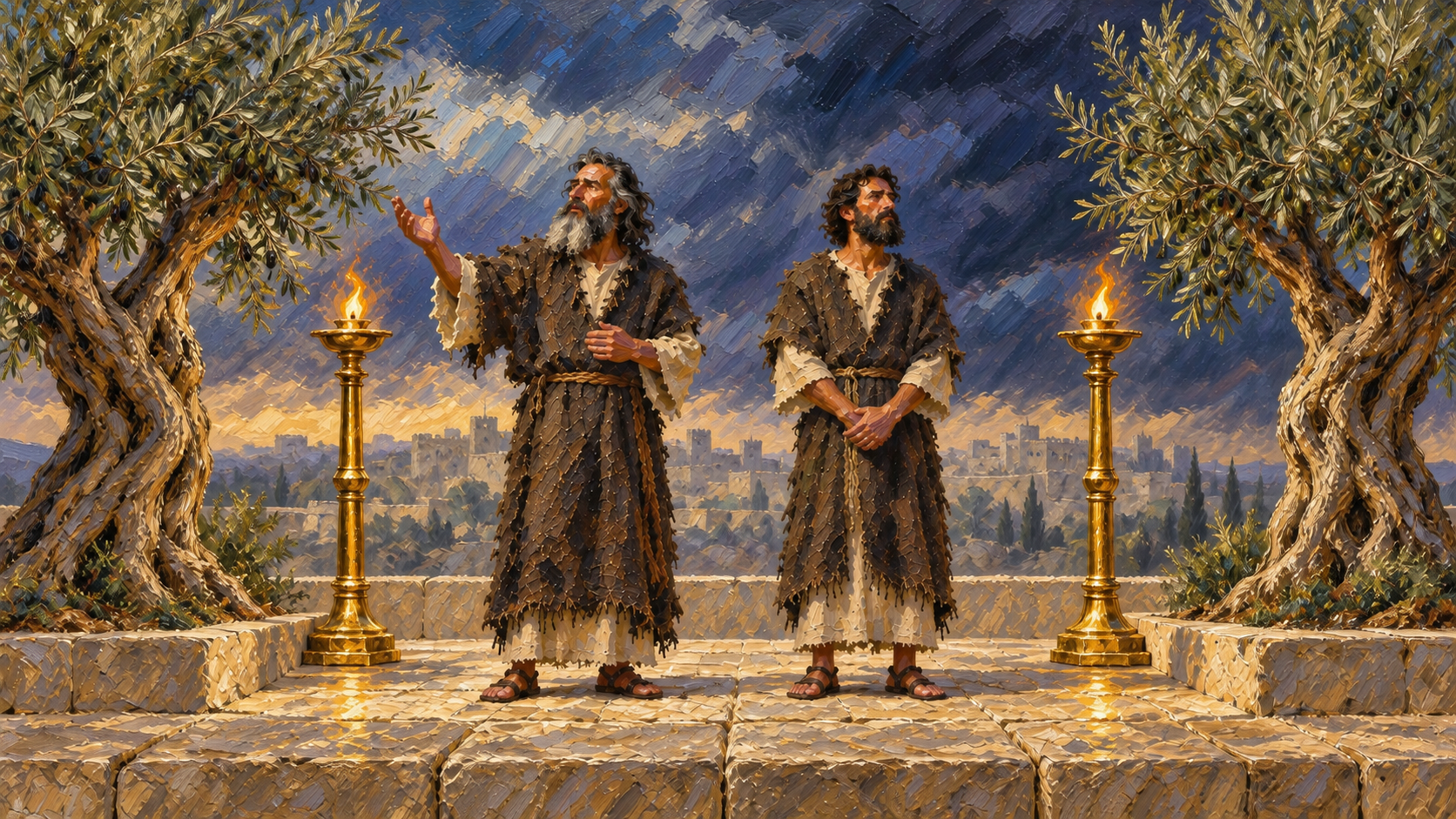
To understand the two lampstands and olive trees in Revelation 11, I need to look back at Zechariah 4. There, God explains how His work moves forward by His Spirit. John applies that picture to two future witnesses during the Tribulation, so reading the passages together helps us understand both the symbols and the real events without going beyond what Scripture tells us.
Zechariah’s Lampstand and God’s Supply
Zechariah ministered after the Babylonian exile, decades after Babylon had conquered Jerusalem and destroyed Solomon’s temple. Many people from Judah had been carried away. When Persia defeated Babylon, King Cyrus allowed the Jewish exiles to return and rebuild. Ezra 1-6 records their return and the opposition they encountered. Although they laid the temple’s foundation, years of resistance and discouragement left the work unfinished.
The returned community still lived under Persian rule, without the independence or the wealth and strength Judah had known in Solomon’s day. Zerubbabel was the governor leading the rebuilding, while Joshua the son of Jehozadak served as high priest in the restored priestly ministry. Haggai and Zechariah called the people to resume the work God had given them.
That setting helps me keep God’s promise in Zechariah 4 connected to the work He had actually assigned. He was restoring worship in Jerusalem and strengthening Zerubbabel to lead a small remnant whose apparent weakness would not defeat His purpose. I cannot turn that promise into assurance that any goal I choose will succeed.
For who has despised the day of small things? For these seven rejoice to see The plumb line in the hand of Zerubbabel.
With a weary remnant and leaders under pressure, a half-built temple could easily seem an unlikely place for God’s glory. But the Lord knew how the work would end and how He would supply what He had commanded. Its success did not depend on the crowd’s confidence in those small beginnings.
I see a similar dependence in Revelation 11. The two witnesses will serve in a world hostile to God, where their position will look anything but safe. What determines their ability to serve is God’s sending and provision, not the world’s approval.
Zechariah saw a solid gold lampstand with a bowl above its seven lamps. Pipes carried oil to the flames, and two olive trees stood beside the structure. Instead of a priest repeatedly refilling the lamps by hand, oil flowed from the trees through the channels. The vision included the lampstand’s continuing supply.
Now the angel who talked with me came back and wakened me, as a man who is wakened out of his sleep. And he said to me, “What do you see?” So I said, “I am looking, and there is a lampstand of solid gold with a bowl on top of it, and on the stand seven lamps with seven pipes to the seven lamps. Two olive trees are by it, one at the right of the bowl and the other at its left.”
A lampstand holds up light but cannot create it from within itself. Its lamps need a continuing supply of oil. That helps me understand what God was showing the discouraged builders: human confidence and a large crowd could not sustain His work. Neither material resources nor political safety could take the place of the Lord who gave the light and supplied what was needed to complete His command.
Normally, people would harvest and press olives, then collect the oil to fill their lamps. In Zechariah’s vision, the supply flowed directly and steadily from the trees. God’s servants could continue His work because He would give them what they needed.
The angel’s explanation concerned Zerubbabel and the temple he had to rebuild. Military might and civil authority had a proper place, but the usual sources of human strength could not accomplish this work in place of God’s Spirit. Careful planning was still needed, and the builders had to work with the resources available to them. Depending on the Spirit did not remove those responsibilities.
This is the word of the LORD to Zerubbabel: “Not by might nor by power, but by My Spirit,” Says the LORD of hosts.
I need that setting when I read this often-quoted verse. Zerubbabel was still responsible to lead, and the builders had to obey God by doing the work. Dependence on His Spirit meant carrying out His command with His help, not becoming passive and leaving the temple unfinished.
The Hebrew ruach, translated Spirit, can mean wind or breath in other passages. Here in Zechariah 4:6, the LORD says, “My Spirit.” He is describing His own divine enabling, not an impersonal force or a human mood. The temple’s completion would depend on God supplying His servants, rather than on human strength controlling the outcome.
That same provision helps me understand the witnesses in Revelation 11. The beast will hate them, and the world will rejoice when they die, yet their ministry does not depend on the world’s permission. The God who supplied Zechariah’s lampstand also supplies these witnesses through extreme opposition.
The Two Anointed Ones and Public Witness
When Zechariah asked again about the two olive trees, the answer identified them as two anointed ones standing beside the Lord of the whole earth.
So he said, “These are the two anointed ones, who stand beside the Lord of the whole earth.”
In Zechariah’s setting, I understand these two servants most naturally as Zerubbabel and Joshua. Zerubbabel descended from David, but he was serving as governor rather than reigning as king. He carried civil responsibility for rebuilding, while Joshua the high priest carried responsibility for the restored worship of the returned people. Neither man was the Messiah, though their offices pointed forward to Him. In Christ, kingship and priesthood meet perfectly: He is the rightful King and the perfect High Priest.
The Hebrew expression translated “anointed ones” carries the idea of oil, which fits the vision’s emphasis on consecration and supply. Zerubbabel and Joshua were not independent sources of life. They stood beside Him as servants whom He appointed and supplied.
I don’t want to overlook the title the Lord of the whole earth. God was addressing a local need in a weakened Jerusalem, but His authority still extended everywhere. John deliberately draws on that language in Revelation 11:4, where the two witnesses stand before the God of the earth. The weakness of His people does not diminish His reign.
A lampstand puts light where people can see it. That makes me consider whether cowardice or compromise could lead me to hide truth God has made clear. I should not bury it beneath my own confusion either. Jesus used the lampstand to explain that His people are meant to bear a visible witness.
You are the light of the world. A city that is set on a hill cannot be hidden. Nor do they light a lamp and put it under a basket, but on a lampstand, and it gives light to all who are in the house.
We do not shine with God’s truth naturally or produce that light ourselves. Christ is the true Light, and we bear witness to Him. Just as a lampstand makes light visible, a witness makes the truth known.
In Revelation 1, Jesus identifies the seven lampstands as the seven churches and walks among them. They bear visible witness under His authority and remain accountable to Him.
The mystery of the seven stars which you saw in My right hand, and the seven golden lampstands: The seven stars are the angels of the seven churches, and the seven lampstands which you saw are the seven churches.
So I need to ask which witnesses each passage describes. In Revelation 1, the lampstands are churches; in Revelation 11, they are the two witnesses. The shared image conveys visible testimony under God’s authority without making the people represented in both passages identical.
The Two Witnesses in Revelation
In Revelation 11, John describes the measuring of the temple and the trampling of the holy city for forty-two months. The Lord then grants authority to His two witnesses, who prophesy in sackcloth for 1,260 days.
And I will give power to my two witnesses, and they will prophesy one thousand two hundred and sixty days, clothed in sackcloth. These are the two olive trees and the two lampstands standing before the God of the earth.
I read this in a futurist, pre-Tribulation, premillennial framework. The church is not appointed to wrath and will be gathered to Christ before the coming hour of trial. Revelation 11 belongs to the future Tribulation period, not to ordinary church history and not to a merely symbolic description of all Christian witness.
The symbols help us understand two real men and their ministry. They prophesy for a measured time, wearing clothing that expresses the tone of their message, and their power has real consequences for their enemies. They also have physical bodies that are killed before God raises them and calls them to ascend. None of that disappears because John describes them through symbols.
Sackcloth is associated in Scripture with mourning and the humility of repentance. It suits prophets addressing a rebellious world at such a serious hour. These men have not come to entertain their hearers.
The 1,260 days should be read alongside Revelation’s other time markers. Revelation 11:2 speaks of forty-two months, while the following verse gives the same period in days. Using the prophetic pattern of thirty-day months, both expressions describe three and a half years. Revelation 12:6 repeats the 1,260-day measurement, and Revelation 12:14 describes the same span as “a time and times and half a time.” Revelation 13:5 then connects forty-two months with the beast’s authority.
Those repeated measurements reach back to Daniel. Daniel 9:24-27 describes seventy prophetic weeks appointed for Daniel’s people and Jerusalem. The final week is a seven-year period, and its covenant is broken in the middle, leaving a final half of three and a half years. Daniel 7:25 and 12:7 use the matching expression “a time and times and half a time.” Taken together, these passages provide the biblical framework for a literal seven-year Tribulation and its especially severe final half, often called the Great Tribulation. Revelation 11 belongs within that future sequence.
The measured time reassures me that the world does not decide when their ministry ends. God appoints the period of their prophecy, and their enemies cannot shorten it. The beast cannot kill them until their testimony is finished.
Their security rests in God’s rule over the length and purpose of their work, not in bodies that cannot be harmed. I find encouragement in that distinction. Only when God says their testimony is finished is the beast allowed to overcome them.
God gives the witnesses authority with deadly consequences for those who try to harm them. They can shut heaven so that no rain falls during their prophecy. They also have power to turn water to blood and strike the earth with plagues.
And if anyone wants to harm them, fire proceeds from their mouth and devours their enemies. And if anyone wants to harm them, he must be killed in this manner. These have power to shut heaven, so that no rain falls in the days of their prophecy; and they have power over waters to turn them to blood, and to strike the earth with all plagues, as often as they desire.
These powers recall earlier prophets. Elijah announced drought in Israel, and his ministry included fire from heaven. Moses brought plagues upon Egypt, including water turned to blood. Revelation deliberately calls those ministries to mind through the authority given to these witnesses.
And Elijah the Tishbite, of the inhabitants of Gilead, said to Ahab, “As the LORD God of Israel lives, before whom I stand, there shall not be dew nor rain these years, except at my word.”
And all the waters that were in the river were turned to blood. The fish that were in the river died, the river stank, and the Egyptians could not drink the water of the river.
Those connections show me why the world cannot dismiss the testimony in Revelation 11 as a harmless religious opinion. The witnesses speak with the backing of the God who judged Egypt and answered Elijah. He still rules the whole earth.
Their authority, however, serves the assignment God gave them. Miraculous power does not make them arrogant performers, and Scripture does not present these signs as entertainment. They serve God’s testimony.
Their Identity, Death, and Public Vindication
The plagues and water turned to blood in Revelation 11 naturally raise the question of Moses, while the drought and fire recall Elijah. Whether these witnesses are Moses and Elijah is the most common question about their identity. Both men also appeared with Jesus on the mountain of transfiguration.
And behold, Moses and Elijah appeared to them, talking with Him.
I see strong reasons to consider Moses and Elijah. Together they represent the Law and the Prophets, and both appeared in glory with Christ at the Transfiguration. Their ministries match the signs in Revelation 11 more directly than those of any other proposed pair. We should give that evidence its full weight.
But Revelation 11 never says, “These are Moses and Elijah.” Scripture could have named them, as it does many other people. I can confidently recognize the deliberate echoes of their ministries without claiming certainty about their identity. Moses and Elijah remain plausible candidates rather than a settled identification we should teach as doctrine.
Others propose Enoch and Elijah because neither died in the ordinary way. They appeal to Hebrews 9:27, where men are appointed to die once and then face judgment. I don’t find that argument as strong as the parallels with Moses and Elijah’s ministries. Hebrews contrasts the ordinary human experience of death and judgment with Christ’s once-for-all sacrifice; it does not predict that every exception must return to earth and die.
The cost of their testimony becomes clear in Revelation 11 when the beast from the bottomless pit makes war against them and kills them. But notice what comes first: “When they finish their testimony.” Their enemies are allowed to act after the appointed witness is complete, so even their deaths do not interrupt God’s work.
When they finish their testimony, the beast that ascends out of the bottomless pit will make war against them, overcome them, and kill them.
Their bodies remain in the street of “the great city,” which Revelation 11:8 spiritually compares to Sodom and Egypt and then identifies as the place “where also our Lord was crucified.” That final description points to Jerusalem. The comparisons do not rename the city; they expose its spiritual condition during this rebellious hour. Sodom recalls deep moral corruption, while Egypt recalls oppression and defiance against God.
People from many nations will look at their bodies and refuse them burial, celebrating so openly that they send gifts to one another. Their response is deliberately public and international because the prophets’ testimony and judgments tormented those who dwell on the earth. Their testimony does not come from cruelty. The world hates the truth and wants to continue rebelling without being warned.
The celebration will be short. After three and a half days, God’s breath of life enters the witnesses and they stand, filling those who watch with great fear. A loud voice from heaven calls them up, and their enemies see them ascend.
Now after the three-and-a-half days the breath of life from God entered them, and they stood on their feet, and great fear fell on those who saw them. And they heard a loud voice from heaven saying to them, “Come up here.” And they ascended to heaven in a cloud, and their enemies saw them.
What catches my attention is that their enemies will see God raise them. He does more than comfort His servants privately; He shows the world that He stood behind the testimony it hated. Their death is real, but it cannot be final when God gives them life again.
The language about the breath of life recalls Scripture’s teaching that life comes from God. We depend on Him for human life, and resurrection depends on Him too. These witnesses stand again because He puts life back into them.
Having two witnesses fits Scripture’s repeated teaching that a matter is established by two or three witnesses. God gives this rebellious world a public testimony that meets His own standard for establishing a matter.
One witness shall not rise against a man concerning any iniquity or any sin that he commits; by the mouth of two or three witnesses the matter shall be established.
The world in Revelation 11 cannot honestly say it received no warning. The testimony is visible and public, given by two witnesses who stand before the God of the earth and speak under His authority.
I also see companionship in God sending two servants into such a severe ministry. Scripture often shows Him sending people together, and that kindness fits here alongside the legal principle of witnesses establishing a matter. We are not meant to bear witness in difficult circumstances in prideful isolation.
The Greek martys describes a witness, someone who gives testimony to what is true. Its later close association with people who die for their testimony fits what happens in Revelation 11, but bearing testimony remains the word’s primary meaning.
Reading the Witnesses Carefully
The vivid details in Revelation 11 need to be read in context. They do not give us permission to attach whatever meaning we choose to the witnesses.
In Revelation 11, the symbols describe prophets who serve for a measured time and face real enemies. Their physical bodies are killed, then God raises them and calls them into heaven. Calling them lampstands and olive trees explains their ministry without making the men unreal.
Moses and Elijah fit the evidence well, but I need to preserve the silence of Revelation 11 about their names. The passage also gives us no authority to identify two people living today as these witnesses.
I understand Revelation 11 within the future Tribulation sequence, not as an event already completed in the past. God supplies these witnesses to warn a rebellious world, then vindicates them in victory over the beast’s opposition.
We can be confident about what Scripture tells us while refusing to claim what it leaves unstated. That restraint expresses submission to God’s Word rather than weakness.
Faithful Witness Now
Although Revelation 11 concerns future prophecy, its teaching about witness also speaks to us now. The church is not these two witnesses, and ordinary Christians cannot claim their particular signs or timeline. Still, all who follow Christ are called to bear witness. Jesus told His disciples they would receive power when the Holy Spirit came upon them and would be witnesses to Him.
But you shall receive power when the Holy Spirit has come upon you; and you shall be witnesses to Me in Jerusalem, and in all Judea and Samaria, and to the end of the earth.
I cannot make the gospel effective by relying on my personality or cleverness. Speaking louder or pressuring a listener cannot do the Holy Spirit’s work either. Faithful witness depends on God’s supply as we abide in Christ and speak the truth. Depending on His Spirit also gives us courage to refuse demands that we change God’s message to please the crowd.
I am the vine, you are the branches. He who abides in Me, and I in him, bears much fruit; for without Me you can do nothing.
Reading Zechariah alongside Revelation helps me see that God calls His servants to faithfulness without asking them to look impressive in themselves. He supplies what their calling requires. As surely as the lampstand needs oil, we can bear fruit only by abiding in Christ.
The gospel itself must remain at the center of Christian witness. Jesus Christ is the eternal Son of God who became fully man without ceasing to be fully God. He lived without sin and willingly endured torture and crucifixion. In His innocent body He bore the punishment for our sins. He shed His blood and died before rising bodily from the dead. The Father and Son remained united in this saving work.
God’s offer of salvation is genuine for every person, though people can resist and reject it. A sinner must repent and trust Jesus Christ instead of relying on personal works. Religious activity and moral improvement cannot save. Through faith in Christ, God makes the believer new and seals him by the Holy Spirit. He is eternally secure in Christ. This security never permits lawlessness, nor should a shallow profession with no new life be mistaken for genuine faith. A faithful witness points away from himself and toward the Savior who alone can save.
My Final Thoughts
After working through Zechariah and Revelation, I believe the two witnesses are real future servants of God whose ministry will testify openly during the Tribulation. Their power does not rest in public influence or human strength. The same Lord who supplied Zechariah’s lampstand will sustain His witnesses until their appointed work is finished. Their ministry and vindication remind me that God’s Word will not be silenced, even in the darkest hour of rebellion.