
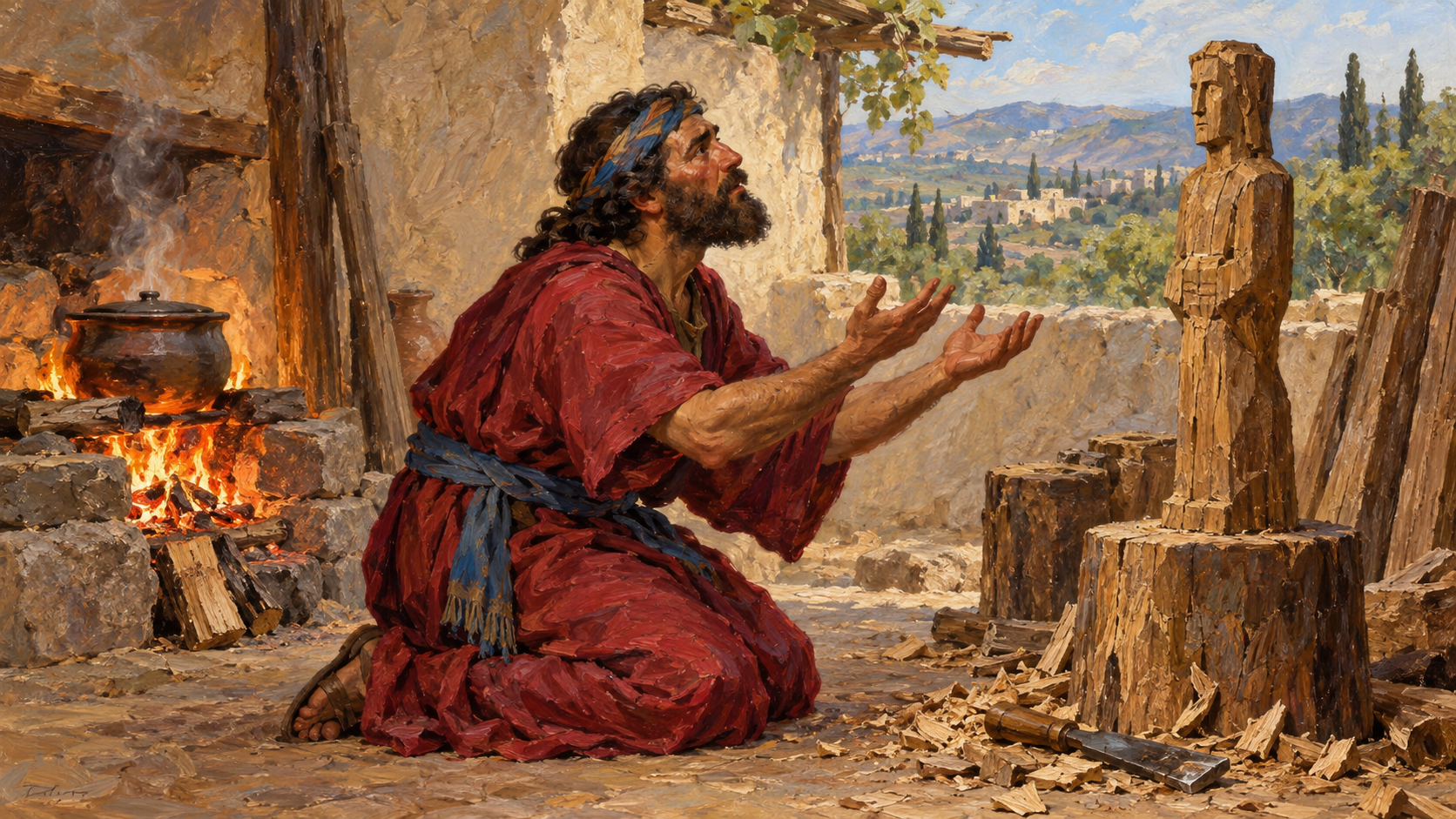
Worshiping a carved image or serving at a pagan altar is easy to recognize as idolatry, but Scripture also asks what rules the heart. I want to understand that inward allegiance as well as the visible act of worship. At the same time, we need to distinguish false worship from a strong interest, a precious gift, or the grief of losing something we love.
The Creator Alone Deserves Worship
In Exodus 20, God commanded Israel to have no rival gods. Deuteronomy 4 explains why they were also forbidden to invent a visible form for the God who spoke at Sinai. Yet Exodus 32 records how quickly they broke the command while still claiming to hold a feast to the LORD.
Isaiah 44 and Psalm 115 expose how helpless gods made by human hands really are. Ezekiel 14 goes further by showing that Israel’s leaders could carry idols in their hearts even while asking for a word from God. Romans 1 explains what both forms of idolatry exchange: the Creator’s glory and truth for things He created.
Jesus teaches that worship and sacred service belong to God alone, yet wealth can become a competing master. He also tells us that the Father seeks worshipers in spirit and truth. Paul applies these truths to the church when he addresses covetousness and participation in pagan worship. John’s command to keep ourselves from idols belongs within this whole biblical teaching. We need to examine both whom we worship and where our loyalty lies.
You shall have no other gods before Me. You shall not make for yourself a carved image–any likeness of anything that is in heaven above, or that is in the earth beneath, or that is in the water under the earth; you shall not bow down to them nor serve them. For I, the LORD your God, am a jealous God, visiting the iniquity of the fathers upon the children to the third and fourth generations of those who hate Me, but showing mercy to thousands, to those who love Me and keep My commandments.
The first command excludes every rival deity, while the second forbids making a carved likeness for worship. God’s people must not bow before that image or give it sacred service. I notice that the command addresses what the worshiper does with the object as well as the object itself.
God has every right to require faithfulness from His covenant people. That is the jealousy described here, rather than petty insecurity. He alone is their Creator and Deliverer, so giving His place to a creature is both false and unfaithful. The warning about generations shows how deeply rebellion can spread through a family. It does not condemn innocent children for their father’s personal guilt, because Scripture holds each person accountable for his or her own sin.
Understanding the original Hebrew and Greek words helps us read these commands accurately. The Hebrew pesel names a shaped or carved image in the command against making it for worship, bowing before it, or giving it sacred service. Similarly, the Greek eidolon refers to an idol or image treated as a god despite having no true divine life. The definitions do not settle every question by themselves. In context, the issue includes the worshiper’s allegiance and actions toward the false object.
The command against idolatry belongs within the larger purpose of God’s law. It reveals His rightful authority and exposes the rebellion that gives His place to another. Yet obedience to the command is not a matter of bare willpower. The command comes from the God who first identified Himself as Israel’s Deliverer.
God Himself later commanded Israel to place cherubim over the mercy seat. The tabernacle had embroidered figures, and the temple included carved decorations. I cannot read Exodus 20 as a prohibition of every picture or sculpture when God gave those instructions. Photographs and decorative forms are not automatically forbidden either. Even the bronze serpent was made at God’s command for a specific act of deliverance.
But generations after Moses, people began burning incense to that same bronze serpent. Hezekiah broke it in pieces because it had become an idol. Its legitimate origin did not justify the sacred devotion people were giving it. Neither history nor beauty could make it worthy of worship, and religious associations or sentimental value could not do that either.
Deuteronomy 4 explains why Israel was not free to invent an image of God. The people heard His words at Horeb but saw no form. If they manufactured one, they would be reducing the living God to the shape of a creature. Instead of approaching the God who had revealed Himself in His Word, they would be approaching a god of their own design.
And he received the gold from their hand, and he fashioned it with an engraving tool, and made a molded calf. Then they said, "This is your god, O Israel, that brought you out of the land of Egypt!" So when Aaron saw it, he built an altar before it. And Aaron made a proclamation and said, "Tomorrow is a feast to the LORD." Then they rose early on the next day, offered burnt offerings, and brought peace offerings; and the people sat down to eat and drink, and rose up to play. And the LORD said to Moses, "Go, get down! For your people whom you brought out of the land of Egypt have corrupted themselves. They have turned aside quickly out of the way which I commanded them. They have made themselves a molded calf, and worshiped it and sacrificed to it, and said, ‘This is your god, O Israel, that brought you out of the land of Egypt!’"
Israel made the calf at Mount Sinai shortly after hearing the LORD forbid rival gods and images used for worship. Moses was still on the mountain receiving the covenant instructions and stone tablets. As his absence continued, the people grew impatient and asked Aaron to make gods to go before them. He collected their gold and fashioned the calf, which they then credited with the exodus the LORD had accomplished. What concerns me here is how little time had passed. They were rejecting truth God had just spoken, not forgetting a command handed down generations earlier.
Aaron proclaimed a feast to the LORD, but using His covenant name did not make the worship acceptable. The people had substituted a false representation for the God who delivered them. They worshiped the calf and sacrificed to it, and God judged that they had turned away from His command.
Sincerity and familiar religious words do not make a practice acceptable by themselves, because God determines how He is known and worshiped. A church may use biblical language while teaching people to trust an object or a human leader. In a home, a spiritual experience can be given more authority than Scripture. Public life can reflect the same error when political power is treated as a savior. In each case, people replace God’s revelation with a picture of God they find easier to control.
He burns half of it in the fire; With this half he eats meat; He roasts a roast, and is satisfied. He even warms himself and says, "Ah! I am warm, I have seen the fire." And the rest of it he makes into a god, His carved image. He falls down before it and worships it, Prays to it and says, "Deliver me, for you are my god!" They do not know nor understand; For He has shut their eyes, so that they cannot see, And their hearts, so that they cannot understand. And no one considers in his heart, Nor is there knowledge nor understanding to say, "I have burned half of it in the fire, Yes, I have also baked bread on its coals; I have roasted meat and eaten it; And shall I make the rest of it an abomination? Shall I fall down before a block of wood?" He feeds on ashes; A deceived heart has turned him aside; And he cannot deliver his soul, Nor say, "Is there not a lie in my right hand?"
Isaiah describes a craftsman using part of a piece of wood to warm himself and cook his meal. He shapes the rest into a god and asks what he has made to deliver him. I can see the contradiction because the wood has not changed its nature. The man’s deceived understanding has made him treat his own work as a god.
Psalm 115 describes the idol’s mouth that cannot speak, along with blind eyes and deaf ears. Even its feet cannot move. The worshiper becomes like that lifeless object because worship gradually shapes what he expects and how he acts. A silent god leaves him free to supply his own message. A god that cannot judge can also be adjusted to approve the person who made it.
The living God stands above the idol because He made us; we did not make Him. He speaks truth that we must receive rather than giving us silence we can fill with our own wishes. He also judges righteously, yet He shows mercy and saves sinners. We know His character through what He has revealed, not through a god shaped to approve us.
because, although they knew God, they did not glorify Him as God, nor were thankful, but became futile in their thoughts, and their foolish hearts were darkened. Professing to be wise, they became fools, and changed the glory of the incorruptible God into an image made like corruptible man–and birds and four-footed animals and creeping things. Therefore God also gave them up to uncleanness, in the lusts of their hearts, to dishonor their bodies among themselves, who exchanged the truth of God for the lie, and worshiped and served the creature rather than the Creator, who is blessed forever. Amen.
Paul traces the exchange back to a refusal to glorify God or thank Him. People reject the Creator, their reasoning becomes futile, and they trade His glory for images of creatures. Having exchanged His truth for the lie, they give worship and sacred service to what He made. The moral consequences follow that first refusal of God.
Creation is not to blame, since it truly displays God’s power and divine nature. The rebellion begins when we treat what points to God as though it were the source itself. Gratitude receives a created thing as His gift. Idolatry separates it from Him and asks it to define who we are or give us permission to live as we choose. It may even ask the gift to provide security or salvation.
Distorted worship also reshapes the way a person lives. When the Creator’s authority is refused, human desire becomes its own court of appeal. I think this helps explain why Romans places idolatry at the root of a wider moral disorder rather than treating it as an isolated ceremonial mistake.
These passages describe more than one outward form of idolatry. Someone may bow before an object or put the LORD’s name on worship He has forbidden. Expecting a created gift to become the source of life makes the same exchange. An institution can also be treated as a savior, and so can a nation or a leader.
I would not use this teaching to condemn every picture or deep affection. Using ordinary means responsibly is not unbelief, and grieving a loss does not prove that we made the lost thing a god. The question is whether creation has received the sacred service or final authority that belongs to God. We can thankfully receive His gifts without separating them from Him and treating them as the source.
Idolatry Reaches the Heart
"Son of man, these men have set up their idols in their hearts, and put before them that which causes them to stumble into iniquity. Should I let Myself be inquired of at all by them? "Therefore speak to them, and say to them, ‘Thus says the Lord GOD: "Everyone of the house of Israel who sets up his idols in his heart, and puts before him what causes him to stumble into iniquity, and then comes to the prophet, I the LORD will answer him who comes, according to the multitude of his idols, that I may seize the house of Israel by their heart, because they are all estranged from Me by their idols."’
Ezekiel was ministering among the Jewish exiles in Babylon when some of Israel’s elders came and sat before him. They appeared to be sincerely seeking God’s counsel, but the LORD exposed the loyalties dividing their hearts. Being far from Jerusalem’s open idolatry had not removed the idols within them. Asking for God’s word did not cancel those allegiances, which placed stumbling blocks before them and estranged them from Him.
Something does not become an idol simply because we enjoy it or care deeply about it. An idol of the heart rules our loyalty and shapes our obedience. Its hold becomes evident when keeping it requires disobeying God, or when the thought of losing it seems to make faithfulness impossible. We have given it God’s place when we trust it to supply what only He can finally give.
Religious activity can continue while another loyalty rules the heart. I may ask for biblical advice while protecting the answer I already want. A person can attend worship while secretly serving his reputation, or pray for provision while refusing honest work or needed restitution. God seeks the heart because what rules us inwardly eventually directs what we do.
In Colossians 3:5, Paul commands believers to put sexual immorality and impurity to death, along with sinful passion and evil desire. He then calls covetousness idolatry. The Greek pleonexia describes greedy grasping for more, which helps us distinguish it from ordinary appreciation or a responsible plan. Paul is not making every wish sinful.
Covetousness promises that possessing what God has not given will secure our lives. The desired thing may be money or another person’s spouse. Someone else may be grasping for status and influence, constant attention, or new experiences. Even control can become the thing we want most. Once possession is treated as the promise of life, God’s commands begin to look like obstacles to it.
The tenth commandment addresses covetous desire before it becomes theft or adultery. That desire can also lead to deception and violence. Achan saw and coveted what God had forbidden, then took it and hid it. David acted on his desire for Bathsheba by committing adultery and arranging a killing. In both cases, false worship in the heart became destructive action through the body.
We need to keep responsible plans and thankful enjoyment distinct from greedy desire. The study on covetousness explores that difference more fully. Here I would ask whether I have made possession a condition of life itself, of obeying God, or of finding joy in Him. That is where desire becomes idolatrous.
Jesus said that no one can serve God and mammon. Money can serve a useful purpose, but it becomes a cruel master when we treat accumulated wealth as though it could make us invulnerable. Profit also takes authority over us when we use it to excuse injustice. I cannot put off obeying God until I feel financially secure enough to do it.
Philippians 3 describes people whose god is their belly. Appetite can govern how a person approaches food or sex, as well as the pursuit of comfort and entertainment. Anger or intoxication may express that same repeated demand for immediate satisfaction. But the body is God’s creation and will be raised. We are to care for it faithfully rather than despise physical life.
Another person’s approval becomes idolatrous when it carries more authority than Christ. Fear of losing a relationship can then control whether we obey Him. Political loyalty can take that place too. A nation or party becomes an idol when we treat it as the church’s savior or give its leaders a moral exemption Scripture never grants.
Even ministry can become a master. A teacher may protect his influence at the cost of truth because he cannot imagine surrendering the platform. Impressive statistics or loyalty to a respected leader can then be valued above faithfulness. The work may still look religious, but the heart has quietly begun serving what the ministry provides.
A career can rule a person, and so can technology or recreation. Even health and beauty can take that place. But we need evidence before making an accusation, because real responsibilities take time. Counting hours alone will not tell me what has authority over my heart. I need to ask what I protect even when it excuses sin, and what I trust to define my worth. A loss becomes revealing when it tempts me to act as though God is no longer worthy of obedience.
Idolatry also exposes a failure of faith. In Hebrews 11:6, Paul, who wrote Hebrews, says that anyone who comes to God must believe that He is and that He rewards those who diligently seek Him. He is not commending vague optimism or faith in faith itself. The people in that chapter trusted the God who had revealed Himself. They believed His promises and acted on His Word even while its fulfillment was not yet visible.
Israel had seen the plagues and passed through the sea. God had provided for the people and spoken His covenant words to them. The calf offered visibility and a sense of control while Moses was absent. Faith would have waited for the LORD whose character and deliverance were already known.
Deuteronomy 6:5 calls us to love the LORD with the whole heart and soul and strength. That devotion gives every lesser love its proper place. We love our families as He commands and manage possessions as gifts He has entrusted to us. Our work comes under His authority, while creation remains something to enjoy with thanksgiving. Faith lets us receive these good things without asking them to become God.
True Worship Is Centered on the Living God
But the hour is coming, and now is, when the true worshipers will worship the Father in spirit and truth; for the Father is seeking such to worship Him. God is Spirit, and those who worship Him must worship in spirit and truth.
When the Samaritan woman raised the dispute between Mount Gerizim and Jerusalem, Jesus did not dismiss the importance of location or history. Truth mattered, and He said that salvation is of the Jews. He then announced the hour when neither mountain would control worship.
Worship in spirit goes beyond ceremony because the heart is truly responding to God. Worship in truth agrees with how He has revealed Himself in Christ. I need both: emotion cannot replace truth, and saying the right words does not take the place of sincerity. The Holy Spirit is fully God and a divine Person. His leading agrees with the written Word, so it never permits us to invent our own way of worship.
The Father seeks these worshipers through the Son, and we come to Him through the Son by the Holy Spirit. That is why Christian worship is Trinitarian. We worship one God who eternally exists as Father and Son and Holy Spirit, rather than three gods.
Some groups accuse Christians of idolatry for worshiping Jesus. They would be right if He were a created being. But Scripture reveals Him as the eternal Son, fully God and fully man, through whom all things were made. He shares the Father’s glory and rightly receives worship. He also forgives sins and gives eternal life, and He reigns with the Father.
In 1 Corinthians 8, Paul confesses one God, the Father, and one Lord, Jesus Christ. All things are through Christ, and through Him believers live. I do not understand Paul to be placing a lesser creature beside God. He includes Jesus in the unique identity of the one God while still distinguishing the Father from the Son as Persons.
I also notice the order in 1 John 5. John connects knowing the true God with life in His Son Jesus Christ, then immediately tells believers to keep themselves from idols. Revelation 5 shows the Lamb receiving heavenly worship with the One seated on the throne. We turn from idolatry to the real Jesus, rather than to a vague religious idea.
Religious Images and Pagan Fellowship
Therefore, my beloved, flee from idolatry. I speak as to wise men; judge for yourselves what I say. The cup of blessing which we bless, is it not the communion of the blood of Christ? The bread which we break, is it not the communion of the body of Christ? For we, though many, are one bread and one body; for we all partake of that one bread. Observe Israel after the flesh: Are not those who eat of the sacrifices partakers of the altar? What am I saying then? That an idol is anything, or what is offered to idols is anything? Rather, that the things which the Gentiles sacrifice they sacrifice to demons and not to God, and I do not want you to have fellowship with demons. You cannot drink the cup of the Lord and the cup of demons; you cannot partake of the Lord’s table and of the table of demons. Or do we provoke the Lord to jealousy? Are we stronger than He?
In 1 Corinthians 8, Paul says that an idol is nothing in the world and there is no other God but one. Chapter 10 does not take that back. The carved object has no divine life, but participating in sacrificial worship creates real fellowship with the altar and the spiritual powers behind pagan religion.
I can acknowledge that the object is powerless without concluding that the worship is harmless. We should not fear every object as though a demon automatically lives in it. Yet joining that pagan worship has a meaning and creates fellowship that we are morally responsible to consider. The idol’s lack of power does not excuse participating in its worship.
Paul places the Lord’s Table in direct contrast with the table of demons. Communion remembers and proclaims Christ’s body and blood; it does not repeat His sacrifice or transform the elements into objects of worship. Believers cannot profess fellowship with Christ while knowingly joining worship directed to another power.
Christians disagree about the use of icons and statues, as well as relics and other devotional objects. Traditions that use them often distinguish veneration from adoration. By veneration they mean honor shown through an image, while they reserve adoration for God. I want to represent that distinction accurately before judging it by Scripture.
Even with that distinction, I do not believe a change of terminology makes bowing before an image safe. Nor does it justify praying through an image or trusting a relic. We should not assign a mediating presence to a sacred object. Exodus connects the image with bowing and service, and the golden calf shows why an intention to honor the LORD cannot make a forbidden form acceptable.
An ordinary work of art is not automatically an idol, nor is a nativity display or an illustrated Bible. A family photograph is plainly not an object of worship. We need to examine religious use and allegiance. A depiction cannot contain Christ or mediate His presence, and it cannot hear prayer or grant protection. It never deserves acts of devotion, because Jesus Christ Himself is the only Savior and Mediator between God and men.
If I limited idolatry to worshiping statues, I could account for the passages about physical images. But I would still have to explain Ezekiel’s heart idols and Paul’s teaching about covetousness and appetite. Jesus’ warning about wealth as a master also reaches beyond statues. Scripture retains the physical meaning while examining any ruling allegiance that gives creation God’s place.
We can also go too far in the other direction and call every strong interest an idol. Good gifts can rule us, but an accusation can create guilt without addressing the actual issue. Does keeping the gift demand sin? Has it begun to define a person’s worth or receive the trust that belongs to God? Neither the time spent nor the strength of the feeling can answer those questions alone.
Others say an image is harmless if it directs their thoughts toward God. But Exodus 32 requires us to examine more than that intention. Aaron used the LORD’s name for the calf feast, and God still condemned the worship. Familiar religious words do not give us permission to replace His revelation with a form we have made.
Paul’s distinction also remains necessary: an idol is nothing as a god, yet pagan ritual is not harmless. Sacrificial fellowship may join a participant to worship offered to demons even though the object has no divine life. We can take that fellowship seriously without fearing every object as though a spirit automatically inhabits it.
Turning From Idols
I would begin examining my own heart by asking what I defend even when Scripture clearly forbids the conduct around it. An idol commonly demands an exemption. A relationship or source of income may seem too necessary to surrender. Pleasure and recognition can make that claim too, as can a cause we have allowed to become more authoritative than God.
We should also examine where we turn for safety and worth. The heart seeks peace and vindication too, often while trying to keep control. Going to a doctor or earning an income does not by itself compete with faith. Neither does calling a trusted friend or taking lawful precautions. The issue is whether we treat a created means as ultimate and begin negotiating away God’s authority.
Fear and loss can reveal our loyalties, but grief itself does not prove idolatry. Losing someone we love or an ability we relied on may bring deep lament. Losing a home or job, or seeing a cherished dream die, can do the same. I would ask whether the loss is being used to justify rebellion. However painful grief may be, it must not become a claim that God no longer deserves our trust and obedience.
We also need to examine how we seek spiritual help. Amulets and horoscopes seek it outside God’s appointed way, as do divination and spells. Occult rituals must be rejected, along with prayers to the dead and trust in sacred objects for protection. Calling these practices harmless curiosity does not change the need to renounce them.
Repentance begins by naming the idol honestly and agreeing with God’s judgment, then turning toward Him. In Acts 19, believers who had practiced magic confessed what they had done and destroyed the books supporting their former way of life. They removed access to the practice while publicly rejecting their old allegiance.
The response needs to address what the idol actually demands. Someone involved in occult practice may need to remove the objects that keep it within reach. Financial deceit calls for confession and restitution, not vague regret. An adulterous relationship must end, while a corrupt influence may require distance and honest accountability. Yet none of these actions cleanses the heart by itself. Destroying an object means little if we still protect the loyalty that gave it power over us.
Repentance turns us from the old allegiance to faithful devotion to God. The Thessalonians turned from idols to serve the living and true God while waiting for His Son from heaven. We likewise need truth about God’s character and the steadying influence of worship among His people. Caring thankfully for His gifts can replace grasping for more. Generous giving and honest work begin to displace selfishness, while prayer and renewed obedience direct us toward God. Endless attention to our own hearts is not how we defeat false worship.
Our salvation rests in Jesus Christ, the eternal Son who became fully man without ceasing to be fully God. He lived without sin, yet wicked men physically tortured Him and shed His blood, putting Him to death. Jesus willingly bore that real punishment for our sins in His innocent body and then rose bodily from the dead.
Wicked men inflicted that suffering. The Father did not punish or curse His Son, and He did not abandon Him. Scripture does not teach that the Father struck or bruised Jesus or poured wrath upon Him. Christ died for the sins of the whole world, which makes God’s offer genuine for every person even though people can resist and reject it. The sinner who repents and trusts Christ is forgiven and born again.
Repentance also changes what we keep giving our attention to. The study on setting the mind on things above develops that daily practice. Truth about the risen Christ must replace the promise the idol held out to us.
Paul addresses the Corinthians as beloved when he tells them to flee idolatry. John likewise calls his readers little children while commanding them to keep themselves from idols. I read those as pastoral instructions to believers, rather than evidence that a truly born-again person becomes unsaved whenever a rival desire appears.
The new birth creates a new person who is indwelt and sealed by the Holy Spirit. Eternal security rests in God’s saving work rather than flawless performance. The same grace that secures also trains believers to reject ungodliness. Security cannot be used to bless continuing fellowship with idols.
A believer can stumble and hide sin. He may then face serious consequences and need discipline. The Spirit convicts through Scripture, and the church may also need to exercise discipline. Permanent departure into unrepentant idolatry raises a different question: was the original profession genuine? In 1 John 2:19, final departure can reveal that someone was never truly of Christ.
A superficial prayer cannot make an idolater safe while that person knowingly refuses Christ’s lordship. The gospel genuinely offers forgiveness to the whole world, though people can resist it. Those who repent and believe are made new, and God receives them and keeps them in Christ.
Now therefore, fear the LORD, serve Him in sincerity and in truth, and put away the gods which your fathers served on the other side of the River and in Egypt. Serve the LORD! And if it seems evil to you to serve the LORD, choose for yourselves this day whom you will serve, whether the gods which your fathers served that were on the other side of the River, or the gods of the Amorites, in whose land you dwell. But as for me and my house, we will serve the LORD.
Before calling Israel to serve the LORD, Joshua recounted what God had already done. He began with Abraham’s call and traced Israel’s deliverance, including the LORD’s care through the wilderness and His gift of the land. I notice that the call to obedience rested on God’s prior faithfulness. Joshua was not simply asking the people to summon more willpower.
The people needed to put away actual foreign gods, because a verbal promise could not make divided worship acceptable. Joshua’s declaration about his household publicly expressed his allegiance and his responsibility to lead. It did not give him the power to bring about the new birth in another person’s heart.
Joshua was not presenting every religion as an equally valid choice. He set the alternatives before Israel so they would face the contradiction: the LORD had shown them covenant grace, while those gods had neither delivered them nor given them the land. Only the living God deserves service in sincerity and truth.
Scripture’s warning against divided worship continues beyond Joshua’s covenant gathering. Revelation 13 describes a beastly power using deceptive signs and demanding worship. It constructs an image and places economic pressure on those who refuse. The final rebellion repeats the exchange seen with the golden calf, now making it a worldwide demand backed by public power.
We should not identify every new technology or political dispute as the mark of the beast. Scripture places the mark within conscious allegiance to the beast and worship of his image during the coming Tribulation. Keeping that setting in view lets us heed the warning about coerced false worship without drawing the church into panic.
Revelation 21 places idolaters among those whose part is in the Lake of Fire, identified as the second death. I understand this to be the final, irreversible destruction of resurrected unbelieving humanity in body and soul. Human beings do not possess inherent immortality. Eternal life is something we receive as God’s gift in Christ. Revelation 20:10 uniquely describes endless torment for the devil and the beast and the false prophet.
My Final Thoughts
I understand idolatry as giving creation what belongs to the Creator. Sometimes that takes the form of a carved image or a religious practice God has not authorized. At other times, the ruling loyalty is hidden in the heart. We need honest repentance and renewed trust in the living God who has made Himself known through His Son, rather than suspicion toward every gift or endless self-examination. Joshua’s question about whom we will serve still reaches me, and I want my obedience to show the answer. God is my refuge, and He alone deserves my worship.