
What makes a desire covetous rather than simply strong? Scripture does not condemn every plan or wish, yet it exposes the grasping desire that treats a created thing as necessary for life. I want to understand how that desire grows into outward sin and how Christ teaches us to live contentedly instead.
The Desire Beneath the Outward Act
We can readily recognize covetousness once it becomes theft or adultery. Fraud and manipulation may reveal it too, as may a family quarrel over money. But the tenth commandment addresses the desire before any of those acts take place. Someone looks at a neighbor’s marriage or home and thinks, “That should be mine.” The same inward grasping can be directed toward the neighbor’s property, position, or way of earning a living.
Hunger can rightly direct us toward food, and concern can lead us to prepare wisely. A worker can desire greater responsibility without sin. Scripture recognizes these lawful desires, so strength of feeling alone does not make a wish covetous. The problem begins when we grasp at what we want as though we are entitled to it. Resentment grows as the desire takes control. It promises security through possession and pressures us to distrust God or disobey His Word.
The tenth commandment and Achan’s sin help us see how an inward desire becomes outward wrongdoing. Paul’s description of covetousness as idolatry then explains why contentment must rest in trust in God’s provision. When considering admiration, wealth, or ambition, we need to keep healthy desires distinct from coveting.
Exodus 20:17 directs our attention to the neighbor whose good we are tempted to claim. In Joshua 7, Achan saw and coveted what God had forbidden, then took it and hid it. Micah 2 describes powerful people planning to seize fields and houses. The desire for another person’s land also appears in 1 Kings 21, where Ahab wanted Naboth’s vineyard and murder followed.
In Luke 12, a man asked Jesus to settle an inheritance dispute. Jesus answered with a warning about covetousness, and His parable of the rich fool exposed the lie that possessions make up a person’s life. Matthew 6 connects our treasure with the direction of our hearts and names God and mammon as rival masters. Jesus then addresses daily needs through the Father’s faithful care.
Romans 7 explains how the command reveals inward sin, while Colossians 3 identifies covetousness as idolatry. In 1 Timothy 6, Paul warns against the desire to be rich and tells wealthy believers to trust the living God and give generously. Philippians 4 and Hebrews 13 show where contentment comes from: Christ’s strength and God’s abiding presence.
"You shall not covet your neighbor's house; you shall not covet your neighbor's wife, nor his male servant, nor his female servant, nor his ox, nor his donkey, nor anything that is your neighbor's."
God gave these commands after rescuing Israel from slavery in Egypt. Their obedience did not buy that rescue. He was teaching a redeemed covenant people how to honor Him and protect their neighbors under His authority. Earlier commands forbid adultery, stealing, and false testimony. The tenth exposes a desire that can feed all three. I could keep my hands off a neighbor’s goods while resenting his possession of them or imagining how they might become mine. Searching for a way to obtain them without looking guilty would not make that desire innocent.
The repeated words “your neighbor’s” tell us whose good the command protects. A wife is a person joined in covenant, not property. A household also had responsibilities and rights concerning its servants and animals, its home, and its other goods. We are not free to treat a neighbor’s covenant relationships as something to satisfy our appetite. His work and the provision God has entrusted to him deserve our respect as well.
That exposes the weakness of a religion concerned only with appearances. Someone may never commit a theft that others can prosecute and still be guilty before God. Paul later says he would not have known covetousness unless the law had said, “You shall not covet.” The command reveals rebellion in the heart and shows why appearing respectable cannot save us.
The Hebrew verb chamad in Exodus 20:17 describes desire and can include taking pleasure in something. We need its context to understand the moral force of the English word “covet” here. Genesis 2:9 uses a related form for trees pleasant or desirable to sight. In Exodus 20, however, the desire reaches toward what belongs to a neighbor.
When Paul quotes the command in Romans 7, he uses the Greek verb epithymeo. It can describe desire in other settings too, so the word itself does not make every strong desire sinful. Understanding the original word helps us read the passage accurately, but we still need to ask what someone wants and why. Pursuing that desire must remain subject to God’s commands.
In Colossians 3, pleonexia describes covetous greed or grasping for more. Paul calls that desire idolatry. He is describing more than a passing wish. The person settles into demanding possession and begins treating desire as a master.
These words do not condemn every appreciation or plan. They help us examine a desire in its setting, including what we want and whether we keep it under God’s authority. I also need to consider how I intend to obtain it and what that pursuit does to my neighbor. Those choices can reveal coveting that a harmless-sounding wish conceals.
We can thank God for another person’s faithfulness or skill and admire the good in that person’s life. Appreciating a home, marriage, or opportunity does not automatically mean we covet it. Healthy admiration may encourage us to work patiently toward a lawful goal. Covetousness treats the neighbor’s good as an accusation against us or as something we deserve to possess. The covetous heart often imagines that the other person must have less for us to feel complete.
Envy and covetousness overlap without meaning exactly the same thing. Envy resents the good someone else enjoys, while covetousness fixes on possessing or controlling what we lack, even taking it. We can envy an ability that cannot be transferred to us. We can also covet money without knowing who owns it. When these desires mature into resentment and grasping, both refuse to love the neighbor gratefully.
Ambition needs the same attention to context. Paul aspired to preach where Christ was not named, and elders may desire a good work. Parents can plan for their children, just as workers can pursue greater skill and responsibility. But when a position starts to define who we are, other people are treated as obstacles and honest limits seem intolerable. Pursuing success through disobedience is the clearest sign that ambition has become corrupt.
I need to ask more than whether someone’s success inspires or frustrates me. Can I rejoice in my neighbor’s good and pursue my own goal honestly? If God says no, am I willing to accept that answer rather than rebel? These questions help me recognize whether getting what I want has become a condition of peace.
When Coveting Moves Toward Taking
Achan’s confession lets us follow what happened when he welcomed covetous desire instead of resisting it.
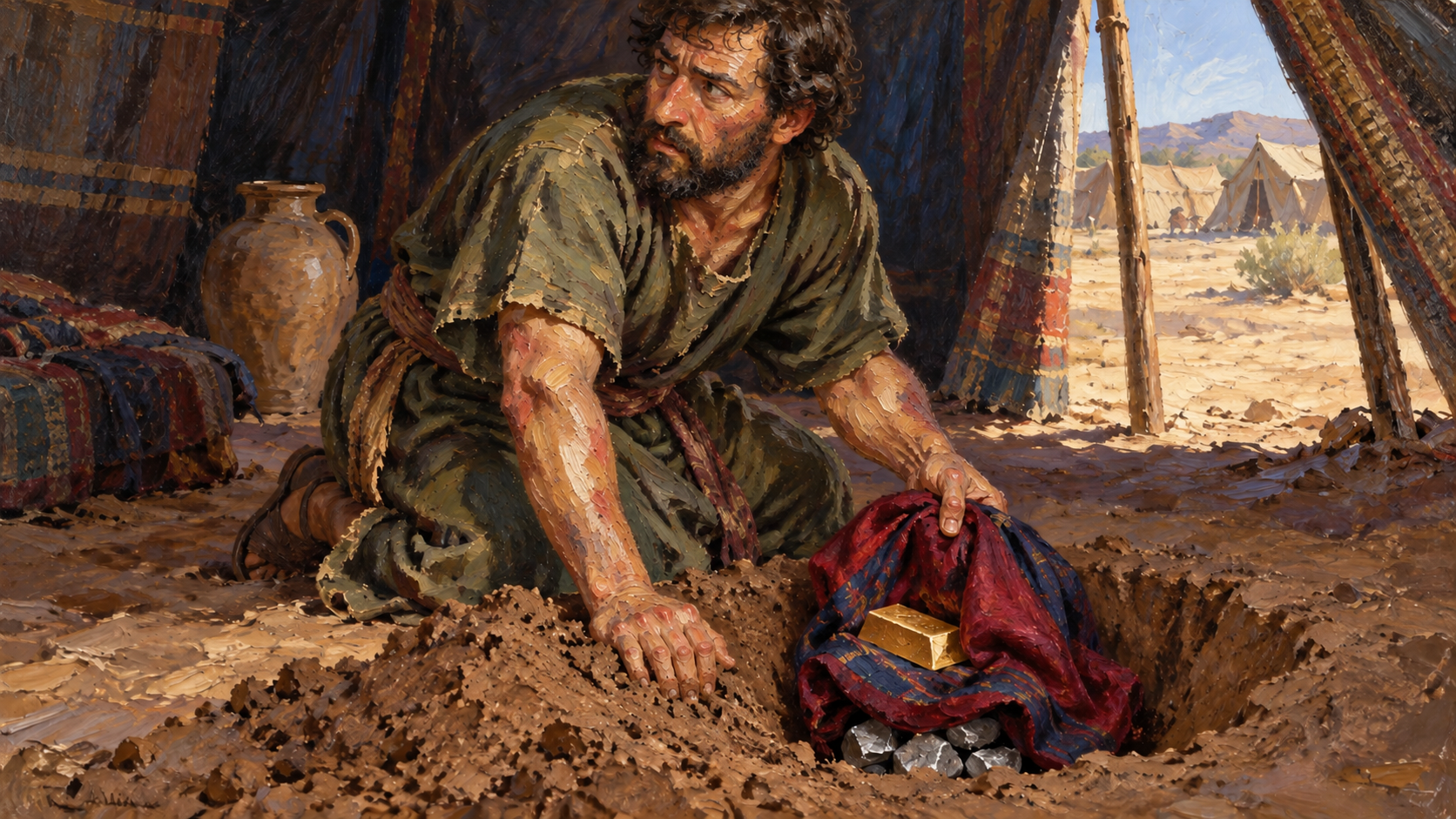
And Achan answered Joshua and said, "Indeed I have sinned against the LORD God of Israel, and this is what I have done: When I saw among the spoils a beautiful Babylonian garment, two hundred shekels of silver, and a wedge of gold weighing fifty shekels, I coveted them and took them. And there they are, hidden in the earth in the midst of my tent, with the silver under it."
The silver and gold from Jericho belonged in the LORD’s treasury, while the other devoted things were to be destroyed. They were not abandoned goods for whichever soldier found them first. Achan knew God’s command, yet he kept looking at the desirable spoils until his desire became coveting. He took them and hid them beneath his tent.
Genesis 3:6 describes a similar sequence: Eve saw and desired the forbidden fruit before taking and eating it. But we need to understand each account in its own setting. Achan deliberately violated God’s command during Israel’s covenant conquest. Although he buried the goods privately, he could not keep the consequences private. Israel suffered defeat at Ai, soldiers died in battle, and the hidden goods were eventually brought into the open.
Secrecy often accompanies covetousness because the person knows the pursuit will not withstand honest examination. A hidden account or deleted message may be more than a minor lapse in judgment. Disguised purchases and altered records can serve the same purpose, and even a carefully incomplete explanation may keep the desire concealed. I would take those details seriously because they may show that coveting has already become deception.
Achan’s judgment took place within Israel’s unique national covenant and conquest. The church has no authority to reproduce those civil penalties. What remains is the warning that God sees hidden grasping and that its harm often reaches beyond what the sinner expects. We need to confess that sin rather than keep protecting it.
The full setting is examined in The Sin of Achan.
Woe to those who devise iniquity, And work out evil on their beds! At morning light they practice it, Because it is in the power of their hand. They covet fields and take them by violence, Also houses, and seize them. So they oppress a man and his house, A man and his inheritance.
Micah describes people planning evil during the night and using their power to carry it out in the morning. Their coveting became a plan to take what belonged to someone else. They seized houses and oppressed families because the possession they wanted had become an excuse to disregard God’s law. Desire had moved beyond a feeling into violence.
Ahab’s desire for Naboth’s vineyard followed that same course. Naboth refused to sell because the land was his ancestral inheritance, and Ahab went home sullen and refused to eat. Jezebel arranged false witnesses and caused Naboth’s death. Ahab then took possession of the vineyard. His disappointment had become entitlement, leading through manipulation and perjury to murder and theft.
Nathan’s parable of the ewe lamb exposed a similar offense in David’s taking of Bathsheba. David had received abundance, yet he took Uriah’s wife and arranged his death. Nathan was not reducing Bathsheba to property. He was confronting David’s abuse of power and his violation of another man’s marriage and life.
These examples make me consider what covetousness does to the neighbor we are commanded to love. A business may take more than is right through deceptive fees, or a family member may manipulate an inheritance. A ministry can use financial secrecy and pressure for the same end. An employer can participate in the sin by withholding wages. When people become tools for acquiring what we want, desire has become oppression.
When a Created Thing Promises Life
The outward harm begins with a deeper lie: the heart starts treating possession as though it can supply life.
And He said to them, "Take heed and beware of covetousness, for one's life does not consist in the abundance of the things he possesses." Then He spoke a parable to them, saying: "The ground of a certain rich man yielded plentifully. And he thought within himself, saying, 'What shall I do, since I have no room to store my crops?' So he said, 'I will do this: I will pull down my barns and build greater, and there I will store all my crops and my goods. And I will say to my soul, "Soul, you have many goods laid up for many years; take your ease; eat, drink, and be merry."' But God said to him, 'Fool! This night your soul will be required of you; then whose will those things be which you have provided?' "So is he who lays up treasure for himself, and is not rich toward God."
A man in the crowd asked Jesus to tell his brother to divide an inheritance. Jesus refused the role he demanded and warned the whole crowd about covetousness. He was not dismissing every civil dispute or calling every inheritance claim wrong. Even a demand framed in legal terms can be governed by a spiritual danger.
The rich man’s land had produced abundantly. Jesus did not accuse him of theft or condemn farming, and nothing in the parable makes barns, planning, or wealth automatically sinful. The man stored treasure only for himself and treated those goods as though they gave him control over the coming years of his own life. I notice what his plan left out: his life belonged to God, and he made no provision for generosity toward anyone else.
The man could build bigger barns, but none of them could hold another night of life for him. His crops would pass to someone else. Death exposed how limited his ownership really was. Jesus calls us to be watchful because useful possessions can still be trusted for something they cannot give: life itself.
Being rich toward God means turning our lives toward His kingdom and using what He entrusts to us in obedient love. It is not a way to buy His favor. Eternal life is His gift, rather than a return we earn on a religious investment.
Jesus’ warning in its full setting can be followed in The Rich Fool.
Therefore put to death your members which are on the earth: fornication, uncleanness, passion, evil desire, and covetousness, which is idolatry. Because of these things the wrath of God is coming upon the sons of disobedience, in which you yourselves once walked when you lived in them.
Because believers have died and their life is hidden with Christ, Paul directs them to seek the things above, where Christ is seated at God’s right hand. He then commands them to put the practices of the old life to death. Covetousness is idolatry because greedy desire lets a created possession rule the heart while promising that it will give us life.
Jesus names God and mammon as rival masters and says we cannot serve both. Money is useful for food and shelter, and it may provide needed medicine or tools. Wealth can also create opportunities to give. But if money becomes lord, it demands disobedience. That happens when income decides what we are willing to call true, when profit excuses injustice, or when wealth becomes the final measure of a person’s worth.
Money is not the only thing a covetous heart wants. Someone may grasp at another person’s spouse or demand exclusive attention. Influence and physical appearance can become objects of the same desire. A ministry platform may be what one person wants, while another seeks control or a reputation someone else has. Whatever the object, the promise remains that possessing it will finally give us life.
The answer is not contempt for creation. God gives good things to receive with thanksgiving. Idolatry detaches the gift from the Giver, while gratitude receives the gift under His authority and remains willing to obey when possession changes.
This connection between desire and false worship is developed further in Idolatry.
But each one is tempted when he is drawn away by his own desires and enticed. Then, when desire has conceived, it gives birth to sin; and sin, when it is full-grown, brings forth death. Do not be deceived, my beloved brethren.
James does not let us blame God for temptation, because the enticement connects with desire inside the person. His picture of birth helps explain the process. Temptation draws us, and desire conceives when the will embraces it. Sin is then born and grows toward the death it eventually produces. I need to distinguish a temptation entering my mind from consenting to it. Consent feeds the desire and may eventually carry it into action.
That distinction gives us room to resist. We may notice envy or an attraction that must not be followed without having to dwell on it. Material craving and fantasies of control also need to be brought into the light before they become a plan. Refusing to dwell on temptation is faithful action, even when we honestly acknowledge that we felt its initial pull.
James 4 traces quarrels and wars to desires at war within people. They lust for what they do not have, and coveting is joined by murder and fighting. Even their requests to God have selfish motives. Prayer becomes a cover for covetousness when we ask Him to serve our appetite instead of submitting the desire to His will.
Romans 7 explains that the holy command reveals this inward disorder but cannot give the sinner new life. Knowing what covetousness is will not save us. Neither social restraint nor a better outward appearance can cleanse the heart. We need forgiveness and new life, including the Spirit’s work within us.
Contentment in Need and in Abundance
Contentment answers the promise that possession will give us life. But I do not understand Paul to be asking us to pretend our material circumstances are painless or unimportant.
But I rejoiced in the Lord greatly that now at last your care for me has flourished again; though you surely did care, but you lacked opportunity. Not that I speak in regard to need, for I have learned in whatever state I am, to be content: I know how to be abased, and I know how to abound. Everywhere and in all things I have learned both to be full and to be hungry, both to abound and to suffer need. I can do all things through Christ who strengthens me.
Paul wrote from confinement after receiving renewed support from the Philippians through Epaphroditus. He welcomed their gift with joy as a real kindness. Contentment did not make practical help from loving friends meaningless, nor did receiving it make Paul less spiritual. He also said he had learned contentment. Through hunger and abundance, he learned that neither deprivation nor surplus defined Christ’s faithfulness.
“I can do all things” needs to be read in that setting. Paul was not offering unlimited achievement to anyone who repeated the sentence. Christ strengthened him to remain faithful when he was full or hungry, supplied or in need. He could face changing circumstances without letting them govern him.
Paul’s contentment did not numb his emotions or stop him from acting. He could rejoice and grieve honestly. He asked churches to pray for him and made practical travel plans. Sometimes he supported himself by working with his hands, and sometimes he received believers’ gifts. He even appealed against unlawful treatment. Contentment means that we do not make ideal conditions a requirement for trusting and obeying God.
Abundance does not necessarily make a person content. Appetite adjusts quickly, and comparison finds a new lack until yesterday’s luxury feels like today’s necessity. Paul needed Christ’s strength to abound as well as to suffer need. Either condition can become spiritually dangerous.
The man in Luke 12 expected stored possessions to guarantee life and rest for his soul. Philippians 4 directs us to Christ for strength, whether we are hungry or full and whether we live with need or abundance.
Let your conduct be without covetousness; be content with such things as you have. For He Himself has said, "I will never leave you nor forsake you." So we may boldly say: "The LORD is my helper; I will not fear. What can man do to me?"
The readers Paul addressed in Hebrews had suffered public reproach and imprisonment because they identified with Christ. They had also seen their possessions plundered. He did not tell them that what they currently owned would cover every future expense. He grounded contentment in God’s promise, “I will never leave you nor forsake you.” Their final security was the Helper’s presence, not the size of an account.
Matthew 6 teaches us to trust the Father who knows His children’s needs. Disciples are to seek His kingdom and righteousness first, instead of serving mammon or allowing anxious thought to rule. That is not a promise of affluence or freedom from hardship. Jesus prepared His followers for persecution while teaching them to rely on the Father’s knowledge and care.
In 1 Timothy 6, godliness with contentment is great gain because we brought nothing into this world and can take nothing out. Paul identifies the love of money as a root of all kinds of evil. He does not say money itself is the root of all evil. Wanting to be rich leads people into snares and harmful lusts.
Paul goes on to tell wealthy believers to trust the living God, who richly gives good things to enjoy, rather than uncertain riches. Their abundance should be expressed in good works and a readiness to give and share. I cannot call wealth holy or treat possession alone as guilt when Scripture asks these more searching questions. Has pride taken hold? Where is the person’s trust? We also need to consider how the goods were acquired and whether they are being enjoyed and shared faithfully.
Wise planning remains part of faithful stewardship. Providing for a household can express love and prudence, as can saving for foreseeable needs and paying legitimate debts. A budget can help direct resources, and appropriate insurance may protect against serious loss. Improving an employable skill can be wise too. I need to ask whether those means help me obey God or have become an imagined guarantee that nothing can go wrong.
Calling every desire for change covetous can silence a worker seeking honest wages or someone pursuing justice. Contentment means refusing sinful means and refusing to place ultimate trust in circumstances. It does not require us to passively accept preventable harm.
Prosperity teaching makes the opposite mistake. It presents wealth as proof of faith and giving as a way to guarantee a larger material return. Scripture calls us to give generously, but grace is not a sales transaction. Jesus and Paul experienced material need, as did other faithful saints. Their need did not mean their faith was deficient.
Poverty does not prove purity any more than wealth proves greed. A poor person may be consumed by coveting, while a wealthy believer may receive possessions humbly and give with unusual generosity. The Bible examines the person’s trust and how the goods were gained. It also asks whether neighbors were harmed and whether the person manages those goods in service to God.
Advertising and social platforms can intensify comparison by presenting other people’s possessions and bodies as measures of our worth. Carefully selected experiences, homes, and public achievements can be presented that way too. Technology does not create a sinful heart, but repeated exposure can train its desires. Wisdom may mean changing what we watch or whom we follow. We should also consider the effect of turning to a screen when we are tired or lonely.
I can pursue an ambition or save responsibly without coveting, because Scripture commends honest work and wise stewardship. Material increase does not prove strong faith, just as contentment does not forbid lawful change or an appeal against injustice. Generosity follows grace as an expression of love and stewardship. It cannot buy blessing or forgiveness, and it does not purchase a larger material return.
Concrete Repentance From Covetousness
We can begin by naming what we actually want. “I struggle with money” may leave the real issue untouched. A house may have become proof of adulthood or a promotion proof of worth. Someone else may treat another person’s attention as proof of beauty, or an inheritance as proof of love. Specific confession exposes the false promise attached to the desire.
Then consider which actions are already serving that desire. Covetousness may feed constant comparison or secret spending. It can also lead to dishonest applications and manipulation, while gambling or exploitative work may promise the gain we want. At other times, sexual fantasy and resentment keep the desire alive. Decisions are made without prayer, and generosity is neglected. Repentance means turning from these practices, not merely feeling ashamed of wanting what they promise.
When grasping has taken what belongs to someone else, restitution may be necessary. Zacchaeus responded to grace by making concrete repayment. John the Baptist called for fruit worthy of repentance, including honest collection and freedom from extortion. Repaying does not buy forgiveness. It shows that repentance no longer protects what was gained.
Generosity helps us treat possessions as gifts God has entrusted to us. We can give thoughtfully and quietly while taking our responsibilities seriously. A dramatic gift must not become a way to evade obligations. Serving someone who cannot improve our status also challenges self-interest. We can learn to rejoice aloud when a neighbor receives something good.
We can give thanks for specific things God has given. We can thank Him for people in our lives and provision already received, along with our abilities and present opportunities. That gives substance to thanksgiving instead of leaving comparison unchecked beneath a general phrase. We receive what is present gratefully without pretending that a painful lack is easy.
Our surroundings and habits can support that response to truth. Unfollow accounts that cultivate envy, and delay unnecessary purchases. If secrecy is part of the problem, review your finances with a trusted believer. Refuse private access that protects the sinful pattern. Memorize passages that answer the desire’s false promise and pray before it becomes a plan. These practices place our conduct under the truth God uses to renew the mind, but they cannot give the heart new life.
The Gospel, the Warning, and the Final Outcome
The command exposes covetousness without being able to cleanse the sinner or create new life. Every person has desired creation wrongly and failed to love a neighbor. We have tried to build life apart from God, and respectable restraint cannot erase that guilt.
Jesus Christ is the eternal Son, fully God and fully man. He was born of a virgin and lived completely without sin. He never grasped what was not His or used power selfishly, and He perfectly loved the Father and His neighbor. Wicked men physically tortured and punished Him, putting Him to death. He willingly bore that real punishment for our sins in His innocent body. He shed His blood and died, then rose bodily. The Father did not punish or curse Jesus, abandon Him, strike or bruise Him, or pour wrath upon Him.
Christ died for the whole world, so God’s offer of salvation is genuine even though people can resist and reject Him. Those who repent and believe are forgiven through His blood and are born again as new people. The Holy Spirit comes to dwell within them and directs them toward a life centered on Christ rather than possession.
The gospel gives us Christ and reconciliation with God, rather than a promise that every financial desire will be fulfilled. In Him we receive a new identity and the Holy Spirit’s abiding presence. God also gives believers a church family and the hope of bodily resurrection. That inheritance cannot be bought or seized.
Paul warns that a covetous person who is an idolater has no inheritance in the kingdom of Christ and God. He is describing a settled identity of unrepentant sin, not teaching that a truly born-again believer loses salvation whenever a covetous thought appears.
The warning still belongs to believers. Colossians tells people whose life is hidden with Christ to put covetousness to death. A Christian can stumble and begin hiding sin, and his greed can harm others. He may need serious correction and experience the Father’s discipline. Eternal security never gives us permission to protect covetousness.
A truly born-again person is a new creation, indwelt and sealed by the Holy Spirit. That person is eternally secure, and grace teaches him to reject ungodliness rather than make peace with it. A permanent, unrepentant life built around idolatrous greed can expose a superficial profession. It does not prove that the new birth was reversed.
We need care that encourages neither presumption nor despair. Repeating a prayer in the past does not justify reassuring an unrepentant exploiter. But a convicted believer should not be told that the struggle itself proves God has abandoned him. We should bring sin into the light and receive Christ’s cleansing. As we learn to walk by the Holy Spirit, any harm needs to be repaired and needed discipline received.
Revelation names idolaters among those whose part is in the Lake of Fire, identified there as the second death. Since Scripture calls covetousness idolatry, we must take that warning seriously. No possession we accumulate can protect us at the Great White Throne.
I understand the Lake of Fire as the final, irreversible destruction of resurrected unbelieving humanity in body and soul. Human souls are not inherently immortal, and eternal life is God’s gift in Christ. Revelation 20:10 uniquely states endless torment for the devil, the beast, and the false prophet. It does not establish eternal conscious torment for human beings.
The severity of the warning reflects a real choice. A person can reject the Messiah’s genuine offer, remain in unbelief, and be blotted from the Book of Life. Those who believe remain written there, while their sins are blotted out through Christ’s blood. Possessions pass away, but the life God gives in His Son endures.
My Final Thoughts
I recognize covetousness in the promise that I must possess some created thing before life can be secure or full. Believing that promise turns a neighbor’s good into an offense and makes obedience negotiable. Jesus offers the life possession never can and forgives through His blood. He makes believers new and remains with us in need as well as abundance. We can plan lawfully and pursue change while keeping both under His authority. Because our life is in Him, we can rejoice in another person’s good and care for our own gifts as things He has entrusted to us. We can also bring grasping desire into the light before it grows into harm.