
A man asked Jesus to settle an inheritance dispute, and Jesus answered with a warning about covetousness. We might wonder how that answered his request, but Jesus saw the deeper trouble. Possessions were crowding eternity out of the man’s thoughts.
Jesus Warned About Covetousness in a Serious Setting
The Parable of the Rich Fool appears in Luke 12, where the crowd had grown so large that people were trampling one another. Jesus warned His disciples about hypocrisy and the fear of man, then called them to confess Him faithfully before God. He was not there to entertain the crowd. People may kill the body but can do no more, while God holds life and final judgment in His hand. That eternal accountability should govern how His people live.
In the middle of that teaching, a man called out about a family dispute:
Then one from the crowd said to Him, “Teacher, tell my brother to divide the inheritance with me.”
Jesus was speaking about eternity while this man was thinking about property. He may truly have been wronged; the passage does not tell us. God’s law takes justice seriously, including inheritance and family duties, and Jesus did not dismiss those responsibilities. But He saw a danger in the man’s heart that settling the legal question alone could not cure.
But He said to him, “Man, who made Me a judge or an arbitrator over you?”
The man called Jesus “Teacher,” yet wanted Him to make his brother act. Instead of asking how to respond to Christ’s teaching or be ready before God, he approached Jesus as a way to get what he wanted. Jesus refused to let the request draw Him away from His mission and used the interruption to warn everyone.
I can’t tell from this passage which brother was in the right. The speaker may have been denied what the law gave him, or his own desire may have distorted the dispute. Jesus left that question unanswered and addressed a danger every person in the crowd needed to face. Even when a claim begins with justice, the desire to get more can come to rule our hearts. Christ looked beyond the outcome the man wanted to what was driving his request.
And He said to them, “Take heed and beware of covetousness, for one’s life does not consist in the abundance of the things he possesses.”
Jesus gives two closely connected commands. The Greek word translated “take heed,” horate, calls us to watch carefully, while “beware,” phylassesthe, means to guard ourselves. Together they help us understand how alert we need to be. Covetousness is dangerous and near enough to take hold in our own hearts without our recognizing it. Jesus is commanding vigilance, not casually suggesting that we be less materialistic.
The Greek word for covetousness is pleonexia, a grasping desire to have more. Colossians 3:5 calls it idolatry because it asks created things to provide what belongs to God. I need to recognize that this desire can sound quite respectable. What I call prudence or financial wisdom may conceal it, as may ambition or a demand for fairness. Even concern for my family or a wish for more room to breathe can hide the growing conviction that life depends on what I possess.
That is why Jesus tells us to guard ourselves rather than merely condemn an obviously greedy person. Covetousness keeps moving the line. What once seemed like enough soon feels small, and the next increase begins to look necessary. The warning reaches people with little as well as people with much. Its question is not simply, “How large is your account?” It asks, “What do you believe you must possess before you can live?”
Jesus uses zoe, the word for life. Possessions can change our circumstances, but they cannot define us before God or forgive our sin. They cannot promise another day or prepare us to meet the Lord. Later in Luke 12, Jesus warns His disciples not to worry about food and clothing. Hoarding and anxious worry may look like opposites, yet both can make earthly provision the center of life. One says, “I have enough to control the future.” The other fears that the future cannot be controlled. Jesus calls both to trust the Father and seek His kingdom.
The Harvest Was a Gift, Not the Sin
Jesus began His parable with a man who was already rich and then received even more:
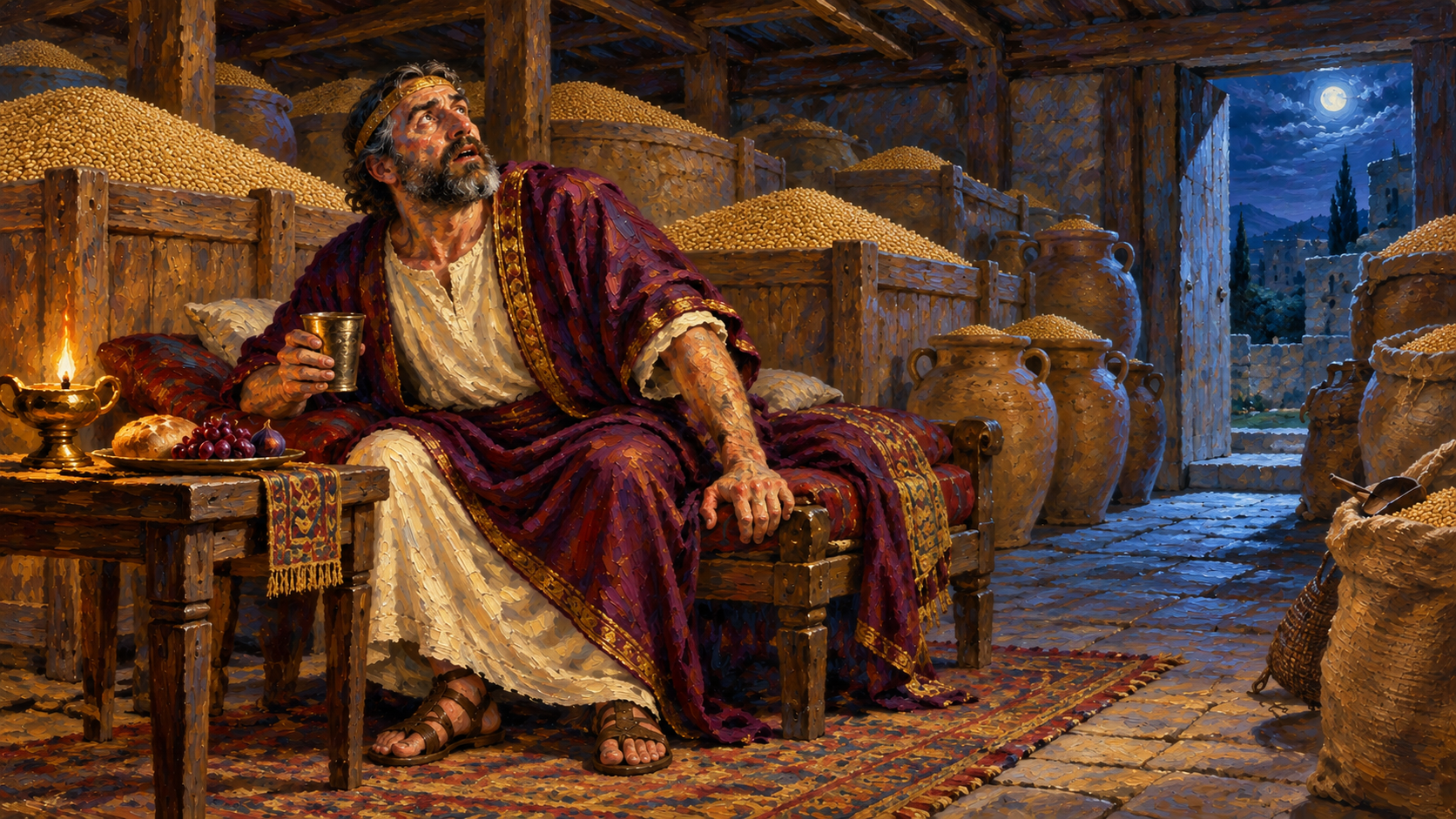
Then He spoke a parable to them, saying: “The ground of a certain rich man yielded plentifully.
Jesus said the ground yielded plentifully. I notice that He did not begin by praising the man’s skill or condemning his farming. The harvest came through God’s providence: He rules the rain and the soil where the seed grows. The seasons and the farmer’s strength are also under His rule. All of it remains dependent on Him, even when the person receiving the harvest gives Him no honor.
The harvest itself was not sinful. Scripture does not condemn a productive field or a growing business, and there is nothing wrong with a household having enough. God gives material blessings that His people may receive with thanksgiving. Proverbs 3:9-10 tells us to honor the LORD with our possessions and the firstfruits of our increase. Whatever the size of the gift, we should receive it in a way that honors the Giver.
In Proverbs, the first part of the increase is used to honor the LORD. Receiving more should lead to more than a calculation of how much we can keep. The rich fool received the fruit of a world God governs, yet he behaved as though the whole result began and ended with himself.
He offered no thanks for the harvest and did not pray about what to do with it. He never asked what faithfulness required or considered who else might benefit. To him, the extra grain presented a storage problem and an opportunity to secure his own ease.
The absence of God from his plans is one of the clearest details in this parable. His abundance did not lead him to worship, and he made his decision without prayer or generosity. That makes me consider what prosperity can reveal about my own heart. Blessing can expose what we trust just as suffering can, so an increase in possessions is no proof that God approves of how we use them.
Bigger Barns Revealed a Life Closed to God
The man’s private conversation shows where his confidence rested:
And he thought within himself, saying, ‘What shall I do, since I have no room to store my crops?’ So he said, ‘I will do this: I will pull down my barns and build greater, and there I will store all my crops and my goods.
He thought within himself and supplied his own answer, as though his own voice were the only one he could hear. The repeated “I” and “my” help us see where his plans were leading. Everything he proposed to do with his crops, barns and goods served his own comfort.
I don’t read this as a warning against storing things wisely. God used the grain Joseph stored in Egypt to save many lives, and Proverbs commends diligence and foresight. We can budget and save for a need while providing for our households and preparing for hard times. The rich man had a practical problem to solve, but he treated the harvest as though God had no claim on it. His own ease had become his highest good.
Joseph stored grain for God’s revealed purpose and preserved other people through famine. The rich man stored it only for the comfort he imagined he would enjoy. I need to consider that difference when making my own plans. The outward actions can look much alike even when the faith and purpose behind them are completely different. Wisdom and trust belong together when we plan as the Lord’s servants, ready for Him to redirect us and committed to using His provision faithfully.
James 4:13-15 warns people who confidently plan where they will go and how long they will stay, already counting on the profit they will make. They do not know what tomorrow will bring. We should plan with this acknowledgment: “If the Lord wills, we shall live and do this or that.” Shutting God out makes planning foolish. The rich man assumed the years ahead belonged to him because the goods did, as though he could store time alongside the grain.
And I will say to my soul, “Soul, you have many goods laid up for many years; take your ease; eat, drink, and be merry.”‘
He spoke to his soul as though grain could satisfy it. Money can support the body for a time, but neither money nor a barn full of crops can secure our lives or make us safe before God. He had mistaken useful provisions for lasting security. While preparing to rest, he never asked whether he was at peace with the Lord.
We can use a home or business faithfully, and the same is true of savings or a retirement plan. Land and tools can serve good purposes too. None of them can become our life, though. If I turn to possessions as my refuge, I am giving them a place that belongs to Christ. We can own things without worshiping them only when we continue to receive and use them under His authority.
God Required the Life He Could Not Secure
The rich man finished his speech to himself, and then God spoke:
But God said to him, ‘Fool! This night your soul will be required of you; then whose will those things be which you have provided?’
God called him a fool. The Greek word translated here is aphron, describing someone senseless or lacking true understanding. He may have been a skilled farmer who ran his business well and prospered. But managing crops successfully did not mean he knew how to face God. His foolishness was spiritual.
Psalm 14:1 says that the fool has said in his heart, “There is no God.” The rich man did not have to say those words for his plans to reveal the same attitude. He spoke and planned as though God had no claim on his spending or saving, or on the rest he intended to enjoy. I can profess belief in God and still arrange my future as if He does not exist. That is practical atheism, and it is a danger this man’s plans expose.
God’s word “Fool” therefore reaches beyond poor financial forecasting. The man’s calculations about his crops and storage space may have been excellent. Yet while counting on future meals and years, he left out the One who gave them all. His view of reality was too small to include the most important truth, so his plan could never be wise.
Jesus’ words “your soul will be required of you” speak of the man’s life and person being summoned in death and accountability. The words do not teach that human souls are inherently immortal apart from God’s sustaining power. The man could not preserve his life by keeping his goods. God had given him breath and could require his life that very night.
Then comes the question the rich man never asked: Who will own all this when you are gone? Ecclesiastes 2:18-21 faces the same sorrow. Someone can labor with wisdom and skill, only to leave the fruit to another who did not work for it. Death removes the illusion of permanent ownership. Nothing stored in a barn can be carried into judgment.
Generosity belongs in this lesson, but adding charitable giving to a self-centered life would not answer the whole warning. The man had arranged his goods while leaving his soul unsurrendered. He was ready to enjoy his barns for years, yet unready when God required his life that night. Death and accountability are at the center of the parable.
Being Rich Toward God Changes How We Hold Possessions
Jesus ended by explaining the parable:
“So is he who lays up treasure for himself, and is not rich toward God.”
Jesus contrasts storing treasure for ourselves with being rich toward God. This reaches deeper than the difference between rich and poor. A poor person can covet, while a wealthy person can fear God and live faithfully and generously. The danger is that we become absorbed in ourselves and expect possessions to give us our identity or make us secure.
To be rich toward God is to live before Him in faith and repentance. Because He is worthy and He is Lord, worship and obedience belong together. We can then give freely while viewing this life in the light of eternity. This grateful stewardship is the fruit of a surrendered life, not a checklist that earns God’s favor. Everything we have comes from Him and remains under His authority, so we should use it for His glory.
Paul applies this directly in 1 Timothy 6:17-19. He tells those who are rich in this present age not to become proud or put their trust in uncertain riches. They are to trust the living God who gives richly and to become rich in good works. Having wealth is not what Paul condemns. He directs those who have it to depend on God and use what He gives generously.
Luke 12 continues in the same direction. The Father knows what His children need, so they are to seek His kingdom instead of living in fear. Jesus tells them to give alms and lay up treasure in heaven, because the heart follows its treasure. Matthew 6:19-21 teaches the same truth: earthly treasure can be destroyed or stolen, while heavenly treasure endures.
Faithful stewardship will not look identical for every disciple. One believer may serve God through a home or business, while another may need to let go of something that has captured the heart. Both must surrender to God. What I receive belongs to Him, so gratitude should shape how I use it under His rule. I can share freely and choose to obey Him even when that costs me something earthly.
We should not measure faithfulness by who owns the least. Selling something does not by itself make a person rich toward God, any more than keeping it proves covetousness. The Lord sees whether faith directs our use of what we have. Generosity expresses love and helps loosen our reliance on ourselves, but it cannot take the place of repentance or make an unsurrendered life faithful.
The rest of Luke 12 describes servants waiting for their master because the Son of Man will come at an unexpected hour. That helps me see why Jesus’ warning goes beyond how we handle money. The rich fool pictures someone unready to meet the Lord. Being rich toward God means living ready for His summons and His return.
For connected studies, see A Bible Study on Covetousness, A Complete Bible Study on the Parable of the Hidden Treasure, A Complete Bible Study on the Parable of the Ten Virgins, and A Complete Bible Study on the Parable of the Prodigal Son.
My Final Thoughts
The Parable of the Rich Fool searches me because his mistake can look so reasonable from the outside. He had a productive year and made a practical plan, yet he planned for everything except God. Jesus does not forbid honest work or wise provision for the future; He exposes covetousness and the quiet unbelief that can hide within those plans. When God required this man’s life, everything he had treated as security belonged to someone else. Jesus Christ is the true riches of God’s grace: He shed His physical blood for sinners and rose bodily from the grave. A full barn cannot save us or overrule death, but Christ calls us out of false security so that we can trust Him, hold His gifts with open hands, and live ready before God.