
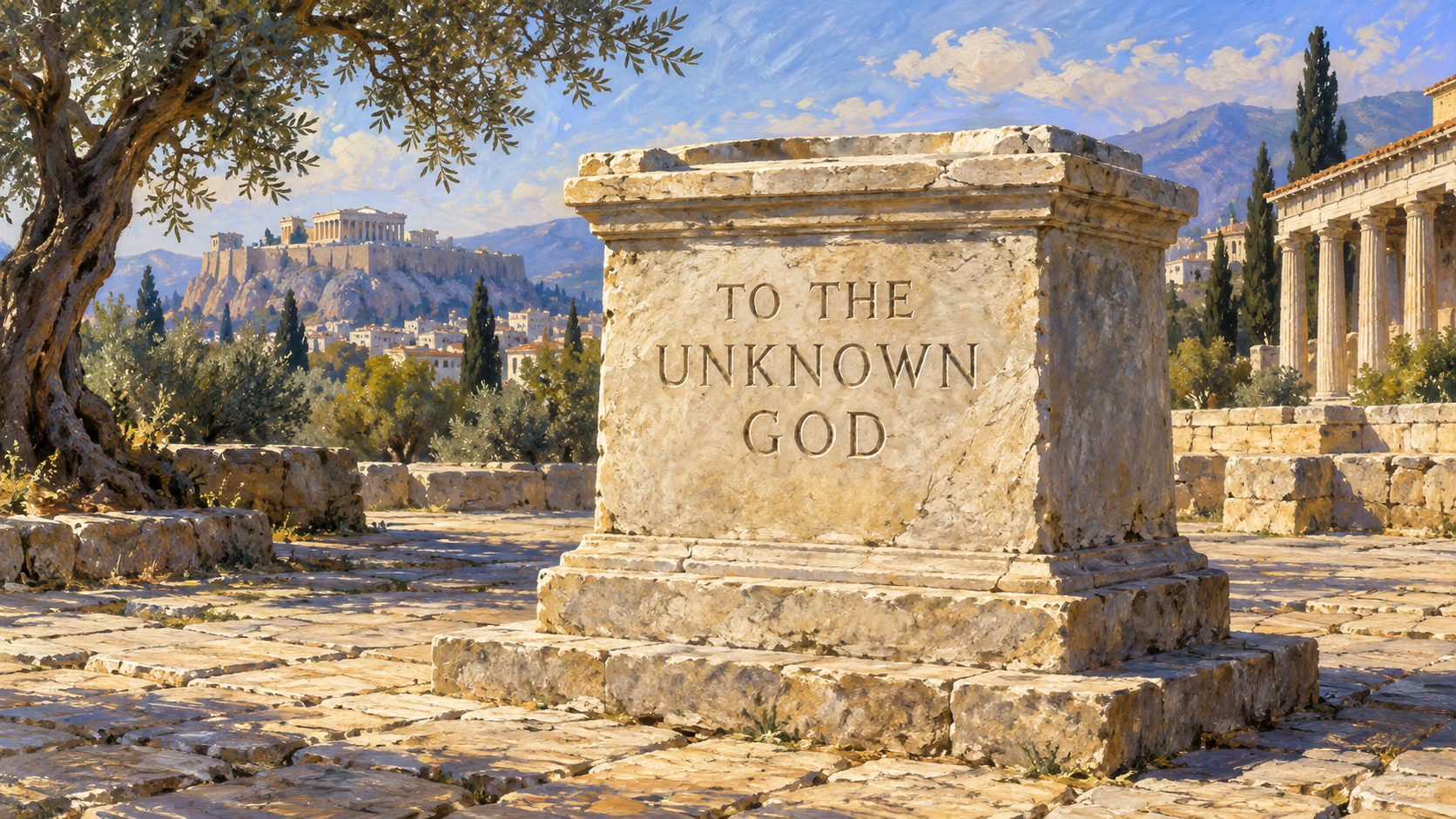
Paul saw a city full of idols when he arrived in Athens. Its religion and philosophical reputation had not brought its people to know their Creator. When he was given a hearing, he began with an altar that admitted ignorance, then proclaimed the God who made them and would judge them through the risen Jesus. I want to follow how he brought those hearers from a familiar inscription to a message that challenged their whole understanding of God.
Paul in Athens and the Road to the Areopagus
Opposition had followed the missionaries from Thessalonica to Berea. Believers escorted Paul away to Athens, while Silas and Timothy stayed behind temporarily. As he waited for them, the city’s idolatry stirred him to speak.
Now while Paul waited for them at Athens, his spirit was provoked within him when he saw that the city was given over to idols. Therefore he reasoned in the synagogue with the Jews and with the Gentile worshipers, and in the marketplace daily with those who happened to be there. Then certain Epicurean and Stoic philosophers encountered him. And some said, “What does this babbler want to say?” Others said, “He seems to be a proclaimer of foreign gods,” because he preached to them Jesus and the resurrection. And they took him and brought him to the Areopagus, saying, “May we know what this new doctrine is of which you speak? For you are bringing some strange things to our ears. Therefore we want to know what these things mean.” For all the Athenians and the foreigners who were there spent their time in nothing else but either to tell or to hear some new thing.
Athens still enjoyed enormous prestige for philosophy, education, and art, though its earlier political power had declined. Luke directs our attention to the worship beneath that impressive appearance. The images represented gods people trusted, and their beauty could not make the worship true. Paul’s spirit was sharply stirred by a city giving the Creator’s honor to created things.
His distress led to daily conversation and reasoned proclamation. He spoke with Jews and Gentile worshipers in the synagogue and with whoever happened to be in the marketplace, or agora, the public center of business and civic life. Waiting for his companions did not keep him from addressing the people already before him.
The philosophers who encountered him came from two different schools. Epicureans sought freedom from bodily pain and mental disturbance, not simply a succession of reckless pleasures. Epicurus’s Letter to Menoeceus explains that aim, while his Principal Doctrines describe the gods as untroubled and death as the dissolution of a body without sensation. A Creator actively governing human affairs and raising the dead for judgment challenged that outlook.
Stoics pursued virtue and self-mastery by living according to nature, understanding divine reason as ordering and pervading the universe. They could speak personally of Zeus and providence, as Epictetus’s Discourses illustrate, yet their account did not preserve the distinction Paul proclaimed between the Creator and what He made. The God of Paul’s message is Lord over the world, not a divine principle within it, and His rule is more than an impersonal fate.
Some dismissed Paul as a spermologos, a seed-picker or babbler. The insult pictured someone collecting scraps of learning as a bird picks up scattered seeds. Others thought he proclaimed foreign deities because he preached Jesus and the resurrection. Neither the insult nor the misunderstanding kept him from explaining further.
They brought him to the Areopagus and asked what his teaching meant. The name can refer to the Hill of Ares or the council associated with it; “Mars Hill” is the familiar traditional name. The council retained public and religious importance under Roman rule. Luke does not settle the meeting’s exact location or legal form, and he reports no conviction. We should not insist that it was either a casual sidewalk exchange or a full criminal trial.
Luke describes the Athenians and resident foreigners as eager to hear and discuss new ideas. That explains the opportunity Paul received without requiring us to treat every person there as frivolous. Paul intended to do more than satisfy curiosity. His hearers would have to respond to the truth he proclaimed.
Then Paul stood in the midst of the Areopagus and said, “Men of Athens, I perceive that in all things you are very religious; for as I was passing through and considering the objects of your worship, I even found an altar with this inscription: TO THE UNKNOWN GOD. Therefore, the One whom you worship without knowing, Him I proclaim to you: God, who made the world and everything in it, since He is Lord of heaven and earth, does not dwell in temples made with hands. Nor is He worshiped with men’s hands, as though He needed anything, since He gives to all life, breath, and all things. And He has made from one blood every nation of men to dwell on all the face of the earth, and has determined their preappointed times and the boundaries of their dwellings, so that they should seek the Lord, in the hope that they might grope for Him and find Him, though He is not far from each one of us; for in Him we live and move and have our being, as also some of your own poets have said, ‘For we are also His offspring.’ Therefore, since we are the offspring of God, we ought not to think that the Divine Nature is like gold or silver or stone, something shaped by art and man’s devising. Truly, these times of ignorance God overlooked, but now commands all men everywhere to repent, because He has appointed a day on which He will judge the world in righteousness by the Man whom He has ordained. He has given assurance of this to all by raising Him from the dead.” And when they heard of the resurrection of the dead, some mocked, while others said, “We will hear you again on this matter.” So Paul departed from among them. However, some men joined him and believed, among them Dionysius the Areopagite, a woman named Damaris, and others with them.
Paul began by describing them as “very religious.” The Greek expression could suggest devotion or superstition, so the rest of his speech must determine how we hear it. He recognized the religious activity plainly visible around them, then pointed to its admitted ignorance: an altar inscribed “TO THE UNKNOWN GOD.” They had an object of worship without knowledge of the One they needed to know.
A later ancient account offers a useful comparison. Pausanias, Description of Greece 1.1.4 mentions altars to gods called Unknown near Phalerum. His plural wording supports the wider practice but does not identify Paul’s particular altar or explain its origin. The suggestion that worshipers feared offending a deity they had overlooked is possible; Luke does not give their reason.
Paul did not tell them they already knew God under a different name. He declared the One they worshiped without knowledge, then corrected what their religion assumed about Him. The altar supplied an opening for the conversation, while God’s revelation supplied its teaching. Sincerity and abundant religious activity had not reconciled these people to their Creator.
The Creator Paul Proclaimed
The God Paul proclaimed made the world and everything in it. He therefore cannot be one local deity competing with others for a place in the universe, or a divine principle woven into its material. He is Lord of heaven and earth because all creation comes from Him. Genesis gives the human origin that underlies Paul’s appeal.
Then God said, “Let Us make man in Our image, according to Our likeness; let them have dominion over the fish of the sea, over the birds of the air, and over the cattle, over all the earth and over every creeping thing that creeps on the earth.” So God created man in His own image; in the image of God He created him; male and female He created them. Then God blessed them, and God said to them, “Be fruitful and multiply; fill the earth and subdue it; have dominion over the fish of the sea, over the birds of the air, and over every living thing that moves on the earth.” And God said, “See, I have given you every herb that yields seed which is on the face of all the earth, and every tree whose fruit yields seed; to you it shall be for food. Also, to every beast of the earth, to every bird of the air, and to everything that creeps on the earth, in which there is life, I have given every green herb for food”; and it was so. Then God saw everything that He had made, and indeed it was very good. So the evening and the morning were the sixth day.
Men and women bear God’s image and owe their existence to Him. The world was His good creation before human rebellion corrupted our conduct. That dependence also runs through Isaiah’s declaration about the Maker who gives breath to people and refuses to share His praise with carved images.
Thus says God the LORD, Who created the heavens and stretched them out, Who spread forth the earth and that which comes from it, Who gives breath to the people on it, And spirit to those who walk on it: “I, the LORD, have called You in righteousness, And will hold Your hand; I will keep You and give You as a covenant to the people, As a light to the Gentiles, To open blind eyes, To bring out prisoners from the prison, Those who sit in darkness from the prison house. I am the LORD, that is My name; And My glory I will not give to another, Nor My praise to carved images. Behold, the former things have come to pass, And new things I declare; Before they spring forth I tell you of them.”
Paul’s statement about handmade temples does not deny that God manifested His presence in Israel’s tabernacle and temple. It denies that a building can contain or confine Him. Nor can gifts brought by worshipers supply a need in the Creator. He gives everyone life, breath, and all they possess.
That leaves me no basis for putting God in my debt through service. The strength and opportunity to serve came from Him, along with the breath I use. He graciously uses His people, and His command to repent makes clear that our response is significant. But He does not depend on us to feed, house, enrich, or protect Him. Worship should express gratitude for what He gives.
Paul and Barnabas had made a similar appeal earlier in Lystra. After a man who had never walked was healed, the crowd tried to honor the missionaries as gods.
And in Lystra a certain man without strength in his feet was sitting, a cripple from his mother’s womb, who had never walked. This man heard Paul speaking. Paul, observing him intently and seeing that he had faith to be healed, said with a loud voice, “Stand up straight on your feet!” And he leaped and walked. Now when the people saw what Paul had done, they raised their voices, saying in the Lycaonian language, “The gods have come down to us in the likeness of men!” And Barnabas they called Zeus, and Paul, Hermes, because he was the chief speaker. Then the priest of Zeus, whose temple was in front of their city, brought oxen and garlands to the gates, intending to sacrifice with the multitudes. But when the apostles Barnabas and Paul heard this, they tore their clothes and ran in among the multitude, crying out and saying, “Men, why are you doing these things? We also are men with the same nature as you, and preach to you that you should turn from these useless things to the living God, who made the heaven, the earth, the sea, and all things that are in them, who in bygone generations allowed all nations to walk in their own ways. Nevertheless He did not leave Himself without witness, in that He did good, gave us rain from heaven and fruitful seasons, filling our hearts with food and gladness.” And with these sayings they could scarcely restrain the multitudes from sacrificing to them.
Barnabas and Paul tore their clothes in distress and tried to stop the sacrifice. They identified themselves as ordinary men and called the crowd to turn from useless objects of worship to the living Creator. Rain, fruitful seasons, food, and gladness were His witness, even among nations He had allowed to go their own ways. In Athens Paul again directed people from their religious assumptions to the God whose goodness sustained them.
The received text says God made every nation from “one blood.” We all descend from Adam, so no ethnicity has a separate human origin or a superior human substance. Every people shares human dignity and owes allegiance to the same Maker. Paul does not erase nations or cultures, since he also speaks of their appointed times and boundaries.
The philosopher and the foreign resident belonged to the same human family, as did the Jew in the synagogue and the stranger in the marketplace. No nation could dismiss repentance as someone else’s religious obligation. The command would come from the Creator who gave life to them all.
God’s determining of times and boundaries places nations under His providence, His continuing care and rule over human affairs. It does not make every border righteous or every conquest morally approved. God can set limits on rulers, raise or humble them, and still judge the evil they freely choose. Political prestige creates no exemption from accountability and establishes no permanent ethnic hierarchy.
Paul said God ordered human life so that people should seek Him, though they might grope for Him, and that He was not far from any of them. Groping suggests a search with limited sight, not clear knowledge of salvation. Their next breath depended on the God their altar admitted they did not know.
Being near their Creator had not reconciled them to Him. Their search had produced temples, images, and competing philosophies. Romans 1 explains the rebellion involved in suppressing revealed truth, while the gospel supplies knowledge of the Savior that creation alone does not give. Paul was calling them to receive what they still lacked.
The Poets, God’s Offspring, and the Folly of Images
Paul also appealed to words from their own literature. “For we are also His offspring” appears near the opening of Aratus’s Phaenomena, where the poet speaks of Zeus. Paul used that recognition of human dependence in speaking about the actual Creator. Quoting the line did not endorse its original pagan setting.
The precise literary source of “in Him we live and move and have our being” is less certain; we should not confidently assign it to a lost work. Paul’s use is clear. Living people depend on God for their existence, so how can something those people fashioned from lifeless metal or stone adequately represent the source of their lives?
Aratus’s words did not make Zeus the true God, and Paul did not merge their religious beliefs with his own. He used something they recognized to expose a contradiction in their worship. Scripture had already condemned the attempt to represent the divine nature through an image made by human hands.
“Take careful heed to yourselves, for you saw no form when the LORD spoke to you at Horeb out of the midst of the fire, lest you act corruptly and make for yourselves a carved image in the form of any figure: the likeness of male or female, the likeness of any animal that is on the earth or the likeness of any winged bird that flies in the air, the likeness of anything that creeps on the ground or the likeness of any fish that is in the water beneath the earth. And take heed, lest you lift your eyes to heaven, and when you see the sun, the moon, and the stars, all the host of heaven, you feel driven to worship them and serve them, which the LORD your God has given to all the peoples under the whole heaven as a heritage. But the LORD has taken you and brought you out of the iron furnace, out of Egypt, to be His people, an inheritance, as you are this day. Furthermore the LORD was angry with me for your sakes, and swore that I would not cross over the Jordan, and that I would not enter the good land which the LORD your God is giving you as an inheritance. But I must die in this land, I must not cross over the Jordan; but you shall cross over and possess that good land. Take heed to yourselves, lest you forget the covenant of the LORD your God which He made with you, and make for yourselves a carved image in the form of anything which the LORD your God has forbidden you. For the LORD your God is a consuming fire, a jealous God. “When you beget children and grandchildren and have grown old in the land, and act corruptly and make a carved image in the form of anything, and do evil in the sight of the LORD your God to provoke Him to anger, I call heaven and earth to witness against you this day, that you will soon utterly perish from the land which you cross over the Jordan to possess; you will not prolong your days in it, but will be utterly destroyed. And the LORD will scatter you among the peoples, and you will be left few in number among the nations where the LORD will drive you. And there you will serve gods, the work of men’s hands, wood and stone, which neither see nor hear nor eat nor smell. But from there you will seek the LORD your God, and you will find Him if you seek Him with all your heart and with all your soul. When you are in distress, and all these things come upon you in the latter days, when you turn to the LORD your God and obey His voice (for the LORD your God is a merciful God), He will not forsake you nor destroy you, nor forget the covenant of your fathers which He swore to them.
At Horeb, Israel heard the LORD without seeing a form they could reproduce. Moses warned them against replacing Him with images of people, animals, or heavenly bodies. The carved objects could neither see nor hear, and their worship would violate the covenant of the God who brought Israel out of Egypt. The warning also held out mercy to those who turned back and sought Him.
Calling all people God’s “offspring” must be read in this setting. They bear His image and depend on Him as their Creator. Spiritual adoption is more than that: through faith in Christ and the new birth, sinners become God’s children in the saving sense. Common human origin establishes dignity and responsibility; it does not establish that everyone is already forgiven or born again.
Ignorance Gives Way to Repentance and Judgment
Paul’s statement that God overlooked former times of ignorance describes patience, not automatic salvation. As the Lystra address also explains, God allowed nations to continue in their ways while giving them witness through His goodness. Their ignorance did not make idolatry innocent.
Now God commands everyone everywhere to repent. Christ has risen, and the saving message is being proclaimed openly to the nations. Repentance means turning from idols and false belief to the living God, giving up our insistence on ruling ourselves. It belongs with faith in Jesus and cannot purchase forgiveness.
A person could enjoy discussing Paul’s ideas without answering that command. Embarrassment about a mistaken religious opinion would not be enough either. His hearers needed to turn to their Creator and His appointed Son, because God had fixed a day when the world would be judged in righteousness.
Jesus is fully God and fully man, and the Father has committed judgment to Him. No forgotten deed or concealed motive can escape His knowledge. By raising Him bodily from the dead, God gave public assurance that His appointed Judge lives. That assurance is more than a private feeling of confidence; it rests on an event God accomplished.
The same resurrection belongs to the gospel Paul explained elsewhere, together with Christ’s death for our sins and His burial.
Moreover, brethren, I declare to you the gospel which I preached to you, which also you received and in which you stand, by which also you are saved, if you hold fast that word which I preached to you–unless you believed in vain. For I delivered to you first of all that which I also received: that Christ died for our sins according to the Scriptures, and that He was buried, and that He rose again the third day according to the Scriptures, and that He was seen by Cephas, then by the twelve. After that He was seen by over five hundred brethren at once, of whom the greater part remain to the present, but some have fallen asleep. After that He was seen by James, then by all the apostles. Then last of all He was seen by me also, as by one born out of due time.
Paul received and proclaimed events attested by witnesses, including Cephas, the apostles, and more than five hundred brethren at once. He was not offering Athens a theory that life might somehow continue after death. He had already preached Jesus and the resurrection in the marketplace, and now he announced the living Man through whom God would judge.
At the Areopagus, Paul’s announcement of resurrection drew mockery from some, while others said they would hear him again. Some joined him and believed. Luke names Dionysius the Areopagite and Damaris, along with others. He reports no vast crowd, but these were real people receiving the truth. I should not measure a witness’s faithfulness only by the size of the response.
“We will hear you again” sounded more respectful than ridicule, yet Luke does not identify it as faith. Curiosity left God’s command unanswered. We cannot manufacture repentance in another person, but we can make the message clear enough that the person understands what is being refused or postponed.
What Creation Reveals and What It Cannot
Paul’s address raises a question about the witnesses available to people everywhere. Creation displays God’s glory and power, providence supplies life and food, and conscience bears witness to the moral weight of our conduct. Scripture explains both the reality of that witness and its limits.
The heavens declare the glory of God; And the firmament shows His handiwork. Day unto day utters speech, And night unto night reveals knowledge. There is no speech nor language Where their voice is not heard. Their line has gone out through all the earth, And their words to the end of the world. In them He has set a tabernacle for the sun, Which is like a bridegroom coming out of his chamber, And rejoices like a strong man to run its race. Its rising is from one end of heaven, And its circuit to the other end; And there is nothing hidden from its heat. The law of the LORD is perfect, converting the soul; The testimony of the LORD is sure, making wise the simple; The statutes of the LORD are right, rejoicing the heart; The commandment of the LORD is pure, enlightening the eyes; The fear of the LORD is clean, enduring forever; The judgments of the LORD are true and righteous altogether. More to be desired are they than gold, Yea, than much fine gold; Sweeter also than honey and the honeycomb. Moreover by them Your servant is warned, And in keeping them there is great reward. Who can understand his errors? Cleanse me from secret faults. Keep back Your servant also from presumptuous sins; Let them not have dominion over me. Then I shall be blameless, And I shall be innocent of great transgression. Let the words of my mouth and the meditation of my heart Be acceptable in Your sight, O LORD, my strength and my Redeemer.
The heavens declare God’s glory throughout the earth. Psalm 19 then turns from the created heavens to God’s Word, which instructs, warns, and exposes the worshiper’s hidden faults. The psalm does not suggest that looking at nature supplies everything God reveals through His Word.
Romans 1 explains why the Creator’s witness has not produced a world of grateful worshipers.
For the wrath of God is revealed from heaven against all ungodliness and unrighteousness of men, who suppress the truth in unrighteousness, because what may be known of God is manifest in them, for God has shown it to them. For since the creation of the world His invisible attributes are clearly seen, being understood by the things that are made, even His eternal power and Godhead, so that they are without excuse, because, although they knew God, they did not glorify Him as God, nor were thankful, but became futile in their thoughts, and their foolish hearts were darkened. Professing to be wise, they became fools, and changed the glory of the incorruptible God into an image made like corruptible man–and birds and four-footed animals and creeping things. Therefore God also gave them up to uncleanness, in the lusts of their hearts, to dishonor their bodies among themselves, who exchanged the truth of God for the lie, and worshiped and served the creature rather than the Creator, who is blessed forever. Amen.
People suppress the truth in unrighteousness, refuse to give thanks, and exchange the Creator’s glory for images. We need to recognize rebellion alongside ignorance. Their problem is not merely a shortage of evidence; sin distorts their response to what God has made known.
Conscience is also a real witness, but its judgment is not infallible. Poor training can distort it, sin can defile it, and repeated wrongdoing can dull its warnings. Paul explains how it accuses or excuses people who do not possess Israel’s revealed Law.
For there is no partiality with God. For as many as have sinned without law will also perish without law, and as many as have sinned in the law will be judged by the law (for not the hearers of the law are just in the sight of God, but the doers of the law will be justified; for when Gentiles, who do not have the law, by nature do the things in the law, these, although not having the law, are a law to themselves, who show the work of the law written in their hearts, their conscience also bearing witness, and between themselves their thoughts accusing or else excusing them) in the day when God will judge the secrets of men by Jesus Christ, according to my gospel.
God shows no partiality between those with the Law and those without it. Hearing commands does not make a sinner righteous, while lacking Israel’s Law does not remove moral responsibility. God will judge even the secrets of people through Jesus Christ. We cannot turn conscience into a convenient permission to do whatever feels acceptable.
Religious desire is not saving knowledge either. The phrase “eternity in their hearts” in Ecclesiastes 3:11 does not promise a saving inward longing in everyone. The verse also says people cannot discover God’s work from beginning to end. Restlessness or religious desire can lead toward idols; neither replaces hearing the truth about Christ.
Creation, providence, and conscience are often discussed as general revelation, witness available broadly to humanity. They establish accountability but do not name Jesus, describe His blood and cross, or announce His burial and bodily resurrection. Special revelation is God’s particular disclosure of truth, including the saving message recorded in Scripture. People need that message to know what Christ has done and receive Him through faith. The study on the existence of God examines the wider evidence. Romans 10 connects hearing the saving message with faith in the risen Lord.
But what does it say? “The word is near you, in your mouth and in your heart” (that is, the word of faith which we preach): that if you confess with your mouth the Lord Jesus and believe in your heart that God has raised Him from the dead, you will be saved. For with the heart one believes unto righteousness, and with the mouth confession is made unto salvation. For the Scripture says, “Whoever believes on Him will not be put to shame.” For there is no distinction between Jew and Greek, for the same Lord over all is rich to all who call upon Him. For “whoever calls on the name of the LORD shall be saved.” How then shall they call on Him in whom they have not believed? And how shall they believe in Him of whom they have not heard? And how shall they hear without a preacher? And how shall they preach unless they are sent? As it is written: “How beautiful are the feet of those who preach the gospel of peace, Who bring glad tidings of good things!” But they have not all obeyed the gospel. For Isaiah says, “LORD, who has believed our report?” So then faith comes by hearing, and hearing by the word of God.
Romans 10 follows the practical consequence: people need to hear about the Lord in whom they are called to believe. Sincerity, nature, conscience, ignorance, and another religion supply no alternative promise of salvation. Jesus is the only Savior and Mediator. The church’s task is therefore to proclaim Him among all nations.
Some go, while others pray and help send them. Translation and patient teaching help people understand, and cultural or travel barriers require courage and practical effort. I cannot use God’s justice as a reason to decide that people who have not heard probably do not need the message. The Judge knows every circumstance and never misjudges anyone, while His command to make disciples remains ours to obey.
Cornelius feared God and prayed, yet the angel did not tell him sincerity was enough. God sent Peter with the words by which he and his household would be saved. God can bring fuller truth through a messenger, Scripture, or a meeting no missionary could arrange. That gives us reason to trust Him and pray for laborers, then speak where He sends us.
Jesus Himself explained the necessity of coming through Him when He answered Thomas on the night before His crucifixion.
“Let not your heart be troubled; you believe in God, believe also in Me. In My Father’s house are many mansions; if it were not so, I would have told you. I go to prepare a place for you. And if I go and prepare a place for you, I will come again and receive you to Myself; that where I am, there you may be also. And where I go you know, and the way you know.” Thomas said to Him, “Lord, we do not know where You are going, and how can we know the way?” Jesus said to him, “I am the way, the truth, and the life. No one comes to the Father except through Me. “If you had known Me, you would have known My Father also; and from now on you know Him and have seen Him.” Philip said to Him, “Lord, show us the Father, and it is sufficient for us.” Jesus said to him, “Have I been with you so long, and yet you have not known Me, Philip? He who has seen Me has seen the Father; so how can you say, ‘Show us the Father’? Do you not believe that I am in the Father, and the Father in Me? The words that I speak to you I do not speak on My own authority; but the Father who dwells in Me does the works. Believe Me that I am in the Father and the Father in Me, or else believe Me for the sake of the works themselves.
Thomas asked how they could know the way, and Jesus identified Himself as the way, the truth, and the life. No one comes to the Father except through Him. His answer gives no place to an alternate salvation through religious sincerity. The One who reveals the Father is the Savior people need to know.
Jesus is the eternal Son, fully God and fully man, who lived completely without sin. Wicked men physically tortured and punished Him before killing Him. He willingly bore real punishment for our sins in His innocent body and shed His blood. His saving work through His blood and death was complete when He died. He was buried and then rose bodily from the grave. The Father did not punish, curse, abandon, strike, bruise, or pour wrath on Jesus.
Christ died for the whole world, so God’s offer of salvation is genuine for every person, although people can resist and reject His grace. Everyone who repents and believes is born again. The Holy Spirit indwells and seals the believer, whose salvation is eternally secure. Regeneration means genuine new birth, not merely adopting a Christian label. Obedience is evidence of that life rather than its price, and assurance never gives permission for lawlessness. The study on the gospel explains this saving message more fully.
What Paul’s Method Teaches Christian Witness
Paul paid attention to people and found an opening in their altar and poetry. He then corrected their beliefs, called them to repent, and proclaimed the resurrection and judgment. Knowing their culture helped him explain what Scripture teaches; it did not give their religion authority to revise the message.
I need both concern for God’s honor and concern for the people who are deceived. Zeal that forgets the people can become harsh, while a desire to seem compassionate can make us unwilling to name the error. Paul reasoned with them about Jesus and the resurrection. His concern produced explanation rather than an outburst against everyone around him.
We do not have to begin every conversation where he began in Athens. In a synagogue he could appeal to Israel’s Scriptures, while among Gentiles he explained the Creator and His providence. He addressed what people actually believed and understood, then led them toward repentance and faith in Jesus. The related study on the life of the apostle Paul follows that ministry in more detail.
I do not read Athens as a failed experiment because Luke’s record omits some teaching about the cross found elsewhere in Paul’s letters. Luke has already told us Paul preached Jesus and the resurrection, and he names people who believed. A summary cannot be expected to reproduce every sentence spoken during days of discussion.
Acts 18 describes Paul reasoning and persuading in Corinth as well. First Corinthians 2 emphasizes Christ crucified and dependence on God’s power rather than human eloquence; it does not say Paul regretted explaining creation to idolaters or abandoned reasoned explanation after Athens.
We should listen closely enough to understand a person’s claims, recognize genuine agreement, and explain contradictions without cruelty. A familiar proverb, an expressed fear, or an admitted uncertainty may give us an opening. But if I leave the conversation at vague ideas about God, the person has still not heard about Christ.
Contextualization means explaining unchanging truth in terms particular hearers can understand. Syncretism changes that truth to accommodate false worship. Paul understood his audience well enough to expose its error, and loved people enough to give them the truth they needed. Further discussion of the evidence for God’s existence can help us reason carefully while continuing toward the gospel.
My Final Thoughts
Paul used an altar’s admission of ignorance to proclaim the Creator, then brought his hearers to the risen Jesus and the command to repent. Creation and conscience make us accountable, but they do not announce what the Savior has done for our sins. I want to understand people well enough to speak patiently and plainly, without mistaking interest in religion for saving faith or leaving them with an unnamed god when Christ has made the Father known.