
When someone asks how we can know God exists, I want to know what led him to ask. He may have an objection no one has answered, or he may be trying to understand a painful loss. He may also be resisting what acknowledging God would require of him. Scripture gives us reasons to believe, but I will not answer someone well by assuming I already know everything going on in his mind.
What Kind of Proof Does Scripture Give?
The Bible begins with a direct statement: “In the beginning God created the heavens and the earth” (Genesis 1:1). It presents God as the eternal Creator on whom everything else depends. He made us, including the minds with which we ask questions about Him. That means we are accountable to Him even while examining the reasons for belief.
His authority does not excuse a careless answer from me. Apologetics means defending the faith, which involves giving reasons and dealing honestly with objections. Scripture directs us to the created world and our moral awareness, then tells us what God has done in history. Its witness leads to Jesus Christ and His bodily resurrection. I want the person asking to know the living God through His Son, rather than leave impressed with my ability to argue.
We should also clarify what someone means by proof. A historical event is not established in the same way we solve a mathematical equation. We examine testimony and the evidence surrounding the event. A moral judgment cannot be weighed on a scale, but that does not make the difference between kindness and cruelty imaginary. Requiring every kind of knowledge to pass one particular test can prevent us from considering the evidence suited to the question.
What God makes known through creation and conscience is often called general revelation. It gives us reason to acknowledge Him, but it does not explain the whole gospel. The stars cannot tell us Jesus’ name or how His blood provides forgiveness. Psalm 19 itself moves from the heavens to the law of the LORD. We need His written Word to understand His promises, and we need Christ to rescue us from sin.
Creation Points Beyond Itself
David uses poetry to describe the heavens bearing witness to God. The sky does not speak with a human voice, yet day after day it displays a world we did not make and cannot sustain.
The heavens declare the glory of God; And the firmament shows His handiwork. Day unto day utters speech, And night unto night reveals knowledge.
Learning how that world works does not remove its Creator. Explaining rainfall, gravity, or photosynthesis tells us something about the order He made. Scientific investigation depends on patterns stable enough to examine and minds capable of understanding them. We can discover how a process operates and still have to ask why such an ordered world exists at all. I do not need to reserve God for the things scientists have not yet explained.
We reason from effects to causes in ordinary life. A house gives us reason to recognize a builder, and a book’s contents point to someone capable of communicating meaning. Hebrews uses the familiar example of a house.
For every house is built by someone, but He who built all things is God.
Hebrews 3 compares Moses, a faithful servant in God’s house, with Christ, the Son over it. The verse belongs to that argument, but it also appeals to something the reader can recognize: a house does not build itself. A house and the universe differ in many respects, so the comparison is not a complete philosophical proof. Even with those limits, it helps us ask whether a proposed cause can account for what it produces. An explanation of the world needs to account for its matter and order as well as its living inhabitants.
Scripture identifies a personal, eternal Creator whose power and wisdom account for that world. Treating impersonal matter as the final explanation leaves further questions about rational thought, moral duty, beauty, and the people who recognize them. Describing the materials from which something is made does not by itself settle every question about its existence.
Living things add to this witness. The National Human Genome Research Institute describes DNA as carrying genetic information used in an organism’s development and functioning. The sequence of its chemical bases encodes instructions used to make proteins or RNA. Cells use this information as they grow, reproduce, and repair damage.
When I read the instructions in a recipe, I know someone arranged them to produce a particular result. I see a similar reason to recognize intelligence in the way living cells use biological information. A cell is not the same thing as a human artifact, and this comparison is not a substitute for studying the biology carefully. But learning how life works gives me further reason to share David’s gratitude to the God who formed him.
I will praise You, for I am fearfully and wonderfully made; Marvelous are Your works, And that my soul knows very well.
His praise is not a laboratory account of embryology. Scientific study can describe how a human body develops without settling the ultimate question of why life exists in an ordered world. Scripture attributes that world to God’s creative work and continuing care, which gives us reason to join David in thanking Him.
The Eternal God and the People He Made
If creation requires an explanation, someone will reasonably ask why God does not need a creator too. If I claimed that absolutely everything had to be made by someone else, I would only have pushed the problem back another step. Scripture instead distinguishes the eternal God from the things that came into existence.
Before the mountains were brought forth, Or ever You had formed the earth and the world, Even from everlasting to everlasting, You are God.
The question “Who made God?” treats Him as one more thing that began to exist. A being made by someone else would itself be a creature. The God revealed in Scripture is self-existent, meaning He depends on nothing outside Himself for His existence. He was not assembled from earlier materials and is not the first object somewhere inside the universe. The world had a beginning; He did not.
We also need to be precise about nothing. Absolute nothingness is not a hidden substance with laws or potential waiting to produce a universe. It has no power to act. The biblical claim is that the living God created, rather than that something caused itself to exist out of absolute nothing. Calling matter the ultimate reality still leaves us asking why it exists and has the order we observe.
We reason and communicate, form relationships, and grieve when someone we love dies. We remember our past and make plans for a future we can imagine but have not seen. We can regret a decision because we recognize that we ought to have acted differently. Genesis describes our personhood in relation to the personal God who made us.
Then God said, "Let Us make man in Our image, according to Our likeness; let them have dominion over the fish of the sea, over the birds of the air, and over the cattle, over all the earth and over every creeping thing that creeps on the earth." So God created man in His own image; in the image of God He created him; male and female He created them.
God is spirit, so bearing His image is not a description of physical resemblance. We reflect Him as creatures capable of reasoning, language, relationships, and moral responsibility. The authority we exercise within creation is delegated by Him, and we answer to Him for its use. Sin has profoundly damaged our conduct without erasing His image. Human dignity therefore belongs to people from the womb through the end of earthly life, as the study on the sanctity of life explains further.
Conscious thought raises another question. The brain is physical, but measuring its activity does not by itself establish the meaning or truth of a thought. We can measure the sound waves carrying a sentence and still have to judge whether the sentence is true. I understand our ability to recognize and reason about truth in light of the God whose image we bear. Our Maker knows and speaks truth, and He made us as embodied persons who can know it too.
Our moral judgments concern more than personal preference. If I condemn betrayal or cruelty, I mean someone ought not to act that way, even if he enjoys it or his neighbors approve. People disagree about morality and sometimes rationalize terrible conduct, yet they still appeal to what they think is right. Paul describes this witness of conscience in Romans 2.
for when Gentiles, who do not have the law, by nature do the things in the law, these, although not having the law, are a law to themselves, who show the work of the law written in their hearts, their conscience bearing witness, and between themselves their thoughts accusing or else excusing them
Paul is explaining why Gentiles as well as Jews are accountable to God. Gentiles did not possess the Mosaic Law as Israel did, but conscience could still accuse or excuse them. Jews who had received the Law were responsible to obey it, rather than merely hear it. Neither group could claim innocence. Paul’s argument proceeds to Romans 3, where everyone has sinned and needs justification through Christ.
An unbeliever can recognize kindness and condemn abuse; denying God does not erase the moral awareness God gave him. But conscience is not infallible, and it cannot save anyone. It may be misinformed, hardened, or wounded and needs correction from Scripture. If justice means only what a group prefers, we have no firm basis for saying the group itself is wrong. Scripture grounds moral law in God’s character and our worth in His image, so popular approval cannot make cruelty right.
Why People Resist the Evidence
These reasons for belief do not mean unbelief can be resolved simply by supplying more information. Romans 1 describes a moral response to what God has made known.
For the wrath of God is revealed from heaven against all ungodliness and unrighteousness of men, who suppress the truth in unrighteousness, because what may be known of God is manifest in them, for God has shown it to them.
The word translated suppress conveys holding something down. Paul describes people resisting God even though they owe Him worship. He is not saying every unbeliever has studied every argument and deliberately lied about his conclusion. Someone may have been poorly taught, encountered religious hypocrisy, or suffered a devastating loss. I need to listen to those circumstances while taking Paul’s warning seriously: we are not innocent observers with no obligation to the God we are discussing.
Paul then explains how creation bears witness to Him.
For since the creation of the world His invisible attributes are clearly seen, being understood by the things that are made, even His eternal power and Godhead, so that they are without excuse.
Humanity is without excuse because God has made His power and divine nature known through what He made. Creation directs us to worship its Maker, rather than the things He made. That witness condemns idolatry and leaves us accountable, but it cannot provide salvation apart from the gospel. We need to tell people about the Christ whom Scripture reveals.
I should answer someone’s actual question honestly, but I cannot assume one more argument will meet his entire need. He also needs God’s grace and conviction. A request for more information may be sincere, or continued postponement may become a way to avoid responding to truth already understood. We need to call people to repentance without pretending we can always identify their motives.
The Creator Has Revealed Himself in Christ
John takes us beyond belief in an unnamed Creator. The Word was with God in the beginning and was Himself God, and everything created came into existence through Him.
In the beginning was the Word, and the Word was with God, and the Word was God. He was in the beginning with God. All things were made through Him, and without Him nothing was made that was made.
This eternal Word became flesh as Jesus Christ. The Maker entered His own creation, becoming fully man without ceasing to be fully God. Colossians describes the reach of His creative work and His authority over it.
For by Him all things were created that are in heaven and that are on earth, visible and invisible, whether thrones or dominions or principalities or powers. All things were created through Him and for Him.
All things were made through Christ and for Him, and the surrounding passage says they continue to hold together in Him. The Creator has identified Himself in the Son, so I cannot leave the discussion at an impersonal force. Our minds and the world we investigate belong to Him. History is moving toward His judgment and kingdom.
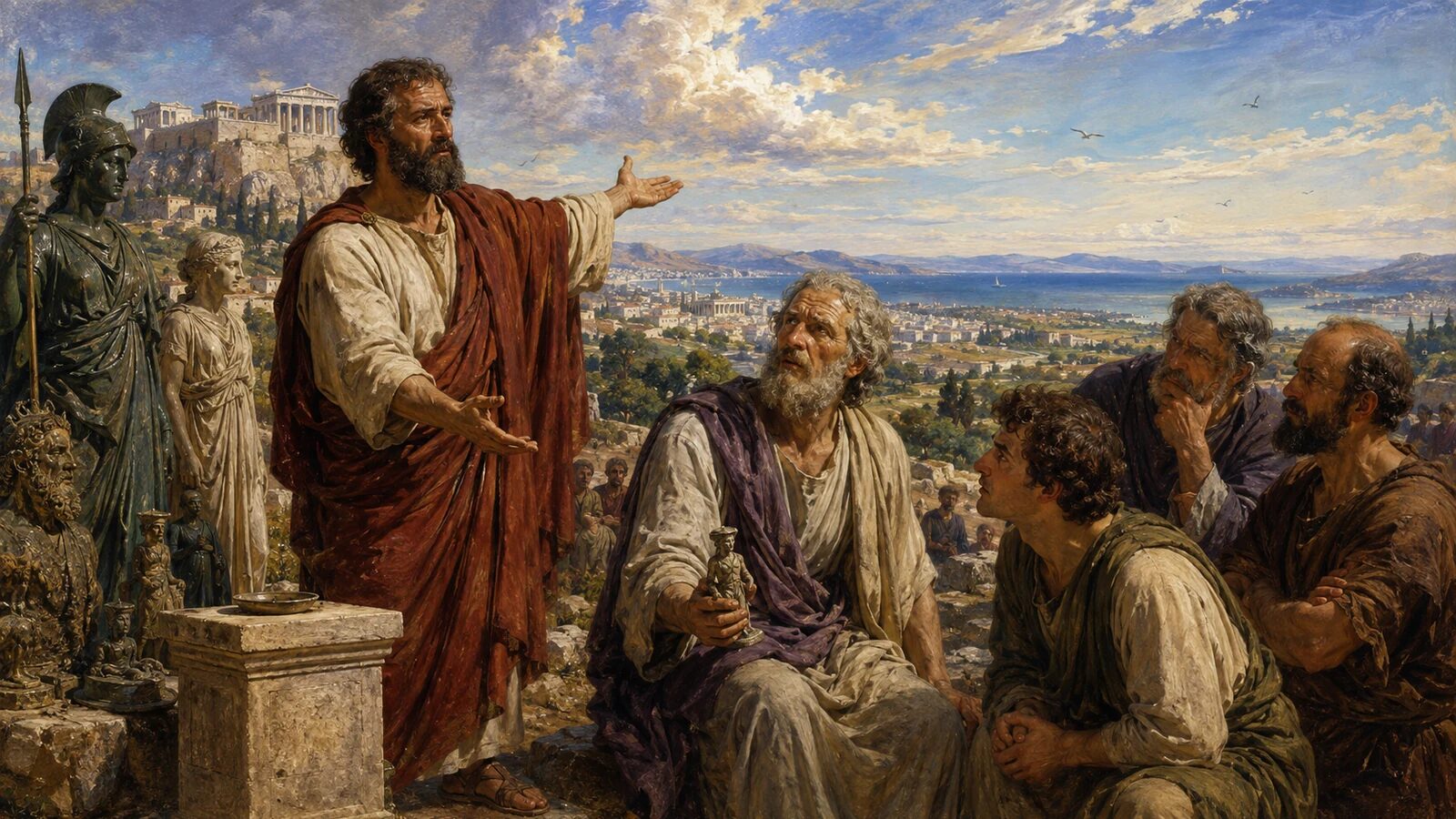
Paul makes that connection between creation and Christ in Acts 17:16–34. Athens was filled with idols, and philosophers brought him to the Areopagus to explain his teaching. He told them that the God who made the world gives every nation life and breath. This God does not depend on temples or human service to sustain Him. Paul even used words familiar from their poets to challenge the idea that the divine nature could be represented by an idol made through human art.
He then called his hearers to repent because God had appointed a day of judgment. Christ’s resurrection gave assurance that the judgment would take place.
because He has appointed a day on which He will judge the world in righteousness by the Man whom He has ordained. He has given assurance of this to all by raising Him from the dead.
Some mocked when they heard about the resurrection, others wanted to hear Paul again, and some believed. Paul reasoned from things his audience could recognize, but his appeal went on to the risen Christ. They needed to respond to Him.
The Judge is also the Savior sinners need. Jesus, born of a virgin and entirely without sin, willingly gave Himself to be slain as the perfect sacrifice for our sins. Wicked men tortured and crucified Him, and He shed His innocent blood and died for us. His sacrificial offering through that blood and death was complete before He was buried and rose bodily. The Father did not punish, curse, abandon, strike, bruise, or pour wrath on Jesus; Father and Son were united in providing our redemption. Our defense of belief in God should lead us to proclaim the One through whom guilty people can be forgiven.
Answering Objections with Truth and Humility
A difficult question does not threaten the truth, and I should not treat the person asking as though he has done something wrong by raising it. We may need to distinguish a created process from its ultimate explanation or discuss why an eternal Creator differs from a creature. A particular biblical question may need its own careful answer; the study on who Cain’s wife was is one example.
A person asking about evil may be grieving a terrible loss. If I begin with a lecture about moral standards before listening to him, I may fail to answer the question he is actually asking. Scripture gives room for lament in Job and the Psalms, and Jesus wept at Lazarus’s tomb. We should listen patiently and never assume that a particular illness or disaster proves the sufferer committed a particular sin.
When we call something objectively wrong, we mean more than that it offends our preferences. I believe the holy God provides the foundation for that judgment: evil violates His good order. Scripture traces evil to creaturely rebellion, including humanity’s fall and the activity of the devil. God remains in authority without becoming the author of sin.
Removing God does not resolve the suffering or give us a firmer basis for condemning it. His knowledge and authority ensure that no wrong escapes final justice, even when human courts fail to discover it. The cross also shows that He did not remain distant from human suffering. The sinless Son was betrayed and crucified by wicked men, yet God provided mercy through what He willingly endured without declaring their evil good.
I cannot tell someone why God permitted a particular loss when He did. I can point him to what God has done in history against sin and death, His promise of resurrection, and His coming judgment. He will defeat the devil and judge rightly. Those promises give us hope without requiring us to pretend that the suffering is less terrible than it is.
1 Peter 3:15 instructs believers to give a defense with meekness and fear, or gentleness and reverence. If I humiliate someone to show how foolish I think his question is, I should not congratulate myself on defending the faith. Plain speaking does not require cruelty, and patience does not require evasion. I also need enough honesty to say when I have not examined a question thoroughly, rather than bluff my way through it.
Someone can accept that a Creator exists and still remain unreconciled to God. Christ died for the whole world, and God offers salvation to everyone, although people can resist and reject Him. Whoever repents and believes is forgiven and born again. The Spirit indwells and seals that believer, whose eternal life is secure in Christ. For a fuller explanation of these truths, see the study of salvation.
When I speak with someone about Christ, I should also be praying for him. We ask God to open blind eyes, grant repentance, and work through His Word in the hearer. I can speak with conviction while recognizing that someone’s new birth does not rest on my skill as a debater.
My Final Thoughts
I believe Scripture gives substantial reasons to know that God exists. Creation bears witness to His power and wisdom, while our personhood and conscience are explained by the God whose image we bear. We can consider these things confidently without pretending a well-phrased argument can give someone new life.
The answer should lead to Jesus Christ, who made us, entered our world, and shed His blood for sinners. He rose bodily and will judge the world in righteousness. I want to speak plainly enough to call people to Him and patiently enough to hear what they are struggling to understand, trusting God to work through His truth.