
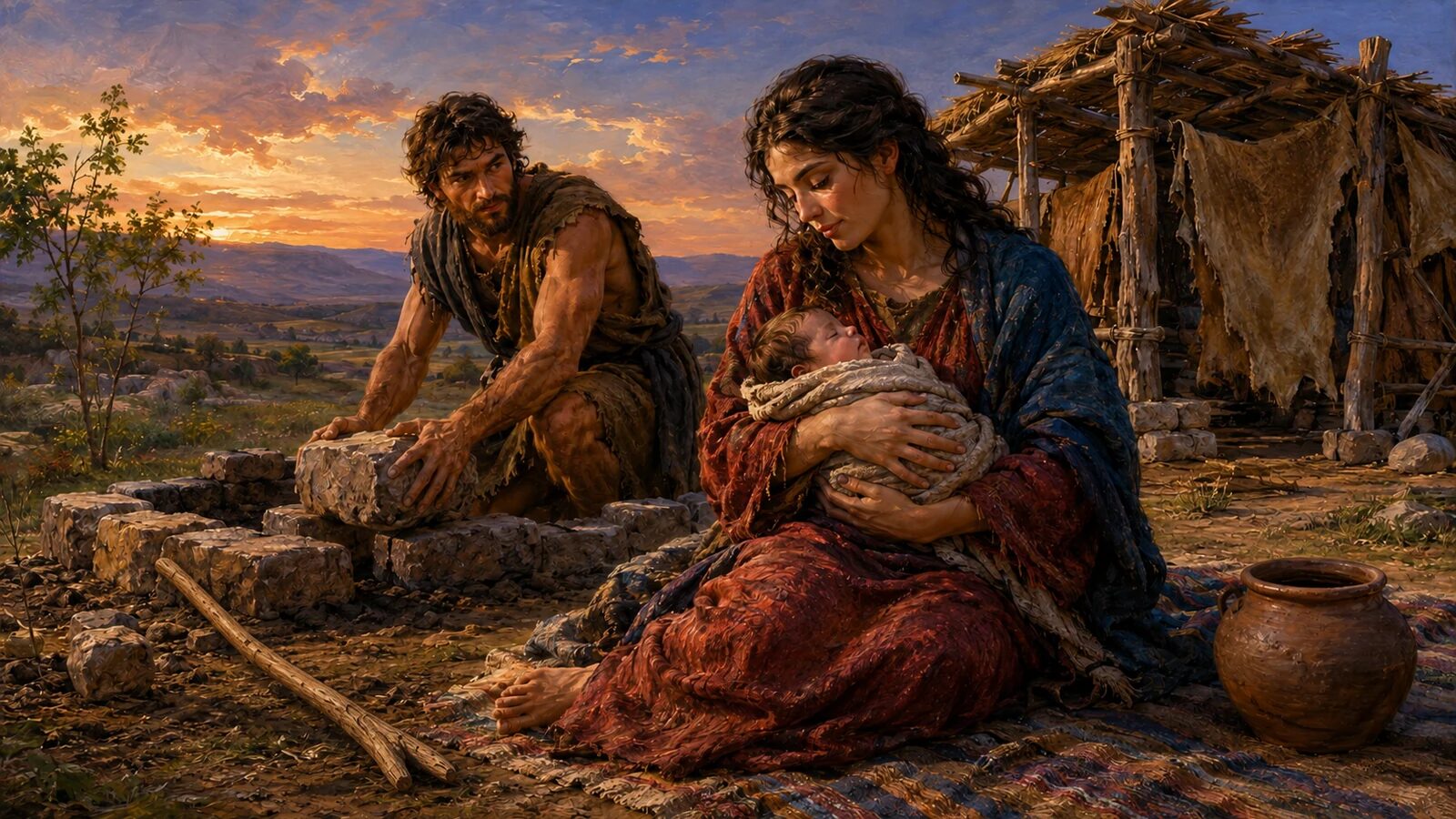
Who did Cain marry? Genesis 4 names Adam and Eve, then Cain and Abel, before mentioning a wife it has not introduced. I want to understand where she fits within the family history Genesis gives us. We do not need to invent people outside Adam’s line to account for her.
One Human Family with Many Unnamed Children
Before Genesis introduces Cain’s wife, it tells us something that governs how we should understand her place in the family. All humanity descends from Adam and Eve. Eve was not the mother of just one branch, for Scripture calls her the mother of all living.
And Adam called his wife’s name Eve, because she was the mother of all living.
If Eve was the mother of all living, Cain’s wife belonged to Adam and Eve’s family too. That leaves no room for a separate human line existing alongside them, including an unrelated population in Nod from which Cain could have chosen a wife.
After Cain murdered Abel, God judged him and sent him away from the LORD’s presence. He settled in Nod, where the account tells us that his wife conceived and bore Enoch. That brief mention has led some readers to question Genesis or imagine pre-Adamite people, meaning people before Adam, or another unrecorded line of human creation. But we can answer the question from the longer family history Genesis itself provides.
Paul confirms the same human unity when he tells the men of Athens that God made every nation from one blood. He is making a theological statement, not offering a modern account of genetics. Our languages and places of residence differ, as do our histories and cultures, but we belong to one human family under one Creator.
And He has made from one blood every nation of men to dwell on all the face of the earth…
Sharing that origin means no group can be regarded as less human than another. Every person bears God’s image and answers to the same Lord, so racism and contempt have no place in biblical Christianity. Cain’s wife belongs within that shared family. Accounting for her does not require us to imagine outsiders with a separate human origin.
Genesis tells us true history without naming everyone who lived. Cain and Abel are named because their lives show sin spreading into murder and the judgment that followed. Seth takes Abel’s place and continues the worshiping line that calls on the LORD. But these three were not Adam and Eve’s only children.
After he begot Seth, the days of Adam were eight hundred years; and he had sons and daughters.
Adam’s unnamed sons and daughters give us the answer we need. Cain could have married one of those daughters. If enough time had passed for grandchildren to be born, she could have been a niece or another close descendant instead. I can be confident that she belonged to the family without claiming to know the exact relationship Scripture leaves unstated.
Adam lived 930 years, and the generations before the Flood also had very long lives. Genesis 5 repeatedly records sons and daughters, giving us reason to picture a family growing over many years. Genesis 4 covers that history briefly. It does not say Cain murdered Abel only days after creation and then entered a world inhabited by no one but his parents. The account follows the events needed for its message without telling us every interval between them.
We are not told how old Cain or Abel was when the murder occurred. Their births appear earlier in the account, but that order does not tell us how many days or years separated the events. Both had time to establish occupations and bring offerings, and they could converse in the field. They belonged to a growing family, including future members whom Cain feared he might encounter.
I do not want to mistake an unnamed person for someone who did not exist. Genesis follows covenant lines and gives particular attention to people at major moral turning points, while leaving many ordinary family details unstated. The Spirit’s purpose in Genesis 4 was to show sin spreading after the fall and contrast Cain’s rebellion with those who later worshiped the LORD. A complete register of Adam’s children was not needed for that purpose, so Cain’s wife remains unnamed.
What Genesis Says About Cain’s Wife
We can also learn from the way Genesis 4:17 introduces Cain’s wife.
And Cain knew his wife, and she conceived and bore Enoch. And he built a city, and called the name of the city after the name of his son, Enoch.
The verse calls her Cain’s wife before saying that she conceived and bore Enoch. It does not describe Cain meeting her for the first time in Nod or finding an unrelated woman from another people. That is a different claim from what the text actually says.
The Hebrew verb yada normally means “to know,” but in Genesis 4:1 and Genesis 4:17 it is a modest expression for marital relations. Understanding its use here helps us avoid reading the verse as Cain’s first meeting with this woman. It tells us that his wife conceived and bore Enoch, placing her within the existing family history without naming her or specifying her relationship to Cain.
From there, Genesis follows Cain’s family after his judgment. His wife bore a son, and Cain built a city. The account eventually reaches Lamech’s violence and pride. At no point does it introduce a population outside Adam’s family.
Cain’s fear of being killed also makes sense within his own family, even though it is sometimes taken as evidence of a large unrelated population.
Surely You have driven me out this day from the face of the ground; I shall be hidden from Your face; I shall be a fugitive and a vagabond on the earth, and it will happen that anyone who finds me will kill me.
Abel was not an anonymous victim in a city of strangers. He was a son and brother within the first family. Cain knew he had shed innocent blood and that his relatives would eventually hear about it. Unnamed siblings could regard him as both guilty and dangerous, and that concern would reach nieces, nephews, and later descendants as the family grew. His words could include people he expected to meet over a long lifetime, not only those alive nearby on that day.
God’s mark did not reward Cain or declare him innocent. The Lord judged him and sent him away, but also restrained private vengeance so that the first murder would not set off an uncontrolled cycle of bloodshed.
And the LORD said to him, “Therefore, whoever kills Cain, vengeance shall be taken on him sevenfold.” And the LORD set a mark on Cain, lest anyone finding him should kill him.
That restraint leaves Cain guilty while keeping judgment in God’s hands. As sin spread, neither Cain nor relatives seeking revenge had the right to decide for themselves what justice required. The Lord remained their Judge.
Genesis tells us what the mark did: it protected Cain from being killed. It gives no physical description and never identifies it as dark skin, an ethnicity, or a racial curse passed to his descendants. Those later racist claims are inventions imposed on the account, not conclusions drawn from it.
Cain’s city, named after Enoch, does not require us to imagine thousands of residents with formal streets, towers, and public buildings. The Hebrew word ir can refer to a city or town, but also to a settled community. Here it describes a settlement formed around Cain’s household and descendants, rather than a modern metropolis.
The family did not remain limited to Cain’s immediate household. Genesis 4 soon names Lamech with his wives and children as the line grew. It describes tent dwelling and livestock, followed by music and metalworking. Society was developing useful skills even while sin took a deeper hold.
Naming the settlement after his son may show Cain’s concern for family identity and legacy after God drove him from the ground. I would keep that as a possibility rather than claim to know all his motives. What Genesis plainly places side by side is human achievement and rebellion. Cain’s descendants organized society and developed useful skills, yet Lamech practiced polygamy and boasted of violence. Cultural ability had not cured the sinful heart.
The Earliest Marriages and God’s Later Law
That leaves a moral question: why was marriage to a close relative allowed at the beginning? Genesis starts with one man and one woman whom God commanded to multiply.
Then God blessed them, and God said to them, “Be fruitful and multiply; fill the earth and subdue it…”
With Adam and Eve as the first and only human couple, their children could marry only within that family. There was no other way for humanity to fulfill the command to multiply. Genesis does not stop to defend the arrangement, but describes the necessary beginning of one family filling the earth.
Genesis gives the creation pattern for marriage before Cain ever appears.
Therefore a man shall leave his father and mother and be joined to his wife, and they shall become one flesh.
Cain’s murder did not undo the pattern God had established for marriage. Genesis 4 plainly condemns his murder but does not condemn his marriage. I would not turn that silence into permission for later incest, but neither would I use it to accuse Genesis of moral confusion.
There is also the question of biological risk. Modern genetics explains why reproduction between close relatives is dangerous: they share more stretches of DNA, making it more likely that a child receives two copies of the same harmful recessive variant. Scripture does not provide Adam and Eve’s genomic details or tell us how many mutations existed in the early generations. Within the biblical creation account, it is reasonable to infer that humanity began without the burden of harmful inherited variants present after many generations. I would keep that theological inference distinct from what a verse explicitly says. It is not a directly testable description of Cain’s family, and the answer depends on the history Scripture gives us, not on treating Genesis as a modern genetics textbook.
By Moses’ time, humanity had spread into many families and nations, with tribes and clans already established. God formed Israel as His covenant people and gave clear limits for sexual relations within the family. Leviticus 18 states those boundaries directly.
“None of you shall approach anyone who is near of kin to him, to uncover his nakedness: I am the LORD.”
Leviticus identifies the forbidden relationships, including a sister or a father’s wife. A granddaughter, an aunt, and a daughter-in-law are also excluded. The expression “uncover nakedness” refers modestly to sexual relations. These commands call God’s people to holiness by protecting family order and sexual purity.
Those commands addressed a later period, when close-family marriage was no longer necessary and God was setting Israel apart from surrounding nations. They do not contradict the beginning described in Genesis. Nor can we dismiss them as merely ceremonial rules for Israel, since the chapter says these practices had already defiled the nations and would cause the land to cast out its inhabitants.
The historical setting had changed as humanity multiplied; God’s character had not. Obligations suited to that later setting do not make morality relative. The first generations came from one married couple, so close-relative marriages were unavoidable. Once there were established clans and nations, God gave explicit boundaries to protect households from sexual confusion and abuse, as well as the rivalry and shame these relationships could bring. His people were bound to obey the commands He gave.
“Do not defile yourselves with any of these things; for by all these the nations are defiled, which I am casting out before you.”
Paul treats the same boundary seriously in the New Testament. When the Corinthian church tolerated a man who had his father’s wife, he called the relationship sexual immorality and said the church should have mourned. It was not a private preference or a gray area that local custom could make acceptable.
It is actually reported that there is sexual immorality among you, and such sexual immorality as is not even named among the Gentiles, that a man has his father’s wife!
We should keep both periods in view. Close-relative marriage was necessary in humanity’s first generations and is not condemned in Genesis, while later incest is plainly forbidden and morally serious. Cain’s marriage does not weaken what Leviticus 18 or 1 Corinthians 5 teaches.
Answers Without Speculation
We can now answer the proposal of another human population from the passages already before us. Genesis 3:20 calls Eve the mother of all living, and Acts 17:26 says every nation came from one blood. An unrelated people from whom Cain chose a wife would not fit that evidence.
Nod was the region where Cain lived after judgment, not evidence that he found unrelated people there. The account does not say he arrived and then chose a wife from another people. Genesis 4:17 already refers to her as his wife.
Neither Cain’s fear nor his settlement requires a separate race. Over the long lives Genesis records, the family could have grown to include many siblings and later descendants. Cain had reason to fear what relatives might do when they learned of Abel’s murder, and his own household could develop into a settled community. Both fit the family history given in Genesis 3:20 and Genesis 5:4 without adding outsiders.
The moral question also becomes clearer when we follow the sequence Genesis gives us. Humanity began within one family, and later Scripture prohibited close-relative unions after the population had multiplied. We are seeing a change in historical circumstances, not confusion or a change in God’s holy character.
We also do not know Cain’s wife’s name. Scripture does not give it, and any name supplied from later tradition stands outside the biblical text. I would not teach such a name as fact when God chose not to record it.
Adam, Sin, and the Savior We Need
Cain’s place in that family also connects this question to the gospel. Genesis presents Adam and Eve as real people, with sin entering through Adam and death spreading because of sin. We all belong to that fallen human family and need the same Savior.
Therefore, just as through one man sin entered the world, and death through sin, and thus death spread to all men, because all sinned…
Paul’s comparison of Adam and Christ depends on a real Adam, the historical head through whom sin and death entered. Christ is the last Adam, the sinless Savior who brings life. I cannot turn Genesis into a loose myth or give humanity unrelated origins without damaging the account on which that gospel argument rests.
Jesus Christ entered this human family to save sinners. He is the eternal Son, fully God and fully man, born of a virgin and entirely sinless. Wicked men physically tortured and punished Him, then killed Him. He willingly bore that real punishment for our sins in His innocent body, shedding His blood. He died, was buried, and rose bodily. The Father did not punish or curse Jesus, nor did He abandon Him. He did not strike or bruise His Son or pour wrath on Him.
Christ died for the whole world, and God’s offer is genuine even though people can resist it. Everyone who repents and believes is forgiven and justified, meaning declared righteous before God. He is born again and made new, with the Holy Spirit indwelling and sealing him, and his eternal life is secure. That security never excuses lawlessness, and a superficial profession does not prove new birth. The Bible that places Cain within one fallen family also announces salvation in Jesus Christ alone.
I want to trust Genesis as history without demanding a record of every person and event. Moses wrote an inspired account with a particular purpose, leaving many children unnamed and omitting details about wives and settlements that did not advance it. That selectivity does not make the history fictional. What God chose not to tell us is missing information, not a contradiction.
There is no need to supply pre-Adamite people or a hidden population outside Adam and Eve’s family. Genesis already describes sons and daughters whose names it does not record, and their long lives allowed that one family to grow over time. We should let that explanation stand without adding speculative details.
Cain’s murder, his fear, and God’s protective mark should also make us take seriously how one act of violence could lead to more bloodshed. His city and the later conduct of Lamech show that social development did not stop sin from shaping human life. I cannot read that as a problem only the first family had. We need God’s mercy and restraint too.
Honoring the whole Bible means accepting both the beginning described in Genesis and the later commands against incest in Leviticus and the New Testament. We should not use the first family’s circumstances to excuse what God forbids in the populated world.
For related study, see Lamech From the Line of Cain, The Age of the Earth, and How to Study the Bible Properly.
My Final Thoughts
Cain’s wife was a descendant of Adam and Eve, most likely Cain’s unnamed sister, though she could have been a niece or another close descendant. Scripture gives neither her name nor her exact relationship to him, and I do not want to turn a guess into a fact. Eve was the mother of all living, and Adam had sons and daughters, so Genesis gives us enough to place her within that one family. We can accept that answer while taking God’s later commands seriously. It also reminds me that all of Adam’s children share a deeper need: only Jesus Christ can overcome the sin and death that entered our family.