
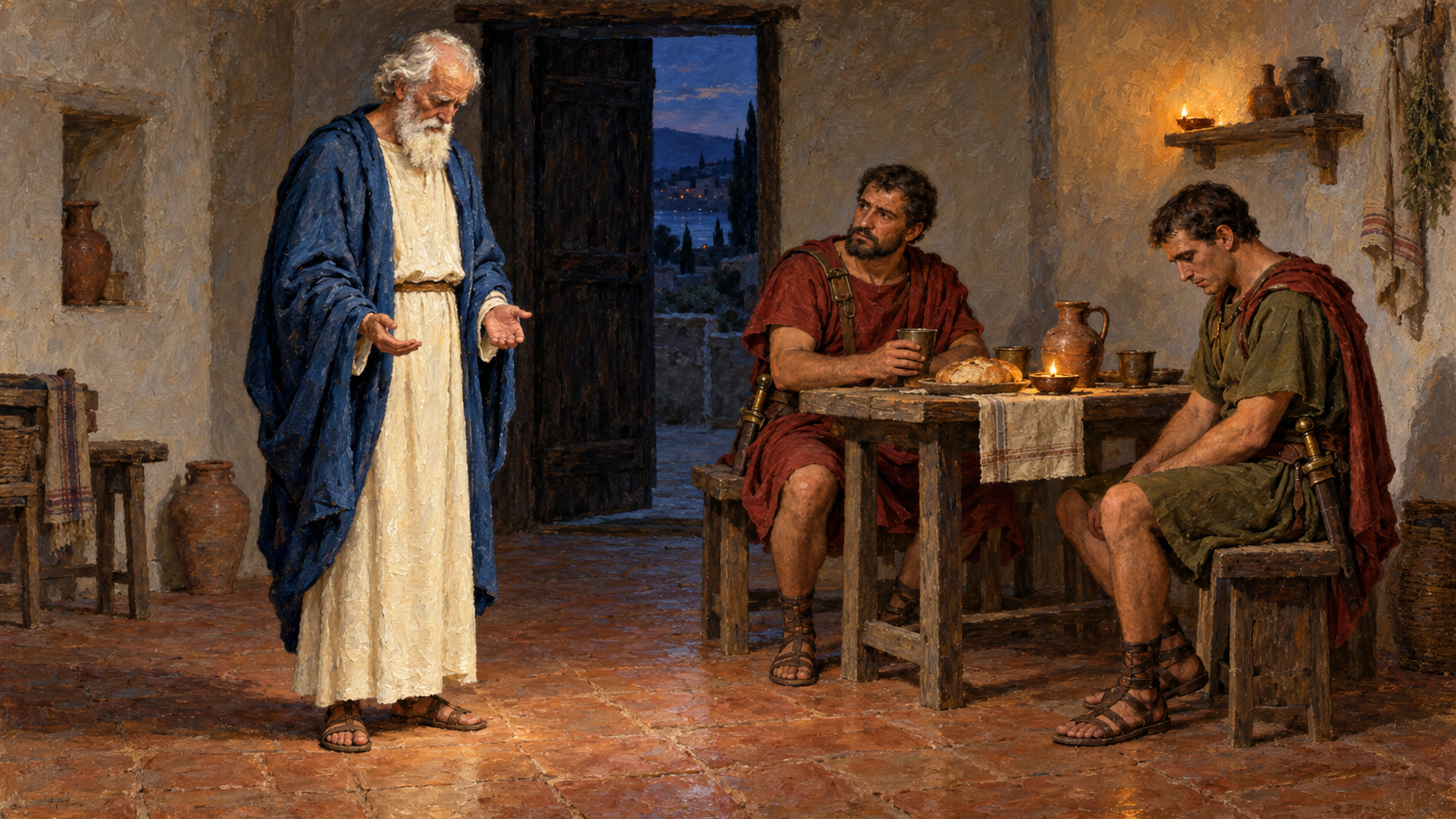
Polycarp deserves attention because his ministry brings us close to the generation that knew the apostles. But closeness to that generation does not make every statement about him equally reliable. I want to read his own letter, consider what others remembered, and distinguish those sources from the account of his death. We can learn from an early Christian pastor while continuing to measure his teaching and reported conduct by Scripture.
Begin With the Sources and Keep Them Separate
My starting point is the authority Scripture claims for itself. Paul’s instruction to Timothy gives us the standard by which to examine a teacher, however early or respected he may be.
But you must continue in the things which you have learned and been assured of, knowing from whom you have learned them, and that from childhood you have known the Holy Scriptures, which are able to make you wise for salvation through faith which is in Christ Jesus. All Scripture is given by inspiration of God, and is profitable for doctrine, for reproof, for correction, for instruction in righteousness, that the man of God may be complete, thoroughly equipped for every good work.
Scripture alone is God-breathed and has final authority over doctrine and conduct. Polycarp was an overseer in Smyrna, and his surviving letter provides valuable evidence of Christian teaching after the apostolic generation. That historical value does not make the letter inspired or its writer infallible. An early document can tell us what someone believed without proving that the belief is true.
We have four main sources to keep in view. Polycarp’s own Epistle to the Philippians gives us his teaching directly. Irenaeus supplies recollections and reports about him. Eusebius, writing much later, preserves some of that earlier material. The Martyrdom of Polycarp is a church account of his arrest and death. Its words should not be presented as though Polycarp wrote them himself.
The dates require the same care. AD 69 or 70 is often given as his birth year, sometimes with the claim that his parents were Christians. The early evidence considered here does not firmly establish either detail. The martyrdom account reports that he had served Christ for eighty-six years, but interpreters differ over whether that describes his age or the length of his Christian service. It is not a complete birth record.
His death belongs in the mid-second century. AD 155 or 156 is commonly proposed from the chronology associated with the proconsul Statius Quadratus, the Roman provincial governor named in the account, although older calculations placed it later. Discussion of that chronology shows why the precise year should not be treated as settled. I would use the broader period confidently and leave the disputed year open.
Polycarp’s Place in Smyrna and the Apostolic Generation
Respect for a teacher and examination of his teaching belong together. The Bereans eagerly received Paul’s message and still searched Scripture to determine whether it was true.
Then the brethren immediately sent Paul and Silas away by night to Berea. When they arrived, they went into the synagogue of the Jews. These were more fair-minded than those in Thessalonica, in that they received the word with all readiness, and searched the Scriptures daily to find out whether these things were so. Therefore many of them believed, and also not a few of the Greeks, prominent women as well as men.
In Against Heresies 3.3.4, Irenaeus says that apostles instructed Polycarp and appointed him in Smyrna. He also says Polycarp knew people who had seen Christ. This is substantial early testimony, including Irenaeus’s statement that he himself saw Polycarp when young.
A more personal recollection survives in Irenaeus’s letter to Florinus, preserved in Eusebius’s Church History 5.20. Irenaeus remembered where Polycarp sat, his appearance and habits, and his accounts of John and others who had seen the Lord. He said Polycarp related their teaching in harmony with Scripture. I take that testimony seriously, while recognizing that it is a later recollection of childhood rather than a transcript recorded at the time.
Calling Polycarp a disciple of John therefore expresses an early historical claim. The New Testament does not name him or describe the relationship. The connection is worth studying, and the study on John the Beloved Disciple considers John’s own biblical witness. Neither personal contact with an apostle nor a respected chain of teachers can make a doctrine right if it contradicts the apostolic Word.
Smyrna lay on the western coast of what is now Turkey, within the Roman province of Asia. Revelation 2 addresses a suffering church there decades before the traditional date of Polycarp’s death. That shared setting makes the passage relevant to his later ministry, but it does not identify him as the unnamed angel, or messenger, addressed in the letter. Identifying that messenger as Polycarp goes beyond what Scripture tells us.
Irenaeus and Eusebius identify him with Smyrna’s church, while his own greeting names “Polycarp” and “the presbyters with him.” Presbyters are elders, and the greeting places him in fellowship with other church leaders. Bishop means overseer in New Testament usage. We should understand the work described rather than assume the title carried every feature of a later office. Polycarp’s position does not establish the later papacy, a sacramental priesthood, Marian doctrines, or a fully developed later hierarchy.
Another report illustrates how much early leaders could differ in practice. In Church History 5.24, Eusebius preserves Irenaeus’s account of Polycarp’s disagreement with Anicetus, the overseer at Rome, over the timing of the annual observance associated with Passover. Each appealed to received custom, neither persuaded the other, and they maintained fellowship. Anicetus honored Polycarp despite their disagreement.
I cannot make Polycarp’s calendar binding simply because he followed it. Nor should every disagreement over a practice divide Christians. We need to determine from Scripture whether God has commanded a particular order, whether essential doctrine is involved, or whether believers are free to differ. Early practice was not uniform in every detail, and age alone cannot settle the question.
Polycarp’s Philippian letter arose from communication between churches. The Philippians had asked for counsel and material associated with Ignatius, another early overseer who wrote while being taken under guard toward execution. Polycarp discussed forwarding letters and asked for further information about Ignatius and his companions. This correspondence places him among congregations exchanging teaching, news, and practical help.
The letter is brief and pastoral. Polycarp addresses married believers, widows, younger people, deacons, and presbyters, urging faith, righteous conduct, repentance, and perseverance. Irenaeus knew the document and commended it as evidence of Polycarp’s faith and preaching. Here we can examine what Polycarp actually taught, rather than reconstructing his teaching entirely from someone else’s memories.
What Polycarp’s Letter Teaches
Polycarp repeatedly draws on apostolic writings. To appreciate that dependence, we need to distinguish the inspired message from a later pastor’s use of it.
For we did not follow cunningly devised fables when we made known to you the power and coming of our Lord Jesus Christ, but were eyewitnesses of His majesty. For He received from God the Father honor and glory when such a voice came to Him from the Excellent Glory: "This is My beloved Son, in whom I am well pleased." And we heard this voice which came from heaven when we were with Him on the holy mountain. And so we have the prophetic word confirmed, which you do well to heed as a light that shines in a dark place, until the day dawns and the morning star rises in your hearts; knowing this first, that no prophecy of Scripture is of any private interpretation, for prophecy never came by the will of man, but holy men of God spoke as they were moved by the Holy Spirit.
Polycarp’s letter echoes or quotes teaching found in Matthew and Luke, Acts, Romans, and the Corinthian letters. Galatians, Ephesians, Philippians, and the Thessalonian correspondence also appear in its language, along with the Pastoral Epistles, 1 Peter, and 1 John. Some wording suggests the influence of Hebrews as well. A particular echo may be disputed, but his broad dependence on apostolic teaching is clear. The letter gives historical evidence of those writings circulating and guiding Christian instruction.
That does not make Polycarp’s own document part of the New Testament canon, the collection of inspired books. He quoted and applied apostolic teaching as a human pastor. His counsel carries weight where it faithfully reflects Scripture; he could not add private revelation or make his own words equal to Paul or Peter.
Polycarp’s teaching about salvation is especially clear when he echoes Paul’s words about grace.
And you He made alive, who were dead in trespasses and sins, in which you once walked according to the course of this world, according to the prince of the power of the air, the spirit who now works in the sons of disobedience, among whom also we all once conducted ourselves in the lusts of our flesh, fulfilling the desires of the flesh and of the mind, and were by nature children of wrath, just as the others. But God, who is rich in mercy, because of His great love with which He loved us, even when we were dead in trespasses, made us alive together with Christ (by grace you have been saved), and raised us up together, and made us sit together in the heavenly places in Christ Jesus, that in the ages to come He might show the exceeding riches of His grace in His kindness toward us in Christ Jesus. For by grace you have been saved through faith, and that not of yourselves; it is the gift of God, not of works, lest anyone should boast. For we are His workmanship, created in Christ Jesus for good works, which God prepared beforehand that we should walk in them.
Polycarp says believers are saved by grace rather than works, through God’s will in Jesus Christ. He then urges righteous conduct, mercy, truthfulness, patience, and the rejection of greed and evil speech. Paul gives us the order for understanding those commands: we are created in Christ for good works. Obedience follows salvation and provides evidence of new life; it does not purchase eternal life.
Polycarp also uses conditional language in exhorting believers to obey. I read those exhortations under the apostles’ clear teaching about genuine new birth and the Holy Spirit’s seal. A Christian label alone does not establish regeneration, but a person truly born again is eternally secure. Polycarp’s wording cannot overrule Scripture by making salvation something we earn or something a genuine believer must keep earning to retain.
Polycarp’s insistence that Christ truly came in the flesh likewise follows the apostolic witness. John begins by identifying the eternal Word as God and then declaring His real incarnation, His coming in human flesh.
In the beginning was the Word, and the Word was with God, and the Word was God. He was in the beginning with God. All things were made through Him, and without Him nothing was made that was made. In Him was life, and the life was the light of men. And the light shines in the darkness, and the darkness did not comprehend it. There was a man sent from God, whose name was John. This man came for a witness, to bear witness of the Light, that all through him might believe. He was not that Light, but was sent to bear witness of that Light. That was the true Light which gives light to every man coming into the world. He was in the world, and the world was made through Him, and the world did not know Him. He came to His own, and His own did not receive Him. But as many as received Him, to them He gave the right to become children of God, to those who believe in His name: who were born, not of blood, nor of the will of the flesh, nor of the will of man, but of God. And the Word became flesh and dwelt among us, and we beheld His glory, the glory as of the only begotten of the Father, full of grace and truth. John bore witness of Him and cried out, saying, "This was He of whom I said, 'He who comes after me is preferred before me, for He was before me.'" And of His fullness we have all received, and grace for grace. For the law was given through Moses, but grace and truth came through Jesus Christ. No one has seen God at any time. The only begotten Son, who is in the bosom of the Father, He has declared Him.
John’s first letter also tests teaching by whether it confesses the Jesus who actually came in the flesh.
Beloved, do not believe every spirit, but test the spirits, whether they are of God; because many false prophets have gone out into the world. By this you know the Spirit of God: Every spirit that confesses that Jesus Christ has come in the flesh is of God, and every spirit that does not confess that Jesus Christ has come in the flesh is not of God. And this is the spirit of the Antichrist, which you have heard was coming, and is now already in the world. You are of God, little children, and have overcome them, because He who is in you is greater than he who is in the world. They are of the world. Therefore they speak as of the world, and the world hears them. We are of God. He who knows God hears us; he who is not of God does not hear us. By this we know the spirit of truth and the spirit of error.
Following 1 John, Polycarp condemns the refusal to confess Jesus Christ coming in the flesh. He confronts the error commonly called docetism, the claim that Christ’s physical humanity and suffering only appeared to be real. Scripture teaches that the eternal Son is fully God and truly became fully man. He was born of a virgin, lived without sin, suffered physically on the cross, and rose bodily. Polycarp’s rejection of a merely apparent humanity agrees with that apostolic witness. The doctrine itself rests on Scripture.
Polycarp also affirms that God raised Jesus and will raise believers, and he rejects the denial of resurrection and judgment. Paul’s explanation shows why these truths belong to the gospel.
Moreover, brethren, I declare to you the gospel which I preached to you, which also you received and in which you stand, by which also you are saved, if you hold fast that word which I preached to you–unless you believed in vain. For I delivered to you first of all that which I also received: that Christ died for our sins according to the Scriptures, and that He was buried, and that He rose again the third day according to the Scriptures, and that He was seen by Cephas, then by the twelve. After that He was seen by over five hundred brethren at once, of whom the greater part remain to the present, but some have fallen asleep. After that He was seen by James, then by all the apostles. Then last of all He was seen by me also, as by one born out of due time. For I am the least of the apostles, who am not worthy to be called an apostle, because I persecuted the church of God. But by the grace of God I am what I am, and His grace toward me was not in vain; but I labored more abundantly than they all, yet not I, but the grace of God which was with me. Therefore, whether it was I or they, so we preach and so you believed. Now if Christ is preached that He has been raised from the dead, how do some among you say that there is no resurrection of the dead? But if there is no resurrection of the dead, then Christ is not risen. And if Christ is not risen, then our preaching is empty and your faith is also empty. Yes, and we are found false witnesses of God, because we have testified of God that He raised up Christ, whom He did not raise up–if in fact the dead do not rise. For if the dead do not rise, then Christ is not risen. And if Christ is not risen, your faith is futile; you are still in your sins! Then also those who have fallen asleep in Christ have perished. If in this life only we have hope in Christ, we are of all men the most pitiable. But now Christ is risen from the dead, and has become the firstfruits of those who have fallen asleep. For since by man came death, by Man also came the resurrection of the dead. For as in Adam all die, even so in Christ all shall be made alive. But each one in his own order: Christ the firstfruits, afterward those who are Christ's at His coming. Then comes the end, when He delivers the kingdom to God the Father, when He puts an end to all rule and all authority and power. For He must reign till He has put all enemies under His feet. The last enemy that will be destroyed is death. For "He has put all things under His feet." But when He says "all things are put under Him," it is evident that He who put all things under Him is excepted. Now when all things are made subject to Him, then the Son Himself will also be subject to Him who put all things under Him, that God may be all in all.
Jesus’ bodily resurrection gives believers a bodily hope. The One who died for our sins was buried and rose again, and those who belong to Him will be raised at His coming. Jesus also taught that resurrection awaits people who will face condemnation.
"Most assuredly, I say to you, he who hears My word and believes in Him who sent Me has everlasting life, and shall not come into judgment, but has passed from death into life. Most assuredly, I say to you, the hour is coming, and now is, when the dead will hear the voice of the Son of God; and those who hear will live. For as the Father has life in Himself, so He has granted the Son to have life in Himself, and has given Him authority to execute judgment also, because He is the Son of Man. Do not marvel at this; for the hour is coming in which all who are in the graves will hear His voice and come forth–those who have done good, to the resurrection of life, and those who have done evil, to the resurrection of condemnation. I can of Myself do nothing. As I hear, I judge; and My judgment is righteous, because I do not seek My own will but the will of the Father who sent Me.
Unbelievers will be raised and judged at the Great White Throne. I would not turn Polycarp’s affirmation of resurrection into proof that the human soul is inherently immortal. Scripture teaches that God raises the dead and that the unredeemed face the final destruction of both body and soul in the Lake of Fire. We need to distinguish what Polycarp actually affirmed from later theories someone might attach to his words.
Leadership, Pastoral Care, and Doctrinal Boundaries
Polycarp’s instructions to deacons and presbyters repeatedly concern character. Financial integrity, compassion, truthfulness, and fair judgment belong together in the work of caring for people. These are also concerns of the Pastoral Epistles.
This is a faithful saying: If a man desires the position of a bishop, he desires a good work. A bishop then must be blameless, the husband of one wife, temperate, sober-minded, of good behavior, hospitable, able to teach; not given to wine, not violent, not greedy for money, but gentle, not quarrelsome, not covetous; one who rules his own house well, having his children in submission with all reverence (for if a man does not know how to rule his own house, how will he take care of the church of God?); not a novice, lest being puffed up with pride he fall into the same condemnation as the devil. Moreover he must have a good testimony among those who are outside, lest he fall into reproach and the snare of the devil. Likewise deacons must be reverent, not double-tongued, not given to much wine, not greedy for money, holding the mystery of the faith with a pure conscience. But let these also first be tested; then let them serve as deacons, being found blameless. Likewise, their wives must be reverent, not slanderers, temperate, faithful in all things. Let deacons be the husbands of one wife, ruling their children and their own houses well. For those who have served well as deacons obtain for themselves a good standing and great boldness in the faith which is in Christ Jesus.
Paul’s instruction to Titus identifies elders and overseers through the same qualifications and teaching responsibilities.
For this reason I left you in Crete, that you should set in order the things that are lacking, and appoint elders in every city as I commanded you– if a man is blameless, the husband of one wife, having faithful children not accused of dissipation or insubordination. For a bishop must be blameless, as a steward of God, not self-willed, not quick-tempered, not given to wine, not violent, not greedy for money, but hospitable, a lover of what is good, sober-minded, just, holy, self-controlled, holding fast the faithful word as he has been taught, that he may be able, by sound doctrine, both to exhort and convict those who contradict.
In the New Testament, elder and overseer describe qualified men leading the local church, while pastor describes their work of shepherding. Deacons have their own service and must meet Scripture’s qualifications. A title or an institution’s prestige cannot excuse greed, harshness, or another serious disqualification in the person holding office.
Polycarp tells presbyters to visit the sick, care for widows, orphans, and the poor, and restore those who wander. They are to avoid favoritism and harsh or unjust judgment. His concern extends to the congregation: wives should live in faith, love, and purity while caring truthfully for their households; widows should pray without slandering others; and younger men must resist lust. These instructions describe holiness expressed in ordinary church life.
I can receive such counsel where it agrees with Scripture without treating Polycarp’s letter as an independent rulebook. The pastor who teaches holiness must practice it in his treatment of the weak, his handling of money, and his judgment of an accusation. His respected office does not place those actions beyond examination.
Polycarp was also firm about the content of the faith. He rejected teaching that denied the incarnation, the cross, resurrection, or coming judgment and directed readers back to the Word delivered from the beginning. Paul explains why a different gospel cannot be accepted merely for the sake of outward agreement.
I marvel that you are turning away so soon from Him who called you in the grace of Christ, to a different gospel, which is not another; but there are some who trouble you and want to pervert the gospel of Christ. But even if we, or an angel from heaven, preach any other gospel to you than what we have preached to you, let him be accursed. As we have said before, so now I say again, if anyone preaches any other gospel to you than what you have received, let him be accursed. For do I now persuade men, or God? Or do I seek to please men? For if I still pleased men, I would not be a bondservant of Christ.
Love does not require fellowship with teaching that destroys Christ’s identity or saving work. We must still describe an opponent’s beliefs accurately. Exaggeration does not become truthful because we believe the error is dangerous, and a severe label should never replace evidence of what someone actually teaches. False Teachers examines these responsibilities more fully.
One distinction is easy to lose when Polycarp’s words are retold. In his Philippian letter, he applies the description Satan’s firstborn to someone who twists the Lord’s words for sinful desire and denies resurrection and judgment. That sentence does not name Marcion. Irenaeus separately reports an encounter in which Polycarp recognized Marcion and used that description of him. We should not merge the later report into the text of the epistle.
The severity reflects the danger of overturning the gospel. It does not give me permission to borrow an ancient insult whenever I dislike a teacher. I need to identify the actual error, explain its consequences, and govern my own speech by Scripture.
What the Martyrdom Account Actually Reports
The account of Polycarp’s last days comes from the Martyrdom of Polycarp. It reports that, at other believers’ urging, he left the city and moved between rural places. When officers found him, he stopped fleeing, received them, and asked for time to pray. Jesus’ instructions help us consider both the earlier retreat and his response when arrested.
"Behold, I send you out as sheep in the midst of wolves. Therefore be wise as serpents and harmless as doves. But beware of men, for they will deliver you up to councils and scourge you in their synagogues. You will be brought before governors and kings for My sake, as a testimony to them and to the Gentiles. But when they deliver you up, do not worry about how or what you should speak. For it will be given to you in that hour what you should speak; for it is not you who speak, but the Spirit of your Father who speaks in you. "Now brother will deliver up brother to death, and a father his child; and children will rise up against parents and cause them to be put to death. And you will be hated by all for My name's sake. But he who endures to the end will be saved. When they persecute you in this city, flee to another. For assuredly, I say to you, you will not have gone through the cities of Israel before the Son of Man comes. "A disciple is not above his teacher, nor a servant above his master. It is enough for a disciple that he be like his teacher, and a servant like his master. If they have called the master of the house Beelzebub, how much more will they call those of his household! Therefore do not fear them. For there is nothing covered that will not be revealed, and hidden that will not be known. "Whatever I tell you in the dark, speak in the light; and what you hear in the ear, preach on the housetops. And do not fear those who kill the body but cannot kill the soul. But rather fear Him who is able to destroy both soul and body in hell. Are not two sparrows sold for a copper coin? And not one of them falls to the ground apart from your Father's will. But the very hairs of your head are all numbered. Do not fear therefore; you are of more value than many sparrows. "Therefore whoever confesses Me before men, him I will also confess before My Father who is in heaven. But whoever denies Me before men, him I will also deny before My Father who is in heaven. "Do not think that I came to bring peace on earth. I did not come to bring peace but a sword. For I have come to 'set a man against his father, a daughter against her mother, and a daughter-in-law against her mother-in-law'; and 'a man's enemies will be those of his own household.' He who loves father or mother more than Me is not worthy of Me. And he who loves son or daughter more than Me is not worthy of Me. And he who does not take his cross and follow after Me is not worthy of Me. He who finds his life will lose it, and he who loses his life for My sake will find it.
Jesus allowed His disciples to flee persecution in one city and go to another. He also told them not to deny Him when brought before rulers. Retreat and courage can therefore belong to the same faithful response. We should not provoke authorities or seek danger to create an impressive confrontation. A preventable death is no spiritual achievement, and a prudent escape is not automatically cowardice.
When the proconsul urged Polycarp to reproach Christ, the document portrays him refusing because he had served Christ for eighty-six years and could not blaspheme his King and Savior. This is the reported answer of the martyrdom account, rather than a statement from his surviving epistle. It expresses a conviction consistent with Christ’s earlier message to Smyrna.
"And to the angel of the church in Smyrna write, 'These things says the First and the Last, who was dead, and came to life: "I know your works, tribulation, and poverty (but you are rich); and I know the blasphemy of those who say they are Jews and are not, but are a synagogue of Satan. Do not fear any of those things which you are about to suffer. Indeed, the devil is about to throw some of you into prison, that you may be tested, and you will have tribulation ten days. Be faithful until death, and I will give you the crown of life. "He who has an ear, let him hear what the Spirit says to the churches. He who overcomes shall not be hurt by the second death."'
Jesus called the church to faithfulness unto death and promised the crown of life. The reported refusal to curse Christ gives us conduct to compare with that command. It does not establish that Polycarp was the unnamed messenger, nor does the reference to eighty-six years resolve the uncertainty about his birth.
The account goes on to describe a fire prepared for his execution. It says the flames surrounded him without consuming him and that an executioner then killed him with a dagger. Those details belong to the document’s testimony. Irenaeus also remembers him as an aged martyr, so the broad evidence of his death does not depend on accepting every detail of the fire’s behavior.
The martyrdom account also reports a predictive dream, a heavenly voice, the unusual behavior of the fire, and blood said to have extinguished the flames. I do not rule out miracles, but recognizing God’s power does not independently confirm every miraculous detail in an ancient document. We should identify these as reported events and leave room for disputed or embellished details without dismissing the account merely because it describes supernatural action.
The text describes Christians collecting Polycarp’s remains and remembering his death, and it distinguishes worship of Christ from love for martyrs. That report does not establish authority for later claims about relics or saintly intercession. Remembering a faithful believer and preserving his remains are different from treating those remains as a source of spiritual power or approaching God through the dead. Scripture directs our worship to God and gives us Jesus as the only Mediator.
Peter’s instruction helps us judge the conduct of someone who suffers for professing Christ.
Beloved, do not think it strange concerning the fiery trial which is to try you, as though some strange thing happened to you; but rejoice to the extent that you partake of Christ's sufferings, that when His glory is revealed, you may also be glad with exceeding joy. If you are reproached for the name of Christ, blessed are you, for the Spirit of glory and of God rests upon you. On their part He is blasphemed, but on your part He is glorified. But let none of you suffer as a murderer, a thief, an evildoer, or as a busybody in other people's matters. Yet if anyone suffers as a Christian, let him not be ashamed, but let him glorify God in this matter. For the time has come for judgment to begin at the house of God; and if it begins with us first, what will be the end of those who do not obey the gospel of God? Now "If the righteous one is scarcely saved, Where will the ungodly and the sinner appear?" Therefore let those who suffer according to the will of God commit their souls to Him in doing good, as to a faithful Creator.
Peter distinguishes suffering for being a Christian from suffering for wrongdoing. He tells those who suffer for Christ to keep doing good and entrust themselves to their faithful Creator. Faithfulness includes their conduct under persecution, rather than merely the fact that others oppose them.
Paul’s account of faith in Hebrews also prevents us from making one outcome the measure of obedience.
And what more shall I say? For the time would fail me to tell of Gideon and Barak and Samson and Jephthah, also of David and Samuel and the prophets: who through faith subdued kingdoms, worked righteousness, obtained promises, stopped the mouths of lions, quenched the violence of fire, escaped the edge of the sword, out of weakness were made strong, became valiant in battle, turned to flight the armies of the aliens. Women received their dead raised to life again. Others were tortured, not accepting deliverance, that they might obtain a better resurrection. Still others had trial of mockings and scourgings, yes, and of chains and imprisonment. They were stoned, they were sawn in two, were tempted, were slain with the sword. They wandered about in sheepskins and goatskins, being destitute, afflicted, tormented– of whom the world was not worthy. They wandered in deserts and mountains, in dens and caves of the earth. And all these, having obtained a good testimony through faith, did not receive the promise, God having provided something better for us, that they should not be made perfect apart from us.
Some escaped the sword and the fire; others were tortured and killed. Both groups are commended for faith. I would be wrong to promise that trust in God always brings physical rescue, or to assume a believer who escaped has failed a test that only death could pass. The study on Faith follows this dependence on God.
Martyrdom cannot buy forgiveness or add anything to Christ’s finished sacrifice. Nor does willingness to die make every doctrine a person held correct. Those who die for the faith are saved by the same grace through faith as other believers. Where Polycarp’s reported refusal to curse Christ agrees with Scripture, we have an example to follow while keeping our faith in Christ Himself.
Receive the Witness Beneath Scripture
Paul tells Christians to esteem faithful workers while testing what they receive. Those instructions allow us to value a teacher without surrendering discernment.
And we urge you, brethren, to recognize those who labor among you, and are over you in the Lord and admonish you, and to esteem them very highly in love for their work's sake. Be at peace among yourselves. Now we exhort you, brethren, warn those who are unruly, comfort the fainthearted, uphold the weak, be patient with all. See that no one renders evil for evil to anyone, but always pursue what is good both for yourselves and for all. Rejoice always, pray without ceasing, in everything give thanks; for this is the will of God in Christ Jesus for you. Do not quench the Spirit. Do not despise prophecies. Test all things; hold fast what is good. Abstain from every form of evil.
Polycarp’s letter helps us see apostolic writings being used to teach a church, defend Christ’s real humanity and resurrection, and call believers to righteous conduct. His early date gives the document historical value. It cannot make his letter inspired, settle a disputed doctrine by itself, or support later church claims merely because his name is attached to them.
I want to receive what agrees with Scripture and be equally honest about what the evidence leaves unresolved. A vivid recollection is still a recollection, and a detailed martyrdom account is still a historical source to examine. Stating those limits does not require contempt for the people who preserved the evidence. It allows us to appreciate their testimony without claiming more than they establish.
Polycarp himself quoted Peter’s teaching about Jesus bearing our sins in His body on the tree. We can follow him back to the apostolic text and the Savior it proclaims.
For to this you were called, because Christ also suffered for us, leaving us an example, that you should follow His steps: "Who committed no sin, Nor was deceit found in His mouth"; who, when He was reviled, did not revile in return; when He suffered, He did not threaten, but committed Himself to Him who judges righteously; who Himself bore our sins in His own body on the tree, that we, having died to sins, might live for righteousness–by whose stripes you were healed. For you were like sheep going astray, but have now returned to the Shepherd and Overseer of your souls.
Jesus is the eternal Son, fully God and fully man, born of a virgin and completely sinless. Wicked men physically tortured and punished Him, putting Him to death. He willingly bore that real punishment for our sins in His innocent body and shed His blood. His saving work through His blood and death was complete before His burial and bodily resurrection. The Father did not punish, curse, abandon, strike, bruise, or pour wrath on Jesus.
Christ died for the whole world, and God’s offer of salvation is genuine for every person, though people can resist His grace and reject Him. Those who repent and believe are forgiven and born again. The Holy Spirit indwells and seals every genuine believer, making salvation eternally secure. Obedience provides evidence of new life rather than earning or keeping salvation, and that security gives no permission for lawlessness. No pastor or martyr can mediate this salvation, and no institution or relic can provide it.
My Final Thoughts
I respect Polycarp as an early pastor who repeatedly directed Christians to apostolic teaching. The account of his death also preserves a reported refusal to deny Christ when facing execution. We can learn from that testimony without making him infallible or repeating disputed details as settled facts. His most useful witness brings us back to Scripture and to the Jesus who truly came in the flesh, died for our sins, and rose bodily. Christ deserves our worship, and His Word must govern both our admiration and our conclusions.