
John is remembered as the disciple Jesus loved, yet this was also the man who wanted judgment on a Samaritan village. He and his brother were known as Sons of Thunder, and he once asked Jesus for a place of greatness. I want to understand how Jesus changed that forceful zeal into courageous love without taking away John’s commitment to truth.
Jesus Called a Son of Thunder and Began Changing Him
John was the son of Zebedee and the brother of James. Before Jesus called them into the Twelve, the brothers worked as fishermen on the Sea of Galilee. Their names often appear near Peter’s because Jesus selected these three men to witness several events the other apostles did not see.
Much of what we know about John comes from what he did. He left the fishing business when Jesus called him and later witnessed the Lord’s glory on the mountain. The Gospels place him close to Jesus at the final supper and near Him at the cross, then describe him running to the empty tomb. After the resurrection, Acts records his bold public witness in Jerusalem and Samaria. By the time we read Galatians, he is named as a recognized pillar of the church.
John’s writings grow out of that firsthand knowledge of Jesus. He testified about what the apostles heard and saw concerning the Word of life, including what they touched. I do not want the warmth of his title to obscure the authority of his testimony. Christ chose him as an eyewitness, and the Holy Spirit inspired what he wrote.
Now after John was put in prison, Jesus came to Galilee, preaching the gospel of the kingdom of God, and saying, “The time is fulfilled, and the kingdom of God is at hand. Repent, and believe in the gospel.” And as He walked by the Sea of Galilee, He saw Simon and Andrew his brother casting a net into the sea; for they were fishermen. Then Jesus said to them, “Follow Me, and I will make you become fishers of men.” They immediately left their nets and followed Him. When He had gone a little farther from there, He saw James the son of Zebedee, and John his brother, who also were in the boat mending their nets. And immediately He called them, and they left their father Zebedee in the boat with the hired servants, and went after Him.
When Jesus called James and John, they were mending nets with their father. They left Zebedee in the boat with the hired servants and followed Jesus. The servants suggest an established fishing operation, although I would not use that detail alone to claim the family was wealthy by every local standard.
John left his occupation and familiar family routine without yet understanding where following Jesus would lead. He did not yet understand the cross and resurrection or the apostolic work ahead of him. That helps me appreciate his response to the call: he trusted Jesus before he understood all that discipleship would involve. The Lord would continue correcting his expectations as they went.
Scripture never identifies John’s hometown or birthplace. Bethsaida and Capernaum both belong to the fishing and ministry setting, but I cannot name either as his birthplace on that basis.
And He went up on the mountain and called to Him those He Himself wanted. And they came to Him. Then He appointed twelve, that they might be with Him and that He might send them out to preach, and to have power to heal sicknesses and to cast out demons: Simon, to whom He gave the name Peter; James the son of Zebedee and John the brother of James, to whom He gave the name Boanerges, that is, “Sons of Thunder”; Andrew, Philip, Bartholomew, Matthew, Thomas, James the son of Alphaeus, Thaddaeus, Simon the Cananite; and Judas Iscariot, who also betrayed Him. And they went into a house.
Jesus gave James and John the name Boanerges, which Mark explains as “Sons of Thunder.” Mark does not tell us exactly why Jesus chose that name, although later events fit strong and forceful temperaments. I can appreciate how zeal makes a disciple decisive without assuming that intensity is already holy. What they did with their zeal depended on whether they listened to Christ; without His direction, it could become harsh or destructive.
Jesus knew the brothers needed to change, but He did not discard them. Grace calls real people and sanctifies them, changing how they live as they receive truth and correction. The Holy Spirit carries that work forward, and the Lord uses both service and suffering to form His disciples.
Then a dispute arose among them as to which of them would be greatest. And Jesus, perceiving the thought of their heart, took a little child and set him by Him, and said to them, “Whoever receives this little child in My name receives Me; and whoever receives Me receives Him who sent Me. For he who is least among you all will be great.” Now John answered and said, “Master, we saw someone casting out demons in Your name, and we forbade him because he does not follow with us.” But Jesus said to him, “Do not forbid him, for he who is not against us is on our side.” Now it came to pass, when the time had come for Him to be received up, that He steadfastly set His face to go to Jerusalem, and sent messengers before His face. And as they went, they entered a village of the Samaritans, to prepare for Him. But they did not receive Him, because His face was set for the journey to Jerusalem. And when His disciples James and John saw this, they said, “Lord, do You want us to command fire to come down from heaven and consume them, just as Elijah did?” But He turned and rebuked them, and said, “You do not know what manner of spirit you are of. For the Son of Man did not come to destroy men’s lives but to save them.” And they went to another village.
John tried to stop a man from casting out demons in Jesus’ name because the man was outside their immediate group. Jesus corrected him. Being close to the Lord did not give John ownership of His work or make ministry the apostles’ private territory. Soon afterward, when a Samaritan village refused Jesus lodging, James and John wanted to call fire down from heaven. Their zeal again needed the Lord’s correction.
The brothers appealed to Elijah’s example, but I have to ask whether they were following what God had actually commanded in their own situation. We cannot copy a biblical event while ignoring its covenant setting. Above all, James and John were overlooking why Jesus was on His way to Jerusalem. They wanted immediate judgment while He was traveling toward the cross to save.
In Mark 10, James and John asked for the highest seats in Christ’s glory. Their ambition needed correction just as their intolerance did. Jesus explained greatness through service and pointed to His own purpose: the Son of Man came to serve and give His life as a ransom. I see His patience with John in these repeated corrections. He was forming a disciple whose strong desires could serve Him, but John had to submit those desires to the Lord instead of seeking His help to fulfill personal ambitions.
John 1 may describe an earlier step toward Jesus. Two disciples of John the Baptist heard him identify Jesus as the Lamb of God. One was Andrew; the other was left unnamed. John is a strong and ancient identification for that second disciple, especially since the Fourth Gospel often leaves its eyewitness author unnamed. Still, the verse never says, “The other was John son of Zebedee.” I accept the identification as a sound inference while keeping it distinct from Scripture’s direct wording. If this was John, he began moving toward Jesus when the Baptist directed attention away from himself and toward the Lamb.
John Saw Christ’s Glory and Learned What It Meant to Be Loved
Now after six days Jesus took Peter, James, and John his brother, led them up on a high mountain by themselves; and He was transfigured before them. His face shone like the sun, and His clothes became as white as the light. And behold, Moses and Elijah appeared to them, talking with Him. Then Peter answered and said to Jesus, “Lord, it is good for us to be here; if You wish, let us make here three tabernacles: one for You, one for Moses, and one for Elijah.” While he was still speaking, behold, a bright cloud overshadowed them; and suddenly a voice came out of the cloud, saying, “This is My beloved Son, in whom I am well pleased. Hear Him!” And when the disciples heard it, they fell on their faces and were greatly afraid. But Jesus came and touched them and said, “Arise, and do not be afraid.” When they had lifted up their eyes, they saw no one but Jesus only. Now as they came down from the mountain, Jesus commanded them, saying, “Tell the vision to no one until the Son of Man is risen from the dead.”
Jesus selected Peter, James, and John to enter Jairus’s house when He raised the girl. These same three accompanied Him onto the mountain for the transfiguration and farther into Gethsemane when He prayed in anguish. Christians often call them the “inner three,” referring to their presence at those events. The Gospels do not give them an official rank by that name.
On the mountain, John saw Jesus’ face shine and His clothes become white as light. Moses and Elijah appeared before a bright cloud overshadowed them, and John heard the Father identify Jesus as His beloved Son. The Father also commanded them to hear Him. That command keeps me from thinking only about the privilege of being there. John had been allowed to see this glory, and he was responsible to listen to the Son.
Even after such unusual access to Jesus, the three still misunderstood suffering and argued about greatness. Later they slept in Gethsemane. Knowing more does not make me mature unless I respond to what God has shown me. Spiritual privilege should make me humble and more willing to listen and obey.
The title “the disciple whom Jesus loved” first appears at the final supper. It is used again near the cross and at the empty tomb, then beside the Sea of Tiberias. At the end of the Fourth Gospel, the Gospel of John, the writer identifies that disciple as the witness who wrote the book.
Jesus’ love for John did not exclude His love for others. This same Gospel says He loved Martha, Mary, and Lazarus, as well as His disciples and His own to the end. What catches my attention is that John never calls himself “the disciple who loved Jesus most.” He describes himself by the love he received from Jesus. My assurance cannot rest on a claim to love the Lord more than someone else does. We love and obey Him in response to His love for us.
That description allowed John to tell what he witnessed without making the Gospel an exercise in self-promotion. He wanted readers to believe that Jesus is the Christ and the Son of God, so they could receive life in His name through faith.
When Jesus had said these things, He was troubled in spirit, and testified and said, “Most assuredly, I say to you, one of you will betray Me.” Then the disciples looked at one another, perplexed about whom He spoke. Now there was leaning on Jesus’ bosom one of His disciples, whom Jesus loved. Simon Peter therefore motioned to him to ask who it was of whom He spoke. Then, leaning back on Jesus’ breast, he said to Him, “Lord, who is it?” Jesus answered, “It is he to whom I shall give a piece of bread when I have dipped it.” And having dipped the bread, He gave it to Judas Iscariot, the son of Simon. Now after the piece of bread, Satan entered him. Then Jesus said to him, “What you do, do quickly.” But no one at the table knew for what reason He said this to him. For some thought, because Judas had the money box, that Jesus had said to him, “Buy those things we need for the feast,” or that he should give something to the poor. Having received the piece of bread, he then went out immediately. And it was night.
The disciples reclined around the table at the supper, and the beloved disciple was close enough to lean toward Jesus. Peter motioned for him to ask who would betray the Lord. We can see their personal closeness in that exchange, but the passage does not provide a complete seating chart or identify John’s place as the formal seat of honor.
John heard Jesus identify the betrayer through the dipped bread. Jesus knew who Judas was and was deliberately moving toward the cross. That makes Judas’s place at the table sobering to me. He had shared in the ministry and was physically close to Jesus, but neither that closeness nor his participation in the meal proved saving faith. John later recorded Judas going out into the night, his heart having remained open to Satan.
John Stood at the Cross and Ran to the Empty Tomb
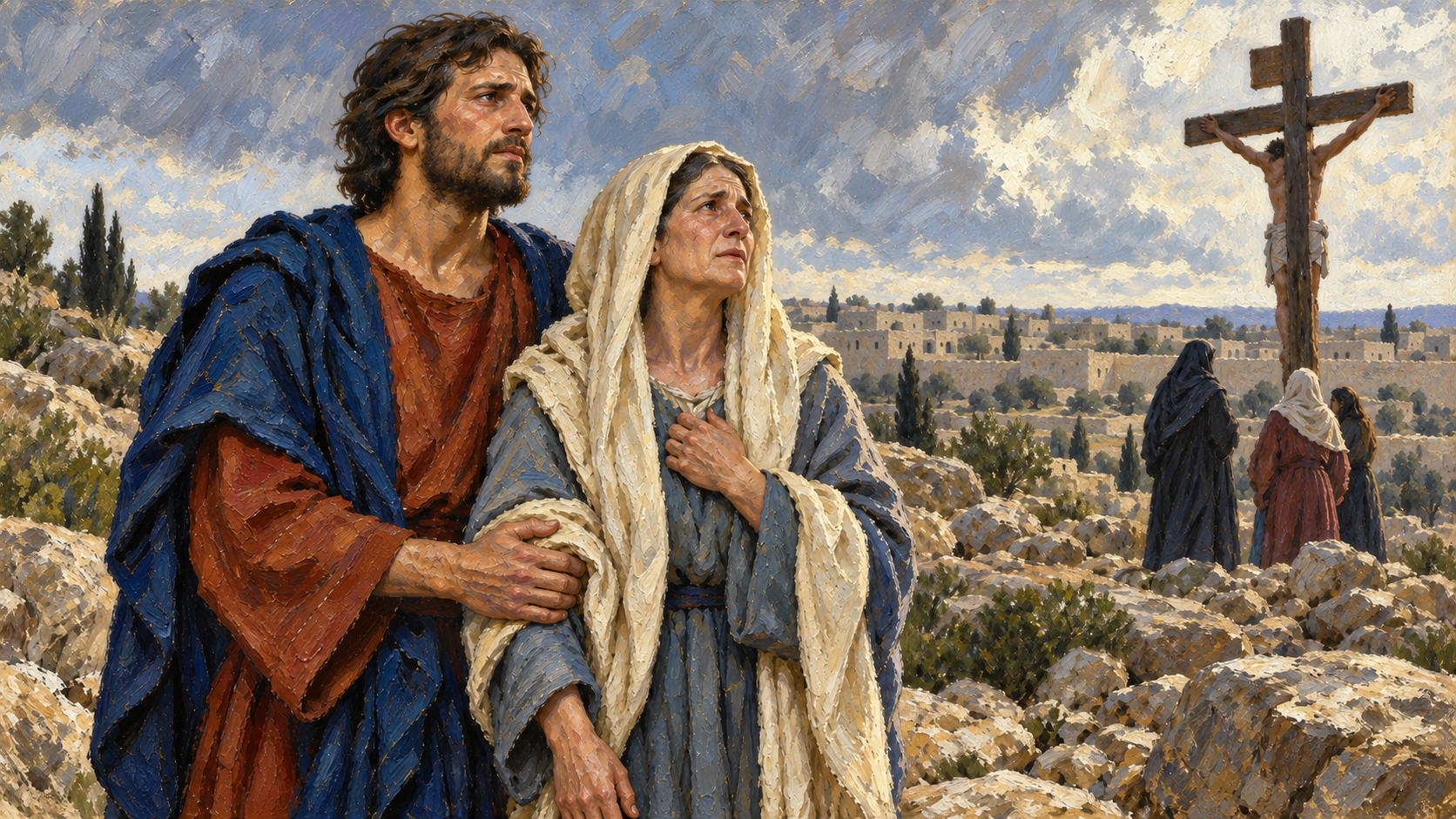
Now there stood by the cross of Jesus His mother, and His mother’s sister, Mary the wife of Clopas, and Mary Magdalene. When Jesus therefore saw His mother, and the disciple whom He loved standing by, He said to His mother, “Woman, behold your son!” Then He said to the disciple, “Behold your mother!” And from that hour that disciple took her to his own home. After this, Jesus, knowing that all things were now accomplished, that the Scripture might be fulfilled, said, “I thirst!” Now a vessel full of sour wine was sitting there; and they filled a sponge with sour wine, put it on hyssop, and put it to His mouth. So when Jesus had received the sour wine, He said, “It is finished!” And bowing His head, He gave up His spirit.
The beloved disciple stood near the cross with several women. I understand that disciple to be John, but his presence should not draw our attention away from the other faithful followers who were also there.
Jesus entrusted His mother to John and John to her, and from that hour the disciple took Mary into his home. Caring for her became a practical family responsibility. Jesus’ brothers had not yet believed during His public ministry, which may help explain His arrangement for Mary. Scripture does not give us the full reason, so I would not press that explanation further.
By providing for Mary, Jesus fulfilled His family responsibility even while completing His saving work. He was not appointing her as a mediator or universal mother of the church. John’s closeness to Jesus now involved caring for someone the Lord had entrusted to him.
Jesus is the eternal Son, fully God and fully man, who was born of a virgin and remained completely sinless. He died for the whole world. Wicked men tortured and killed Him, and He willingly bore that real punishment for our sins in His innocent body. He shed His blood and died, was buried, and then rose bodily. Throughout that saving work, the Father did not punish or curse His beloved Son. He did not abandon, strike, or bruise Jesus, nor did He pour wrath on Him.
God genuinely offers salvation, although people can resist and reject Him. Everyone who repents and believes is forgiven and justified, made right before God. That person is born again and made new. The Holy Spirit dwells within and seals the believer, who is eternally secure. That security gives no excuse for lawlessness. Judas’s place among the disciples reminds me why I cannot treat outward association or a shallow profession as proof that someone has truly been born again.
A fuller study of Jesus’ provision for Mary is available in the study on Mary, the mother of Jesus.
Now the first day of the week Mary Magdalene went to the tomb early, while it was still dark, and saw that the stone had been taken away from the tomb. Then she ran and came to Simon Peter, and to the other disciple, whom Jesus loved, and said to them, “They have taken away the Lord out of the tomb, and we do not know where they have laid Him.” Peter therefore went out, and the other disciple, and were going to the tomb. So they both ran together, and the other disciple outran Peter and came to the tomb first. And he, stooping down and looking in, saw the linen cloths lying there; yet he did not go in. Then Simon Peter came, following him, and went into the tomb; and he saw the linen cloths lying there, and the handkerchief that had been around His head, not lying with the linen cloths, but folded together in a place by itself. Then the other disciple, who came to the tomb first, went in also; and he saw and believed. For as yet they did not know the Scripture, that He must rise again from the dead. Then the disciples went away again to their own homes.
After Mary Magdalene reported that the stone had been moved, Peter and the other disciple ran to the tomb. John reached it first but paused outside until Peter had entered. When John followed him in, he saw the linen cloths and the separate face cloth, and he believed.
John’s belief was real, yet verse 9 says they did not understand from Scripture that Jesus must rise from the dead. I appreciate how honestly he records that limit in their understanding. Jesus’ later appearances and teaching would help them understand more fully what the empty tomb had already established.
John recorded who arrived first and who entered first with the detail of someone who was there. I do not read the race as a measure of either man’s spiritual rank. Peter’s quick entry and John’s careful observation lead us to the same historical fact: Jesus’ body was gone, and the arrangement of the grave cloths did not fit a hurried theft. The resurrection appearances and ascension receive fuller treatment in the study on post-resurrection Jesus and His ascension.
The Beloved Disciple Bore Exact Eyewitness Testimony
John 21 identifies the beloved disciple as the eyewitness who wrote the Gospel, although it does not give his personal name as “John.” To identify him, we have to consider several pieces of evidence together. There is no single signed verse that settles the question for us.
The beloved disciple appears close to the Twelve and has a particular connection with Peter. He was present at the final supper and the cross, and he witnessed the resurrection. I also understand him to be the unnamed disciple who knew the high priest. The Gospel also names other prominent disciples while leaving John son of Zebedee unnamed. Taken together, the evidence makes John the natural fit.
Some readers identify the beloved disciple as Lazarus because this Gospel also says Jesus loved him. Others propose an otherwise unknown disciple from Jerusalem. I am not persuaded by either explanation. Lazarus is named directly elsewhere, and he does not appear at the supper or in the apostolic pairings. An unknown writer also leaves the early and widespread attribution to John less well explained.
In the second century, Irenaeus wrote that the disciple who leaned on Jesus’ breast published the Gospel while living at Ephesus. The Muratorian Fragment also connects John with the Fourth Gospel. Those witnesses cannot replace the evidence within the Gospel, but their agreement with it strengthens the identification. I conclude that the writer was John son of Zebedee, the apostle and beloved disciple. More about how the four inspired accounts fit together appears in the study on the four Gospels.
After these things Jesus showed Himself again to the disciples at the Sea of Tiberias, and in this way He showed Himself: Simon Peter, Thomas called the Twin, Nathanael of Cana in Galilee, the sons of Zebedee, and two others of His disciples were together. Simon Peter said to them, “I am going fishing.” They said to him, “We are going with you also.” They went out and immediately got into the boat, and that night they caught nothing. But when the morning had now come, Jesus stood on the shore; yet the disciples did not know that it was Jesus. Then Jesus said to them, “Children, have you any food?” They answered Him, “No.” And He said to them, “Cast the net on the right side of the boat, and you will find some.” So they cast, and now they were not able to draw it in because of the multitude of fish. Therefore that disciple whom Jesus loved said to Peter, “It is the Lord!” Now when Simon Peter heard that it was the Lord, he put on his outer garment (for he had removed it), and plunged into the sea. But the other disciples came in the little boat (for they were not far from land, but about two hundred cubits), dragging the net with fish. Then, as soon as they had come to land, they saw a fire of coals there, and fish laid on it, and bread. Jesus said to them, “Bring some of the fish which you have just caught.” Simon Peter went up and dragged the net to land, full of large fish, one hundred and fifty-three; and although there were so many, the net was not broken. Jesus said to them, “Come and eat breakfast.” Yet none of the disciples dared ask Him, “Who are You?”–knowing that it was the Lord. Jesus then came and took the bread and gave it to them, and likewise the fish. This is now the third time Jesus showed Himself to His disciples after He was raised from the dead. So when they had eaten breakfast, Jesus said to Simon Peter, “Simon, son of Jonah, do you love Me more than these?” He said to Him, “Yes, Lord; You know that I love You.” He said to him, “Feed My lambs.” He said to him again a second time, “Simon, son of Jonah, do you love Me?” He said to Him, “Yes, Lord; You know that I love You.” He said to him, “Tend My sheep.” He said to him the third time, “Simon, son of Jonah, do you love Me?” Peter was grieved because He said to him the third time, “Do you love Me?” And he said to Him, “Lord, You know all things; You know that I love You.” Jesus said to him, “Feed My sheep. Most assuredly, I say to you, when you were younger, you girded yourself and walked where you wished; but when you are old, you will stretch out your hands, and another will gird you and carry you where you do not wish.” This He spoke, signifying by what death he would glorify God. And when He had spoken this, He said to him, “Follow Me.” Then Peter, turning around, saw the disciple whom Jesus loved following, who also had leaned on His breast at the supper, and said, “Lord, who is the one who betrays You?” Peter, seeing him, said to Jesus, “But Lord, what about this man?” Jesus said to him, “If I will that he remain till I come, what is that to you? You follow Me.” Then this saying went out among the brethren that this disciple would not die. Yet Jesus did not say to him that he would not die, but, “If I will that he remain till I come, what is that to you?” This is the disciple who testifies of these things, and wrote these things; and we know that his testimony is true. And there are also many other things that Jesus did, which if they were written one by one, I suppose that even the world itself could not contain the books that would be written. Amen.
Beside the Sea of Tiberias, John recognized Jesus on the shore and told Peter, “It is the Lord!” After breakfast, Jesus restored Peter publicly and foretold the kind of death by which he would glorify God.
When Peter asked about the beloved disciple, Jesus answered, “If I will that he remain till I come, what is that to you? You follow Me.” A rumor then spread that John would not die. The Gospel corrects it by returning to what Jesus actually said: He had not promised that John would remain alive until the Second Coming.
I appreciate John’s willingness to correct a rumor that made him sound special. He could not let a flattering account of his own future stand in place of the Lord’s actual words. His correction gives us another reason to take his commitment to exact testimony seriously.
At the close of the chapter, this disciple is identified as the witness and writer. John also makes clear that he selected what to include, since the world could not contain books recording everything Jesus did. A selective account can still tell us what truly happened. John chose his material to serve the Gospel’s stated purpose.
Christ Turned John’s Zeal into Courageous Service
Now when they saw the boldness of Peter and John, and perceived that they were uneducated and untrained men, they marveled. And they realized that they had been with Jesus. And seeing the man who had been healed standing with them, they could say nothing against it. But when they had commanded them to go aside out of the council, they conferred among themselves, saying, “What shall we do to these men? For, indeed, that a notable miracle has been done through them is evident to all who dwell in Jerusalem, and we cannot deny it. But so that it spreads no further among the people, let us severely threaten them, that from now on they speak to no man in this name.” So they called them and commanded them not to speak at all nor teach in the name of Jesus. But Peter and John answered and said to them, “Whether it is right in the sight of God to listen to you more than to God, you judge. For we cannot but speak the things which we have seen and heard.” So when they had further threatened them, they let them go, finding no way of punishing them, because of the people, since they all glorified God for what had been done. For the man was over forty years old on whom this miracle of healing had been performed.
Peter and John went to the temple, where a man who had been lame from birth was healed through their apostolic ministry. They publicly preached the resurrection and were arrested. The rulers could see that these men lacked formal rabbinic training, yet their boldness and the healed man standing beside them could not be dismissed. Most of all, the rulers recognized that Peter and John had been with Jesus.
This was a different response from the John who had sought a throne beside Christ or tried to silence a man outside his circle. He stood with Peter and gave Jesus the glory. When the officials ordered them to stop speaking, the apostles refused, knowing that faithful witness would expose them to danger. John had not lost his courage. He was using it in obedience to the truth instead of acting on an uncontrolled temper.
Galatians 2 later names James, Cephas, and John as recognized pillars who extended fellowship to Paul and Barnabas. A pillar supports the building, which helps me understand the kind of leadership being described. John was trusted to strengthen the early church; the description did not make him a celebrity or give him authority independent of Christ.
Now when the apostles who were at Jerusalem heard that Samaria had received the word of God, they sent Peter and John to them, who, when they had come down, prayed for them that they might receive the Holy Spirit. For as yet He had fallen upon none of them. They had only been baptized in the name of the Lord Jesus. Then they laid hands on them, and they received the Holy Spirit. And when Simon saw that through the laying on of the apostles’ hands the Holy Spirit was given, he offered them money, saying, “Give me this power also, that anyone on whom I lay hands may receive the Holy Spirit.” But Peter said to him, “Your money perish with you, because you thought that the gift of God could be purchased with money! You have neither part nor portion in this matter, for your heart is not right in the sight of God. Repent therefore of this your wickedness, and pray God if perhaps the thought of your heart may be forgiven you. For I see that you are poisoned by bitterness and bound by iniquity.” Then Simon answered and said, “Pray to the Lord for me, that none of the things which you have spoken may come upon me.” So when they had testified and preached the word of the Lord, they returned to Jerusalem, preaching the gospel in many villages of the Samaritans.
In Luke 9, John wanted fire from heaven to consume a Samaritan village. In Acts 8, he returned to Samaria with Peter to minister to new believers. I notice how different his purpose had become. The apostles prayed that these people would receive the Holy Spirit and laid hands on them, witnessing the Spirit’s work among them.
Their welcome did not mean they would overlook corrupt ambition. When Simon the sorcerer tried to buy spiritual authority, Peter confronted him. John’s growth in love belonged with that same apostolic message: Samaritans could be welcomed across an old hostility while wrongdoing was still rebuked directly.
On the way back to Jerusalem, Peter and John preached the gospel in many Samaritan villages. John was now serving Samaritans, the very people he had once wanted to face immediate judgment. Jesus had changed how he responded to rejection and widened his willingness to serve.
John’s Writings Hold Love and Truth Together
John wrote five New Testament books: his Gospel, three letters, and Revelation. In the Gospel, he selected signs and teaching that reveal Jesus as the eternal Son so readers may believe and have life in His name. His eyewitness testimony in 1 John helps us examine whether a claim to fellowship agrees with obedience and love. That letter also addresses assurance and insists that Jesus Christ truly came in the flesh. In 2 John and 3 John, truth and love guide his teaching on discernment and hospitality. He addresses faithfulness in the church and confronts domineering leadership. Revelation takes us from the risen Christ’s messages to the churches to a view of the heavenly throne. It continues through divine judgment and Christ’s millennial reign, then the final judgment and new creation.
We should expect a Gospel account to sound different from a personal letter or apocalyptic prophecy. The change in style does not erase the themes shared across John’s writings. His concern with eyewitness testimony and life continues, often expressed through images of light and truth. Love belongs with obedience in these books, and believers are taught to overcome. Throughout them, John keeps our attention on the Lamb and on Jesus’ divine identity.
The church received these books under John’s name from the early centuries. Their own claims and shared theology also fit apostolic authorship. Without decisive evidence, I see no good reason to divide them among several otherwise unknown men named John.
Beloved, let us love one another, for love is of God; and everyone who loves is born of God and knows God. He who does not love does not know God, for God is love. In this the love of God was manifested toward us, that God has sent His only begotten Son into the world, that we might live through Him. In this is love, not that we loved God, but that He loved us and sent His Son to be the propitiation for our sins. Beloved, if God so loved us, we also ought to love one another. No one has seen God at any time. If we love one another, God abides in us, and His love has been perfected in us. By this we know that we abide in Him, and He in us, because He has given us of His Spirit. And we have seen and testify that the Father has sent the Son as Savior of the world. Whoever confesses that Jesus is the Son of God, God abides in him, and he in God. And we have known and believed the love that God has for us. God is love, and he who abides in love abides in God, and God in him.
John’s emphasis on love becomes easier to understand when we remember how he describes its beginning. God loved us first and revealed that love by sending His Son. I cannot create God’s love through my own effort. When we love one another, we respond to the love He has already given and make it visible in our lives.
The same John who urges us to love one another also speaks sharply about false teaching. He insists on the confession that Jesus Christ came in the flesh and identifies the spirit of antichrist in the denial of that truth. His warnings about deceivers are practical: believers must not support a teacher who rejects the doctrine of Christ.
In 2 John, loving others belongs with walking according to God’s commandments. Truth directs how we love, and love governs how we speak and practice the truth. I cannot read Revelation, either, and mistake John’s love for a reluctance to confront sin. Along with recording holy worship and celebrating the Lamb’s victory, he calls compromised churches to repent and announces judgment. His mature love never denies God’s justice.
I, John, both your brother and companion in the tribulation and kingdom and patience of Jesus Christ, was on the island that is called Patmos for the word of God and for the testimony of Jesus Christ. I was in the Spirit on the Lord’s Day, and I heard behind me a loud voice, as of a trumpet, saying, “I am the Alpha and the Omega, the First and the Last,” and, “What you see, write in a book and send it to the seven churches which are in Asia: to Ephesus, to Smyrna, to Pergamos, to Thyatira, to Sardis, to Philadelphia, and to Laodicea.” Then I turned to see the voice that spoke with me. And having turned I saw seven golden lampstands, and in the midst of the seven lampstands One like the Son of Man, clothed with a garment down to the feet and girded about the chest with a golden band. His head and hair were white like wool, as white as snow, and His eyes like a flame of fire; His feet were like fine brass, as if refined in a furnace, and His voice as the sound of many waters; He had in His right hand seven stars, out of His mouth went a sharp two-edged sword, and His countenance was like the sun shining in its strength. And when I saw Him, I fell at His feet as dead. But He laid His right hand on me, saying to me, “Do not be afraid; I am the First and the Last. I am He who lives, and was dead, and behold, I am alive forevermore. Amen. And I have the keys of Hades and of Death. Write the things which you have seen, and the things which are, and the things which will take place after this. The mystery of the seven stars which you saw in My right hand, and the seven golden lampstands: The seven stars are the angels of the seven churches, and the seven lampstands which you saw are the seven churches.
John says he was on Patmos “for the word of God and for the testimony of Jesus Christ.” The island setting and early testimony support the traditional view that authorities banished him there. I accept that understanding while distinguishing it from the exact wording of Revelation, which neither uses the word exile nor names the emperor responsible.
On Patmos, John saw the glorified Son of Man and was commanded to write what he saw. What he received was meant to reach others, not remain a private spiritual experience. His inspired testimony was addressed to real churches and to everyone who hears the prophecy.
Irenaeus places the publication of John’s Gospel in Ephesus, and Eusebius later preserves earlier testimony that John remained there until the reign of the Roman emperor Trajan. I give those witnesses weight, but I also want readers to know where the information comes from. It is tradition outside inspired Scripture, rather than something narrated in the Gospel.
Later sources describe John surviving boiling oil or poison, but I would not preach those dramatic accounts as established history. Scripture also does not tell us with certainty that he was the last apostle to die. We can appreciate his faithful endurance without relying on legends to make it impressive.
John helps me see why a strong temperament needs to submit to Scripture and the Holy Spirit. Strength becomes useful in that obedience, just as gentleness matures when it remains willing to speak the truth. As we abide in Christ, the Lord develops our courage and discernment. Love and holiness grow together under His patient care.
My Final Thoughts
John did not stop caring about truth when he learned to love. Jesus sanctified his strong temperament until his zeal served the Lord’s purpose. The Son of Thunder came to welcome Samaritans and care for Mary, yet he was still courageous enough to stand before rulers. He even corrected a rumor that made him look special. I see the foundation for that life in the way he described himself: his identity rested on Jesus’ love for him, not on loving Jesus more than everyone else did. I want to receive that same love through faith and stay close to the truth John witnessed. Christ can reshape my strong impulses into faithful service as I do.