
How should Christians honor Mary without giving her the place Scripture gives to Jesus alone? The Bible calls her blessed and shows us her remarkable faith, yet she called herself a servant and rejoiced in God her Savior. I want to follow her life in the Gospels and Acts so we can compare that record with the claims later made about her.
Mary Received Grace and Bore the Eternal Son
God chose Mary to conceive and bear the Messiah while she was a virgin, giving her a unique place in biblical history. After Gabriel’s announcement, she carried Jesus in her womb and gave birth to Him, then raised Him with Joseph. She later watched His ministry and stood near His cross. After His resurrection and ascension, she joined the disciples in prayer.
Luke calls Mary blessed and records both her faith in God’s promise and her song of praise. He also shows us a lowly servant who gave God the glory and rejoiced in Him as her Savior. I want to give her the honor that account calls for, without either despising her or exalting her beyond God’s Word.
Mary’s life helps me see what it means to receive grace. She did not earn the incarnation or give the Son His deity; God favored her and kept His promises through her. He also gave her the strength for a calling that brought deep sorrow along with extraordinary joy.
Moreover the LORD spoke again to Ahaz, saying, “Ask a sign for yourself from the LORD your God; ask it either in the depth or in the height above.” But Ahaz said, “I will not ask, nor will I test the LORD!” Then he said, “Hear now, O house of David! Is it a small thing for you to weary men, but will you weary my God also? Therefore the Lord Himself will give you a sign: Behold, the virgin shall conceive and bear a Son, and shall call His name Immanuel. Curds and honey He shall eat, that He may know to refuse the evil and choose the good. For before the Child shall know to refuse the evil and choose the good, the land that you dread will be forsaken by both her kings.
Isaiah spoke when David’s royal house faced a crisis. Ahaz feared Syria and northern Israel, but when the LORD told him to ask for a sign, the king refused with words that sounded pious. His answer expressed unbelief. God Himself then promised a sign to the house of David: a virgin would conceive and bear a Son called Immanuel.
The Hebrew word almah describes a young woman of marriageable age and fits an unmarried young woman in its biblical uses. We need to respect Isaiah’s immediate historical setting while also receiving the inspired fullness Matthew gives the promise. Matthew uses parthenos, the Greek word meaning “virgin,” and says Mary’s conception fulfilled Isaiah.
I would not rest the virgin conception on one disputed dictionary definition. Matthew and Luke plainly tell us that Mary had not known a man and that the child was conceived by the Holy Spirit. Joseph was not His biological father. Immanuel means “God with us” and points to the eternal Son entering real human life.
Now in the sixth month the angel Gabriel was sent by God to a city of Galilee named Nazareth, to a virgin betrothed to a man whose name was Joseph, of the house of David. The virgin’s name was Mary. And having come in, the angel said to her, “Rejoice, highly favored one, the Lord is with you; blessed are you among women!” But when she saw him, she was troubled at his saying, and considered what manner of greeting this was. Then the angel said to her, “Do not be afraid, Mary, for you have found favor with God. And behold, you will conceive in your womb and bring forth a Son, and shall call His name JESUS. He will be great, and will be called the Son of the Highest; and the Lord God will give Him the throne of His father David. And He will reign over the house of Jacob forever, and of His kingdom there will be no end.” Then Mary said to the angel, “How can this be, since I do not know a man?” And the angel answered and said to her, “The Holy Spirit will come upon you, and the power of the Highest will overshadow you; therefore, also, that Holy One who is to be born will be called the Son of God. Now indeed, Elizabeth your relative has also conceived a son in her old age; and this is now the sixth month for her who was called barren. For with God nothing will be impossible.” Then Mary said, “Behold the maidservant of the Lord! Let it be to me according to your word.” And the angel departed from her.
Gabriel came to Nazareth and spoke to Mary, a virgin betrothed to Joseph of David’s house. Her Son would be called the Son of the Highest. God would give Him David’s throne, and His kingdom would never end.
Mary asked how the promise could be fulfilled when she did not know a man. She was asking for an explanation, and Gabriel answered by directing her to God’s power: the Holy Spirit would come upon her, and the power of the Highest would overshadow her.
That overshadowing describes God’s creative presence and power. It bears no resemblance to the physical relations between deities and women in pagan myths. The Holy One born from Mary is the eternal Son taking a true human nature.
Jesus did not begin to exist in Mary’s womb. The Word was with God and was God before creation. Through the virgin conception, the eternal Son took on real humanity without ceasing to be the same divine Person.
Gabriel called Mary “highly favored.” The Greek kecharitomene is a perfect passive form connected with grace or favor. That grammar helps me understand Mary as someone who received God’s favor rather than someone who supplied it.
That word does not tell us Mary was immaculately conceived or free from every personal sin. Nor does it make her a storehouse of grace for other people. God graciously chose her for a calling that would never be repeated, so her honor rests on what He did for her.
Recognizing grace does not diminish Mary’s place. It lets us honor her as someone who received God’s gift and faithfully answered His Word, while giving Him the glory for that gift.
Mary answered, “Behold the maidservant of the Lord! Let it be to me according to your word.” She placed herself under God’s Word without claiming to understand everything His promise would mean for her.
Mary’s betrothal carried legal weight, and a pregnancy before she and Joseph came together exposed her to suspicion and could end their marriage. Matthew tells us Joseph planned a private divorce until an angel explained how she had conceived. We are not told every social reaction, so I would not fill in scenes of hardship Scripture does not record. What it does tell us is enough to see that her obedience carried a cost.
Mary’s question helps me distinguish an honest desire to understand from a demand that God meet my terms. She asked how His promise would happen, then received His answer and yielded to His Word. Asking the question was not the opposite of faith.
Mary Magnified God Her Savior
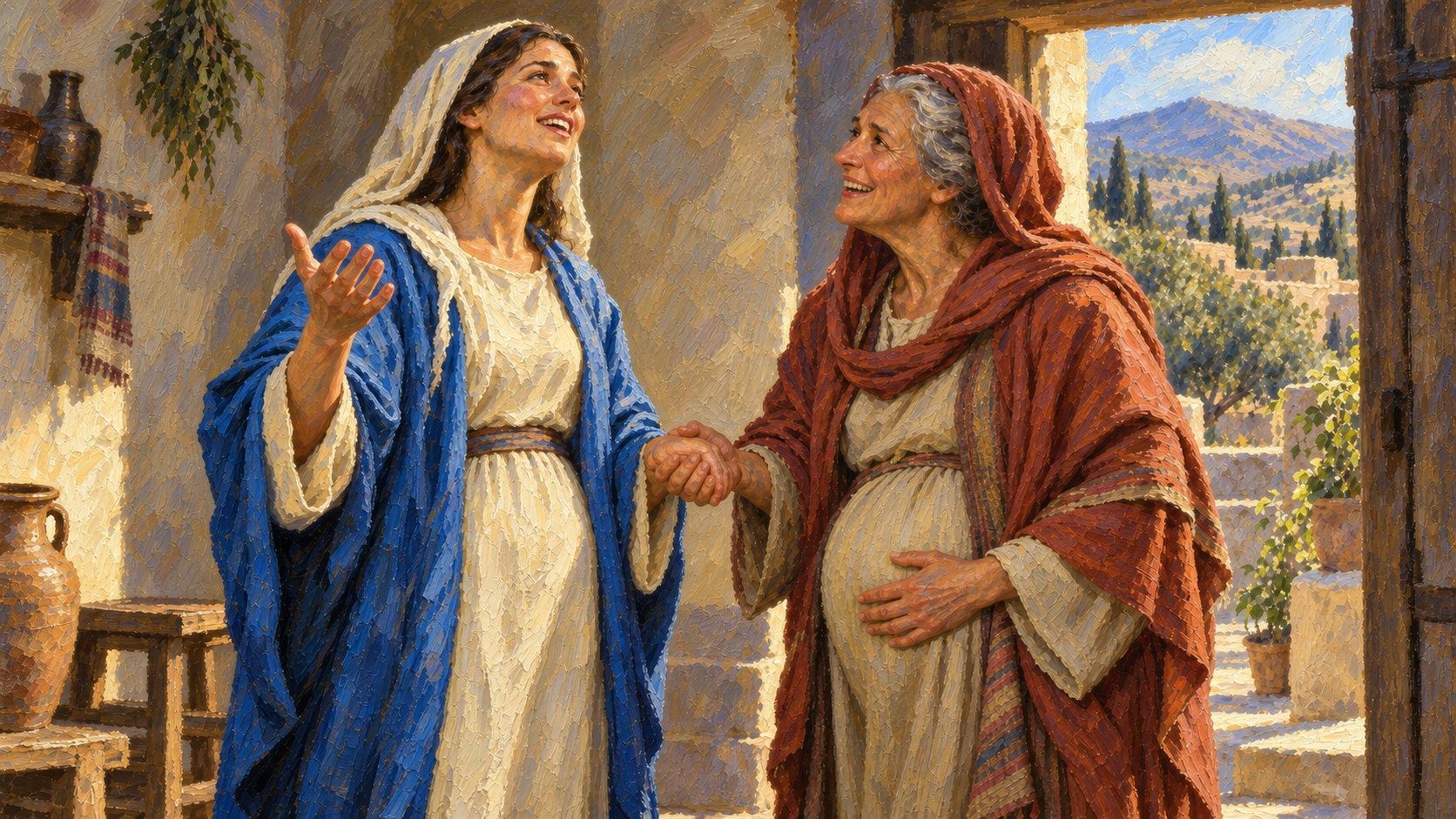
Now Mary arose in those days and went into the hill country with haste, to a city of Judah, and entered the house of Zacharias and greeted Elizabeth. And it happened, when Elizabeth heard the greeting of Mary, that the babe leaped in her womb; and Elizabeth was filled with the Holy Spirit. Then she spoke out with a loud voice and said, “Blessed are you among women, and blessed is the fruit of your womb! But why is this granted to me, that the mother of my Lord should come to me? For indeed, as soon as the voice of your greeting sounded in my ears, the babe leaped in my womb for joy. Blessed is she who believed, for there will be a fulfillment of those things which were told her from the Lord.” And Mary said: “My soul magnifies the Lord, And my spirit has rejoiced in God my Savior. For He has regarded the lowly state of His maidservant; For behold, henceforth all generations will call me blessed. For He who is mighty has done great things for me, And holy is His name. And His mercy is on those who fear Him From generation to generation. He has shown strength with His arm; He has scattered the proud in the imagination of their hearts. He has put down the mighty from their thrones, And exalted the lowly. He has filled the hungry with good things, And the rich He has sent away empty. He has helped His servant Israel, In remembrance of His mercy, As He spoke to our fathers, To Abraham and to his seed forever.” And Mary remained with her about three months, and returned to her house.
Filled with the Holy Spirit, Elizabeth called Mary blessed among women and “the mother of my Lord.” She was identifying the Person in Mary’s womb as her Lord. That honors who Jesus is without making His mother the source of His divine nature.
Mary praised God in language deeply rooted in the Old Testament, especially Hannah’s prayer. Her soul magnified the Lord and her spirit rejoiced in Him. She celebrated His might and holiness together with His mercy, recognizing His righteous judgment and care for the lowly. She closed by remembering His covenant promise to Abraham and his seed.
I notice where Mary placed the emphasis when she said every generation would call her blessed: the Mighty One had done great things for her. God did the work, and she received the blessing. She knew Israel’s Scriptures well enough to understand her experience through His promises instead of making it a reason for self-importance.
Mary rejoiced in “God my Savior.” In that confession, she placed herself among those who needed His mercy. She never presented herself as the Savior’s sinless counterpart or a second mediator.
A defender of Mary’s sinlessness may answer that God saved her in advance by preserving her from original sin. That is the explanation later Roman Catholic theology gives, but Scripture never teaches an immaculate conception for Mary. Rome formally defined the doctrine in 1854; it did not receive it from an apostolic statement.
Luke 2 places Mary and Joseph under the law of purification after childbirth. Their offering of birds was the provision for a family with limited means, and Leviticus 12 includes a sin offering in that rite. I would not use the ceremony to accuse Mary of a particular offense connected with giving birth. It does, however, place her within Israel’s ordinary need for covenant cleansing, not outside humanity’s fallen condition.
Scripture says all have sinned and repeatedly identifies Jesus alone as completely without sin. Transferring His unique sinlessness to Mary would go beyond the honor God’s Word gives her.
And when eight days were completed for the circumcision of the Child, His name was called JESUS, the name given by the angel before He was conceived in the womb. Now when the days of her purification according to the law of Moses were completed, they brought Him to Jerusalem to present Him to the Lord (as it is written in the law of the Lord, “Every male who opens the womb shall be called holy to the LORD”), and to offer a sacrifice according to what is said in the law of the Lord, “A pair of turtledoves or two young pigeons.” And behold, there was a man in Jerusalem whose name was Simeon, and this man was just and devout, waiting for the Consolation of Israel, and the Holy Spirit was upon him. And it had been revealed to him by the Holy Spirit that he would not see death before he had seen the Lord’s Christ. So he came by the Spirit into the temple. And when the parents brought in the Child Jesus, to do for Him according to the custom of the law, he took Him up in his arms and blessed God and said: “Lord, now You are letting Your servant depart in peace, According to Your word; For my eyes have seen Your salvation Which You have prepared before the face of all peoples, A light to bring revelation to the Gentiles, And the glory of Your people Israel.” And Joseph and His mother marveled at those things which were spoken of Him. Then Simeon blessed them, and said to Mary His mother, “Behold, this Child is destined for the fall and rising of many in Israel, and for a sign which will be spoken against (yes, a sword will pierce through your own soul also), that the thoughts of many hearts may be revealed.”
Mary and Joseph brought Jesus to Jerusalem to obey the Law. Simeon took the child in his arms and praised God for preparing salvation before all peoples. Jesus would be light for the Gentiles and glory for Israel.
Simeon also warned Mary that her Son was appointed for the fall and rising of many. He would be a sign people spoke against, and a sword would pierce her own soul. God had favored Mary, but He had not promised her uninterrupted honor.
Mary would see people misunderstand and reject Jesus, with opposition growing until wicked men publicly tortured and killed Him. Simeon’s words help us understand that receiving God’s grace does not exempt us from suffering.
Mary Learned, Obeyed, and Pointed Others to Jesus
His parents went to Jerusalem every year at the Feast of the Passover. And when He was twelve years old, they went up to Jerusalem according to the custom of the feast. When they had finished the days, as they returned, the Boy Jesus lingered behind in Jerusalem. And Joseph and His mother did not know it; but supposing Him to have been in the company, they went a day’s journey, and sought Him among their relatives and acquaintances. So when they did not find Him, they returned to Jerusalem, seeking Him. Now so it was that after three days they found Him in the temple, sitting in the midst of the teachers, both listening to them and asking them questions. And all who heard Him were astonished at His understanding and answers. So when they saw Him, they were amazed; and His mother said to Him, “Son, why have You done this to us? Look, Your father and I have sought You anxiously.” And He said to them, “Why did you seek Me? Did you not know that I must be about My Father’s business?” But they did not understand the statement which He spoke to them. Then He went down with them and came to Nazareth, and was subject to them, but His mother kept all these things in her heart. And Jesus increased in wisdom and stature, and in favor with God and men.
At twelve years old, Jesus remained in Jerusalem while the returning company traveled on without realizing He was absent. Mary and Joseph found Him in the temple after three days. He was sitting among the teachers, listening and asking questions, and everyone who heard Him was amazed at His understanding.
Mary spoke from a mother’s real distress: “Your father and I have sought You anxiously.” Jesus answered that He must be about His Father’s business. Joseph was His faithful legal father and guardian, but God was His Father in a unique sense.
Mary and Joseph did not fully understand His answer, but Mary kept these things in her heart. Jesus returned to Nazareth and remained subject to them. Following His divine mission did not mean treating His parents disrespectfully; obedience at home belonged to His sinless human life.
Mary was still learning about her Son’s mission. Scripture does not make her all-knowing, and I do not think we need to do that to appreciate her faith. She was a real mother who faithfully kept truths in her heart even before she understood their full meaning.
On the third day there was a wedding in Cana of Galilee, and the mother of Jesus was there. Now both Jesus and His disciples were invited to the wedding. And when they ran out of wine, the mother of Jesus said to Him, “They have no wine.” Jesus said to her, “Woman, what does your concern have to do with Me? My hour has not yet come.” His mother said to the servants, “Whatever He says to you, do it.” Now there were set there six waterpots of stone, according to the manner of purification of the Jews, containing twenty or thirty gallons apiece. Jesus said to them, “Fill the waterpots with water.” And they filled them up to the brim. And He said to them, “Draw some out now, and take it to the master of the feast.” And they took it. When the master of the feast had tasted the water that was made wine, and did not know where it came from (but the servants who had drawn the water knew), the master of the feast called the bridegroom. And he said to him, “Every man at the beginning sets out the good wine, and when the guests have well drunk, then the inferior. You have kept the good wine until now!” This beginning of signs Jesus did in Cana of Galilee, and manifested His glory; and His disciples believed in Him. After this He went down to Capernaum, He, His mother, His brothers, and His disciples; and they did not stay there many days.
When the wine ran out at Cana, Mary brought the need to Jesus. He answered, “Woman, what does your concern have to do with Me? My hour has not yet come.” His Messianic work followed the Father’s will and divine timing. Being His mother did not give Mary authority to direct His signs.
Jesus was not speaking contemptuously when He called her “Woman”; He used that same address tenderly at the cross. His question nevertheless made clear that Mary could not direct His signs simply because she was His mother.
Mary then told the servants, “Whatever He says to you, do it.” I want to follow the direction she gave them. She turned their attention to Jesus’ command, without telling Him what to perform or asking them to seek power from her.
Jesus changed the water into wine, revealing His glory through the sign, and His disciples believed in Him. Mary neither caused nor controlled that miracle.
Then His brothers and His mother came, and standing outside they sent to Him, calling Him. And a multitude was sitting around Him; and they said to Him, “Look, Your mother and Your brothers are outside seeking You.” But He answered them, saying, “Who is My mother, or My brothers?” And He looked around in a circle at those who sat about Him, and said, “Here are My mother and My brothers! For whoever does the will of God is My brother and My sister and mother.”
Mary and Jesus’ brothers came while He was teaching, and He asked who His mother and brothers were. Looking at those gathered around Him, He said that whoever does God’s will belongs to His spiritual family. He described a closeness like that of a brother or sister and even included the bond of a mother.
Jesus’ care for Mary at the cross shows that He was not denying His responsibility toward her. Here He was explaining that biological nearness does not give someone privileged spiritual access. People enter God’s family by receiving and obeying His Word.
Mary belongs within that description too. Her blessedness was never limited to having physically borne Jesus, for He elsewhere called those who hear God’s Word and keep it blessed. Her faithful response fits what He said.
Scripture Presents Jesus’ Brothers and Sisters as Mary’s Other Children
Now it came to pass, when Jesus had finished these parables, that He departed from there. When He had come to His own country, He taught them in their synagogue, so that they were astonished and said, “Where did this Man get this wisdom and these mighty works? Is this not the carpenter’s son? Is not His mother called Mary? And His brothers James, Joses, Simon, and Judas? And His sisters, are they not all with us? Where then did this Man get all these things?” So they were offended at Him. But Jesus said to them, “A prophet is not without honor except in his own country and in his own house.” Now He did not do many mighty works there because of their unbelief.
The people of Nazareth knew Mary as Jesus’ mother and named James, Joses, Simon, and Judas as His brothers. They also spoke of His sisters in the plural. The way the passage groups them as a family strongly indicates children Mary and Joseph had after Jesus.
Matthew 1:25 says Joseph did not know Mary until she had brought forth her firstborn Son. I would not make the word “until” carry the whole argument, since it does not always require a later reversal. In this context it protects the virgin conception, but it does not suggest that Mary and Joseph continued abstaining after Jesus’ birth.
Luke calls Jesus Mary’s firstborn, a word that can have a legal meaning even if no other children follow. Here it also fits the named siblings. John 7 distinguishes His unbelieving brothers from the disciples, while Acts 1 later places them beside Mary among the believers. Galatians identifies James as the Lord’s brother as well.
Mary was a virgin when Jesus was conceived and born. Putting the passages together leads me to conclude that afterward she and Joseph had sons and daughters within a normal, honorable marriage. Their marital union did not stain her holiness or diminish the virgin conception.
We should be fair to those who believe Mary remained a virgin throughout her life. Roman Catholic interpreters commonly take the brothers to be cousins or other close relatives. Eastern Orthodox tradition often understands them as Joseph’s children from an earlier marriage, an explanation popularized in part by the late second-century Protoevangelium of James. That account of an older widower is not apostolic Scripture.
The Greek adelphoi can have a broader meaning than biological brothers, so the word alone does not settle the question. But the Gospels repeatedly group these brothers with Mary and distinguish them from Jesus’ disciples. They mention sisters too and trace the brothers from unbelief into later faith. In that setting, I find the ordinary meaning of siblings the best fit for the record.
We do not need Mary’s perpetual virginity to defend Jesus’ virgin conception. That belief can also leave the impression that an honorable marriage is less holy than lifelong abstinence. Hebrews calls marriage honorable, so Mary and Joseph’s later married life would have been obedience rather than defilement.
Mary Stood at the Cross and Prayed With the Church
Now there stood by the cross of Jesus His mother, and His mother’s sister, Mary the wife of Clopas, and Mary Magdalene. When Jesus therefore saw His mother, and the disciple whom He loved standing by, He said to His mother, “Woman, behold your son!” Then He said to the disciple, “Behold your mother!” And from that hour that disciple took her to his own home.
Mary stood near her Son as wicked men tortured and crucified Him. The child she had carried was now bleeding and dying before her, fulfilling Simeon’s prophecy of a sword piercing her soul.
I want to honor Mary for remaining there without assigning her suffering a power Scripture never gives it. Her grief was not redemptive. She did not offer a second sacrifice or share Christ’s work as Mediator, and the Bible never presents her as a co-redemptrix. Jesus alone bore sins in His innocent body and shed the blood that saves.
John records Jesus caring for His mother in the midst of His own suffering, without giving us speeches to fill out her grief. I want to respect that restraint. Sentimental scenes the apostles never recorded would add to the Gospels rather than help us hear them.
Jesus told Mary, “Woman, behold your son,” and told the beloved disciple, “Behold your mother.” From that hour, the disciple took her into his home.
His brothers’ unbelief during His public ministry may help explain why Jesus made that arrangement. John was faithful and present at the cross. Scripture does not identify the brothers’ unbelief as the only reason, so I would leave that explanation as a possibility.
Even while completing His saving work, Jesus made sure His mother would have practical care in a household. I see both His obedience and His compassion in that provision. Carrying out His spiritual mission did not mean neglecting His family.
Jesus entrusted Mary to the beloved disciple, who took her into his home. That is the care the passage describes; it does not appoint her the universal mother of the church.
Then they returned to Jerusalem from the mount called Olivet, which is near Jerusalem, a Sabbath day’s journey. And when they had entered, they went up into the upper room where they were staying: Peter, James, John, and Andrew; Philip and Thomas; Bartholomew and Matthew; James the son of Alphaeus and Simon the Zealot; and Judas the son of James. These all continued with one accord in prayer and supplication, with the women and Mary the mother of Jesus, and with His brothers.
Mary’s final named appearance in Scripture comes after Jesus’ bodily resurrection and ascension. She joined the apostles in prayer and supplication, together with other women and Jesus’ brothers.
She was part of the congregation gathered in her risen Son’s name, waiting with the other disciples for the Father’s promise. She did not preside over them or receive their prayers, and she did not distribute the Holy Spirit.
Jesus’ brothers were now among the believers too. 1 Corinthians 15 records His resurrection appearance to James, who later became a leader in Jerusalem. These passages show the family moving from misunderstanding and unbelief to shared prayer with the church.
Honor Mary Without Giving Her Christ’s Place
The ancient title Theotokos, often translated “God-bearer,” also appears as “Mother of God.” Christians used it to defend the identity of the Person Mary bore: He is truly God. Jesus is one Person, fully God and fully man, not a merely human person loosely joined to the divine Son.
Understood in that sense, the title tells us who Christ is without claiming Mary originated His deity. She is His mother according to His real human birth, and the One she bore is the eternal Son. She is not the mother of the Father or the Holy Spirit and did not create the Trinity. Nor did she cause the Son to exist eternally.
Modern hearers can easily misunderstand that title, so I prefer Scripture’s direct wording, “the mother of Jesus.” We can defend His deity and the unity of His Person without building devotional claims on a title the Bible itself does not use.
Therefore I exhort first of all that supplications, prayers, intercessions, and giving of thanks be made for all men, for kings and all who are in authority, that we may lead a quiet and peaceable life in all godliness and reverence. For this is good and acceptable in the sight of God our Savior, who desires all men to be saved and to come to the knowledge of the truth. For there is one God and one Mediator between God and men, the Man Christ Jesus, who gave Himself a ransom for all, to be testified in due time,
Roman Catholic and Eastern Orthodox believers commonly distinguish veneration, or honor given to saints, from the worship owed to God. I want to acknowledge what they mean by that distinction rather than argue as though they make none.
Acknowledging that distinction does not answer whether Scripture teaches us to pray to Mary. The apostles never prayed to Mary or asked a departed believer to intercede. They did not call her a mediator or teach that she carries our requests to Christ. Christian prayer is directed to God through Jesus Christ.
Paul identifies the Man Christ Jesus as the one Mediator between the one God and humanity. Living believers may pray for one another, but doing so does not give them a share in His office. Scripture gives us neither a command nor an example of invoking departed saints.
Mary’s own words turn our attention toward the Lord. She magnified Him and rejoiced in Him as her Savior while celebrating His mercy. Her counsel at Cana was to do whatever Jesus said.
We are not told when Mary died or where she was buried. Scripture records no bodily assumption, coronation, or enthronement as queen of heaven. Its account of her ends in Acts 1, where she is praying with the congregation.
Rome formally defined the bodily Assumption in 1950. The ancient stories about Mary’s departure differ from one another and come from outside the apostolic record. I cannot make a belief binding on Christians when it rests on biblical silence and later legend.
Mary shares the sure hope of bodily resurrection that belongs to every believer united with Christ. An unrecorded early assumption adds no honor to Jesus and cannot be made a requirement of Christian faith.
Mary heard God’s Word and asked an honest question, then yielded to His answer and praised Him for His mercy. She kept difficult truths in her heart when she did not yet understand them. Her faith was lived out in ordinary family responsibilities and deep sorrow, and she remained with Christ’s people after His resurrection.
I would not mistake that faith for passive weakness. Mary faced misunderstanding and difficult travel as she raised a family. She knew the terror of losing sight of her child and later saw public opposition grow around Him. Remaining near His cross took endurance, as did waiting in prayer after His ascension.
Her life also helps us see that faith can grow. Mary did not understand everything Jesus said at twelve, and His family did not always grasp His public mission. Yet her final biblical appearance places her among people who knew He had risen and were waiting for His promise.
We honor Mary best when we believe the Savior she bore and obey the Word she received. Giving her powers or titles the apostles never assigned does not honor her faith.
The miracle in Mary’s womb was the incarnation of the only Savior. Jesus is the eternal Son, fully God and fully man. He was born of a virgin and remained completely without sin.
Wicked men physically tortured and punished Jesus before killing Him. He willingly bore that real punishment for our sins in His innocent body. He shed His blood, died, was buried, and rose bodily. The Father did not punish or curse Jesus. He did not abandon, strike, or bruise His Son, nor did He pour wrath on Him.
Christ died for the whole world, and God’s offer of salvation is genuine even though people can resist and reject it. Mary’s obedience could not save her, and devotion to her cannot save anyone else. Everyone who repents and believes in Jesus is forgiven and justified, meaning that God declares the believer righteous. That person is born again and made new. The Holy Spirit comes to dwell within and seals the believer, who is eternally secure in Christ.
Eternal security does not excuse lawlessness, nor does a shallow profession prove that someone has been born again. Mary’s own confession directs us to magnify the Lord and trust God her Savior. The virgin mother points us to the virgin-born Son.
My Final Thoughts
I believe we honor Mary best by telling the whole truth Scripture gives us about her. She was the virgin mother of Jesus who received God’s grace and followed Him faithfully through real sorrow. She also needed the Savior she carried, and she never claimed His place as the source of grace or the one Mediator. Her clearest recorded instruction directs us to do whatever Jesus says. We should receive the virgin conception as real history and honor Mary without giving her powers Scripture never assigns. Our faith must rest in the eternal Son who became fully human without ceasing to be God.