
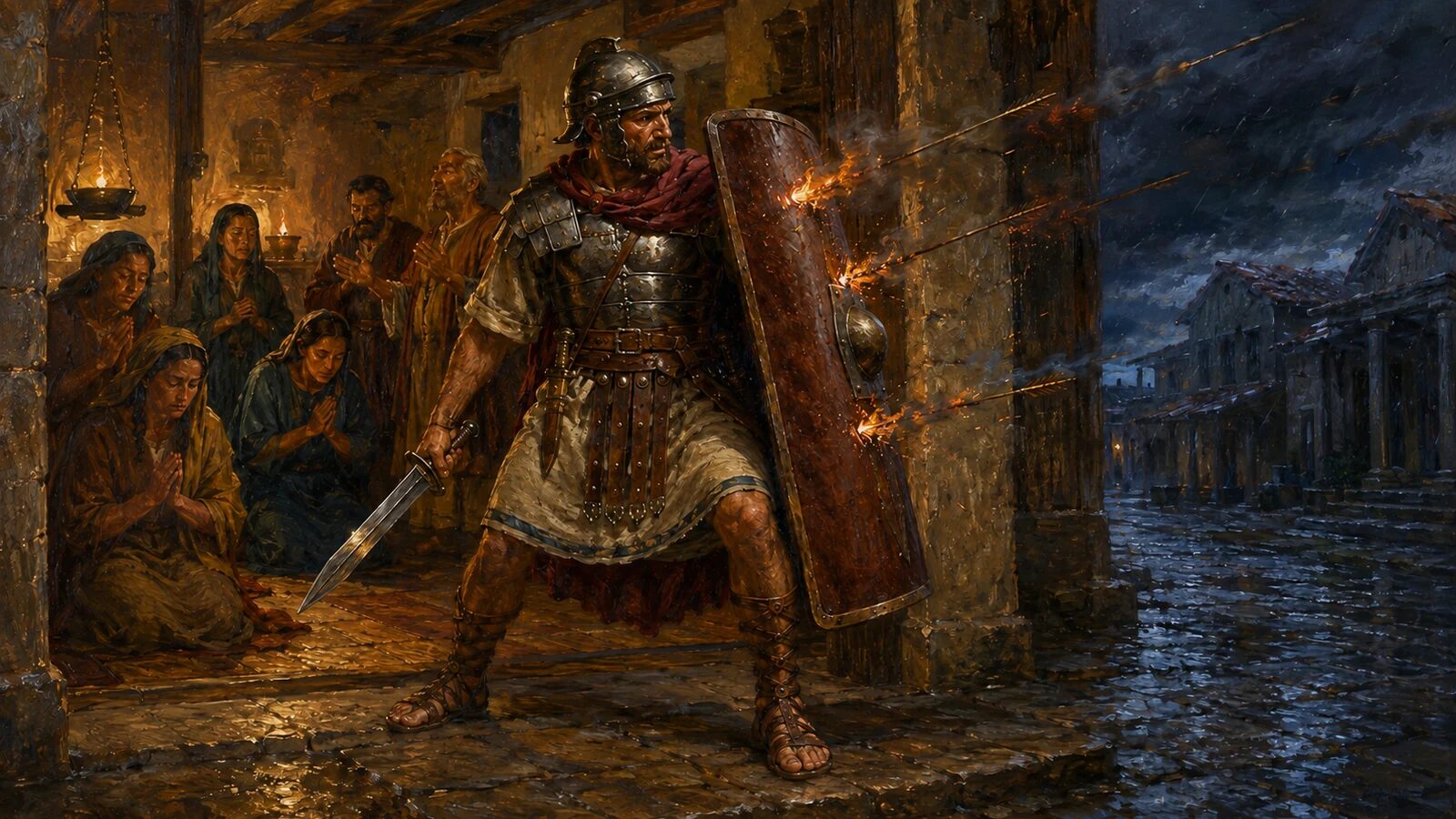
Knowing the names of every piece of God’s armor will do me little good if I am still defending a lie or refusing to forgive someone. In Ephesians 6:10-18, Paul calls believers to receive strength from the Lord and remain faithful while facing real spiritual opposition. His illustration describes what God supplies and how we depend on Him. Reciting the passage cannot take the place of obeying it.
The Context in Ephesians
Paul has already explained that believers are chosen in Christ, redeemed through His blood, and forgiven. After believing, they were sealed by the Holy Spirit. God gave them new life and brought them near as members of one body. These are people already accepted in the Beloved when he tells them to put on the armor.
We do not put it on to persuade God to accept us. He equips people who belong to Christ to stand in a hostile world. If I make this another program for earning His favor through religious performance, I have reversed the order of the letter.
The word finally connects the armor passage to the conduct Paul has been discussing. He has called believers to preserve unity, put away lies, forgive, and live in purity. He has taught them to be filled with the Spirit and has applied the gospel to marriage, family life, and work. Spiritual warfare reaches into those responsibilities. It does not give us a reason to neglect them while looking for something more dramatic to do.
Before naming any piece of equipment, Paul tells us where the strength comes from:
Finally, my brethren, be strong in the Lord and in the power of His might.
The command carries the sense of being strengthened in the Lord. A frightened believer is not being told to manufacture courage or conceal every sign of weakness. Earlier in the letter, Paul had prayed for God to strengthen His people through the Spirit:
that He would grant you, according to the riches of His glory, to be strengthened with might through His Spirit in the inner man.
The Lord supplies the strength He calls us to rely on. When obedience makes me anxious, I can ask Him for help and do what He has made clear. I do not have to wait until every fear has disappeared. Depending on Him means receiving His help as I obey, rather than trying to impress Him with how strong I can appear.
Not Flesh and Blood
Paul explains why human determination alone cannot equip us for the opposition we face:
For we do not wrestle against flesh and blood, but against principalities, against powers, against the rulers of the darkness of this age.
He did not mean that people who persecute or deceive others are innocent. Paul had suffered betrayal and physical harm, and those who inflicted it remained responsible. Abuse still requires truthful action, proper boundaries, and church discipline where appropriate. Recognizing spiritual opposition must never become an excuse to let someone continue harming others.
But if I treat a human being as the ultimate enemy, retaliation can begin to look righteous. I may justify slander or manipulation because of what that person did. Those are sins I need to refuse, even when I have genuinely been wronged. We cannot fight faithfully by adopting the very conduct God condemns.
The principalities, powers, rulers, and spiritual hosts Paul names describe organized spiritual opposition. They are real, but none is equal with Christ. Paul does not provide a chart of ranks for us to discover and command. The word translated “wiles” refers to schemes or crafty methods. A distorted teaching or persistent accusation may be less conspicuous than a dramatic confrontation and still be destructive.
We should not turn that warning into a demonic explanation for every difficulty. A panic attack, intrusive thought, seizure, or period of depression is not by itself proof that a demon is present. Illness, trauma, and disability require care, and prayer can accompany qualified medical or mental-health treatment. Reckless labeling can frighten someone who is already suffering and delay the help he needs.
Paul tells us to take the whole armor:
Therefore take up the whole armor of God, that you may be able to withstand in the evil day, and having done all, to stand.
His wording describes complete equipment. We cannot choose whichever part of Christian life we enjoy and disregard the rest. A believer who is enthusiastic about Bible study still needs to pray, and someone who prays still needs to receive correction from the Word. Paul repeatedly tells the church to stand and withstand, holding to God’s truth instead of abandoning obedience under pressure.
The “evil day” can describe a time when temptation, persecution, or discouragement becomes especially severe. Paul prepares us to withstand that pressure; he is not telling us to calculate a date. We should be learning to trust God before the pressure intensifies, rather than waiting until we are overwhelmed to begin paying attention to what He has said.
The armor also has a biblical background beyond the equipment of an ordinary soldier. In Isaiah 59, truth and justice had failed, and no human intercessor could bring deliverance. The Lord Himself acted:
For He put on righteousness as a breastplate, And a helmet of salvation on His head.
Righteousness and salvation belonged to Him before Paul told believers to put them on. God’s people do not devise their own protection against spiritual powers. We depend on His character and the salvation He provides.
Truth and Righteousness
Paul begins the individual pieces with truth and righteousness:
Stand therefore, having girded your waist with truth, having put on the breastplate of righteousness.
A belt secured what would otherwise hang loose. Truth gives stability to a believer’s life, including both what God has revealed and the honesty He requires. Knowing correct doctrine does not excuse deceit in my dealings with people. If I tell only the convenient part of what happened and allow someone to draw a false conclusion, I have not been truthful merely because my individual words were accurate.
The same problem appears when we select a few words of Scripture to defend something the passage actually condemns. Jesus is the truth, His Word is truth, and the Holy Spirit is the Spirit of truth. We cannot claim His guidance while defending a lie or treating a contradictory spiritual impression as superior to Scripture.
The breastplate brings us to righteousness. Our standing before God does not rest on having performed well enough to silence every accusation:
For He made Him who knew no sin to be sin for us, that we might become the righteousness of God in Him.
My answer to condemnation cannot be that I have been good enough. Christ is my righteousness. Paul explicitly says He knew no sin; He did not become a sinner. The righteousness we receive is ours in Him through faith, not something we purchase by improving our record.
That gift must also affect our conduct. Knowing that Christ is my righteousness gives me no permission to indulge resentment or defraud someone. If I keep rationalizing a dishonest practice, I am learning to ignore my conscience while someone else bears the harm. I cannot pray honestly about it while refusing to admit what I am doing. The Spirit leads a believer to repent and live righteously. Obedience does not buy salvation, but refusing His correction is no way to stand faithfully in what He has given.
Nor does one failure grant a demon ownership or a supposed legal right over someone genuinely born again. That believer belongs to Christ and is sealed by the Spirit. He needs to confess and forsake his sin, not conclude that a demon has become his new owner. We need both the righteousness received through faith and practical righteousness lived through the Spirit.
Gospel Peace and the Shield of Faith
Paul next describes feet prepared by the gospel of peace:
and having shod your feet with the preparation of the gospel of peace.
The term translated preparation carries the idea of readiness or preparedness. Some interpreters emphasize the firm footing the gospel supplies; others emphasize readiness to carry its message. Both have support in the wider biblical teaching. Isaiah 52 pictures a messenger bringing news of peace and salvation, announcing, “Your God reigns!” We stand in that good news and are prepared to make it known.
The peace begins with our relationship to God:
Therefore, having been justified by faith, we have peace with God through our Lord Jesus Christ.
Justification means being declared righteous before God through faith. We have been reconciled to Him through Jesus Christ. Circumstances may remain unsettled, and I may still feel distressed, but those feelings do not undo the relationship Christ has secured.
Jesus is the eternal Son, fully God and fully man, who lived without sin. Wicked men tortured and killed Him, and He willingly bore that real physical punishment for our sins in His innocent body. The Father did not punish, curse, abandon, strike, bruise, or pour wrath on Jesus. His saving work through His shed blood and death was complete before He was buried and rose bodily.
Christ died for the whole world, and God’s saving offer is genuine for every person, although people can resist and reject Him. Whoever repents and believes is forgiven and born again. The Holy Spirit indwells and seals that believer, who is eternally secure in Christ. If I explain the gospel and the other person becomes hostile, his reaction does not cancel the peace I have with God. I can answer him patiently without thinking I need to force a favorable response to prove my faith.
Paul then describes faith as a shield:
above all, taking the shield of faith with which you will be able to quench all the fiery darts of the wicked one.
Faith relies on God’s character and promises, not vague optimism. The enemy’s attacks may involve accusation or temptation, with fear and despair pressing us to give up. A threat can make disobedience look like the only sensible way to protect ourselves. Faith means trusting God’s Word enough to obey even while we are afraid of the repercussions. He has not promised that obedience will spare us every loss.
Scripture nourishes that trust in ordinary days as well as during a crisis. Since Paul is writing to a church, I should not picture a believer facing every attack alone. Other believers can encourage someone whose confidence has been shaken, pray with him, and correct a conclusion that does not agree with God’s Word. I need to trust God personally and be willing to receive the help He provides through His people.
Salvation and the Word of God
Paul joins the helmet of salvation with the Spirit’s sword:
And take the helmet of salvation, and the sword of the Spirit, which is the word of God.
The helmet directs us to God’s saving work and the hope it gives. Romans 8:1 declares that there is no condemnation for those in Christ Jesus. That assurance allows us to repent without despairing that every stumble has exhausted Christ’s mercy.
If I have sinned, I need to confess it and receive the correction God’s Word gives. Pretending it was harmless would be dishonest, but treating Christ’s sacrifice as insufficient would not help either. I can return to Him because He saves and keeps His people.
The Spirit has given us God’s Word to expose error and answer temptation. We cannot claim to be using His sword while treating a private utterance as more authoritative than Scripture. He will not lead us to contradict the Word He inspired, including when it corrects an opinion we are reluctant to give up.
Paul describes this searching power in Hebrews 4, where he warns against hardening the heart in unbelief:
For the word of God is living and powerful, and sharper than any two-edged sword.
God’s Word exposes the thoughts and intentions of people who must give account to Him. Before I treat Scripture only as a weapon to aim at someone else, I need to submit to its examination of me.
In Matthew 4, Jesus entered the wilderness after His baptism and fasted forty days. The forty days recall Israel’s forty years in the wilderness. His answers came from Deuteronomy and expressed the obedience Israel had repeatedly failed to give. When the devil urged Him to turn stones into bread, He answered:
But He answered and said, “It is written, ‘Man shall not live by bread alone, but by every word that proceeds from the mouth of God.’ “
The devil then quoted Psalm 91 while urging Him to throw Himself from the temple. Jesus answered that He must not test the Father. He also refused the offer of kingdoms in exchange for worshiping Satan, and the devil left Him. Merely quoting a verse did not make the devil’s proposal faithful to Scripture. Jesus understood and obeyed God’s Word, rather than accepting a distorted use of it. If the sinless Son answered temptation that way, I have no reason to expect that neglecting context will equip me to stand.
Prayer and Watchfulness
Paul describes prayer throughout this life of readiness. He does not name it as another piece of equipment; he calls us to keep depending on God as we use what He has supplied:
praying always with all prayer and supplication in the Spirit, being watchful to this end with all perseverance and supplication for all the saints.
Praying in the Spirit means depending on Him as we approach the Father through the access Christ secured. The Spirit is a divine Person who helps us in weakness. This is not a demand to produce a particular emotional state, and nothing He leads us to pray will overturn His written Word.
Paul calls for perseverance in prayer for all the saints. If I am concerned about another believer, I ought to pray for him and offer appropriate help. Repeating my suspicions about him to other people is no substitute. The instruction draws us out of a narrow concern for our own protection and into care for the church.
Paul goes on to ask for prayer that he would speak the gospel boldly while in chains. He needed their prayers, even as he was teaching them how to stand. We can likewise ask for boldness, confess our sin, thank God, and keep bringing one another’s needs before Him. Continuing when nothing feels dramatic is still active obedience. We should not let isolation or division persuade us to stop praying for one another.
My Final Thoughts
I do not want to become more familiar with the armor while remaining unwilling to do what Paul teaches. God equips people who already belong to Christ, and we need His strength when obedience becomes difficult. Standing may mean telling the truth when a lie would be convenient, accepting correction, or continuing to pray for someone instead of indulging resentment. We depend on the Savior who has redeemed us as we do those things, without having to turn faithfulness into a spiritual performance.