
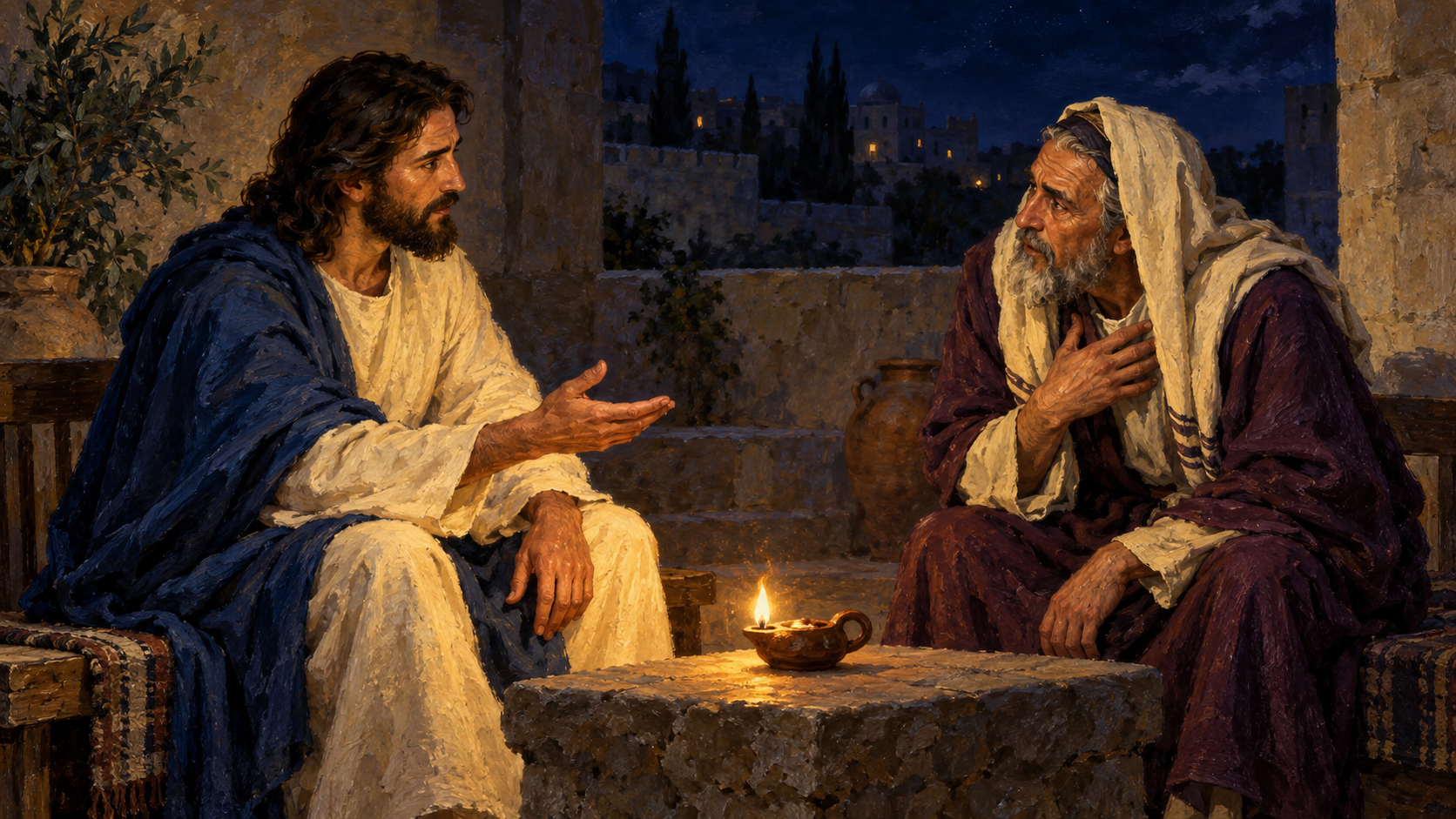
Jesus told Nicodemus, “You must be born again.” Nicodemus knew the Scriptures and took his religious life seriously. He was a respected teacher of Israel, yet he needed life from God just as surely as anyone else. That makes me stop and consider how much someone can know about God without having received life from Him.
Why Nicodemus Needed More Than Religion
The end of John 2 prepares us for the conversation in John 3. Many people believed in Jesus’ name when they saw His signs, but Jesus did not entrust Himself to them because He knew what was in man. John then introduces Nicodemus, a Pharisee and ruler of the Jews. He came to Jesus by night and acknowledged Him as a teacher from God.
Nicodemus approached Jesus respectfully, but Jesus addressed a need that respect alone could not meet. We can recognize something true about Him without having spiritual life. Admiring His miracles or appreciating His teaching does not bring us into the kingdom. Nicodemus needed to understand why a new birth was necessary.
Jesus answered and said to him, “Most assuredly, I say to you, unless one is born again, he cannot see the kingdom of God.”
Jesus’ use of “unless” leaves Nicodemus no substitute for the new birth, even though Nicodemus had Jewish ancestry and a respected place among Israel’s teachers. His Pharisaic discipline could not give him spiritual life either. None of those advantages could take the place of God’s inward work or grant him entrance into the kingdom.
That makes me consider whether I am relying on religious involvement to do what only God can do. Coming from a Christian family or attending church cannot make a person born again. We may improve our behavior and learn the Bible, and we may even serve in ministry, but none of that can create spiritual life. Neither can an intense emotional experience. The new birth is God’s work by the Holy Spirit through the truth of the gospel.
Calling someone “born again” should mean more than saying he has become serious about religion. Nicodemus was already a disciplined man who knew Scripture and taught Israel, yet his deepest need remained. God does not gradually polish the old life until it becomes spiritual. He gives a genuinely new beginning that religious effort could never produce.
God’s work does not remove our responsibility to respond to Him. Jesus spoke to Nicodemus about his need and then called him to believe in the Son. People can hear God’s genuine appeal and either receive or resist it, and they are accountable for that response. No amount of education can produce spiritual life. God Himself gives that life through His Spirit as the gospel is believed.
In John 3, Jesus expected Nicodemus to recognize what the Old Testament had promised about this inward change. Deuteronomy 30:6 speaks of God circumcising the heart so His people will love Him. Ezekiel 36 connects cleansing with the promise of a new heart and God’s Spirit within them. Later, Titus 3 describes regeneration, meaning new birth or a new beginning, and Ephesians 1 explains how believers receive the Holy Spirit and are sealed as God’s own.
Born From Above by Water and the Spirit
Nicodemus understood Jesus’ words as another physical birth and asked how a man could enter his mother’s womb a second time. His question helps us see why Jesus distinguished flesh from Spirit. Flesh can only produce flesh, so the life needed for God’s kingdom has to come from the Spirit.
The Greek wording in John 3:3, gennēthē anōthen, can mean “born again” or “born from above.” Understanding both meanings helps us follow the conversation accurately. Nicodemus was thinking of another physical birth, while Jesus was explaining an entirely new life that comes from God above.
A baby does not cause his own birth, just as a sinner cannot create spiritual life within himself. But I cannot use that comparison to set aside what Jesus tells Nicodemus about believing. Jesus identifies God as the source of life and then directs Nicodemus to the lifted Son, promising eternal life to whoever believes.
Jesus continues by explaining the kind of birth He means.
Jesus answered, “Most assuredly, I say to you, unless one is born of water and the Spirit, he cannot enter the kingdom of God.”
That which is born of the flesh is flesh, and that which is born of the Spirit is spirit.
Some understand “water and the Spirit” as a reference to physical birth followed by spiritual birth. Others connect the water with Old Testament cleansing language, and I believe Ezekiel 36 gives us the strongest background for Jesus’ words. God joins His promise of clean water with a new heart and a new human spirit. He also promises His own Spirit within His people, connecting cleansing with inward renewal.
Then I will sprinkle clean water on you, and you shall be clean; I will cleanse you from all your filthiness and from all your idols. I will give you a new heart and put a new spirit within you.
Jesus asked Nicodemus, “Are you the teacher of Israel, and do not know these things?” (John 3:10). I understand that rebuke in light of what Nicodemus should have known about God’s promise to cleanse and renew His people. They needed more than external commands, and God had already promised to change their hearts through His own work.
John 3:5 does not teach that water baptism causes regeneration. Jesus is explaining birth from above, and an outward washing cannot create a new heart or replace the Spirit’s work. Christ commands baptism as a public act of obedience after salvation, through which the believer identifies with Him. It is not a process that automatically produces salvation.
Baptism deserves our obedience even though it cannot give us life. The believer is saved by God’s mercy through faith in Christ, then identifies with Him openly in baptism. The water can display cleansing and union with Him, but only God can cleanse the conscience and give a new heart. Treating baptism as the cause of new birth assigns an outward act the work Jesus gives to the Spirit. Dismissing it as unimportant treats His command lightly. Scripture allows neither.
Faith in Christ and God’s Work of Regeneration
Jesus’ explanation did not end with a vague spiritual experience. He directed him to the Son of Man who must be lifted up, using what happened in Numbers 21 to explain what He meant. Israel had sinned in the wilderness and faced judgment through fiery serpents. God told Moses to lift up a bronze serpent, and those who looked to the remedy He provided lived.
And as Moses lifted up the serpent in the wilderness, even so must the Son of Man be lifted up, that whoever believes in Him should not perish but have eternal life.
For God so loved the world that He gave His only begotten Son, that whoever believes in Him should not perish but have everlasting life.
Faith does not earn life by being strong enough. It trusts the Savior God has provided, like an empty hand receiving Christ rather than paying a price for Him. I see that same relationship in John 1: people really do respond to Christ, while God is the One who gives them life.
But as many as received Him, to them He gave the right to become children of God, to those who believe in His name: who were born, not of blood, nor of the will of the flesh, nor of the will of man, but of God.
John describes people receiving Christ and believing in His name, while making clear that their new birth comes from God. Neither bloodline nor human will can produce it. I do not have to choose between God giving life and people needing to believe, because this passage holds both together. Christ died for the whole world, so the gospel invitation is genuine, and everyone who believes in Him receives life.
When Paul writes to Titus, he uses palingenesia, the Greek word for regeneration, new birth, or a new beginning. That meaning helps us understand the change he is describing, but the sentence also tells us where salvation comes from. Paul credits God’s mercy and the Holy Spirit’s renewing work, not improved behavior that earns a reward.
not by works of righteousness which we have done, but according to His mercy He saved us, through the washing of regeneration and renewing of the Holy Spirit.
Peter also connects the new birth to the living Word of God.
having been born again, not of corruptible seed but incorruptible, through the word of God which lives and abides forever.
The Spirit gives life through the truth God has spoken, so the gospel’s message about Jesus cannot be set aside. Jesus Christ is the eternal Son, fully God and fully man. He was born of a virgin and remained completely sinless, yet wicked men physically tortured and punished Him before killing Him. He willingly bore that real punishment for our sins in His innocent body and shed His blood when He died. After His burial, He rose bodily. As sinners believe this gospel and come to Christ, the Spirit gives them life.
No believer can claim to have made himself spiritually alive, so regeneration leaves me no grounds for boasting. But receiving grace does not release anyone from responsibility before God. He commands people to repent and believe. Repentance turns us away from defending sin and toward God, while faith rests on Jesus Christ as Lord and Savior. We do not purchase salvation by either response; we respond rightly to the grace He offers in Christ.
The Spirit’s Seal and the Believer’s Living Hope
If I am born again, do I have the Holy Spirit now, or must I wait for a second stage of salvation? Scripture answers that question plainly, and the answer gives us real comfort: everyone who truly belongs to Christ has the Spirit of Christ.
Now if anyone does not have the Spirit of Christ, he is not His.
According to Paul, someone cannot belong to Christ and still be without His Spirit. The same Spirit who gives a believer life also indwells him and seals him as God’s own. Ephesians 1 explains when that happens.
In Him you also trusted, after you heard the word of truth, the gospel of your salvation; in whom also, having believed, you were sealed with the Holy Spirit of promise.
The believers heard the word of truth and trusted Christ, and Paul says they were sealed with the Holy Spirit. My assurance rests on what God has done here rather than on how secure I feel. His seal marks us as His own and gives security. Paul calls the Spirit the guarantee of the inheritance until the redemption of the purchased possession, so our continued life does not depend on maintaining religious intensity. God has given us His Spirit.
Having the Spirit dwell in us is different from being filled by Him for service. I need to keep that difference clear when I read the commands to be filled with the Spirit and to walk by Him. Sin grieves Him, and we should confess it quickly when He convicts us. But that does not mean a truly born-again believer is repeatedly unsealed and resealed. His indwelling belongs to salvation itself.
David prayed, “Do not take Your Holy Spirit from me” (Psalm 51:11), and Saul lost the Spirit’s empowering presence connected with his kingship. I take those passages seriously as warnings about sin and presuming on God’s empowerment for an office. Their setting also helps me distinguish that empowerment from the New Covenant promise that the Spirit indwells and seals every true believer. They do not overturn what Ephesians 1 and Romans 8 teach.
The new birth also joins the believer to Christ’s resurrection hope.
Blessed be the God and Father of our Lord Jesus Christ, who according to His abundant mercy has begotten us again to a living hope through the resurrection of Jesus Christ from the dead.
Peter offered suffering believers more than vague optimism. He pointed them to God’s abundant mercy and Jesus Christ’s bodily resurrection. Because Christ lives, everyone born of God has a living hope. That life belongs to the risen Savior’s resurrection life and cannot be reduced to a temporary religious mood.
Those who are born of God become His children and enter the household of faith. The Spirit who gives them life also begins to produce fruit. Their assurance rests in the same God who gave that life and keeps everyone who truly belongs to Him.
Being born of God means I belong to Him as His child, not simply that I have a private spiritual feeling. He brings us into His family, where we belong with His people rather than remaining detached from them. The Spirit turns our lives toward Christ and begins to grow His fruit in us. I need to recognize that as the result of receiving life from the God who raised Jesus, not as a price we pay to be saved.
Grace, Assurance, and the Fruit of New Life
Nicodemus helps me understand why religious standing cannot answer our need for new birth. He knew Scripture and held a public position, yet Jesus still told him he needed life from God. Baptism must be understood in that light too: it is commanded obedience after salvation, but the act itself cannot create spiritual life.
Faith receives Christ without earning regeneration or obligating God to reward us with salvation. We are saved by His grace and mercy. Those truly born again are indwelt and sealed by the Holy Spirit, and that new birth cannot be lost. Their security rests on God’s seal, which is stronger than human emotion or weakness.
I cannot use eternal security to excuse sin or reassure someone who professes faith but remains permanently unchanged and continues to reject Christ. Fruit never purchases life, but new life does bear fruit. That does not mean a true believer will never struggle or stumble. He needs correction and will continue to grow, while his assurance rests on Christ’s promise and the Spirit who seals those who belong to Him.
This is why I reject both Calvinism and Arminian loss-of-salvation teaching. Calvinism wrongly restricts Christ’s saving provision and makes God’s saving call irresistible for a hidden group. Scripture says God loved the world, and Christ gave Himself as a ransom for all. I cannot restrict that genuine worldwide offer when these passages extend it to everyone. People can resist the Holy Spirit and remain in unbelief, yet everyone who believes in the Son receives life.
Arminian loss-of-salvation teaching makes the opposite mistake by treating the new birth and the Spirit’s seal as reversible. Scripture teaches that those truly born again are kept by God. Eternal security does not excuse rebellion, and the warnings against false profession remain serious.
We need to come to Christ rather than hide behind religious language. I have to ask whether I have received Him by faith, because admiring Jesus and approving of Christian morals cannot take the place of that response. God does not require sinners to repair themselves until they become worthy. He calls them to repent and believe the gospel, and the Spirit gives life through the living Word as they receive Christ.
The Spirit’s seal also gives us no reason to treat sin lightly. The new life God gives begins to change our direction as our love for Him and other Christians grows. We begin to show the family resemblance of His children through obedience and through confessing and repenting of sin.
That is the gospel we need to preach plainly. Vague spiritual advice or a bloodless message about discovering ourselves cannot meet our need. We need the Son of God who shed His blood and died, then rose bodily. He gives life to everyone who believes in Him.
For further study, see Soteriology: The Study of Salvation, The Gospel, and The Holy Spirit Indwelling vs Coming Upon. The studies on Baptism in the Bible, Repentance, and The Blood of Christ for Salvation develop these connected truths further.
My Final Thoughts
Being born again is not a stronger form of religion or a better version of our old life. It is new life from God through the Holy Spirit as we believe in Jesus Christ. After following Jesus’ conversation with Nicodemus, I keep coming back to how completely this shuts the door on pride while leaving the gospel invitation wide open to the world. We come to Christ with empty hands. God gives life, seals His children with His Spirit, and keeps everyone who truly belongs to Him. That security should lead us away from sin and into a life that increasingly shows the family resemblance of our Father.