
Why does Scripture return so often to the stranger, the widow, the fatherless, and the poor? Each could be left with little protection, yet God never overlooks them. I want to understand why He names these people so often. From the Law through the New Testament, His care for them shows us something about His own character.
“A father of the fatherless, a defender of widows, Is God in His holy habitation.”
God defends people who cannot defend themselves, and He commands His people to provide for them and act justly. Our obedience should reflect His character in the way we respond to someone in need. Mercy does not earn salvation, but genuine faith cannot remain unmoved when that need is right in front of us.
Who Scripture Calls Vulnerable
In the Old Testament, a “stranger” often means a resident foreigner or sojourner living among Israel. That person did not share the inherited tribal land or all the protection an Israelite household could provide. God’s command to love the stranger did not erase Israel’s covenant identity. It did forbid the people to use their privileges as an excuse for cruelty or exploitation. A person’s ancestry or social standing could never determine whether he received justice.
A widow had lost the husband who ordinarily provided legal and economic protection, and a fatherless child could be left without anyone to defend the household. Land and inheritance were closely tied to family relationships, as was a person’s standing in court. Losing a husband or father could therefore leave a family exposed almost immediately. Scripture tells God’s people to recognize that need and respond, without romanticizing the weakness itself.
The poor are often named alongside these groups because their needs overlap. A stranger might also be poor, and losing a household provider could push a widow or child into poverty. But we should not assume poverty always has the same cause. Someone may have been oppressed or suffered calamity or illness. Foolish choices and sin can also play a part. I need to recognize those differences without using them as a reason to harden my heart toward someone who truly needs help.
| Group | Common vulnerability | Scripture’s concern |
|---|---|---|
| Stranger | Lives without inherited land or full social standing. | Must not be mistreated, oppressed, or denied justice. |
| Widow | May lack household protection and provision. | Must not be exploited or abandoned. |
| Fatherless | May lack a defender, inheritance protection, and provision. | God promises to hear and plead their cause. |
| Poor | May lack food, security, work, or legal power. | God commands generosity, justice, and honest provision. |
I think God returns to these people so often because we are regularly tempted to overlook someone with little power. A stranger may have no local family to turn to, while a widow may have no one to speak for her. A fatherless child may have no influence at all. Naming each of them makes the need specific, so God’s people cannot pretend they have not seen it.
Mercy Built Into the Law
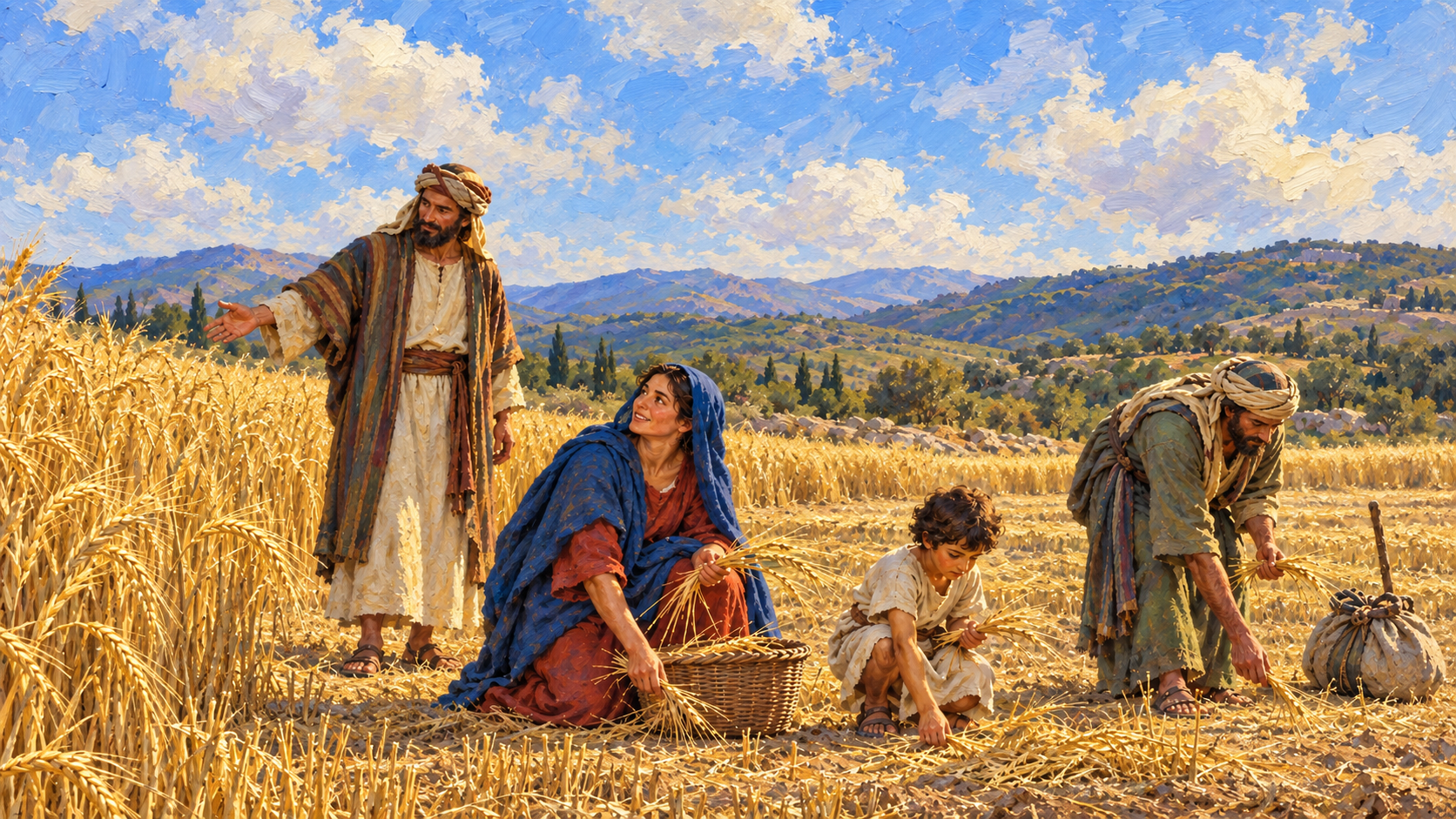
Through the Law of Moses, God made provision for the needy part of Israel’s ordinary covenant life. Mercy did not depend on whether a landowner happened to feel generous at harvesttime. When harvesting fields and vineyards, owners had to leave the edges and gleanings for people in need rather than strip the land bare.
“When you reap the harvest of your land, you shall not wholly reap the corners of your field, nor shall you gather the gleanings of your harvest.”
“You shall leave them for the poor and the stranger: I am the LORD your God.”
Leaving that grain protected people’s dignity as well as their survival. The poor and the stranger could enter the field and gather food from what God required the owner to leave. That involved responsibility on both sides: the landowner had to resist the greed that would take every last stalk, and the person in need did the work of gathering. God’s provision allowed them to work for the food they needed.
When God says, “I am the LORD your God,” I hear why the owner could not simply take everything his field produced. The land belonged to the LORD, and every harvest was His gift. Israel’s landowners did not own their fields in an absolute sense, so those unharvested corners reminded them that their prosperity could not be built by shutting out the weak.
Ruth shows us what that provision meant for a person who needed it. She was a Moabite widow living as a stranger in Bethlehem. Naomi had returned from Moab grieving and empty, and Ruth had entered a land that was not originally her own. When Ruth went out to glean, she was using a provision God had already written into Israel’s law.
Boaz obeyed what righteousness required and went beyond the bare minimum. He provided a safe field for Ruth to work in and ordered the young men not to touch her. He also made water available, then instructed his workers to let extra grain fall for her. The law showed Boaz what justice required, and he let obedience to it grow into generosity. The fuller study of the book of Ruth follows this covenant kindness through the whole account.
“The LORD repay your work, and a full reward be given you by the LORD God of Israel, under whose wings you have come for refuge.”
I notice that Boaz used the strength and authority God gave him to protect a woman who had sought refuge under the wings of the LORD. His mercy did not set aside truth or Israel’s covenant order. Ruth still worked, and his care for her was wise as well as generous.
Justice and Provision Within Israel
Food in the fields would not be enough if the courts remained corrupt. A vulnerable person could glean one day and be robbed the next if judges favored the powerful. God therefore commanded Israel to preserve justice for people with little social leverage.
“You shall not pervert justice due the stranger or the fatherless, nor take a widow’s garment as a pledge.”
Israel could not deny justice to a victim who lacked influence. A widow’s garment could not be seized in a way that stripped away basic protection. Nor could anyone treat a fatherless child as easy prey simply because no father stood beside him at the city gate. God saw what the powerful might try to hide.
In Exodus, God reminded Israel that they had once lived as strangers in Egypt. He forbade them to afflict widows or fatherless children and promised to hear if those people cried to Him. They might have no earthly advocate, but they could bring their suffering before God and be heard.
“You shall neither mistreat a stranger nor oppress him, for you were strangers in the land of Egypt.”
“You shall not afflict any widow or fatherless child.”
Israel knew what it was to be outnumbered and vulnerable under a cruel master in Egypt. Remembering that experience was meant to shape how the people treated others. God had redeemed them and taught them to live under His justice, not to repeat Egypt’s cruelty toward those in their care.
Deuteronomy also connected provision with the third-year tithe. Israel was to store the produce within its gates so that the Levite and those without secure provision could eat and be satisfied. The study of tithing explains that covenant practice and how generosity should be understood under the New Covenant.
“And the Levite, because he has no portion nor inheritance with you, and the stranger and the fatherless and the widow who are within your gates, may come and eat and be satisfied.”
The Levite had no tribal land inheritance, and strangers and vulnerable households often lacked secure support. God gave Israel concrete ways to provide for them as part of its worship. Gleanings and stored food helped meet the need for provision, while fair judgments protected people from injustice. Debts were released at appointed times, and wages had to be paid honestly. Care for the needy belonged in these ordinary dealings as well as in the produce stored within their gates.
The Prophets and Psalms Reveal God’s Justice
The Prophets rebuked people who kept bringing offerings while refusing to repent or show mercy to those they oppressed. The sacrifices were not unimportant, since God Himself had commanded them under the Law. The hypocrisy lay in continuing religious activity alongside oppression.
“Wash yourselves, make yourselves clean; Put away the evil of your doings from before My eyes. Cease to do evil.”
“Learn to do good; Seek justice, Rebuke the oppressor; Defend the fatherless, Plead for the widow.”
Isaiah tells the people to put away evil and seek justice, keeping holiness and compassion together. Defending the fatherless and pleading for the widow are part of repentance, not replacements for it. I cannot claim to worship the Holy One while treating His call to defend these people as unrelated to holiness.
Jeremiah gave the same warning at the temple gate. The people trusted in the temple’s presence even while oppressing others and shedding innocent blood. They also followed other gods. God told them not to rely on those lying words, because their treatment of the vulnerable exposed the false confidence behind their religious activity.
“If you do not oppress the stranger, the fatherless, and the widow, and do not shed innocent blood in this place, or walk after other gods to your hurt, then I will cause you to dwell in this place.”
Malachi closes the Old Testament with the same concern. God comes near in judgment against sorcery and adultery, and He names perjury as well. His judgment also falls on those who exploit wage earners or take advantage of widows and orphans. Turning away the alien reveals that same lack of reverence for God. How I treat someone I could easily exploit says something about whether I fear the LORD.
The Psalms and Proverbs help us understand why God commands this care: He watches over the vulnerable Himself. He is the mighty Redeemer who takes up the cause of people without an earthly defender, and His commands call His people to act in keeping with that care.
“The LORD watches over the strangers; He relieves the fatherless and widow; But the way of the wicked He turns upside down.”
Psalm 146 contrasts the LORD with rulers whose plans die with them. God keeps truth forever, and His justice reaches people who are oppressed. He feeds the hungry and raises those who are bowed down. I should understand His care for the stranger as part of His righteous rule, not as something separate from being King.
“Do not remove the ancient landmark, Nor enter the fields of the fatherless; For their Redeemer is mighty; He will plead their cause against you.”
Moving an ancient boundary marker let someone quietly steal land from a household without a strong defender. Proverbs warns that God sees that scheme. Someone who enters the fields of the fatherless has forgotten who will plead their cause: their mighty Redeemer. When the LORD Himself takes up their cause, the absence of a human defender does not leave them truly undefended.
Jesus and the Needy
When Jesus began His public ministry in Nazareth, He read from Isaiah and applied the passage to Himself. His mission included preaching good news to the poor. He entered human need as the promised Messiah rather than observing it from a distance.
“The Spirit of the LORD is upon Me, Because He has anointed Me To preach the gospel to the poor.”
Jesus fed hungry people and touched lepers whom others avoided. He welcomed children near Him and healed the sick, and He spoke with outcasts. His compassion also included rebuking religious leaders who devoured widows’ houses. Yet He never set aside truth in showing mercy: He called sinners to repentance and warned them of judgment. His care reached people in their need without becoming shallow.
In Matthew 25, Jesus describes receiving a stranger and feeding someone who is hungry. He also speaks of clothing people and visiting the sick, along with coming to those in prison. He says that what was done for the least of His brethren was done to Him. We need to understand that connection without turning mercy into a way to earn salvation.
“I was a stranger and you took Me in.”
“Inasmuch as you did it to one of the least of these My brethren, you did it to Me.”
Scripture teaches salvation by grace through faith, not by works, so Matthew 25 cannot be teaching salvation by social work. But I should not miss what it does say about allegiance to Christ. That allegiance cannot remain invisible forever, because people’s response to His brethren reveals what is happening in their hearts. Mercy gives evidence that the King has truly been received; it does not pay for salvation.
Mercy in the Church Requires Wisdom
Acts 6 shows the early church responding to a concrete need. The Hellenists complained that their widows were being overlooked in the daily distribution, and the apostles took the complaint seriously rather than dismissing it as unspiritual. They appointed qualified men to oversee that care while protecting their own ministry of the Word and prayer.
“There arose a complaint against the Hebrews by the Hellenists, because their widows were neglected in the daily distribution.”
When vulnerable members are neglected, the church has a responsibility to care for them. Good organization can help prevent favoritism or confusion from interfering with that care, so practical service deserves serious attention. We must not abandon the ministry of the Word or despise the work of meeting needs. As members of the body of Christ, we are responsible to serve and protect one another.
Paul’s instructions to Timothy add discernment. The church was to honor widows who were truly widows. At the same time, families had to care for their own members so that church resources remained available for people with no support.
“Honor widows who are really widows.”
“If any believing man or woman has widows, let them relieve them, and do not let the church be burdened.”
Paul’s instructions help me see why generosity needs discernment. When families fulfill their responsibilities, the church can keep support available for people who have no one else. The aim is not to make someone dependent on the church when his family should be caring for him. At the same time, the church must not abandon people who genuinely have no support. Paul gives order to this care so that compassion results in true needs being met.
When James speaks of true religion, his word “visit” describes active concern for a widow or orphan in trouble. A polite greeting that leaves the person in the same distress does not fulfill that care. He joins it with the call to remain unspotted from the world, so mercy and holiness still belong together.
“Pure and undefiled religion before God and the Father is this: to visit orphans and widows in their trouble.”
The Old Testament stranger lived within Israel’s covenant order. The command to love him did not erase every distinction between Israel and the nations, and that command alone does not settle every modern question about borders or civil policy. It does tell us plainly that cruelty and dishonest treatment are wrong. God’s people may not turn courts against outsiders or treat someone with contempt simply because he came from somewhere else.
Paul rebukes believers who fail to provide for their own households, so care for others also begins close to home. A church’s words about mercy lose credibility if it overlooks its own needy members. That includes aging parents and abandoned children, along with other vulnerable people already in its fellowship.
Compassion requires us to consider what help a person actually needs. One situation may call for immediate help, while another needs patient discipleship or honest accountability. Work may be needed, or someone may need protection from abuse. Church discipline may also be required. Laziness can hide behind the word “discernment,” so I need to examine whether I am using caution to avoid helping. I also should not mistake foolish enabling for compassion. Scripture calls us away from both errors.
Defending vulnerable people requires us to take oppression seriously, because God hears the afflicted when they cry. We must not excuse abuse or silence the people suffering from it to keep powerful people comfortable. This kind of true love stays joined to holiness and leads us to act.
God’s care for widows and orphans also helps us understand His mercy in sending His Son for sinners who could not save themselves. Jesus is the eternal Son of God, fully God and fully man, and He entered our weakness without sin. He preached good news and welcomed the lowly before giving Himself for sinners. Wicked men physically tortured and punished Him before killing Him, yet He willingly bore real punishment for our sins in His innocent body through suffering and bloodshed. He died and was buried, then rose bodily.
We care for vulnerable people because God’s mercy has reached us in Christ, not to purchase salvation. We love because He first loved us, and we forgive because we have been forgiven. Our Father defends the helpless, and our Savior came for sinners with no righteousness of their own. The study of God’s providence and provision explains how He often meets needs through His people as they obey Him in ordinary life.
What the church teaches should become visible in its mercy. We cannot use correct words about grace to excuse refusing what love asks of us. James, John, and Jesus do not allow us to separate living faith from its fruit, because that faith is joined to the living Christ.
My Final Thoughts
Care for vulnerable people belongs within Christian doctrine, rather than being a side issue once we have finished studying it. God’s character and Christ’s ministry show us why genuine faith becomes visible in our response to need. I need wisdom in showing mercy, but I cannot use wisdom as a respectable reason to look away. These passages should first make me examine how our homes and churches care for people close at hand. They also challenge how we treat outsiders and use what God has given us. Mercy sometimes costs convenience, and at other times it means confronting injustice when powerful people would prefer silence. Our God is the Father of the fatherless and the defender of widows, and His people should learn to notice those the world finds easy to ignore.