
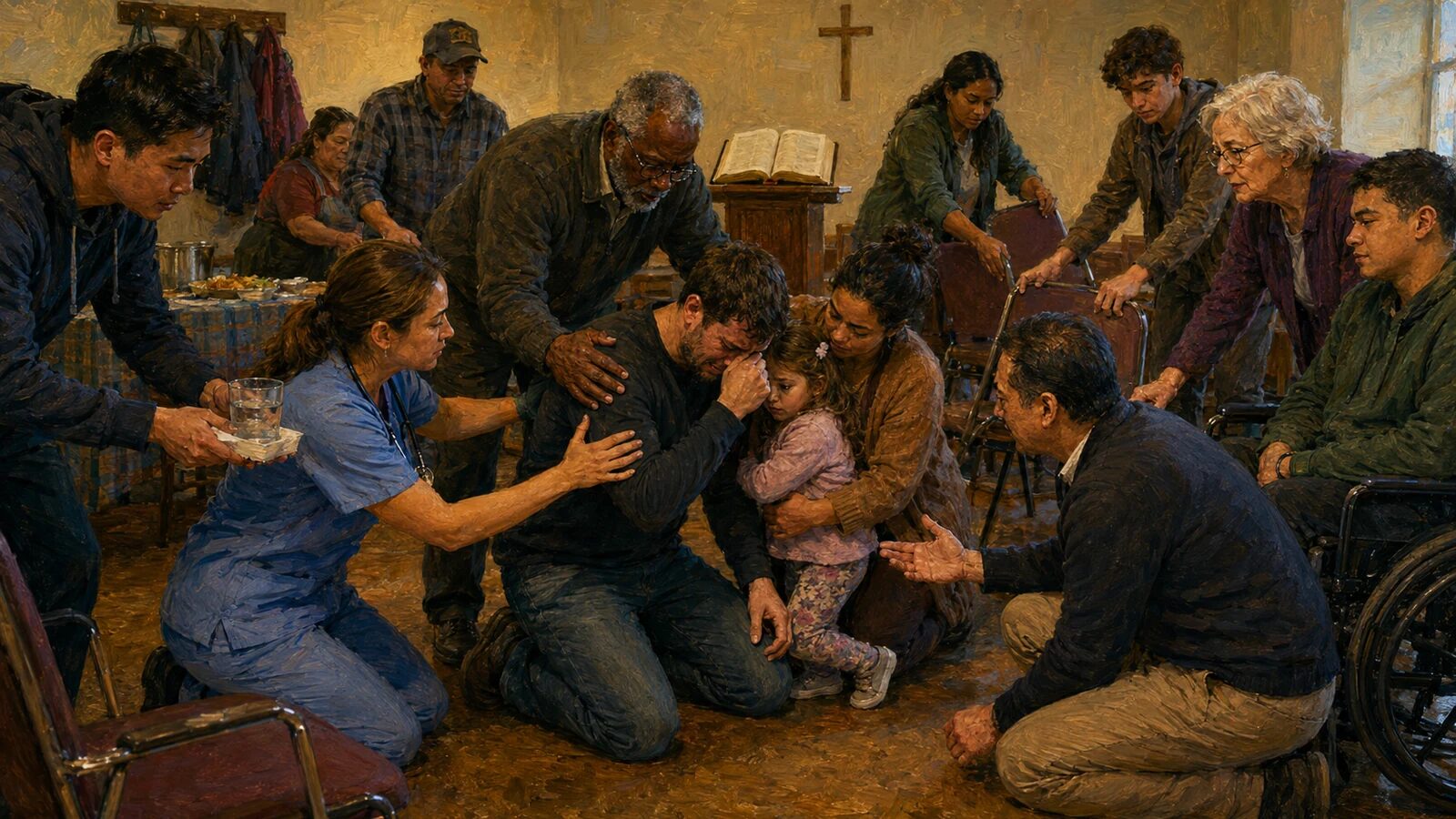
When Paul calls the church the Body of Christ, he means more than people who attend the same meetings or enjoy the same teaching. The Holy Spirit joins every truly saved person to Christ and to His people. That relationship gives us responsibilities toward one another, whether our temptation is to take over, compare ourselves with others, or quietly withdraw. I want to follow Paul’s explanation and consider what it asks of us in the ordinary life of a church.
One Body Under Christ the Head
The Corinthians had spiritual gifts, but they also had serious divisions, pride, and tolerated sin. Their fascination with prominent gifts had distorted their understanding of service. Paul corrected them by explaining the relationship God had already established among them.
Now you are the body of Christ, and members individually.
These believers belonged together without losing their individual places. The Greek soma means “body,” and mele refers to its members or parts. Paul’s picture is of living people who need one another, not interchangeable workers assigned to religious departments. Being an individual does not make me independent of the body, and belonging to it does not make my own contribution unnecessary.
The person who feels indispensable needs this correction, but so does the one who assumes he has nothing useful to offer. Both are misjudging their place. The church belongs to Jesus and depends on Him; it does not replace Him. Nor is Paul identifying the church with Jesus’ physical body during His earthly life or with the bread of communion understood as His literal body.
Colossians explains the authority under which these members live and serve.
And He is the head of the body, the church, who is the beginning, the firstborn from the dead, that in all things He may have the preeminence.
The Greek kephale means “head.” Christ gives the church life and direction, and He has first place. A wealthy donor cannot purchase that authority, and a forceful leader cannot acquire it by intimidating people. Popularity and tradition must also answer to Him. We did not form a committee and choose Jesus as an honorary chairman; the church owes its existence to Him.
He leads His people through His Word and Spirit. The Holy Spirit will not direct us to disobey Scripture, so a claim of spiritual guidance is no excuse for setting biblical truth aside. Pastors serve under Christ as the Chief Shepherd. He gives qualified leaders to teach and care for His people, and we should honor that work without allowing any man to usurp His headship.
This also affects how I judge a church’s growth. Attendance and activity can increase without people becoming more faithful to Christ. Ephesians 4 describes maturity through sound doctrine, truth spoken in love, and believers equipped to serve. We need to look for those things rather than assume that excitement proves spiritual health.
How the Spirit Places Believers Into the Body
A Christian family, years of attendance, and a name on a membership roll cannot give someone new birth. Neither can useful religious work. A sinner enters Christ’s body through salvation by grace through faith in the crucified and risen Lord. Paul identifies the Spirit as the One who brings believers into that union.
For by one Spirit we were all baptized into one body, whether Jews or Greeks, whether slaves or free, and have all been made to drink into one Spirit.
This happens when a person is saved. Water baptism follows as commanded obedience and a public picture of identification with Christ; it does not cause the new birth or create this union. Nor is Paul describing a later spiritual experience that admits an advanced class of Christians to the body. He says all these believers shared in the Spirit’s work, including Corinthians whose immaturity required stern correction.
Jews and Greeks, slaves and free, ordinarily lived with deep divisions between them. Their circumstances and personalities did not disappear when they believed, but those distinctions could no longer determine whether they belonged. The Spirit had joined them to the same Christ and to one another.
Being “made to drink into one Spirit” describes their shared life in the indwelling Holy Spirit, not communion or literal drinking. Every genuinely born-again person receives that life. A Complete Bible Study on the Person of the Holy Spirit examines His work within believers.
If I feel out of place among Christ’s people, this gives me something firmer to rely on than how easily I fit into a social group. The Spirit who gave me new life placed me in the body. I still need to learn how to live alongside other believers, but I do not have to become someone else before I can serve them.
Many Members and Gifts for Service
Paul’s explanation of the body confronts Corinth’s habit of ranking people by their gifts.
For as the body is one and has many members, but all the members of that one body, being many, are one body, so also is Christ.
A foot does not become useless because it is not a hand, and an ear does not stop belonging because it is not an eye. Much of a body’s necessary work happens through parts that draw no attention. The comparison helps me recognize how foolish it is to measure a believer’s value by visibility. A large audience cannot make someone more necessary to Christ than the member whose service is scarcely noticed.
God placed the members as He pleased. Our gifts and opportunities are responsibilities He entrusted to us, not trophies proving that we outrank somebody else. Paul makes their purpose explicit.
But the manifestation of the Spirit is given to each one for the profit of all.
If the gift is meant to benefit others, asking how it can demonstrate my spirituality is already taking me in the wrong direction. I should be asking how to serve the people God has placed around me. Pride can turn a public gift into self-promotion, while fear or resentment can keep a quieter member from serving at all.
Romans 12 applies this sober assessment to different kinds of service. A teacher should give attention to teaching, while an encourager takes encouragement seriously. Giving calls for generosity, leadership for diligence, and mercy for cheerfulness. We are responsible to use what God has given faithfully, rather than spend our time wishing He had assigned us someone else’s work.
A visit to a hurting believer may help in ways a public event cannot. Patiently teaching children, praying for someone, giving privately, or offering wise counsel can meet needs most of the church never hears about. The service is valuable because it helps people under Christ’s care, not because we can attach a platform or a title to it.
I do not accept dramatic claims about spiritual gifts without testing them, as a hyper-charismatic approach can encourage. Neither do I hold the cessationist view that miraculous gifts have ceased. The Spirit is a divine Person who distributes gifts according to His will. Scripture tests the claims made about His work, and a genuine gift honors Christ and serves His people within biblical order. A Complete Bible Study on the Gifts of the Holy Spirit develops this subject further.
Love, Maturity, and Life in a Local Church
First Corinthians 13 belongs within this correction about gifts. Paul was not interrupting the subject to provide a passage for weddings. He was explaining why impressive spiritual activity without love fails the people it is supposed to benefit. The way we use a gift cannot be separated from its purpose.
Ephesians joins the same concern for love with a firm commitment to truth.
but, speaking the truth in love, may grow up in all things into Him who is the head, Christ.
I cannot use sound doctrine to excuse cutting someone down, but neither can I use love to rationalize sin or dismiss correction. Truth tells us what is right, and love governs how we help people face it. Maturity should make a church steadier in doctrine and more patient in dealing with people, rather than harsh, gullible, or willing to tolerate anything. The study on The Fruit of the Spirit examines the character His work produces.
Ephesians 4:16 describes the body growing through what each part supplies. The preceding verses identify Christ’s gifts of apostles, prophets, evangelists, and pastors and teachers for equipping the saints. Leaders prepare God’s people for ministry instead of performing everything while the congregation watches. The foundational apostles and prophets are not recreated in every generation; their inspired witness now governs the church through Scripture.
This shared life takes visible form in local churches. All true believers belong to Christ’s body, but the Corinthians had particular duties toward people they actually knew. Believers in Rome and elders in Ephesus likewise served real congregations. Joining a local membership roll does not create union with Christ, yet commitment to a faithful church gives us a setting in which to practice the care that union requires.
Paul, the author of Hebrews, calls believers to consider how they can encourage one another as the Day approaches.
And let us consider one another in order to stir up love and good works, not forsaking the assembling of ourselves together.
He is concerned with more than an attendance record. People need to know one another well enough to notice weakness, offer help, forgive offenses, and give needed correction. Teaching through a screen can be useful when illness, distance, persecution, or other unusual circumstances prevent gathering. It cannot provide everything those relationships involve.
There are biblical reasons to leave an unhealthy church, and a painful experience should not be brushed aside. Leaving such a congregation is different from deciding that we never need fellowship or accountability again. We should seek a church where Scripture is final authority, the gospel is clear, and Jesus is honored. Its pastors and elders must be biblically qualified men who shepherd people rather than control them.
The institution also needs correction if it treats members as labor to use until they wear out. Christ purchased people with His blood. Leaders are responsible to care for His sheep, not consume them to preserve a reputation or expand a program. A faithful church equips people to serve while recognizing that they too need care.
Holiness, Restoration, and Errors That Harm the Body
Caring for people includes dealing with sin. In the same letter that describes Christ’s body, Paul confronted the serious public immorality Corinth had tolerated. Calling their tolerance unity would not make it loving.
Therefore purge out the old leaven, that you may be a new lump, since you truly are unleavened. For indeed Christ, our Passover, was sacrificed for us.
Paul’s concern was faithfulness to Christ and the well-being of His people, rather than keeping the church’s reputation intact at any cost. Excused sin spreads harm. Bitterness, false doctrine, and pride can also damage a congregation, and leaders make it worse when they protect wrongdoing to avoid conflict.
The need for correction does not give us permission to become arrogant. Galatians describes how believers should approach someone overtaken in a trespass.
Brethren, if a man is overtaken in any trespass, you who are spiritual restore such a one in a spirit of gentleness.
Restoration calls for gentleness and an honest awareness that I too am vulnerable to temptation. The aim is to call the sinner back while protecting those who have been harmed. Refusing to confront sin abandons that responsibility, but humiliating someone is no substitute for helping him repent. Holiness and gentleness need to govern the same work.
Corinth also warns us against taking a gift as proof of holiness. These believers could be gifted and deeply immature at the same time. Spiritual claims need examination, and so do our motives for serving. A church that admires talent but ignores character has learned very little from Paul’s correction.
We also need to distinguish an immature believer from someone who has participated in church without ever being born again. Church involvement cannot save that person. Salvation comes through Jesus Christ, the eternal Son who became fully man while remaining fully God. He was born of a virgin and lived without sin. Wicked men physically tortured and punished His innocent body, and He willingly endured that punishment for our sins. He shed His blood and died, completing His saving work through His blood and death before His bodily resurrection. The Father did not punish, curse, abandon, strike, bruise, or pour wrath on Jesus.
He was buried and rose bodily, having died for the whole world. God’s offer is genuine, although people can resist it. Everyone who repents and believes is forgiven and justified, meaning declared righteous before God. That person is born again, indwelt and sealed by the Holy Spirit, and placed in Christ’s body. Every genuine believer is eternally secure. Such assurance never excuses lawlessness, and a superficial profession does not establish new birth.
If you belong to Him, consider the people you can now serve. You do not have to wait for a more impressive gift or an important title. Seek faithful fellowship, learn the Word, and give attention to the needs within reach. Serving under Christ includes accepting correction ourselves and extending the same patience we need from others.
My Final Thoughts
The Body of Christ consists of people the Spirit has joined to the living Lord. Jesus alone is its Head, and none of us can supply the life and authority He gives. That should humble the prominent member and encourage the person who assumes his contribution is worthless. Both need to understand their place through Christ’s provision instead of comparison.
I want that understanding to shape how I treat His people. They are neither competitors nor a source of free labor, and fellowship involves more than finding a meeting I enjoy. We belong to the same Savior. As we learn His truth, use what He has entrusted to us, and care for one another with patience, we grow together under His direction.