
Jesus’ saying about new wine and old wineskins is often treated as a general lesson about change. But why did He use that picture in the first place, and what question was He answering? When I read the whole conversation, the Bridegroom and the question of fasting tell me how to understand the picture.
Jesus was not giving advice about church programs or personal reinvention. He had come to establish the promised new covenant, and self-righteous religious expectations could not contain what He came to do. At the same time, He was not attacking God’s Law or giving people permission to live without obedience. He came to fulfill the Law and Prophets, and the life He gives changes the heart.
The Bridegroom’s Presence Changed the Fasting Question
Matthew, Mark, and Luke all place the wineskins saying in a discussion about fasting. John’s disciples and the Pharisees practiced fasting, while Jesus’ disciples ate and drank. The difference drew questions because religious seriousness was often measured by visible habits.
Matthew records John’s disciples asking why they and the Pharisees fasted often while Jesus’ disciples did not. Mark tells us that John’s disciples and the Pharisees were fasting when people raised the question. In Luke, the questioners mentioned frequent prayers as well as fasting, comparing those practices with the way Jesus’ disciples ate and drank. In all three accounts, people were judging His followers by familiar religious patterns, and the disciples’ conduct did not seem right to those judging them.
“Then the disciples of John came to Him, saying, ‘Why do we and the Pharisees fast often, but Your disciples do not fast?’ And Jesus said to them, ‘Can the friends of the bridegroom mourn as long as the bridegroom is with them? But the days will come when the bridegroom will be taken away from them, and then they will fast.’”
Before explaining the wineskins, Jesus asked them to consider His presence among them. The friends of a bridegroom would not mourn at his wedding as though he were absent. Jesus used that picture to explain why His disciples were not fasting then. He was not questioning the value of fasting, since He said they would fast later. The Bridegroom had arrived, and they should not act as though He had not.
He also said that days would come when the Bridegroom would be taken away. Those words look ahead to His rejection and death. Jesus would be betrayed and arrested, then mocked and scourged by wicked men. They crucified and killed Him. In His innocent body, He physically bore the punishment for our sins and shed His blood. He died and was buried, but He rose bodily. Christian fasting must therefore be understood in relation to the crucified and risen Christ rather than used as a performance that earns righteousness.
Jesus’ presence is what I want to keep in view as we read the rest of His answer. The issue was not whether a new religious pattern was better simply because it was new. People were measuring His disciples by familiar expectations while failing to recognize who stood among them. The Son of God had come, and one more rule about when respectable people should fast could not account for His arrival.
The Garment and Wineskins Expose an Impossible Mixture
After speaking of the Bridegroom, Jesus pictured a piece of new cloth sewn onto an old garment. Luke says that no one cuts a piece from a new garment to patch an old one. Doing that damages the new garment, and the piece does not match the old.
“No one puts a piece from a new garment on an old one; otherwise the new makes a tear, and also the piece that was taken out of the new does not match the old.”
Cutting the new garment would ruin it, and the patch would not truly repair the old one. That mismatch helps me understand what Jesus was saying about His coming. He could not be fitted into a system that resisted Him as though He were a small repair to it. The picture is more specific than a rule that new things are good and old things are bad.
The questioners had wanted to judge Jesus and His disciples by established fasting patterns. But His ministry involved far more than a schedule: the Bridegroom was present and the kingdom was being announced. Sinners were being called to Him. Making His ministry into a stricter fasting schedule would turn it into a patch for Pharisaic expectations instead of receiving what He brought.
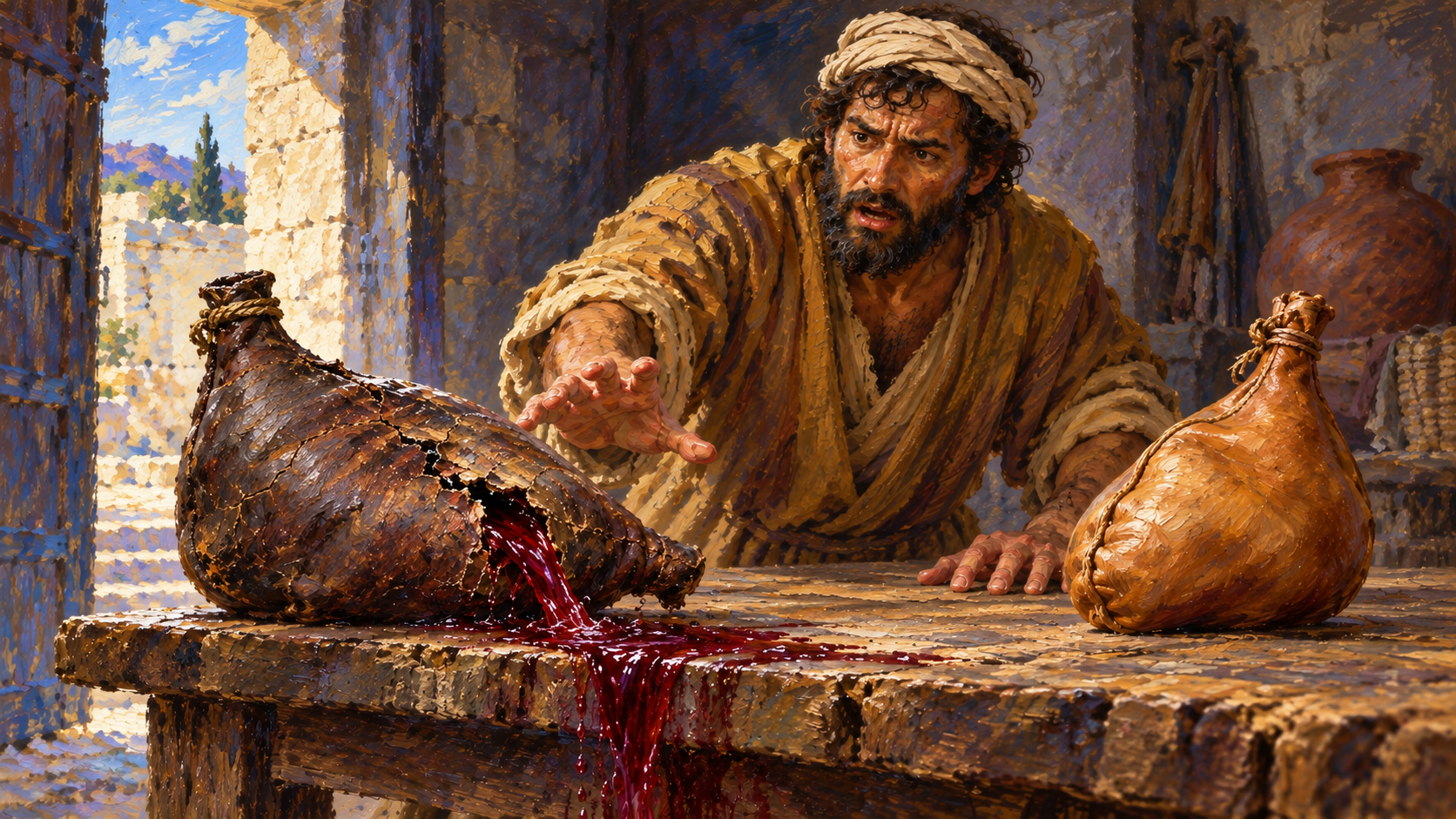
Jesus then described new wine being put into wineskins. As the wine continued to ferment, it would expand and press against the skin. An old, brittle skin could no longer stretch, so it would burst and the wine would spill. Both would be lost. A new skin had the flexibility to hold the new wine as it expanded.
“And no one puts new wine into old wineskins; or else the new wine will burst the wineskins and be spilled, and the wineskins will be ruined. But new wine must be put into new wineskins, and both are preserved.”
Christ’s kingdom work and the new covenant life He brings cannot fit within religious self-confidence. I cannot cling to an unchanged heart and my own pride while simply adding Jesus to what I already believe I can accomplish. That would make Him serve a system of self-righteousness and distort the gospel, as though human merit could manage grace. The answer is not a better human container for the gospel. The sinner needs new birth.
Luke says that both the wine and the new wineskins are preserved. That detail helps me see that Jesus was bringing God’s promises to fulfillment in the right covenant form, rather than promoting destructive novelty. We should not use “old wineskins” as a label for every old practice. In this conversation, the problem is a form of religion that refuses to receive Christ and His fulfillment.
Luke then adds a sentence that is often left out. A person accustomed to old wine does not immediately desire the new because he says the old is better.
“And no one, having drunk old wine, immediately desires new; for he says, ‘The old is better.’”
The preference for old wine explains resistance to Jesus rather than canceling the earlier picture. Familiar religious patterns can feel safer than repentance and faith, even when the system we are comfortable with cannot save us. Jesus was exposing that reluctance to receive Him, not campaigning for novelty. Someone satisfied with the old order may prefer the religious world he understands to acknowledging that the Bridegroom has arrived and that he needs a new heart.
Jesus Fulfilled the Law and Brought the Promised Covenant
We must be careful not to make God’s Law itself the bad wineskin. Jesus said plainly that He did not come to destroy the Law or the Prophets.
“Do not think that I came to destroy the Law or the Prophets. I did not come to destroy but to fulfill.”
The Mosaic covenant was holy and good. It exposed sin and governed Israel while pointing forward to Christ, but it could not justify sinners or give life to an unchanged heart. I need to keep that distinction clear: Jesus did not come to correct a mistake in God’s plan. Human sin was the problem, and sinners could not make themselves righteous. Human traditions added another obstacle when they set aside God’s command, while self-righteous confidence kept people from receiving their Savior.
Christ fulfilled the Law through perfect obedience and by bringing its shadows to their intended goal. The sacrifices pointed to His better sacrifice, and the priesthood pointed to a better Mediator. He bore sin’s punishment and brought in the new covenant that God had already promised. Jeremiah spoke of God writing His law on hearts and forgiving iniquity. Ezekiel promised a new heart and a new spirit.
God had already promised a covenant unlike the one made when Israel came out of Egypt. So the change Jesus brought was not an improvised answer to a failed plan. Another external rule would not meet the need. God promised to forgive guilt and change His people from within, and Jesus brought that work to fulfillment in agreement with the Law and Prophets that foretold it.
“I will give you a new heart and put a new spirit within you; I will take the heart of stone out of your flesh and give you a heart of flesh.”
When Paul described believers as ministers of the new covenant, he contrasted the Law’s work with the life the Spirit gives. His words “the letter kills” do not mean that God’s written Word is evil. The Law exposes and condemns sin, but it cannot supply the life a sinner lacks. Only the Spirit can give that life.
“Who also made us sufficient as ministers of the new covenant, not of the letter but of the Spirit; for the letter kills, but the Spirit gives life.”
Hebrews explains the change in covenant administration even more directly:
“In that He says, ‘A new covenant,’ He has made the first obsolete. Now what is becoming obsolete and growing old is ready to vanish away.”
The first covenant became obsolete when God called the promised covenant new. It had served its God-given purpose and pointed forward to Christ, so we should not mistake its passing for evidence that God’s earlier revelation was wicked or mistaken. Christ established the promised new covenant in His blood. Through Him we receive forgiveness and a new relationship with God, with the Holy Spirit giving life from within.
An external command can show me what is wrong, but it cannot turn a heart of stone into a heart that loves God. That is why religious pressure cannot produce the obedience the Spirit enables. The new covenant supplies what the sinner lacks through forgiveness in Christ and the gift of the Spirit. God has not lowered His standard of holiness; His Spirit works obedience from within.
A fresh brand or more exciting worship style cannot give us the inward renewal God promised. A person can learn Christian language and become comfortable in Christian gatherings without being changed within. Admiring Christian ethics does not make that change either. New wine belongs in a life made new by God. As 2 Corinthians 5:17 says, the person in Christ is a new creation. This is life in Christ, far more than self-improvement or an unchanged person adopting religious language.
Christian Liberty Rejects Legalism and Lawlessness
In Galatians, Paul confronted teachers who insisted that Gentile believers needed circumcision and the Mosaic Law to belong to God’s people. His answer helps us understand why Christ cannot become an addition to religious self-confidence. Paul showed that Christ is sufficient and that God’s promise came before the Law. The Spirit is received by faith. None of that required him to call the Law evil.
“Stand fast therefore in the liberty by which Christ has made us free, and do not be entangled again with a yoke of bondage.”
Paul’s warning makes me consider what a person might add to the gospel as though Christ had left His work unfinished. Some rely on visible religious marks or ancestral identity. Others look to calendar observance or personal discipline, or to what they have achieved morally. Those things become bondage when we depend on them as the basis or completion of our acceptance before God. Christ does not need our works to finish His saving work.
Yet Paul did not turn freedom in Christ into permission for lawlessness. Believers are to serve one another through love instead of using liberty as an opportunity for the flesh. The Spirit produces fruit that an external system cannot create in an unchanged heart. Grace gives us a new life, rather than leaving the flesh in charge beneath a covering of religious language.
An inherited practice may be wise and biblical, or it may be only a human habit. Its age does not answer that question. We need to ask whether it submits to Scripture and honors Christ, rather than treating every tradition as an enemy because it is old. Nor does the image of new wine give us permission to ignore holiness. The new covenant gives a new heart and Spirit-enabled obedience, and grace teaches believers to turn from ungodliness.
Church methods can have real consequences for the people a church serves, but they are not the subject of this conversation. Jesus was answering the fasting question by speaking about Himself. His answer also concerns covenant fulfillment and the heart that receives what He brings. If I reduce the parable to a lesson about innovation, I lose sight of the Savior at its center.
We should test a new movement or idea by Christ and His Word before calling it “new wine”. A practice can be new and still be human and self-serving, just as an old one can. The image calls us to receive what Jesus brings. It does not make our own preferences true simply because we give them a memorable biblical name.
The Passage Calls for More Than Religious Repair
I cannot make my moral record the basis of my acceptance and then add Jesus as a finishing touch. The same is true of heritage or rituals, and of keeping visibly separate from others. None can serve as the foundation of our acceptance while Christ becomes an accessory. This was part of the blindness of the Pharisees. We need Christ as our Savior, not as a patch on human merit.
We also should not confuse age with faithfulness. Some old practices remain good because they are rooted in Scripture. Other habits grow brittle because pride or fear controls them. The important question is whether following that practice honors Christ’s authority and helps us obey His Word.
Repairing a sinner’s reputation cannot give him new covenant life. We need forgiveness through Christ’s blood and new birth, with the Holy Spirit dwelling within us and turning our lives in a new direction. Training an old heart to behave differently will not bring it into salvation.
The same question reaches into our personal lives. Someone can admire Christian teaching and adopt Christian morals, even becoming comfortable among believers, without trusting Christ. That can change how a life looks from the outside, but it cannot create spiritual life. I need to ask whether God has made me new in His Son, rather than whether I simply look better to other people.
Grace then produces obedience rather than self-righteous performance. A new wineskin is not a heart freed from Christ’s commands; it is a heart made alive to God. Believers are not under Sinai as their covenant, but they remain under the authority of Jesus and are taught by the Spirit to walk in holiness. We can fast and pray without using either as proof of our worth. Love and service also grow from the new life Christ gives rather than becoming a way to earn it.
My Final Thoughts
When I put this saying back into the conversation about fasting, I cannot use new wine as a slogan for whatever change seems exciting. The Bridegroom had come, and His presence could not be treated as a patch on self-righteous religion or poured into a heart that refused Him. Jesus fulfilled the Law and established the promised new covenant in His blood, so sinners need more than religious adjustment; we need the new life only He can give. That grace frees us from trying to earn God’s acceptance, but it also teaches us to obey Christ from a heart made alive by the Spirit.