
The Pharisees appear so often in conflict with Jesus that it is easy to think we already know who they were. Yet I want to understand what they believed and why He spoke so sharply to many of them. Knowing a great deal about religion did not keep them from pride, and I need to take that warning seriously myself.
The Pharisees Were an Influential Jewish Movement
The Pharisees belonged to Judaism during the Second Temple period. The Gospels often show them questioning Jesus and challenging His disciples. Many opposed His claims. But “Pharisee” does not mean every Jewish person or every teacher, and it is not a name for anyone who takes obedience seriously. Jesus and His apostles were Jewish, as were His first disciples. He rebuked unbelief and hypocrisy among particular leaders within that Jewish setting. We must not turn His words into contempt for Jewish people.
The Pharisees differed from the Sadducees, who were closely connected with the priestly establishment. Sadducees denied the resurrection and the existence of angels or spirits, while Pharisees confessed those truths and tried to apply the Law throughout ordinary life. Scribes and lawyers sometimes worked with Pharisees, but those names are not interchangeable. A scribe was trained in the Law; being a Pharisee meant belonging to a particular movement.
The name “Pharisee” is usually connected with a Hebrew or Aramaic root related to separation. “Separated ones” may describe their concern for purity or a distinct way of life, though the title’s exact origin remains debated. That possible meaning can help us consider the name, but it cannot tell us with certainty how the whole movement began.
Pharisaic influence became visible in the centuries before Christ, especially during the rule of the Hasmoneans. Some historians connect them with earlier pious Jews often called the Hasidim. That may describe part of the background, but the evidence does not trace a simple, unbroken organization from one group to the other.
By the first century, Pharisees were well-known interpreters with considerable influence among the people. The Jewish historian Josephus distinguished them from the Sadducees and Essenes and described their beliefs broadly. His writing can help us understand the historical setting, but I give Scripture the final authority when interpreting the encounters recorded in the Gospels and Acts.
Later rabbinic writings can help us understand traditions that developed and were remembered, provided we pay attention to when those writings appeared. The Mishnah was compiled in writing around AD 200, and the Jerusalem and Babylonian Talmuds came later still. We should not picture Jesus debating a finished Talmud in the first century.
Several Pharisaic convictions were true. They confessed the resurrection of the dead and believed in angels and spirits. They received the Law as God’s Word and wanted its commands followed outside the temple as well. Their teaching addressed ordinary concerns about purity and tithing, along with how to observe the Sabbath. It also covered fasting, vows, and meals. Jesus did not rebuke them for taking Scripture seriously or for wanting to obey it carefully.
The trouble came when inherited interpretations were treated as though God had given them and then used to cancel what He had commanded. Many leaders trusted the record others could see while neglecting justice, mercy, and faith. Most seriously, they rejected the Messiah to whom Scripture pointed. That troubles me because a person can defend true doctrine and still have a proud, unbelieving heart. Someone may defend the resurrection while refusing the risen Lord, or study commandments while missing the heart of the Law.
The New Testament also shows individual Pharisees responding differently. Nicodemus listened to Jesus and later defended lawful procedure before helping to bury Him. Gamaliel restrained a council ready for violence, and other Pharisees warned Jesus that Herod wanted to kill Him. Acts even names Pharisees who believed. I cannot ignore those men when describing the movement’s frequent opposition to Jesus.
Jesus Exposed Religious Confidence That Never Reached the Heart
In those days John the Baptist came preaching in the wilderness of Judea, and saying, “Repent, for the kingdom of heaven is at hand!” For this is he who was spoken of by the prophet Isaiah, saying: “The voice of one crying in the wilderness: ‘Prepare the way of the LORD; Make His paths straight.'” Now John himself was clothed in camel’s hair, with a leather belt around his waist; and his food was locusts and wild honey. Then Jerusalem, all Judea, and all the region around the Jordan went out to him and were baptized by him in the Jordan, confessing their sins. But when he saw many of the Pharisees and Sadducees coming to his baptism, he said to them, “Brood of vipers! Who warned you to flee from the wrath to come? Therefore bear fruits worthy of repentance, and do not think to say to yourselves, ‘We have Abraham as our father.’ For I say to you that God is able to raise up children to Abraham from these stones. And even now the ax is laid to the root of the trees. Therefore every tree which does not bear good fruit is cut down and thrown into the fire. I indeed baptize you with water unto repentance, but He who is coming after me is mightier than I, whose sandals I am not worthy to carry. He will baptize you with the Holy Spirit and fire. His winnowing fan is in His hand, and He will thoroughly clean out His threshing floor, and gather His wheat into the barn; but He will burn up the chaff with unquenchable fire.”
John addressed Pharisees and Sadducees together, despite the sharp doctrinal disagreements between them. Both needed to repent. Being physically descended from Abraham could not protect an unrepentant hearer, although God remained faithful to His covenant. John directed everyone to the Coming One, who is mightier than he and who will separate wheat from chaff.
The fruit John required showed whether repentance was genuine; it did not purchase mercy. No one is saved by moral performance. I cannot appeal to ancestry or baptism to conceal a heart that refuses Christ, any more than church attendance or religious vocabulary could do that for me.
“Do not think that I came to destroy the Law or the Prophets. I did not come to destroy but to fulfill. For assuredly, I say to you, till heaven and earth pass away, one jot or one tittle will by no means pass from the law till all is fulfilled. Whoever therefore breaks one of the least of these commandments, and teaches men so, shall be called least in the kingdom of heaven; but whoever does and teaches them, he shall be called great in the kingdom of heaven. For I say to you, that unless your righteousness exceeds the righteousness of the scribes and Pharisees, you will by no means enter the kingdom of heaven.
Jesus did not destroy the Law or lower God’s holiness. When He said our righteousness must exceed that of the scribes and Pharisees, He was not asking us to accumulate more rules. The rest of the Sermon on the Mount shows how deeply God’s commands reach into the heart. Jesus addressed the anger behind murder and the lust behind adultery. He required honest speech instead of manipulative oaths, and His command to love extended even to enemies. Our devotion is to be lived before the Father, not performed for an audience.
Many Pharisees were admired for visible discipline, but Jesus showed that someone could live that way and still have an unchanged heart. Comparing myself with a worse person cannot produce the righteousness needed for God’s kingdom. I need the life God gives and the righteousness that comes through faith in Christ.
I also notice that Jesus honors God’s commands and condemns those who teach others to break them. His rebuke gives us no reason to set grace against obedience. He distinguishes obedience that grows from faith from a self-righteous performance that seeks status while avoiding the full claim of God’s Word.
We can see the difference in the meals Jesus shared with Pharisees. In Luke 7, Simon the Pharisee judged a woman known as a sinner while she wept at Jesus’ feet. Jesus exposed Simon’s cold welcome through His parable of two debtors who had nothing with which to pay. The woman’s tears and perfume did not purchase forgiveness. Jesus said her faith had saved her, and her love showed the mercy she had received.
When Pharisees complained elsewhere that Jesus received sinners and ate with them, He answered with the parables of a lost sheep, a lost coin, and a lost son. Repentance should bring joy. Jesus was not approving sin by receiving sinners; He called them to repent. His answer confronts the pride that keeps measuring another person’s disgrace without admitting its own need for mercy.
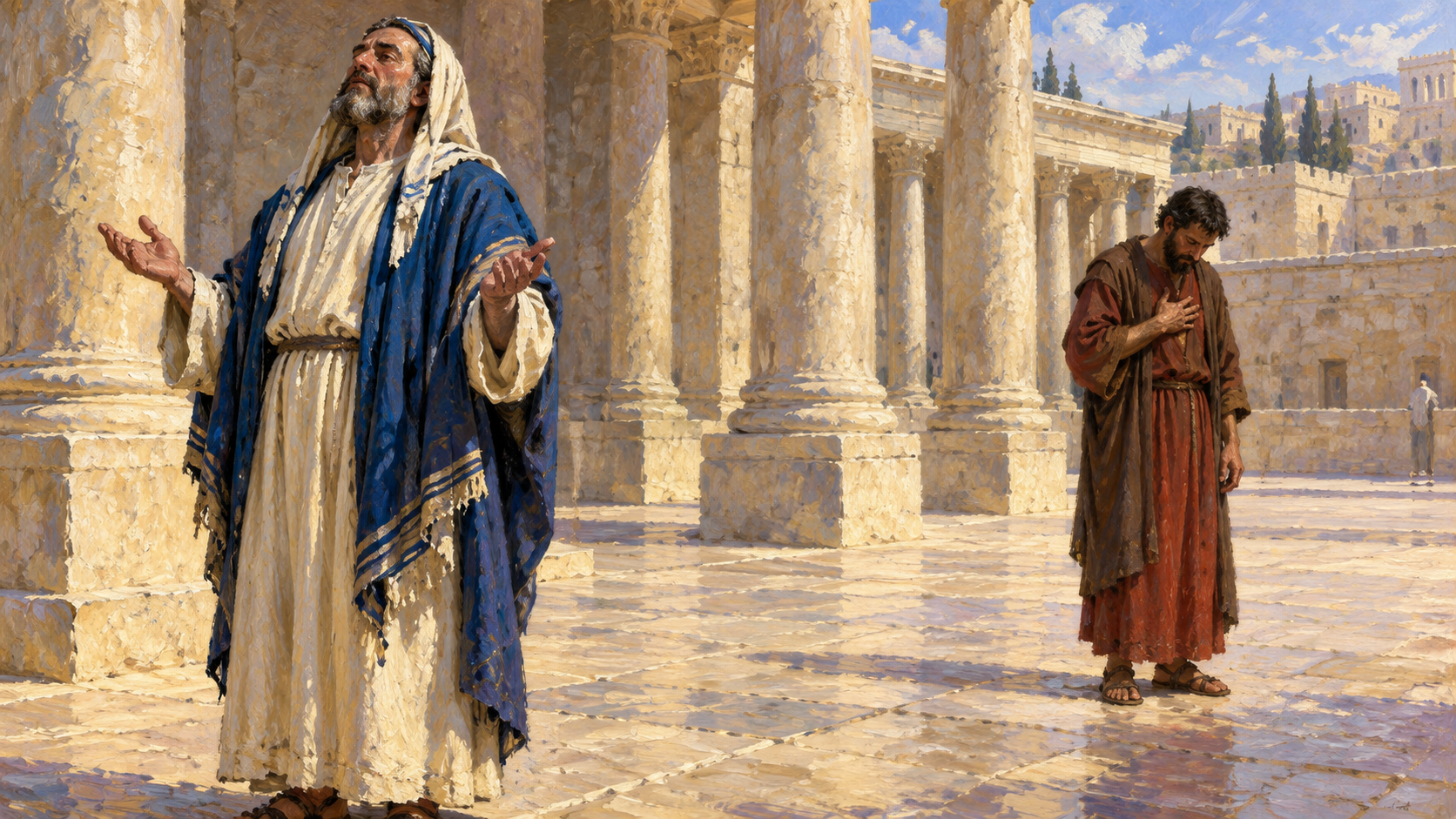
Also He spoke this parable to some who trusted in themselves that they were righteous, and despised others: “Two men went up to the temple to pray, one a Pharisee and the other a tax collector. The Pharisee stood and prayed thus with himself, ‘God, I thank You that I am not like other men–extortioners, unjust, adulterers, or even as this tax collector. I fast twice a week; I give tithes of all that I possess.’ And the tax collector, standing afar off, would not so much as raise his eyes to heaven, but beat his breast, saying, ‘God, be merciful to me a sinner!’ I tell you, this man went down to his house justified rather than the other; for everyone who exalts himself will be humbled, and he who humbles himself will be exalted.”
Jesus aimed this parable at people who trusted their own righteousness and despised others. Fasting can accompany sincere devotion, and giving what God requires is obedience, so the Pharisee’s practices were not all wrong. The problem was his confidence in them. He used them to congratulate himself by comparison with other people.
The tax collector asked God for mercy without offering achievements or excuses. He did not try to make himself look better by pointing to someone worse, and Jesus said he went home justified rather than the Pharisee. I need to hear that even if my doctrine is conservative and my habits are disciplined. Years of respectable service cannot justify me or make God owe me acceptance. Thinking they could would show that I had misunderstood both sin and grace.
Humility does not require us to call evil good or act as though obedience is unimportant. It means agreeing with God’s judgment and giving up confidence in ourselves so that we receive His mercy. A fuller look at this subject is available in the study on true humility.
Christ Placed Scripture Above Tradition and False Strictness
At that time Jesus went through the grainfields on the Sabbath. And His disciples were hungry, and began to pluck heads of grain and to eat. And when the Pharisees saw it, they said to Him, “Look, Your disciples are doing what is not lawful to do on the Sabbath!” But He said to them, “Have you not read what David did when he was hungry, he and those who were with him: how he entered the house of God and ate the showbread which was not lawful for him to eat, nor for those who were with him, but only for the priests? Or have you not read in the law that on the Sabbath the priests in the temple profane the Sabbath, and are blameless? Yet I say to you that in this place there is One greater than the temple. But if you had known what this means, ‘I desire mercy and not sacrifice,’ you would not have condemned the guiltless. For the Son of Man is Lord even of the Sabbath.” Now when He had departed from there, He went into their synagogue. And behold, there was a man who had a withered hand. And they asked Him, saying, “Is it lawful to heal on the Sabbath?”–that they might accuse Him. Then He said to them, “What man is there among you who has one sheep, and if it falls into a pit on the Sabbath, will not lay hold of it and lift it out? Of how much more value then is a man than a sheep? Therefore it is lawful to do good on the Sabbath.” Then He said to the man, “Stretch out your hand.” And he stretched it out, and it was restored as whole as the other. Then the Pharisees went out and plotted against Him, how they might destroy Him.
Deuteronomy allowed a traveler to pluck grain by hand from a neighbor’s standing crop, so the disciples were not stealing. The Pharisees objected because they treated that hand-plucking as forbidden Sabbath work. Jesus answered from Scripture, recalling David’s need and the priests who served in the temple on the Sabbath. He applied Hosea’s words about mercy before declaring His own authority as Lord of the Sabbath.
Jesus called the disciples guiltless and taught that doing good on the Sabbath was lawful. I cannot read that as a rebellious Messiah breaking a holy Law. The Lord of the Sabbath was confronting interpreters whose rules condemned innocent people and resisted mercy. He did not violate the command God had given.
After Jesus restored the man’s withered hand, these leaders went out to plan how they could destroy Him. I find that response deeply troubling. They had just seen a suffering person made whole, yet they wanted to preserve their accusation instead of rejoicing in God’s mercy. A system meant to guard holiness was being used to oppose a merciful work of God.
Being strict does not by itself make an interpretation faithful. I need to ask whether it agrees with the biblical text and reflects God’s character, and whether I am submitting to Christ’s authority. The command and its covenant setting receive fuller treatment in the study on the Sabbath day of rest.
Then the scribes and Pharisees who were from Jerusalem came to Jesus, saying, “Why do Your disciples transgress the tradition of the elders? For they do not wash their hands when they eat bread.” He answered and said to them, “Why do you also transgress the commandment of God because of your tradition? For God commanded, saying, ‘Honor your father and your mother’; and, ‘He who curses father or mother, let him be put to death.’ But you say, ‘Whoever says to his father or mother, “Whatever profit you might have received from me is a gift to God”– then he need not honor his father or mother.’ Thus you have made the commandment of God of no effect by your tradition. Hypocrites! Well did Isaiah prophesy about you, saying: ‘These people draw near to Me with their mouth, And honor Me with their lips, But their heart is far from Me. And in vain they worship Me, Teaching as doctrines the commandments of men.'” When He had called the multitude to Himself, He said to them, “Hear and understand: Not what goes into the mouth defiles a man; but what comes out of the mouth, this defiles a man.” Then His disciples came and said to Him, “Do You know that the Pharisees were offended when they heard this saying?” But He answered and said, “Every plant which My heavenly Father has not planted will be uprooted. Let them alone. They are blind leaders of the blind. And if the blind leads the blind, both will fall into a ditch.” Then Peter answered and said to Him, “Explain this parable to us.” So Jesus said, “Are you also still without understanding? Do you not yet understand that whatever enters the mouth goes into the stomach and is eliminated? But those things which proceed out of the mouth come from the heart, and they defile a man. For out of the heart proceed evil thoughts, murders, adulteries, fornications, thefts, false witness, blasphemies. These are the things which defile a man, but to eat with unwashed hands does not defile a man.”
This dispute was about ceremonial handwashing before a meal, not ordinary cleanliness. The scribes and Pharisees asked why the disciples violated the tradition of the elders. Jesus answered with the more serious question: why did their tradition violate God’s command?
Mark’s parallel calls a gift devoted to God Corban. Giving to God was not wrong, but this religious declaration could be used to withhold support owed to needy parents. What sounded consecrated could therefore make “Honor your father and your mother” ineffective. Jesus would not allow the human rule to overrule the divine command.
Isaiah had described people whose lips honored God while their hearts remained far from Him. They taught human commandments as though those commands came from God. Jesus then explained that moral defilement comes from the heart, where ceremonial washing cannot reach it. Washing hands cannot remove greed or false witness, and it cannot cleanse sexual sin, murder, or blasphemy.
A family or congregation can develop wise habits without doing anything sinful. The problem begins when we give a custom God’s authority or let it contradict Scripture. I need to be willing to examine a familiar practice if it has become a cover for disobedience. No human habit may become a test of righteousness that God never established.
We also need to be clear about what we mean by legalism. People sometimes use the word against any serious effort to obey, yet Jesus obeyed the Father perfectly and honored every part of Scripture. He told His disciples to keep His commands. Following biblical church order is not legalism, and neither is pursuing sexual purity or truthfulness. Refusing idolatry is obedience too.
Legalism treats keeping the law or performing religious works as a way to be justified before God. It also gives human rules the authority of God’s commands and makes them conditions of acceptance. We see the related danger when someone carefully polices visible conduct while excusing pride and greed within. Injustice and unbelief can remain untouched under that scrutiny. The conflicts with the Pharisees show us how these errors work.
Grace gives us no reason to abandon obedience. Ephesians 2 says salvation is God’s gift rather than a reward for works, then explains that believers are created in Christ Jesus for good works. Those works grow out of salvation; they cannot bring it about. However genuine the fruit, forgiveness still rests on Christ’s blood. The difference between grace and religious bondage is examined further in the study on Galatians.
Nicodemus and the Believing Pharisees Show the Need for New Birth
There was a man of the Pharisees named Nicodemus, a ruler of the Jews. This man came to Jesus by night and said to Him, “Rabbi, we know that You are a teacher come from God; for no one can do these signs that You do unless God is with him.” Jesus answered and said to him, “Most assuredly, I say to you, unless one is born again, he cannot see the kingdom of God.” Nicodemus said to Him, “How can a man be born when he is old? Can he enter a second time into his mother’s womb and be born?” Jesus answered, “Most assuredly, I say to you, unless one is born of water and the Spirit, he cannot enter the kingdom of God. That which is born of the flesh is flesh, and that which is born of the Spirit is spirit. Do not marvel that I said to you, ‘You must be born again.’ The wind blows where it wishes, and you hear the sound of it, but cannot tell where it comes from and where it goes. So is everyone who is born of the Spirit.” Nicodemus answered and said to Him, “How can these things be?” Jesus answered and said to him, “Are you the teacher of Israel, and do not know these things? Most assuredly, I say to you, We speak what We know and testify what We have seen, and you do not receive Our witness. If I have told you earthly things and you do not believe, how will you believe if I tell you heavenly things? No one has ascended to heaven but He who came down from heaven, that is, the Son of Man who is in heaven. And as Moses lifted up the serpent in the wilderness, even so must the Son of Man be lifted up, that whoever believes in Him should not perish but have eternal life. For God so loved the world that He gave His only begotten Son, that whoever believes in Him should not perish but have everlasting life. For God did not send His Son into the world to condemn the world, but that the world through Him might be saved. “He who believes in Him is not condemned; but he who does not believe is condemned already, because he has not believed in the name of the only begotten Son of God. And this is the condemnation, that the light has come into the world, and men loved darkness rather than light, because their deeds were evil. For everyone practicing evil hates the light and does not come to the light, lest his deeds should be exposed. But he who does the truth comes to the light, that his deeds may be clearly seen, that they have been done in God.”
Nicodemus was a Pharisee and a ruler of the Jews who recognized that God’s presence was necessary to explain Jesus’ signs. Yet Jesus told this respected teacher that he had to be born again. That keeps me from confusing recognition of God’s work with receiving the life of the Spirit. Religious office and biblical learning could not produce that life, nor could Nicodemus’ national identity.
The words about being born of water and the Spirit recall the prophetic promise of cleansing and a new heart, especially in Ezekiel 36. As a teacher of Israel, Nicodemus should have understood the need for inward renewal that only God could supply. Jesus was not teaching that baptismal water causes regeneration. Water baptism follows personal faith and pictures identification with Christ, while the Holy Spirit is the One who gives new life.
Jesus directed Nicodemus to the Son of Man who would be lifted up and explained God’s love for the world. Whoever believes in Him receives everlasting life, while whoever refuses Him remains condemned. Belonging to a respected movement could not settle Nicodemus’ standing before God. Each person must be born again through faith in the Son.
John later records Nicodemus asking whether the Law judges a man before hearing him. At Jesus’ burial, he brought costly spices and helped Joseph of Arimathea care for the body. I see growing courage and attachment to Jesus in those actions, but I do not want to supply a private conversion scene that Scripture has not given us.
Gamaliel urged the council not to risk fighting against God, and some Pharisees warned Jesus that Herod meant to kill Him. These men did not act like the hostile leaders around them. Their actions deserve to be recognized, although wise counsel by itself does not prove saving faith. We need to let the recorded evidence shape what we say about each man.
And certain men came down from Judea and taught the brethren, “Unless you are circumcised according to the custom of Moses, you cannot be saved.” Therefore, when Paul and Barnabas had no small dissension and dispute with them, they determined that Paul and Barnabas and certain others of them should go up to Jerusalem, to the apostles and elders, about this question. So, being sent on their way by the church, they passed through Phoenicia and Samaria, describing the conversion of the Gentiles; and they caused great joy to all the brethren. And when they had come to Jerusalem, they were received by the church and the apostles and the elders; and they reported all things that God had done with them. But some of the sect of the Pharisees who believed rose up, saying, “It is necessary to circumcise them, and to command them to keep the law of Moses.” Now the apostles and elders came together to consider this matter. And when there had been much dispute, Peter rose up and said to them: “Men and brethren, you know that a good while ago God chose among us, that by my mouth the Gentiles should hear the word of the gospel and believe. So God, who knows the heart, acknowledged them by giving them the Holy Spirit, just as He did to us, and made no distinction between us and them, purifying their hearts by faith. Now therefore, why do you test God by putting a yoke on the neck of the disciples which neither our fathers nor we were able to bear? But we believe that through the grace of the Lord Jesus Christ we shall be saved in the same manner as they.”
Acts explicitly calls these men “some of the sect of the Pharisees who believed.” They were inside the church, but they had brought a serious error with them. They wanted Gentile believers circumcised and commanded to keep the Law of Moses, tying those requirements to salvation.
Peter answered by pointing to what God had already done among the Gentiles. God knew their hearts and had given them the Holy Spirit, purifying them by faith. They did not need to convert to Judaism before they could belong to Christ. Jews and Gentiles are saved in the same way, through the grace of the Lord Jesus Christ.
I notice that Scripture still calls these Pharisees believers even while recording an error that needed correction. Conversion does not remove every inherited assumption at once. We must correct serious error from Scripture without forgetting that genuine believers may need time to grow out of long-held ways of thinking.
In Acts 23, Paul identified with the Pharisees’ belief in resurrection before a council divided by Sadducean denial. Pharisaic scribes then said they found no evil in him. Paul could truthfully acknowledge that common ground without endorsing everything the movement taught. I do not need to deny what someone gets right in order to reject his errors.
The Woes Warn of Final Judgment, Not Mere Religious Failure
Then Jesus spoke to the multitudes and to His disciples, saying: “The scribes and the Pharisees sit in Moses’ seat. Therefore whatever they tell you to observe, that observe and do, but do not do according to their works; for they say, and do not do. For they bind heavy burdens, hard to bear, and lay them on men’s shoulders; but they themselves will not move them with one of their fingers. But all their works they do to be seen by men. They make their phylacteries broad and enlarge the borders of their garments. They love the best places at feasts, the best seats in the synagogues, greetings in the marketplaces, and to be called by men, ‘Rabbi, Rabbi.’ But you, do not be called ‘Rabbi’; for One is your Teacher, the Christ, and you are all brethren. Do not call anyone on earth your father; for One is your Father, He who is in heaven. And do not be called teachers; for One is your Teacher, the Christ. But he who is greatest among you shall be your servant. And whoever exalts himself will be humbled, and he who humbles himself will be exalted. “But woe to you, scribes and Pharisees, hypocrites! For you shut up the kingdom of heaven against men; for you neither go in yourselves, nor do you allow those who are entering to go in. Woe to you, scribes and Pharisees, hypocrites! For you devour widows’ houses, and for a pretense make long prayers. Therefore you will receive greater condemnation. “Woe to you, scribes and Pharisees, hypocrites! For you travel land and sea to win one proselyte, and when he is won, you make him twice as much a son of hell as yourselves. “Woe to you, blind guides, who say, ‘Whoever swears by the temple, it is nothing; but whoever swears by the gold of the temple, he is obliged to perform it.’ Fools and blind! For which is greater, the gold or the temple that sanctifies the gold? And, ‘Whoever swears by the altar, it is nothing; but whoever swears by the gift that is on it, he is obliged to perform it.’ Fools and blind! For which is greater, the gift or the altar that sanctifies the gift? Therefore he who swears by the altar, swears by it and by all things on it. He who swears by the temple, swears by it and by Him who dwells in it. And he who swears by heaven, swears by the throne of God and by Him who sits on it. “Woe to you, scribes and Pharisees, hypocrites! For you pay tithe of mint and anise and cummin, and have neglected the weightier matters of the law: justice and mercy and faith. These you ought to have done, without leaving the others undone. Blind guides, who strain out a gnat and swallow a camel! “Woe to you, scribes and Pharisees, hypocrites! For you cleanse the outside of the cup and dish, but inside they are full of extortion and self-indulgence. Blind Pharisee, first cleanse the inside of the cup and dish, that the outside of them may be clean also. “Woe to you, scribes and Pharisees, hypocrites! For you are like whitewashed tombs which indeed appear beautiful outwardly, but inside are full of dead men’s bones and all uncleanness. Even so you also outwardly appear righteous to men, but inside you are full of hypocrisy and lawlessness. “Woe to you, scribes and Pharisees, hypocrites! Because you build the tombs of the prophets and adorn the monuments of the righteous, and say, ‘If we had lived in the days of our fathers, we would not have been partakers with them in the blood of the prophets.’ “Therefore you are witnesses against yourselves that you are sons of those who murdered the prophets. Fill up, then, the measure of your fathers’ guilt. Serpents, brood of vipers! How can you escape the condemnation of hell? Therefore, indeed, I send you prophets, wise men, and scribes: some of them you will kill and crucify, and some of them you will scourge in your synagogues and persecute from city to city, that on you may come all the righteous blood shed on the earth, from the blood of righteous Abel to the blood of Zechariah, son of Berechiah, whom you murdered between the temple and the altar. Assuredly, I say to you, all these things will come upon this generation. “O Jerusalem, Jerusalem, the one who kills the prophets and stones those who are sent to her! How often I wanted to gather your children together, as a hen gathers her chicks under her wings, but you were not willing! See! Your house is left to you desolate; for I say to you, you shall see Me no more till you say, ‘Blessed is He who comes in the name of the LORD!'”
When Jesus said the scribes and Pharisees sat in Moses’ seat, He told His hearers to respect what truly came from Moses. He did not tell them to imitate teachers who spoke God’s commands without obeying them. I cannot take His words as approval of every tradition, since Matthew 15 has already shown Him rejecting traditions that canceled God’s command.
Matthew records this public address during Jesus’ final week, after His entry into Jerusalem and repeated challenges to His authority. Jesus condemned the leaders in the hearing of the crowds and His disciples. They needed the warning so that they would not reproduce the same kind of religion themselves.
The received text includes Matthew 23:14, giving the chapter eight woe statements. The familiar count of seven comes from critical editions that omit verse 14. Since these studies normally follow the Textus Receptus, or received Byzantine tradition, I retain that verse and count eight. I do not believe an Alexandrian omission should control the count.
The woes show how far this corruption had spread. These leaders refused the kingdom and used their influence in ways that hindered others from entering. Their long prayers created a religious appearance while they exploited vulnerable people, and their converts came to share the same danger. They found ways around binding oaths and carefully tithed small herbs while neglecting justice, mercy, and faith. What people saw looked admirable, but greed and self-indulgence ruled within. They even honored dead prophets while preparing to reject the One to whom those prophets had pointed.
Jesus did not tell them to stop giving what was due. They were to practice justice, mercy, and faith without neglecting their other responsibilities. Their obedience had become selective, arranged around what people would notice. His picture of straining out a gnat while swallowing a camel exposed how badly their priorities had gone wrong.
When Jesus calls someone a “hypocrite” here, He means more than the ordinary inconsistency every believer has to fight. He exposes a person performing religion before others while hiding a very different inward life. I cannot answer that rebuke by making the appearance more convincing. Jesus says the inside must first be cleansed.
Jesus lamented that He had wanted to gather Jerusalem’s children, but they were unwilling. I do not see an insincere invitation in His words. His desire was real, and they were responsible for refusing Him. The passage gives us no reason to replace that willing Savior and human refusal with cold fatalism or irresistible grace.
Jesus also asked how those hardened leaders could escape “the condemnation of hell.” Behind “hell” is Gehenna, a name drawn from the Valley of Hinnom that He used for final judgment. Understanding that word helps us recognize the seriousness of His warning. He was not merely predicting embarrassment or damage to their reputation.
Unbelievers will be raised and judged at the Great White Throne. The Lake of Fire is Gehenna and the second death, bringing final, irreversible destruction to the human body and soul. Human beings have no immortality of their own, and Scripture does not teach that they remain conscious in torment forever. Revelation 20:10 uniquely describes endless torment for the devil together with the beast and the false prophet.
Calling a fire “unquenchable” means no one can stop it before it completes God’s judgment. It does not require an indestructible human soul kept alive without end. John’s warning about chaff and Jesus’ words about Gehenna leave us with the same sober conclusion. Religious status cannot protect someone who finally rejects the Messiah.
After Jesus raised Lazarus, the conflict reached a crisis. The council did not deny His many signs, but its leaders feared that widespread belief would threaten their position and the nation. John names both chief priests and Pharisees, so we need to keep the groups distinct. The chief-priestly establishment was largely connected with Sadducean power. Pharisees were a different influential group, yet leaders from both were willing to cooperate against Jesus despite their deep disagreements.
Caiaphas argued that one man should die rather than the nation perish. God gave those words a meaning beyond what Caiaphas intended: Jesus would die for the nation and gather God’s scattered children. That purpose did not excuse the conspirators. They remained morally responsible for choosing murder.
Wicked men physically tortured and punished Jesus, shedding His innocent blood and killing Him. He willingly bore that real punishment for our sins in His innocent body, then rose bodily from the grave. The Father did not punish or curse His beloved Son. He did not abandon, strike, or bruise Jesus, nor did He pour wrath on Him.
Christ died for the whole world, so God’s offer of salvation is genuine even though people can resist and reject Him. Everyone who repents and believes receives forgiveness and eternal life. Mercy was not withheld from these leaders because they belonged to a particular class. Many saw the Light and chose to protect their threatened position instead of receiving Him.
Paul Shows How Christians Must Leave Self-Righteousness Behind
Finally, my brethren, rejoice in the Lord. For me to write the same things to you is not tedious, but for you it is safe. Beware of dogs, beware of evil workers, beware of the mutilation! For we are the circumcision, who worship God in the Spirit, rejoice in Christ Jesus, and have no confidence in the flesh, though I also might have confidence in the flesh. If anyone else thinks he may have confidence in the flesh, I more so: circumcised the eighth day, of the stock of Israel, of the tribe of Benjamin, a Hebrew of the Hebrews; concerning the law, a Pharisee; concerning zeal, persecuting the church; concerning the righteousness which is in the law, blameless. But what things were gain to me, these I have counted loss for Christ. Yet indeed I also count all things loss for the excellence of the knowledge of Christ Jesus my Lord, for whom I have suffered the loss of all things, and count them as rubbish, that I may gain Christ and be found in Him, not having my own righteousness, which is from the law, but that which is through faith in Christ, the righteousness which is from God by faith; that I may know Him and the power of His resurrection, and the fellowship of His sufferings, being conformed to His death, if, by any means, I may attain to the resurrection from the dead.
Paul knew Pharisaic life from within. Before believing in Christ, he could appeal to his ancestry and the covenant sign he had received as an infant. He was thoroughly instructed and known for his zeal, appearing blameless by the public standards of the Law. Yet that zeal had driven him to persecute the church.
After meeting Christ, Paul did not add Jesus as one more achievement to his religious record. He counted the things he once called gain as loss so that he might gain Christ. He gave up confidence in his own righteousness from the Law and desired the righteousness God gives through faith in Christ.
Even Paul’s impressive religious record could not give him resurrection life. He wanted to know Christ and the power of His resurrection, and he was willing to share in Christ’s sufferings. His obedience continued, but he now served because he belonged to Christ. I need that same distinction in my own thinking: service grows from belonging to Him and gives me no claim over God.
That keeps us from two opposite errors. We cannot present our works as a way to earn salvation, but neither can we call God’s commands “legalism” to excuse disobedience. Scripture tells us what sin and righteousness are. It also teaches us how we are saved and how to live faithfully afterward.
Teachers have particular responsibility for the people who listen to them. They must not place demands on others that they refuse to bear themselves, or use titles and public attention to elevate themselves. Manipulating vulnerable people is no less wrong when religious language makes it sound respectable. Nor can a technical distinction excuse plain disobedience. Sound teaching helps people understand Scripture and come to Christ, strengthening their faith so that mercy and justice become visible in their lives. A faithful teacher serves those people humbly rather than performing religion before them.
A congregation should not use “Pharisee” as a weapon against someone who raises a biblical concern. We need to examine the passage together and ask where the practice comes from. Scripture may command it directly, or a sound inference may support it. An inherited habit, however, does not become God’s command simply because we describe it in religious language. If He gave the command, we should obey it; if He did not, we must not pretend otherwise. A label cannot do that work of understanding for us.
These warnings also concern what I allow in private. Speaking true doctrine and behaving respectably in public cannot make up for greed or lust hidden within. Bitterness and deceit may also reveal that unbelief still rules a person’s heart. When someone repents, we should welcome him rather than resent the mercy Christ has shown him. His past gives us no reason to deny fellowship where Jesus has cleansed.
Nicodemus was learned, but he still needed to be born again. We need that same new birth, whatever our religious heritage or how favorably we compare ourselves with others. Years of sound teaching and ministry work cannot justify us either. Before the Son whom God gave for the world, we have to give up confidence in ourselves.
My Final Thoughts
These passages keep me from using the name Pharisee for anyone I dislike. They confessed several biblical truths, and some listened to Jesus or acted with courage. Yet many leaders gave human tradition God’s authority and trusted the religion others could see while rejecting the Messiah before them. Their conduct makes me examine where I place my own confidence. Correct doctrine and strict habits cannot replace a cleansed heart or the new birth. We are saved by grace through faith in Jesus Christ, so our obedience grows from the life He gives rather than making Him owe us acceptance. We need to submit every tradition to Scripture and welcome repentant sinners with joy, remembering that our confidence belongs in Christ rather than ourselves.