
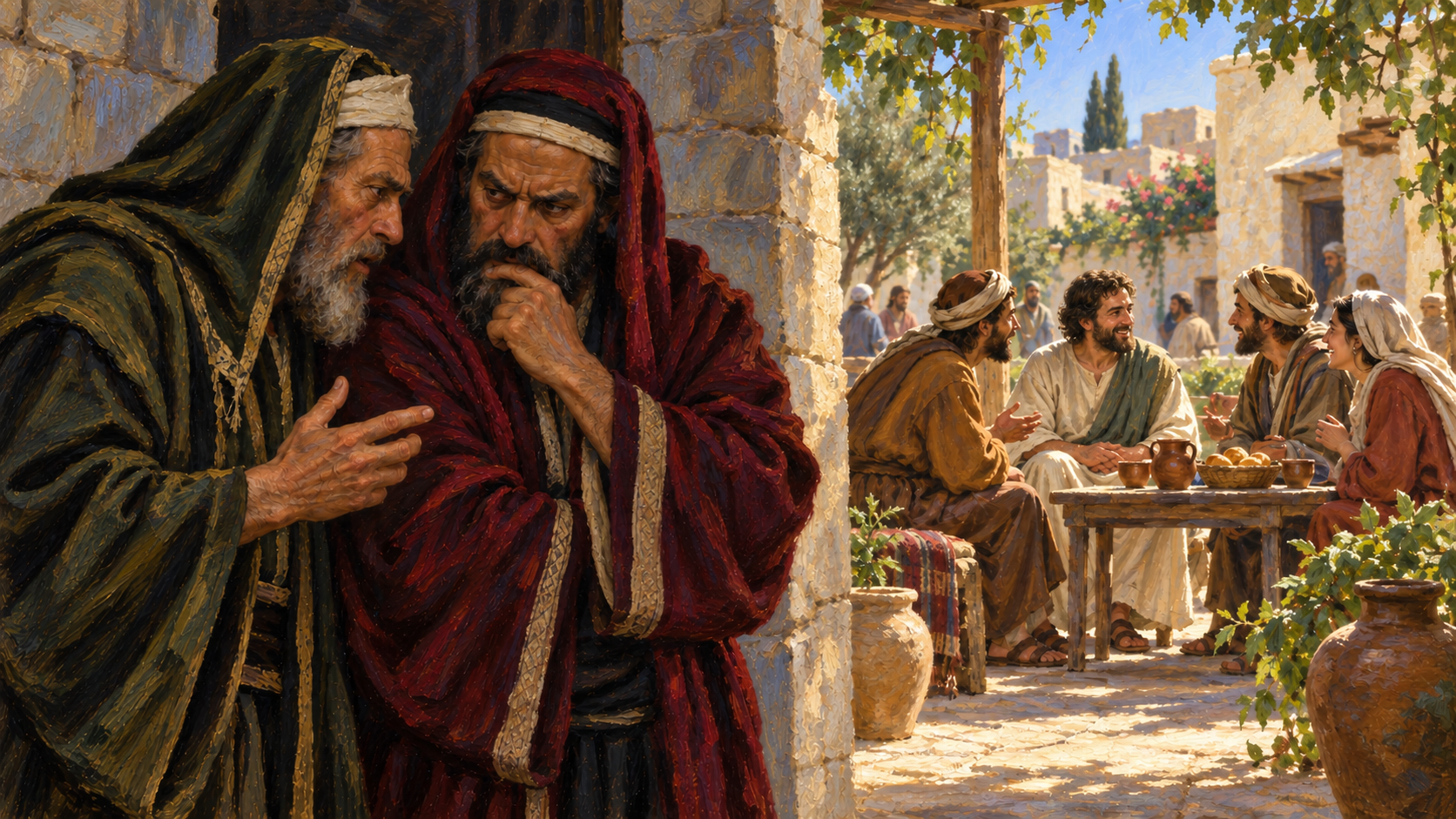
Why would the chief priests want to kill a man Jesus had raised from the dead? John gives the reason: people were believing in Jesus because of Lazarus. I want to follow the events leading to that plot, because the leaders’ response exposes what can happen when preserving influence becomes more important than receiving the truth.
The Miracle That Made Lazarus a Target
By the time Jesus reached Bethany, Lazarus had been in the tomb four days. Mary and Martha had been grieving their brother’s death, but Jesus’ delay did not mean He was unable to help. He had said that the illness would serve God’s glory and the glorifying of the Son. What followed would reveal His authority in a way the people gathered there could witness.
Before going to the tomb, Jesus told Martha, “I am the resurrection and the life” (John 11:25). He then called Lazarus out of the grave. The man who had died emerged still bound in graveclothes, and Jesus told the people to loose him and let him go. The people who had mourned him were now seeing him alive again.
Many of those who saw it responded by believing in Jesus:
Then many of the Jews who had come to Mary, and had seen the things Jesus did, believed in Him.
The sign directed their faith toward the One who had called Lazarus from the tomb. It revealed Jesus as the Son sent by the Father, with authority over life and death. The study on the miracles of Jesus examines that purpose in His works more broadly. John also tells us why he recorded the signs:
And truly Jesus did many other signs in the presence of His disciples, which are not written in this book; but these are written that you may believe that Jesus is the Christ, the Son of God, and that believing you may have life in His name.
John’s purpose requires more from a reader than amazement at an unusual event. Lazarus’s return to life bears witness that Jesus is the Christ, the Son of God, and calls us to believe in Him for life. The leaders who opposed Him were faced with that same testimony.
The Council Chose Control Over Truth
Some of those present reported what Jesus had done to the Pharisees. The chief priests and Pharisees then gathered a council to discuss His growing influence:
Then the chief priests and the Pharisees gathered a council and said, “What shall we do? For this Man works many signs. If we let Him alone like this, everyone will believe in Him, and the Romans will come and take away both our place and nation.”
The leaders acknowledged that Jesus was working signs. Their concern was what the spread of belief would do to their place and nation, and they anticipated Roman intervention if it continued. Instead of asking how they should respond to the One doing these works, they discussed how to contain His influence.
The fear of what Rome might do made their argument sound practical, but it could not justify resisting the truth before them. They should have been leading people to recognize God’s work and respond in repentance and worship. Protecting their authority had become a reason to oppose the One to whom the signs pointed.
Caiaphas, the high priest, argued that one man should die rather than the whole nation perish. John explains that his words carried a prophetic meaning beyond that political calculation: Jesus would die for the nation, and would gather into one the children of God scattered abroad. From that day, the leaders plotted to put Him to death. God’s saving purpose did not make their decision to murder Jesus righteous.
After that decision, Jesus withdrew from public activity among them and went with His disciples to Ephraim, near the wilderness. John 11:49–54 gives that sequence. The decision against Jesus was already in place when He later returned to Bethany and Lazarus became a second target.
Bethany Made the Witness Impossible to Ignore
John marks Jesus’ return to Bethany as six days before Passover:
Then, six days before the Passover, Jesus came to Bethany, where Lazarus was who had been dead, whom He had raised from the dead.
At the meal there, Martha served, Lazarus sat at the table with Jesus, and Mary anointed the Lord’s feet with costly oil. The man who had been in the tomb was now eating with the One who had raised him. John records no speech from Lazarus in this scene; his presence at the table was itself evidence of what Jesus had done.
People came to Bethany to see that man as well as Jesus. His restored life was drawing attention, and the chief priests wanted to stop its effect:
Now a great many of the Jews knew that He was there; and they came, not for Jesus’ sake only, but that they might also see Lazarus, whom He had raised from the dead.
But the chief priests plotted to put Lazarus to death also, because on account of him many of the Jews went away and believed in Jesus.
Their decision concerned a man against whom John records no wrongdoing. Lazarus had become a threat because people believed in Jesus on account of him. The leaders wanted to remove the witness instead of submitting to the Lord whose power his life displayed.
I find the proposal especially reckless in light of the miracle. Killing Lazarus could not strip Jesus of His authority over death or change the fact that He had raised him. The plan exposed how determined these leaders were to resist Christ. They were willing to murder Lazarus as well as Jesus to suppress evidence that should have led them to faith.
This was a plot, not a momentary outburst. The council had already chosen to seek Jesus’ death, and now the chief priests extended that intention to the man whose life was persuading others. Deliberate planning did not make their course wise; it meant they were organizing their resistance to God. The study on Lazarus considers his place in the Gospel account more fully.
Lazarus Pointed Beyond Himself to Jesus
The direction of the people’s faith explains why Lazarus became a target. They believed in Jesus because of him. The Greek expression di’ auton in John 12:11 means “on account of him” or “because of him.” Lazarus was the reason people were coming to believe, but Jesus was the One in whom they believed.
Lazarus had neither raised himself nor acquired an independent power to give life. He was the man Jesus had rescued from the grave, and his restored life bore witness to the Lord’s authority. The chief priests were not simply objecting to Lazarus becoming well known. They wanted to stop belief in Christ, so attacking His witness was a way of resisting Him.
John’s wording also prevents us from treating this as a conflict between Jesus and all Jewish people. In John 12:9, many of “the Jews” came to see Him and Lazarus; in verse 11, many of “the Jews” believed in Him. Jesus, His apostles, Lazarus, Mary, and Martha were Jewish too. John specifically identifies the chief priests as the people plotting against Lazarus.
The context determines the scope of John’s references to the Jews. Sometimes the expression concerns people in Judea more broadly, while elsewhere it refers to hostile authorities or their circles. Here, Jewish people believed while certain Jewish leaders resisted. We should be precise about whom John describes, rather than turn his account of those leaders’ rebellion into an accusation against an entire people.
Evidence, Opposition, and God’s Appointed Time
Before raising Lazarus, Jesus had already appealed to His works as evidence of His relationship with the Father. John 10 records His challenge to those who opposed Him:
If I do not do the works of My Father, do not believe Me; but if I do, though you do not believe Me, believe the works, that you may know and believe that the Father is in Me, and I in Him.
Jesus called them to consider the works even though they resisted His words, so that they might recognize the Father’s presence in Him and His unity with the Father. Their response was another attempt to seize Him. The later raising of Lazarus supplied further evidence, yet the council’s response was to plan His death.
Evidence had led many people to believe, but it did not force these leaders to submit. They acknowledged the signs while treating the faith those signs produced as a threat.
When Jesus entered Jerusalem after the return to Bethany, the people who had seen Lazarus raised continued to speak about it. Others came to meet Him because they had heard what He had done:
Therefore the people, who were with Him when He called Lazarus out of his tomb and raised him from the dead, bore witness. For this reason the people also met Him, because they heard that He had done this sign.
The Pharisees complained, “Look, the world has gone after Him!” (John 12:19). They were exaggerating the extent of the response, but their frustration showed that the witness was spreading beyond their control. The plot against Lazarus had not stopped people speaking about the miracle.
Lazarus’s restored life therefore helps explain the conflict as the cross drew near. It drew people to Jesus and provoked stronger official hostility. The raising of one man had become part of the events leading toward the Savior’s death. The study on the resurrection grave clothes follows another physical witness to Christ’s power over death.
Even then, the leaders did not determine Jesus’ hour. John 12:36 records Him leaving and hiding after calling the people to believe in the light. His earlier withdrawal to Ephraim and this later departure both show Him continuing His ministry without submitting to His opponents’ timetable. He would give His life according to the Father’s purpose.
John records the intention to kill Lazarus, but does not tell us the outcome of that plot. Nor does he describe Jesus taking Lazarus away or keeping him under visible protection. We know what the chief priests planned, and we know that Jesus continued toward His appointed death. We should not add a rescue or a death for Lazarus to complete an account John leaves there.
Jesus had said that He would lay down His life willingly. That did not make the wicked hands that inflicted His suffering innocent. The sinless Son physically bore the punishment for our sins in His body, willingly shed His blood for the sins of the whole world, and completed His saving work through His death before rising bodily. His enemies truly killed Him, yet they could not turn His voluntary sacrifice into a defeat of God’s purpose.
The study on Jewish attempts to kill Jesus traces these hostile leaders’ wider opposition. The study of Jesus as truth considers the One they were refusing to receive.
What Lazarus’s Testimony Teaches Us
Lazarus became a target because his restored life was persuading others to believe in Christ. Faithful testimony can still provoke opposition. That gives us no reason to seek conflict or call every criticism persecution, but it also means that universal approval cannot be our measure of faithfulness.
The desire to preserve control can lead any human heart into resistance, whether a person is religious or irreligious. The council’s fear of losing its place should make me examine what I am trying to protect. If I dismiss a faithful correction because accepting it would weaken my position, I am allowing self-protection to decide what I call true. I need to consider what God’s Word says before attacking the person who has exposed something wrong. The council’s practical calculations led toward murder because keeping control had become more important than receiving Christ.
Our testimony should direct people to the Lord as clearly as Lazarus’s restored life did. When God saves or changes a person, we should speak truthfully about His work and explain whom we trust. The witness has not become the Savior. Whatever attention a testimony receives should help people understand Christ’s mercy and authority, rather than encourage them to admire the person telling it.
John wrote the signs so that we may believe Jesus is the Christ, the Son of God, and receive life in His name. I should not study the leaders’ response as though only their unbelief needs to be considered. Lazarus’s return from the grave confronts us with the Lord who called him out. We are called to trust that Lord, receive His truth, and submit to Him.
My Final Thoughts
The chief priests wanted to kill Lazarus because people were believing in Jesus on account of him. His restored life had made him a witness they wanted to silence. I need to take their response seriously when truth challenges a position I would rather defend. I also want the way I speak about God’s work to keep directing people to Christ, because Lazarus could not save anyone. It is Jesus, the crucified and risen Lord, who has authority over death and gives life to those who believe in Him.