
When Jesus healed someone or calmed a storm, He gave people a reason to ask who He was. His words explain what those works revealed, and the Gospels call us to respond to Him. I want to follow that teaching carefully, because amazement at a miracle does not necessarily lead a person to faith.
What the Miracles Reveal About Jesus
A biblical miracle is an extraordinary act of God within His creation, displaying power beyond what creatures can accomplish through ordinary ability. God sustains the world and its dependable patterns; creation is not an independent machine from which He is normally absent. The God who gives and preserves life can also act in unusual, recognizable ways to reveal His authority and carry out His purposes.
That does not diminish His providence, His care through ordinary circumstances. We can thank Him for food, medical care, timely help from a friend, and protection from danger. But calling every welcome coincidence a miracle can obscure what the Gospel writers describe. Jesus commanded a storm to stop, multiplied a small supply of food, gave sight to a man born blind, expelled demons, and called a dead man from his tomb. Human skill or fortunate timing cannot explain those acts.
John calls the miracles signs because they identify someone and reveal truth about Him. He explains why he selected the events recorded in his Gospel.
And truly Jesus did many other signs in the presence of His disciples, which are not written in this book; but these are written that you may believe that Jesus is the Christ, the Son of God, and that believing you may have life in His name.
John wants his readers to believe that Jesus is the Christ, the Son of God, and receive life in His name. The signs support that testimony. They are not offered simply to make us admire extraordinary events while avoiding the question of Jesus’ identity.
Lists often count about three dozen individually narrated miracles across the four Gospels, with thirty-seven a common conventional total. Scripture does not supply that number as a final tally. Counts vary depending on how parallel accounts and events involving several acts are handled. The Gospel summaries describe many more healings and deliverances than the individually narrated cases, and John 21 says the world could not contain the books if everything Jesus did were written one by one. The testimony selected is sufficient to identify Him, even though it is not an exhaustive record.
Jesus also appealed to His works as witnesses that the Father had sent Him. We need to read those works alongside His teaching and the Scriptures they fulfilled. The prophets had announced God’s saving action, including opened eyes and ears, strength for the lame, and good news for the poor. Jesus’ ministry gave people concrete reasons to recognize the promised Messiah.
His authority did not make Him indifferent to the people receiving help. He saw hungry crowds and supplied food, touched people suffering from disease, and had compassion on a widow grieving for her only son. Their bodies and grief were real concerns to Him. His call to repentance and faith did not make their present suffering unimportant, and relieving that suffering did not remove their need for forgiveness.
Read with His words about Himself, these works reveal more than a human prophet who happened to receive power. Jesus commanded creation and claimed authority to forgive sins. The Gospels present Him as the Creator who became truly human without ceasing to be God. We should neither deny His genuine humanity nor reduce His identity to that of a remarkable human teacher.
Authority Over Creation and Human Need
John identifies the wedding at Cana as Jesus’ first sign. When the wine ran out, He told the servants to fill six stone waterpots used for Jewish purification. They filled them to the brim, and the water became wine of remarkable quality. Running out of wine could bring embarrassment upon the hosts, but John’s stated purpose directs our attention to Jesus’ glory and the disciples’ faith.
When the master of the feast had tasted the water that was made wine, and did not know where it came from (but the servants who had drawn the water knew), the master of the feast called the bridegroom. And he said to him, “Every man at the beginning sets out the good wine, and when the guests have well drunk, then the inferior. You have kept the good wine until now!” This beginning of signs Jesus did in Cana of Galilee, and manifested His glory; and His disciples believed in Him.
The master of the feast did not know where the wine had come from, but the servants knew what they had done at Jesus’ command. John says the sign manifested His glory, and His disciples believed in Him. The passage records real wine; it does not endorse drunkenness or promise Christians a life of luxury. We should receive the event as John explains it rather than make it support an unrelated expectation.
On the Sea of Galilee, the disciples encountered His authority in a frightening setting. Mark 4 describes waves filling their boat while Jesus slept. Several disciples were experienced fishermen, so their alarm cannot be dismissed as ignorance of the lake. They woke Him, and He spoke to the wind and sea.
Then He arose and rebuked the wind, and said to the sea, “Peace, be still!” And the wind ceased and there was a great calm. But He said to them, “Why are you so fearful? How is it that you have no faith?” And they feared exceedingly, and said to one another, “Who can this be, that even the wind and the sea obey Him!”
The storm gave way to a great calm at His command. Jesus then confronted the disciples about their fear and lack of faith, while they asked, “Who can this be?” Their question reaches beyond relief at surviving. Israel’s Scriptures describe the LORD stilling the sea, and these men had just seen the wind and waves obey Jesus. His sleep showed His genuine human life; His command revealed authority over the creation surrounding them.
Matthew 14 records a separate occasion when Jesus walked on the water. Peter stepped out toward Him, became afraid as he saw the wind, and began to sink. When he cried for help, Jesus reached out and caught him. We should not combine this with the sleeping and calming of the storm in Mark 4. Both events taught the disciples to depend on Christ, but they happened in different circumstances.
The feeding miracles also brought the disciples beyond their calculations about what they could supply. All four Gospels record the feeding of about five thousand men; Matthew notes women and children as well. Matthew and Mark also describe a separate feeding of four thousand. The starting supplies and the baskets remaining differ, and Jesus Himself later referred to both occasions (Matthew 16:9–10). These are two events, not confused versions of one feeding.
Then Jesus said, “Make the people sit down.” Now there was much grass in the place. So the men sat down, in number about five thousand. And Jesus took the loaves, and when He had given thanks He distributed them to the disciples, and the disciples to those sitting down; and likewise of the fish, as much as they wanted. So when they were filled, He said to His disciples, “Gather up the fragments that remain, so that nothing is lost.” Therefore they gathered them up, and filled twelve baskets with the fragments of the five barley loaves which were left over by those who had eaten. Then those men, when they had seen the sign that Jesus did, said, “This is truly the Prophet who is to come into the world.”
The people ate as much as they wanted, and the disciples gathered twelve baskets of fragments from the five barley loaves. Jesus had met a real need. John then describes the crowd trying to make Him king by force and later seeking Him for more food. Jesus directed them to the lasting food He gives and identified Himself as the Bread of Life. If I turn the feeding into a promise that believers will never experience hunger, I overlook His call to receive eternal life through faith.
Healing, Compassion, and Authority Over Demons
Jesus healed fever and paralysis, opened blind eyes and deaf ears, and cleansed leprosy. He also healed hemorrhage, restored a withered hand, and healed an injured ear. Sometimes He touched a person; at other times He simply spoke, even when the sufferer was some distance away. Those differences prevent us from treating His works as a ritual technique someone can master, because the healing came through His authority.
John the Baptist had identified Him as the Lamb of God and witnessed the Spirit descend upon Him. Later, while imprisoned under Herod, John sent disciples to ask whether Jesus was the Coming One. Jesus answered by directing the messengers to what they could hear and see.
Jesus answered and said to them, “Go and tell John the things which you hear and see: The blind see and the lame walk; the lepers are cleansed and the deaf hear; the dead are raised up and the poor have the gospel preached to them. And blessed is he who is not offended because of Me.”
The works Jesus named correspond to the promises of Isaiah, particularly the opened eyes and ears and strengthened limbs of Isaiah 35 and the good news of Isaiah 61. He gave John reasons to recognize Him as Messiah, then warned against stumbling over Him. John was to receive the evidence Jesus supplied even though the Lord’s work was not proceeding as people might expect.
His compassion was evident in particular encounters. He saw people as sheep without a shepherd, touched a leper, and stopped the funeral procession of a widow’s only son. Yet He did not heal every sick person in the Roman world. His concern for sufferers does not give us authority to demand that every instance of suffering end on our timetable.
The Gospels also distinguish physical disease from demonization, even when summaries mention both together. John 9 rejects the disciples’ assumption that a man’s blindness had to result from his own sin or his parents’ sin. We must not assume a particular person’s illness or disability proves personal wrongdoing, deficient faith, or demon possession.
When Jesus did confront unclean spirits, He commanded them. He did not negotiate with them as equals or borrow authority through occult incantations. Mark 5 describes a tormented man living among the tombs in the country of the Gadarenes. He could not be restrained and was harming himself. The herd of pigs also fits the largely Gentile setting.
When he saw Jesus from afar, he ran and worshiped Him. And he cried out with a loud voice and said, “What have I to do with You, Jesus, Son of the Most High God? I implore You by God that You do not torment me.” For He said to him, “Come out of the man, unclean spirit!” Then He asked him, “What is your name?” And he answered, saying, “My name is Legion; for we are many.” Also he begged Him earnestly that He would not send them out of the country. Now a large herd of swine was feeding there near the mountains. So all the demons begged Him, saying, “Send us to the swine, that we may enter them.” And at once Jesus gave them permission. Then the unclean spirits went out and entered the swine (there were about two thousand); and the herd ran violently down the steep place into the sea, and drowned in the sea.
The demons recognized Jesus and had to ask permission to enter the swine. After they left, people saw the man clothed and in his right mind. They were afraid and asked Jesus to leave. A remarkable deliverance had taken place before them, but witnessing it did not ensure that they would welcome the One who had delivered him.
Jesus sent the restored man home to tell what the Lord had done and how He had shown him mercy. I need to keep the man and Christ’s mercy in view when reading the encounter. The passage is not a manual for staging dramatic confrontations or becoming fascinated with a demon’s vocabulary. Jesus had freed someone who had been living in terrible bondage.
Some opponents attributed His expulsions of demons to Beelzebub. Jesus exposed the contradiction in that accusation: Satan would be casting out Satan. He then explained whose power was at work and what His presence meant.
But if I cast out demons by the Spirit of God, surely the kingdom of God has come upon you.
The King had arrived and was confronting Satan’s dominion. His works displayed the authority of the kingdom and gave a preview of restoration under His reign. That preview should strengthen our hope, while the remaining presence of disease, death, disasters, and demonic activity reminds us that the full restoration has not yet come. Even after Pentecost, the apostles suffered while creation continued to groan.
Authority Over Death and Sin
The Gospels name three people Jesus restored from death during His earthly ministry. Jairus learned that his twelve-year-old daughter had died while Jesus was still on His way to the house. At Nain, a widow was accompanying her only son to burial. At Bethany, Lazarus had already been in his tomb four days when Jesus arrived.
Jesus took the girl by the hand and told her to arise. He stopped the procession at Nain and commanded the young man to rise. At Bethany, He ordered the stone removed and called Lazarus from the tomb. The different circumstances did not limit His authority: death yielded to His word in each case.
Now when He had said these things, He cried with a loud voice, “Lazarus, come forth!” And he who had died came out bound hand and foot with graveclothes, and his face was wrapped with a cloth. Jesus said to them, “Loose him, and let him go.”
These people returned to mortal life. Scripture does not describe them receiving glorified, incorruptible bodies or being freed from the prospect of death thereafter. Their restoration was extraordinary, but it was different from Jesus’ own resurrection. He rose bodily never to die again.
In John 10, Jesus said He willingly laid down His life and had authority to take it again. Other passages say the Father raised Him and speak of the Spirit giving life. Those statements express the unity of the Father, Son, and Holy Spirit, not competition within God. The one triune God acts in perfect agreement.
The risen Jesus had identifiable wounds, ate in His disciples’ presence, and invited them to touch Him. They were not encountering a surviving spirit. John says the doors were shut when Jesus stood among them, but does not explain how He entered or say that He walked through a wall. Luke describes Him vanishing at Emmaus without describing a visible journey to another location. I can affirm the reality of His risen body without inventing its physical mechanics.
But now Christ is risen from the dead, and has become the firstfruits of those who have fallen asleep. For since by man came death, by Man also came the resurrection of the dead. For as in Adam all die, even so in Christ all shall be made alive. But each one in his own order: Christ the firstfruits, afterward those who are Christ’s at His coming.
Firstfruits are the beginning of a harvest, and Paul uses that term to explain the assurance Christ’s resurrection gives His people. Others had returned to mortal life before Him, but He entered incorruptible resurrection life. Those who belong to Him will receive bodily resurrection at His coming, when mortality gives way to immortality and corruption to incorruption. Their future rests on the Lord who has already conquered death.
Jesus will return bodily to rule in the literal kingdom promised to David. His thousand-year reign will be followed by final judgment and the eternal order in which death is no more. The Gospel miracles give us grounds for that hope because the King has already demonstrated His authority over the enemies He will finally remove.
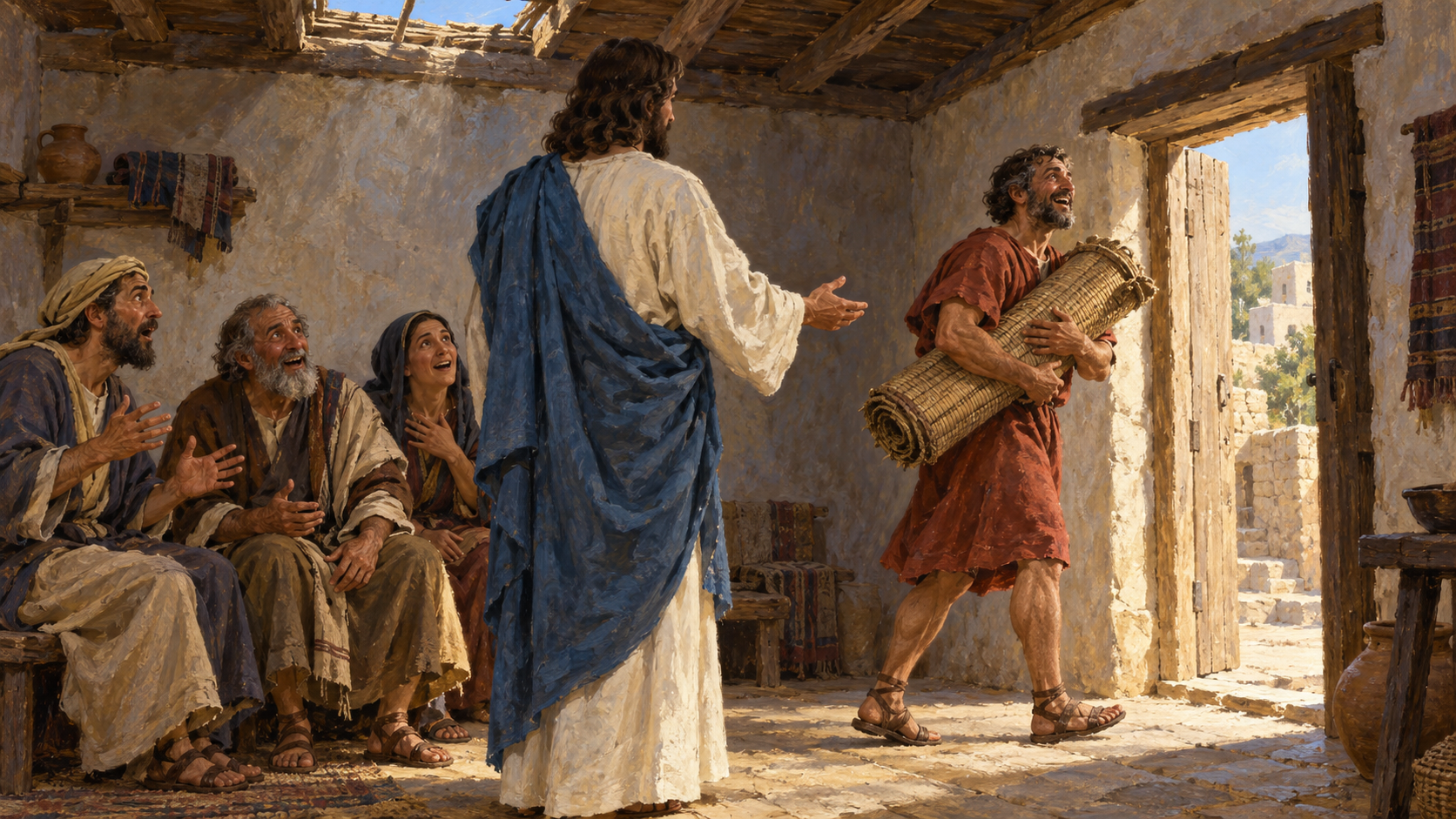
Before His resurrection, Jesus had also used a visible healing to establish His authority to forgive sin. In Mark 2, four men lowered a paralyzed man through a roof because the crowd blocked their access. Before healing him, Jesus pronounced his sins forgiven. The scribes understood that forgiveness belongs to God, but they concluded that Jesus was blaspheming.
When Jesus saw their faith, He said to the paralytic, “Son, your sins are forgiven you.” And some of the scribes were sitting there and reasoning in their hearts, “Why does this Man speak blasphemies like this? Who can forgive sins but God alone?” But immediately, when Jesus perceived in His spirit that they reasoned thus within themselves, He said to them, “Why do you reason about these things in your hearts? Which is easier, to say to the paralytic, ‘Your sins are forgiven you,’ or to say, ‘Arise, take up your bed and walk’? But that you may know that the Son of Man has power on earth to forgive sins”–He said to the paralytic, “I say to you, arise, take up your bed, and go to your house.” Immediately he arose, took up the bed, and went out in the presence of them all, so that all were amazed and glorified God, saying, “We never saw anything like this!”
Anyone could pronounce forgiveness without giving the observers an immediate way to test the claim. Jesus commanded the man to rise and carry his bed home, and he did so before them all. That visible act supported His claim that the Son of Man has authority on earth to forgive sins. New birth and forgiveness are real works of God’s saving mercy; here the bodily healing was the observable sign establishing Jesus’ authority to grant that mercy.
Signs, Unbelief, and Modern Miracle Claims
The Greek text uses overlapping terms for these works. Semeion is a sign that identifies or points to something; dunamis emphasizes power and can describe a mighty work. Teras is a wonder, and ergon means a work or deed. John frequently uses the last term when Jesus appeals to His Father’s works as testimony. These are different ways of describing aspects of an event, not four compartments into which every miracle must be sorted. Thayer discusses sign, power, wonder, and work in their respective entries.
A demand for another sign was not always an honest search for understanding. In Matthew 12, Jesus healed a demon-possessed man who had been blind and mute, and opponents attributed the Spirit’s work to Satan. Some scribes and Pharisees then asked for a sign on their own terms.
Then some of the scribes and Pharisees answered, saying, “Teacher, we want to see a sign from You.” But He answered and said to them, “An evil and adulterous generation seeks after a sign, and no sign will be given to it except the sign of the prophet Jonah. For as Jonah was three days and three nights in the belly of the great fish, so will the Son of Man be three days and three nights in the heart of the earth.
Jesus used Jonah’s three days and three nights in the great fish to point to His own burial and bodily resurrection. He then spoke of Nineveh’s response to Jonah’s preaching and the queen of the South’s journey to hear Solomon. They had responded to less light than the people standing before Him had received. Someone greater than Jonah and Solomon was present, yet these opponents resisted Him.
The response to Lazarus makes that resistance especially plain. Many witnesses believed after seeing him raised, but others reported the event to the Pharisees. The council discussed Jesus’ signs without denying that He was doing them.
Then many of the Jews who had come to Mary, and had seen the things Jesus did, believed in Him. But some of them went away to the Pharisees and told them the things Jesus did. Then the chief priests and the Pharisees gathered a council and said, “What shall we do? For this Man works many signs. If we let Him alone like this, everyone will believe in Him, and the Romans will come and take away both our place and nation.”
The leaders feared that widespread belief in Jesus would lead to Roman intervention and cost them their place and nation. They moved toward killing Him, and later the chief priests plotted against Lazarus too (John 12:10–11). Evidence had not forced them to submit. Miracles support the truth, but they do not compel saving faith against a person’s will. Faith comes through hearing God’s word, and each hearer is responsible for how he responds to Christ.
An impressive event cannot make false doctrine true. Scripture warns of signs associated with deception, so a claim must be examined alongside the message it supports and the biblical identity of Jesus. We also need to consider its fruit. Wonder becomes dangerous when it is used to demand belief without allowing the claim to be tested by God’s word.
I am not a cessationist: I do not believe Scripture requires us to regard the Spirit’s miraculous gifts as having ended. We may pray for healing and deliverance and receive genuine reports of God’s work with gratitude. That openness does not excuse credulity or the practices often called hyper-charismatic, in which dramatic manifestations are accepted without adequate testing. No gifted personality is entitled to exemption from Scripture’s scrutiny.
But the manifestation of the Spirit is given to each one for the profit of all: for to one is given the word of wisdom through the Spirit, to another the word of knowledge through the same Spirit, to another faith by the same Spirit, to another gifts of healings by the same Spirit, to another the working of miracles, to another prophecy, to another discerning of spirits, to another different kinds of tongues, to another the interpretation of tongues. But one and the same Spirit works all these things, distributing to each one individually as He wills.
The Spirit is a divine Person who distributes gifts as He wills, for the benefit of the body. No believer controls Him, and no single gift establishes that its recipient is saved or spiritually superior. Nor does belief in miracles require us to claim that every Christian will reproduce all of Jesus’ works. He is the unique Son, and the gifts given to members of His body differ.
A claim of healing should be specific enough to examine: what condition was present, and what actually changed? Independent medical evidence can help establish that, rather than a person’s feeling that he ought to report success. A ministry must not pressure someone to declare healing or withdraw from treatment. Medication changes belong with the prescribing clinician; some medicines, including steroid tablets, can be unsafe to stop abruptly.
The message behind the claim also needs examination. A dramatic video cannot vindicate a ministry that diminishes Christ or distorts His gospel. Selling access to spiritual power, manipulating a crowd, blaming sick people, and hiding failed predictions are reasons to challenge a ministry’s conduct. No apparent success excuses dishonesty.
God is able to heal, and we should pray earnestly. Yet Paul left Trophimus sick and gave Timothy practical advice for a recurring infirmity. Paul also learned in his own suffering to depend on God’s sufficient grace in weakness. These passages prevent us from promising every believer immediate relief or blaming continued suffering on inadequate faith.
Receiving help from physicians, medicine, therapy, or assistive devices is not unbelief. Prayer and ordinary care can accompany one another. A suffering person needs truthful companionship and practical help, not pressure to defend God’s reputation by pretending the symptoms have disappeared. We can ask for healing without making the person responsible for producing it.
Jesus came to provide more than relief from present troubles. Wicked men physically tortured and punished Him before killing Him, and He willingly bore that real punishment for our sins in His innocent body. He shed His blood for the whole world and completed His saving work through His blood and death before rising bodily. The Father did not punish, curse, abandon, strike, bruise, or pour wrath on Jesus.
For I delivered to you first of all that which I also received: that Christ died for our sins according to the Scriptures, and that He was buried, and that He rose again the third day according to the Scriptures,
His signs direct us to this crucified and risen Savior. God’s invitation is genuine, and people can resist it, just as eyewitnesses resisted Jesus despite the works before them. Turn to Him in repentance and faith. Everyone who believes is forgiven and justified, meaning declared righteous before God, and receives new birth. The Holy Spirit indwells and seals the believer, who is eternally secure in Christ. That security permits no lawlessness, and a shallow profession does not prove that someone has become a new creation.
We do not need to pretend that sickness, disability, grief, or uncertainty is a small burden. The signs reveal the King who can overcome those enemies, even while full bodily redemption awaits His return. Until then, we can pray honestly, receive proper care, and test every claim without depending on a spectacle to sustain our faith.
My Final Thoughts
The miracles direct my attention to Jesus, who commands creation, has compassion on sufferers, and holds authority over sin and death. He gives us reason to trust Him without promising that every present affliction will end before His return. We should pray boldly, welcome the Spirit’s gifts, examine what is claimed, and care faithfully for those who continue to suffer. Our hope rests in the crucified and risen Christ who forgives those who believe and will finally make all things right.