
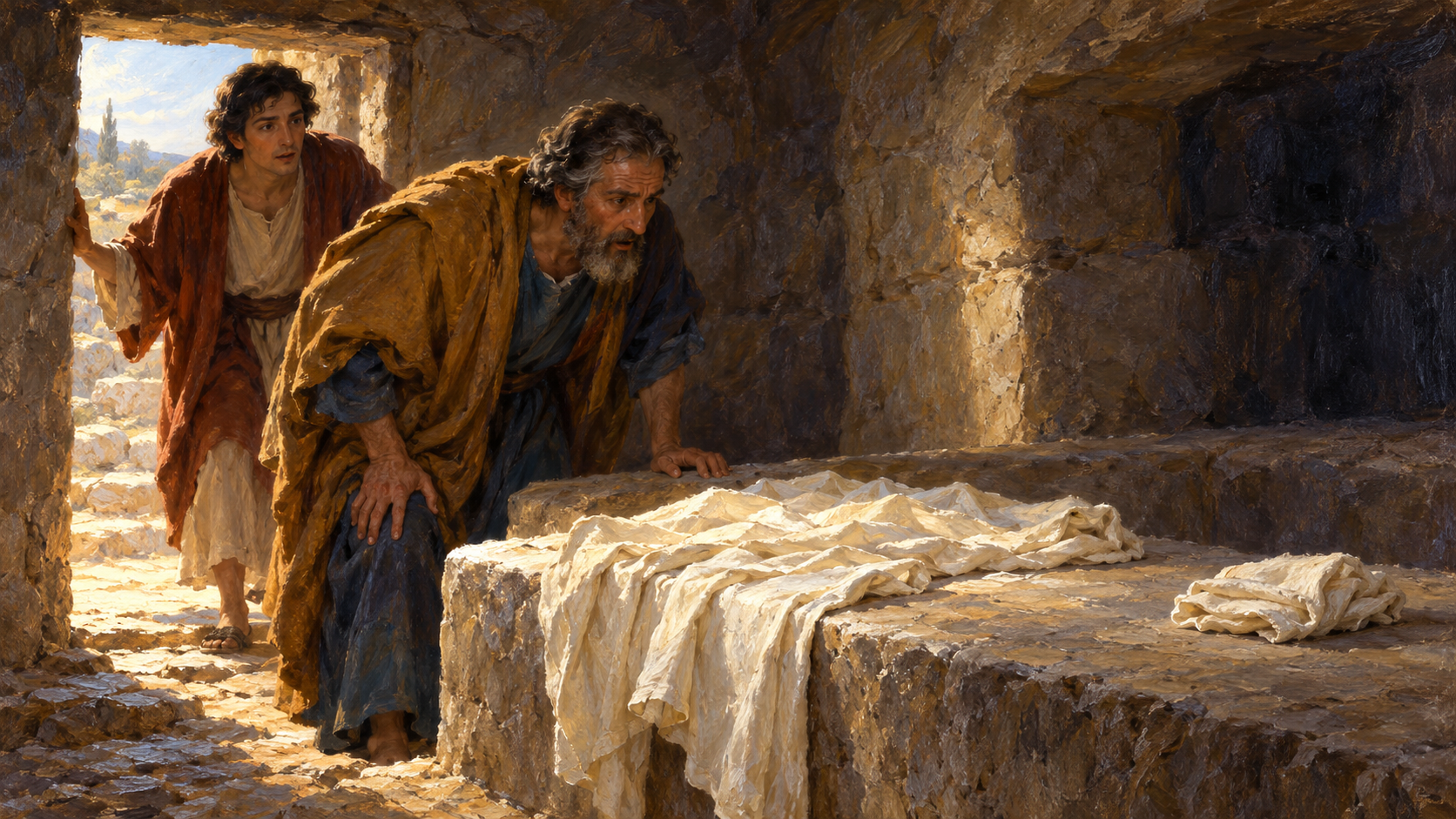
Peter and John entered Jesus’ tomb and found the linen cloths still there, with the face cloth lying separately. What did those details actually show them, and how much can we honestly say about the way the cloths were arranged? I want to stay close to John’s words and then place this scene beside the Bible’s larger witness that Jesus rose bodily from the dead.
The Burial and the First Morning
To understand why the cloths were there, we need to begin with Jesus’ burial. He died on the Preparation Day as the Sabbath approached at sunset, so Joseph of Arimathea asked Pilate for His body and placed it in his own new tomb near the crucifixion site. Nicodemus brought a large mixture of myrrh and aloes to use as they wrapped the body according to Jewish burial custom. The women watched where Jesus was laid and planned to bring more spices after the Sabbath.
After this, Joseph of Arimathea, being a disciple of Jesus, but secretly, for fear of the Jews, asked Pilate that he might take away the body of Jesus; and Pilate gave him permission. So he came and took the body of Jesus. And Nicodemus, who at first came to Jesus by night, also came, bringing a mixture of myrrh and aloes, about a hundred pounds. Then they took the body of Jesus, and bound it in strips of linen with the spices, as the custom of the Jews is to bury. Now in the place where He was crucified there was a garden, and in the garden a new tomb in which no one had yet been laid. So there they laid Jesus, because of the Jews’ Preparation Day, for the tomb was nearby.
John uses the plural othonia for linen cloths, while Matthew describes fine linen in the singular and Luke also says the body was wrapped in linen. We do not have to set those descriptions against each other. One writer can name the burial material as a cloth while another describes the pieces used with the spices.
The Gospels describe an honorable burial in a nearby new tomb, carried out with the Sabbath approaching. They do not describe embalming or a body wrapped like a mummy, so I would not use their words to reconstruct a precise wrapping technique. The women saw where the body was placed and later prepared additional spices.
Now when evening had come, there came a rich man from Arimathea, named Joseph, who himself had also become a disciple of Jesus. This man went to Pilate and asked for the body of Jesus. Then Pilate commanded the body to be given to him. When Joseph had taken the body, he wrapped it in a clean linen cloth, and laid it in his new tomb which he had hewn out of the rock; and he rolled a large stone against the door of the tomb, and departed. And Mary Magdalene was there, and the other Mary, sitting opposite the tomb.
Now behold, there was a man named Joseph, a council member, a good and just man. He had not consented to their decision and deed. He was from Arimathea, a city of the Jews, who himself was also waiting for the kingdom of God. This man went to Pilate and asked for the body of Jesus. Then he took it down, wrapped it in linen, and laid it in a tomb that was hewn out of the rock, where no one had ever lain before. That day was the Preparation, and the Sabbath drew near. And the women who had come with Him from Galilee followed after, and they observed the tomb and how His body was laid. Then they returned and prepared spices and fragrant oils. And they rested on the Sabbath according to the commandment.
Mary Magdalene arrived at the tomb on the first day of the week while it was still dark and saw that the stone had been removed. John tells us that she assumed someone had taken the Lord’s body and that no one knew where it had been placed. Her first report gives us no triumphant announcement of a resurrection she already understood.
Peter and the disciple Jesus loved ran to the tomb, but the beloved disciple arrived first. He stooped to look inside and saw the linen cloths, then waited outside. When Peter arrived, he went straight in and saw both the linen and the separate face cloth. The other disciple followed him inside only after Peter had entered.
What Peter and John Saw in the Tomb
Now the first day of the week Mary Magdalene went to the tomb early, while it was still dark, and saw that the stone had been taken away from the tomb. Then she ran and came to Simon Peter, and to the other disciple, whom Jesus loved, and said to them, “They have taken away the Lord out of the tomb, and we do not know where they have laid Him.” Peter therefore went out, and the other disciple, and were going to the tomb. So they both ran together, and the other disciple outran Peter and came to the tomb first. And he, stooping down and looking in, saw the linen cloths lying there; yet he did not go in. Then Simon Peter came, following him, and went into the tomb; and he saw the linen cloths lying there, and the handkerchief that had been around His head, not lying with the linen cloths, but folded together in a place by itself. Then the other disciple, who came to the tomb first, went in also; and he saw and believed. For as yet they did not know the Scripture, that He must rise again from the dead. Then the disciples went away again to their own homes.
I notice that John describes more than a missing body. The linen remained, while the cloth that had been around Jesus’ head was folded or wrapped together in a separate place. Seeing that arrangement moved the beloved disciple to belief.
If someone had removed the body, why unwrap it there and leave valuable spices and cloth behind? I see no obvious reason, and the orderly materials with the face cloth set apart do not fit a hurried theft. Those details strengthen the empty-tomb witness without telling us how every fold looked.
The disciples returned home, but Mary stayed and soon encountered the risen Jesus. What they saw in the tomb had begun to lead them toward understanding. Christ’s personal appearance removed all doubt that He lived.
These followers did not have to guess later which cave held Jesus’ body. Joseph had placed Him in his own new tomb with the women watching. Matthew also records that His opponents secured the tomb and posted a guard because they remembered His prediction of resurrection. With those circumstances known, a simple mistake about the tomb does not explain what happened.
The stone was not moved to release a trapped Jesus, for God had already raised Him. Opening the entrance let the witnesses inspect where His body had lain and see the linen still there. The open tomb gave them access to the evidence of His resurrection, rather than giving Jesus a way to escape.
Mary’s first assumption helps me see how restrained this account is. She was not expecting a resurrection or treating every unusual detail as a miracle. She thought the body had been moved until Jesus called her by name. Peter left marveling, while the beloved disciple began to believe before fully understanding the Scriptures. The writers let us follow their growing conviction as they examined the evidence and then encountered Jesus Himself.
We can ask honest questions as we follow that evidence. The Gospels do not ask us to believe a rumor. Jesus was buried in a known tomb, and witnesses found its entrance open with the linen still inside. Heavenly messengers explained what had happened before Jesus appeared bodily to His followers. Honest examination should lead us toward the conclusion they reached, that Jesus Christ is risen.
John calls the linen pieces othonia, and he uses soudarion for the cloth that had been around Jesus’ head or face. He uses that same word when Lazarus emerges with his face wrapped in John 11. Older English may call this a “napkin,” but the object in view was a burial cloth. It was not a dining napkin carrying a message about table etiquette.
The linen cloths were keimena, lying or laid there. That tells us their location and posture, but it does not give us a diagram or say they kept a hollow human shape. For the face cloth, John uses entetyligmenon, indicating that it was wrapped or folded together. He also tells us plainly that it lay in a separate place.
What I notice is that the tomb had not been stripped bare. Jesus was no longer in the cloths, but the materials used for His actual death and burial remained while He Himself lived.
John uses three verbs for seeing as he describes the disciples at the tomb. In verse 5 he uses blepei as the beloved disciple sees the linen from outside. Peter then enters and observes the cloths in verse 6, where John uses theorei. In verse 8, eiden describes what the beloved disciple did when he saw and believed.
The context can give these verbs different shades of meaning. Theoreo often fits sustained observation, and we can follow the movement from looking outside to entering and believing. But I would not turn that movement into a rule for every use of these words. Greek does not make blepo always a superficial glance, theoreo always scientific analysis, or eidon always spiritual comprehension.
Eiden is simply a common past form of the verb “to see.” John connects the seeing with belief in his sentence; the verb does not contain a hidden definition of faith. Understanding the Greek helps us read accurately when we consider its grammar and context alongside the way the word is used elsewhere. Treating each synonym as a separate spiritual stage asks the words to teach something they do not establish.
The most natural reading is that the empty tomb and remaining cloths led the other disciple to an initial belief that Jesus had risen. John says he entered and believed what he saw, which fits the Gospel’s purpose of bringing readers to faith in Jesus as the Christ and Son of God. Through that belief they may have life in His name.
Yet verse 9 says they did not know the Scripture that He must rise from the dead. I would not read John’s belief as though he already understood every prophecy, the nature of the resurrection body, or the mission that would follow. He believed because of what he saw before he fully grasped why the resurrection was necessary according to Scripture.
Some interpreters take “believed” to mean only that John accepted Mary’s report of a missing body. The sentence does not directly name what he believed, so we should acknowledge that question. Even so, the attention given to the cloths and John’s later reflection persuade me that he was beginning to believe Jesus had risen. Verse 9 still makes clear that his understanding had room to grow.
Claims the Grave Clothes Do Not Support
John does not say Jesus’ body passed through intact wrappings. The linen may have lain in an orderly way, but “lying” does not mean it formed an empty cocoon. I can affirm His supernatural resurrection without adding a mechanism John never describes.
We are not told who folded or wrapped the face cloth together either. Jesus may have done it, an angel may have moved it, or its position may have resulted from the resurrection itself. Since John leaves that unexplained, I do not want to choose an answer on his behalf.
Another often-repeated story claims that a folded napkin told a Jewish servant, “The master is coming back.” That idea has no foundation in the Gospel text or a reliable basis in first-century dining custom. The soudarion is a burial face cloth, not a coded table napkin.
Scripture never identifies a grave cloth that would be preserved for later veneration. Questions about the Shroud of Turin depend on a separate chain of historical and scientific claims. Whatever someone concludes about that object cannot add to or subtract from the inspired witness.
I do not believe we weaken the case for the resurrection by leaving those additions out. If I make the argument depend on an appealing detail John never gives, I have made it easier to undermine. Keeping the evidence honest allows us to reason from what Scripture actually records.
Lazarus and the Risen Body of Jesus
John deliberately draws our attention to grave clothes in his account of Lazarus being raised too. Lazarus had been dead four days when Jesus ordered the stone removed and called him out. He emerged with his hands and feet still bound and his face wrapped.
Then Jesus, again groaning in Himself, came to the tomb. It was a cave, and a stone lay against it. Jesus said, “Take away the stone.” Martha, the sister of him who was dead, said to Him, “Lord, by this time there is a stench, for he has been dead four days.” Jesus said to her, “Did I not say to you that if you would believe you would see the glory of God?” Then they took away the stone from the place where the dead man was lying. And Jesus lifted up His eyes and said, “Father, I thank You that You have heard Me. And I know that You always hear Me, but because of the people who are standing by I said this, that they may believe that You sent Me.” Now when He had said these things, He cried with a loud voice, “Lazarus, come forth!” And he who had died came out bound hand and foot with graveclothes, and his face was wrapped with a cloth. Jesus said to them, “Loose him, and let him go.”
Jesus told those nearby to loose Lazarus and let him go. Lazarus had truly been raised, but he returned to mortal life and would eventually die again. The popular claim that Jesus had to use his name or every dead person would rise may sound impressive in preaching, but John does not give that explanation.
Jesus left His grave clothes behind and rose into incorruptible life as the firstfruits. That is a greater victory than returning to the mortal life Lazarus received. I can see the uniqueness of Christ’s resurrection in that contrast without needing a theory about His glorified body passing through fabric.
John focuses first on Mary Magdalene, then on Peter and the beloved disciple. Luke describes a group of women arriving with spices. They found the stone removed and went inside, where the body was gone. Two heavenly messengers reminded them that Jesus had foretold both His crucifixion and His resurrection on the third day.
Now on the first day of the week, very early in the morning, they, and certain other women with them, came to the tomb bringing the spices which they had prepared. But they found the stone rolled away from the tomb. Then they went in and did not find the body of the Lord Jesus. And it happened, as they were greatly perplexed about this, that behold, two men stood by them in shining garments. Then, as they were afraid and bowed their faces to the earth, they said to them, “Why do you seek the living among the dead? He is not here, but is risen! Remember how He spoke to you when He was still in Galilee, saying, ‘The Son of Man must be delivered into the hands of sinful men, and be crucified, and the third day rise again.'” And they remembered His words. Then they returned from the tomb and told all these things to the eleven and to all the rest. It was Mary Magdalene, Joanna, Mary the mother of James, and the other women with them, who told these things to the apostles. And their words seemed to them like idle tales, and they did not believe them. But Peter arose and ran to the tomb; and stooping down, he saw the linen cloths lying by themselves; and he departed, marveling to himself at what had happened.
A Gospel writer can focus on one member of a visiting group without denying that the others were there. In the same way, naming the angel who spoke does not mean no second angel was present. Each Gospel selects details that contribute to our understanding of that morning, and those choices do not make the accounts contradictory.
The women remembered Jesus’ words and reported what had happened, but the apostles initially dismissed their testimony as idle tales. Peter went to the tomb and saw the linen cloths lying by themselves, then left marveling. I notice that neither the men nor the women understood everything at once. Unbelief was not confined to one personality or sex; these first witnesses had to work through grief and confusion as they came to understand that Jesus lived.
The angels asked, “Why do you seek the living among the dead?” That question tells us why the tomb was empty. Jesus was alive, and His earlier words explained what the women were seeing. His body had not simply been moved somewhere else.
God raised Jesus’ body, which is why the tomb was empty. His resurrection was not a vision or the continuing influence of a dead teacher. It was also far more than the survival of an immaterial soul. When He appeared, He spoke with His disciples and showed them His wounds. They could touch Him, and He ate in their presence. This was His glorified body, no longer subject to death.
Then, the same day at evening, being the first day of the week, when the doors were shut where the disciples were assembled, for fear of the Jews, Jesus came and stood in the midst, and said to them, “Peace be with you.” When He had said this, He showed them His hands and His side. Then the disciples were glad when they saw the Lord. So Jesus said to them again, “Peace to you! As the Father has sent Me, I also send you.” And when He had said this, He breathed on them, and said to them, “Receive the Holy Spirit. If you forgive the sins of any, they are forgiven them; if you retain the sins of any, they are retained.” Now Thomas, called the Twin, one of the twelve, was not with them when Jesus came. The other disciples therefore said to him, “We have seen the Lord.” So he said to them, “Unless I see in His hands the print of the nails, and put my finger into the print of the nails, and put my hand into His side, I will not believe.” And after eight days His disciples were again inside, and Thomas with them. Jesus came, the doors being shut, and stood in the midst, and said, “Peace to you!” Then He said to Thomas, “Reach your finger here, and look at My hands; and reach your hand here, and put it into My side. Do not be unbelieving, but believing.” And Thomas answered and said to Him, “My Lord and my God!” Jesus said to him, “Thomas, because you have seen Me, you have believed. Blessed are those who have not seen and yet have believed.”
The doors were shut when Jesus stood among the disciples, so His arrival was plainly supernatural. John does not say He passed through the wood, though. He may have opened the way miraculously or appeared through another divine action. I do not need to supply the method to believe what John says happened.
Jesus invited Thomas to examine His wounds, and Thomas answered, “My Lord and my God!” Those wounds connect the risen body with the body that was crucified. Wicked men had physically tortured and punished Jesus before killing Him, yet the same Jesus now stood before His disciples alive and victorious.
The Grave Clothes in the Larger Resurrection Witness
A missing body and removed stone could suggest that someone had moved or stolen the body. That was Mary’s first assumption. The burial cloths left behind make it harder to sustain, especially with the head cloth set apart. Then the evidence goes beyond the tomb: angels announced His resurrection, and Jesus appeared repeatedly to individuals and groups. His followers spoke with Him and touched Him. They shared His presence at the table and later watched Him ascend.
The disciples’ initial confusion does not fit the claim that they had stolen the body. Nor does that theory explain the burial materials left behind or the appearances that followed. A theft could leave a tomb empty, but it could not produce the living Jesus who invited Thomas to examine His wounds. I also cannot see how frightened disciples could become truthful witnesses to a risen Lord if they knew they had secretly moved His body.
A vision arising from grief would not account for the empty tomb and the cloths left inside. Jesus also appeared to different people in different settings, including the more than five hundred brethren Paul says saw Him at once. The Gospel claim concerns a public, bodily resurrection. It is not simply a private feeling that a dead teacher remained spiritually present.
The claim that Jesus never died cannot account for His scourging and crucifixion. The spear wound confirmed His death, and Pilate obtained official verification before releasing the body. Jesus then received burial preparation and was placed in a sealed tomb. What His followers saw afterward was a transformed life, not a severely wounded man needing rescue and care. Such a survivor could not be the incorruptible conqueror of death the New Testament presents.
We should be able to defend the resurrection without claiming to know how every strip of linen lay. John gives neither a complete description of the tomb chamber nor an explanation of the resurrection’s mechanism. I want to rely on the evidence God supplied, which is sufficient without a modern crime-scene reconstruction.
Paul’s summary of the received gospel helps us see why Christian faith does not depend on one interpretation of the linen. Christ died for our sins according to the Scriptures, was truly buried, and rose on the third day as Scripture foretold. He then appeared to many witnesses.
Moreover, brethren, I declare to you the gospel which I preached to you, which also you received and in which you stand, by which also you are saved, if you hold fast that word which I preached to you–unless you believed in vain. For I delivered to you first of all that which I also received: that Christ died for our sins according to the Scriptures, and that He was buried, and that He rose again the third day according to the Scriptures, and that He was seen by Cephas, then by the twelve. After that He was seen by over five hundred brethren at once, of whom the greater part remain to the present, but some have fallen asleep. After that He was seen by James, then by all the apostles. Then last of all He was seen by me also, as by one born out of due time.
The burial confirms that Jesus truly died, while the empty tomb shows that His body was no longer where Joseph had laid it. Leaving the grave clothes behind makes a secret or hurried removal less plausible. The appearances show that Jesus Himself lives, and Scripture explains how His death and resurrection fulfill God’s saving purpose.
Paul’s words “unless you believed in vain” address people denying bodily resurrection. If that is removed from a profession of faith, what remains is not the saving gospel he preached. He is examining the content and reality of their profession, not saying that someone genuinely born again can become unborn. The rest of the chapter grounds Christian hope in the historical fact that Christ rose.
Jesus is the eternal Son, fully God and fully man. He was born of a virgin and lived without any sin. Wicked men physically tortured and punished Him before killing Him, and He willingly bore that real punishment for our sins in His innocent body. He shed His blood and truly died, then was buried and rose bodily. The Father did not punish or curse His Son, nor did He abandon Jesus or pour wrath on Him.
Paul calls Christ the firstfruits, which takes our attention beyond His resurrection alone. Firstfruits were the first portion of a harvest, offered before the rest was gathered. The image helps me understand why His resurrection begins and guarantees a harvest still to come. Those who belong to Him will also be made alive at His coming.
But now Christ is risen from the dead, and has become the firstfruits of those who have fallen asleep. For since by man came death, by Man also came the resurrection of the dead. For as in Adam all die, even so in Christ all shall be made alive. But each one in his own order: Christ the firstfruits, afterward those who are Christ’s at His coming. Then comes the end, when He delivers the kingdom to God the Father, when He puts an end to all rule and all authority and power. For He must reign till He has put all enemies under His feet. The last enemy that will be destroyed is death. For “He has put all things under His feet.” But when He says “all things are put under Him,” it is evident that He who put all things under Him is excepted. Now when all things are made subject to Him, then the Son Himself will also be subject to Him who put all things under Him, that God may be all in all.
Our hope rests in God raising the dead, not in a soul escaping the body because human beings are naturally immortal. The body now buried in weakness and corruption will be raised in power and clothed with glory. Paul’s phrase “spiritual body” refers to a real resurrected body fitted for life under the Holy Spirit’s power, rather than something unreal or immaterial. We have already seen that bodily reality in the risen Jesus, who could be touched and could eat.
But someone will say, “How are the dead raised up? And with what body do they come?” Foolish one, what you sow is not made alive unless it dies. And what you sow, you do not sow that body that shall be, but mere grain–perhaps wheat or some other grain. But God gives it a body as He pleases, and to each seed its own body. All flesh is not the same flesh, but there is one kind of flesh of men, another flesh of animals, another of fish, and another of birds. There are also celestial bodies and terrestrial bodies; but the glory of the celestial is one, and the glory of the terrestrial is another. There is one glory of the sun, another glory of the moon, and another glory of the stars; for one star differs from another star in glory. So also is the resurrection of the dead. The body is sown in corruption, it is raised in incorruption. It is sown in dishonor, it is raised in glory. It is sown in weakness, it is raised in power. It is sown a natural body, it is raised a spiritual body. There is a natural body, and there is a spiritual body. And so it is written, “The first man Adam became a living being.” The last Adam became a life-giving spirit. However, the spiritual is not first, but the natural, and afterward the spiritual. The first man was of the earth, made of dust; the second Man is the Lord from heaven. As was the man of dust, so also are those who are made of dust; and as is the heavenly Man, so also are those who are heavenly. And as we have borne the image of the man of dust, we shall also bear the image of the heavenly Man.
The body that rises has continuity with the body that died, yet it is gloriously transformed. Jesus remains the crucified and risen Lord, with death no longer having dominion over Him. Believers will bear the image of the heavenly Man. The grave clothes left behind belong within that larger promise, because the living Christ is no longer held by death.
When I return to the linen details, I want to keep what John actually gives us. The cloths remained after Jesus’ body was gone, the face cloth lay separately, and what the beloved disciple saw moved him to belief. We can take those facts seriously without adding a body-shaped shell or a coded napkin legend.
John openly admits that the disciples were still learning to understand what they had seen. Their faith matured as they considered the empty tomb in light of Christ’s own words and the prophetic Scriptures. His bodily appearances ruled out the idea that someone had simply moved His body. Scripture gives us the explanation we need for the evidence.
Jesus rose bodily, retaining the wounds by which His followers recognized Him. He received worship because He is God, and death no longer had dominion over Him. The same Jesus ascended and will return bodily, so a merely spiritual resurrection cannot account for what Scripture tells us.
We must also receive the gospel personally. Christ died for the whole world, and God’s offer is genuine even though people can resist it by rejecting His Son. Whoever repents and believes in the risen Christ is forgiven and justified before God. That person is born again, indwelt and sealed by the Holy Spirit, and eternally secure. This security never excuses lawlessness, nor does a shallow profession without evidence of new life prove that someone has been born again. The hope of resurrection calls us to remain steadfast in obedience.
That bodily hope reaches into the way we grieve. We do not have to deny the pain at a funeral, because Scripture itself calls death an enemy. Christ will finally destroy that enemy. His empty tomb gives everyone who belongs to Him reason to face loss with hope: death will not have the final word when He comes.
My Final Thoughts
After following the burial cloths through the Gospel accounts, I believe they are a quiet but meaningful part of the empty-tomb witness. Jesus was no longer among the dead, although the linen remained and the face cloth lay separately. John gives us no body-shaped shell or coded napkin message, so we should understand the details alongside Christ’s words and His bodily appearances rather than adding to them. Because Jesus truly rose as the firstfruits, everyone who belongs to Him can face death with the settled hope that He will raise His people when He comes.