
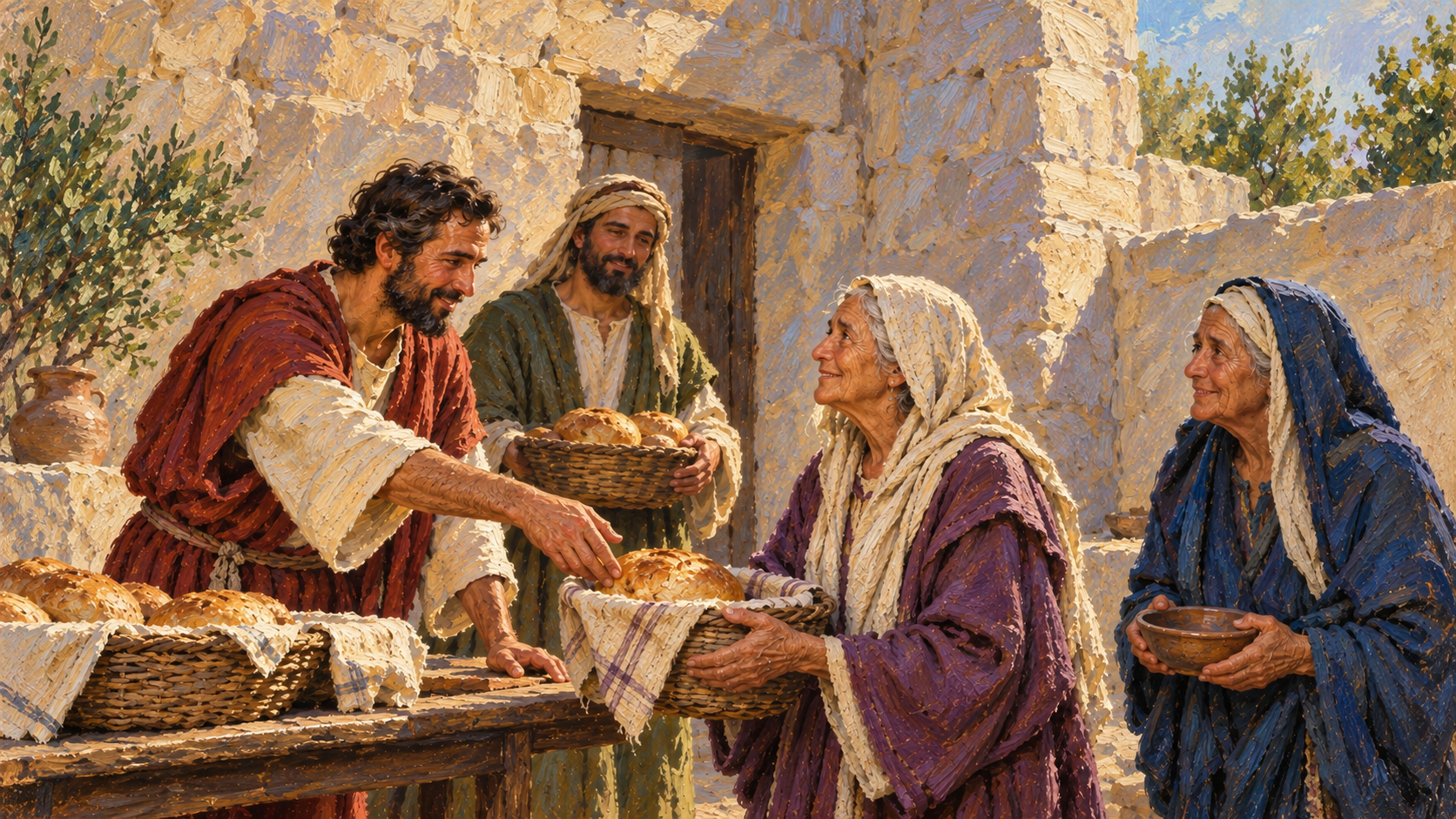
The Hellenists appear in Acts when widows are being overlooked, when Saul encounters opposition, and when believers carry the gospel to Antioch. In Acts 6 and 9, the term refers to Greek-speaking Jews. Their language and cultural background help explain the setting, but they do not tell us whether these people believed in Jesus. Some Hellenists belonged to the church; others fiercely opposed it.
I want to follow those passages carefully, including the question about the wording in Acts 11. We will also see why a church’s unity required practical care, and how God used people familiar with the Greek-speaking world to spread the same gospel beyond Jerusalem.
Who the Hellenists Were
Luke first names the Hellenists while describing growth in the Jerusalem church:
“Now in those days, when the number of the disciples was multiplying, there arose a complaint against the Hebrews by the Hellenists, because their widows were neglected in the daily distribution.”
This complaint arose among believers who shared faith in Christ but differed in language and cultural setting. The Hellenists were Greek-speaking Jews, often connected with the Diaspora, the Jewish communities living outside the land of Israel. The Hebrews were more closely associated with the Hebrew- or Aramaic-speaking life of Judea and Jerusalem. These descriptions do not require every person to have spoken only one language.
Greek-speaking Jews might have grown up outside Judea, worshiped in a Greek-speaking synagogue, and dealt regularly with Gentile neighbors. Speaking Greek did not make them Gentiles or mean they had abandoned Israel’s God. Language and faithfulness are different questions. A Hellenist could trust Christ, as those in Acts 6 did, or resist the gospel, as Saul’s opponents later did.
| Group in Acts 6 | Likely distinction | Why it affected the church |
|---|---|---|
| Hebrews | Jewish believers more closely tied to the Hebrew- or Aramaic-speaking setting of Judea. | They may have been more socially rooted in Jerusalem. |
| Hellenists | Greek-speaking Jewish believers, often connected with Diaspora culture and synagogue life. | Their widows were vulnerable to being overlooked in a local distribution system. |
| The church | One redeemed people gathered around the risen Christ. | The body had to correct a practical failure without abandoning the Word of God. |
The wider setting had developed over several centuries. Alexander the Great’s conquests spread Greek language and culture across the eastern Mediterranean and Near East. Greek influence continued under the kingdoms that followed him, and by New Testament times the language was widely used in public life, education, trade, and government.
Jewish communities were established throughout that world, including Alexandria, Cyrene, Cyprus, Cilicia, Syria, Asia Minor, and Rome. They retained Jewish religious practices and synagogue life while using the language around them. Cultural involvement varied, and some compromised with pagan beliefs or practices. We should not assume either spiritual faithfulness or apostasy merely from the label Hellenist.
A widely understood language later allowed believers to communicate the gospel across regional boundaries. Roads connected cities, and synagogues provided places where preachers could begin reasoning from Scripture. God used these circumstances without making Greek culture the source of the message. What the church proclaimed was the death and bodily resurrection of Israel’s Messiah.
A Neglected Group and a Wise Response
The widows in Acts 6 were not receiving equal care in the daily distribution. Language differences, local relationships, or the arrangements for distributing food might have contributed, but Luke does not identify the cause or say the neglect was deliberate. We can take the failure seriously without assigning a motive he has not supplied.
A widow might have lost her provider and have little family support nearby. If a particular group of widows was being missed, the church needed to correct the distribution, not merely affirm that everyone belonged. The apostles called the congregation together:
“Then the twelve summoned the multitude of the disciples and said, ‘It is not desirable that we should leave the word of God and serve tables.’”
Managing the distribution personally would have drawn the apostles away from their responsibility to teach. They therefore asked the disciples to choose seven men of good reputation, full of the Holy Spirit and wisdom, whom they could appoint over this work. Their own commitment remained:
“But we will give ourselves continually to prayer and to the ministry of the word.”
Prayer and teaching required sustained attention, and the widows required dependable provision. Giving qualified people responsibility for the distribution allowed both duties to receive proper care. The apostles were not declaring practical service unimportant; they were organizing it so it would be done faithfully.
“And the saying pleased the whole multitude. And they chose Stephen, a man full of faith and the Holy Spirit, and Philip, Prochorus, Nicanor, Timon, Parmenas, and Nicolas, a proselyte from Antioch.”
All seven men had Greek names, which fits the circumstances, but a Greek name alone does not establish every detail of a man’s background. Luke specifically identifies Nicolas as a proselyte from Antioch, meaning he had converted to Judaism before becoming a Christian. The congregation brought the seven before the apostles, who prayed and laid hands on them.
Many Christians regard this as the beginning of the deacons’ ministry. The assignment certainly involved service, but Luke does not call the seven deacons here. Paul later gives qualifications for that office in 1 Timothy 3. I would distinguish the appointment Luke explicitly describes from the inference that these were the first deacons. In either case, the church entrusted practical care to men whose character and wisdom fitted them for the responsibility.
A church cannot protect unity by asking neglected people to stop mentioning their needs. Here the apostles involved the whole congregation in a remedy while preserving the ministry of the Word. The study of the body of Christ explores how shared membership brings responsibilities toward one another, including people whose circumstances differ from our own.
Stephen, Philip, and Saul
Luke next records Stephen’s public witness. He was full of faith and power, and God worked wonders and signs through him. Men associated with a synagogue disputed with him, but they could not withstand the wisdom and Spirit by which he spoke. Acts 6:9 connects these opponents with regions such as Cyrene, Alexandria, Cilicia, and Asia, placing the dispute within the wider Jewish world.
In Acts 7, Stephen traced Israel’s dealings with God and confronted resistance to the Holy Spirit. He accused his hearers of betraying and murdering the Righteous One. He was then stoned, becoming the first martyr whose death Acts records. The study of Stephen follows his testimony and death in greater detail.
Persecution scattered believers after Stephen was killed. Philip, another of the seven appointed in Acts 6, preached Christ in Samaria. He later explained Isaiah’s prophecy of the suffering Servant to the Ethiopian official. The same man who had been entrusted with practical care in Jerusalem now carried the gospel to people beyond it.
Saul had been a persecutor of the church, but the risen Jesus met him on the road to Damascus and changed the course of his life. He began preaching Jesus as the Christ. When he came to Jerusalem, believers were afraid of him and did not believe he was a disciple. Barnabas brought him to the apostles and reported his encounter with the Lord and his bold preaching in Damascus. The study of Saul’s conversion examines that change more fully.
Saul then spoke openly in Jerusalem:
“And he spoke boldly in the name of the Lord Jesus and disputed against the Hellenists, but they attempted to kill him.”
These Hellenists were Greek-speaking Jewish opponents, not the Christian group whose widows had been neglected. Saul came from Tarsus in Cilicia and could communicate within their Greek-speaking setting. A man who had once persecuted believers was now defending Jesus before people who wanted to kill him.
The brethren learned of the danger, brought Saul to Caesarea, and sent him to Tarsus. His later work as the apostle Paul would reach across the Greek-speaking Roman world, but opposition had already begun. The study of Paul’s life traces the wider course of his calling.
Knowing a hearer’s language and background can help us explain the gospel clearly. It cannot guarantee acceptance. Saul’s hearers could understand what he said and still reject the Christ he proclaimed. We should value clear communication while remembering that a familiar accent or shared upbringing cannot give anyone new life.
Antioch and the Gospel’s Outward Movement
Acts 11 returns to the scattering that followed Stephen’s death. Luke is taking up another part of those earlier events, rather than describing a new persecution after Saul’s conversion. Scattered believers traveled as far as Phoenicia, Cyprus, and Antioch, initially speaking the Word only to Jews. Then he describes men from Cyprus and Cyrene:
“But some of them were men from Cyprus and Cyrene, who, when they had come to Antioch, spoke to the Hellenists, preaching the Lord Jesus.”
“And the hand of the Lord was with them, and a great number believed and turned to the Lord.”
Acts 11:20 requires care because manuscripts and translations differ. The NKJV reads “Hellenists.” Other manuscripts read the Greek word for “Greeks,” and translations sometimes render the audience as Greeks or Greek-speaking non-Jews. The translation notes on this verse reflect that difference.
There is also an interpretive question. Some understand Hellenists here as Greek-speaking Jews, consistent with Acts 6 and 9. Others understand a Greek-speaking Gentile audience because verse 19 says the scattered believers had preached only to Jews, while verse 20 describes this further outreach. We should acknowledge both the wording and the contextual reason for that reading, rather than assume every English use of Hellenists identifies an identical group.
What Luke states plainly is that these men preached the Lord Jesus, the Lord was with them, and many believed and turned to Him. Antioch became a significant center of Christian teaching and, later, the mission to Gentiles. The textual question does not erase that development or change the identity of the Hellenists in Acts 6 and 9.
When Jerusalem heard the news, the church sent Barnabas. He saw God’s grace, rejoiced, and urged the believers to remain faithful to the Lord. He then went to Tarsus to find Saul and brought him to Antioch. Together they spent a whole year meeting with the church and teaching many people. The disciples were first called Christians there.
These events connect people and places already introduced in Acts. Stephen’s death was followed by scattering; Saul, once a persecutor, became a preacher; and Barnabas brought him from Tarsus into the teaching work at Antioch. God carried the gospel outward despite the cruelty intended to suppress it. His use of persecution did not make the persecutors’ actions righteous. The full study of Acts follows that continuing mission.
Language, Scripture, and Unity
Greek served the apostles and evangelists as they addressed people across the Roman world. Paul used it in preaching and in letters to churches, and God gave the New Testament in Greek. The language’s usefulness did not give Greek philosophy or religion authority over what the apostles taught. Inspiration belongs to Scripture, not to the culture in which a language is spoken.
Greek translations of the Old Testament, commonly called the Septuagint, also belonged to the world of Greek-speaking Jews and early Christians. The Old Testament was written chiefly in Hebrew, with portions in Aramaic. I use the Hebrew Masoretic Text as the basis for Old Testament study and do not grant a Greek translation authority to overrule it. That is a judgment about the text’s authority, rather than a denial that ancient Jews and Christians used Greek translations. The study of the Septuagint addresses those questions more fully.
The message preached in Greek remained the fulfillment of God’s promises through Israel’s Scriptures. Jesus was proclaimed as the Christ and Son of David, the suffering and risen Lord. Making His identity understandable to people who spoke Greek did not turn Him into a different Savior or allow Greek culture to reshape the gospel.
| Subject | Careful statement | Guardrail |
|---|---|---|
| Greek language | It helped the gospel travel across regions and peoples. | Language served the message; it did not create the message. |
| Septuagint | Greek Old Testament translations were part of the Hellenistic Jewish world. | They must not overrule the Hebrew Masoretic Text. |
| New Testament Greek | God used Greek as the written language of the New Testament. | Inspiration belongs to Scripture, not to Greek culture itself. |
| Hellenists | They could often move between Jewish and Greek-speaking settings. | They must not be treated as a blanket term for Gentiles. |
Differences in language also affected relationships within the church. In Acts 6, the apostles recognized the groups involved in the complaint and arranged for the neglected widows to receive care. They did not require one language or background before the widows could be cared for. Their shared standing in Christ required them to take one another’s needs seriously.
Paul later explained the saving standing all believers share:
“For you are all sons of God through faith in Christ Jesus.”
“There is neither Jew nor Greek, there is neither slave nor free, there is neither male nor female; for you are all one in Christ Jesus.”
Jewish ancestry gives no one a superior claim to salvation, and being Greek does not make someone less welcome in Christ. Men and women, slaves and free people, become God’s children through the same faith in the same Savior. Paul is explaining their standing before God. His words do not erase created distinctions or cancel His instructions about family order and the qualifications for church service.
Ephesians 2 likewise describes believing Jews and Gentiles reconciled in one body through Christ’s blood. Both have access to the Father by one Spirit. Their unity rests on His saving work and on the truth He gave through the apostles and prophets, with Christ Himself as the chief cornerstone. Common faith therefore has consequences for the way believers receive and serve one another.
What We Should and Should Not Conclude
We should identify the Hellenists from the passage in which they appear. Acts 6 concerns Greek-speaking Jewish believers, Acts 9 concerns Greek-speaking Jewish opponents, and Acts 11 introduces a textual and interpretive question within the developing Antioch mission. Treating the term everywhere as another name for Gentiles obscures the people Luke is describing.
Neither should we suppose a cultural background determines faithfulness. God may use someone’s language, education, birthplace, or citizenship to open opportunities for service. Those advantages do not remove the need for repentance or the temptation to conform to a culture’s sins. Every culture must answer to Christ, including the one most familiar to me.
The neglected widows also require more from us than admiration for the apostles’ solution. If a group in our congregation is being missed, we need to understand the failure and correct it. Responsible administration is part of caring for people. A repeated declaration that we are united will not provide food to someone our arrangements keep overlooking.
At the same time, the apostles’ devotion to prayer and teaching warns us against allowing urgent administration to consume every ministry responsibility. The church needs qualified servants who can carry practical work faithfully, while the Word continues to be taught. Helping people and proclaiming Christ must remain joined in the church’s life.
Stephen, Philip, Saul, and the scattered believers preached Jesus. Their different circumstances help explain whom they met and how they spoke, but the content of their witness was the same Savior. A church can adapt its language to make that message understood without changing what people need to hear.
Jesus is the eternal Son of God, fully God and fully man. He came in fulfillment of God’s promises to Israel and lived without sin. Wicked people tortured and killed Him, inflicting real punishment on His innocent body, while He willingly gave Himself for the sins of the whole world. Through His blood and death He completed His saving sacrifice before His burial and bodily resurrection. The Father did not punish, curse, abandon, strike, bruise, or pour wrath on Jesus. Father, Son, and Holy Spirit were united in providing salvation.
This gospel is genuinely offered to everyone. Greek-speaking Jews needed Christ, as did Hebrew-speaking Jews, Samaritans, and Gentiles. A widow and an educated synagogue debater needed the same forgiveness. People may resist God’s grace, but everyone who receives Christ in repentance and faith is forgiven and given eternal life. Speaking the right language, belonging to the right community, or having useful education cannot replace personally trusting the crucified and risen Lord.
My Final Thoughts
The Hellenists help us understand how language and background affected the church’s life without deciding anyone’s standing before God. Neglected widows needed care, Saul’s opponents needed the gospel, and the believers in Antioch needed teaching. God used people able to communicate across those settings, while Christ remained the Savior they proclaimed. I want us to practice that same faithfulness: listen carefully, correct neglect, and make the gospel clear without changing it to suit the audience.