
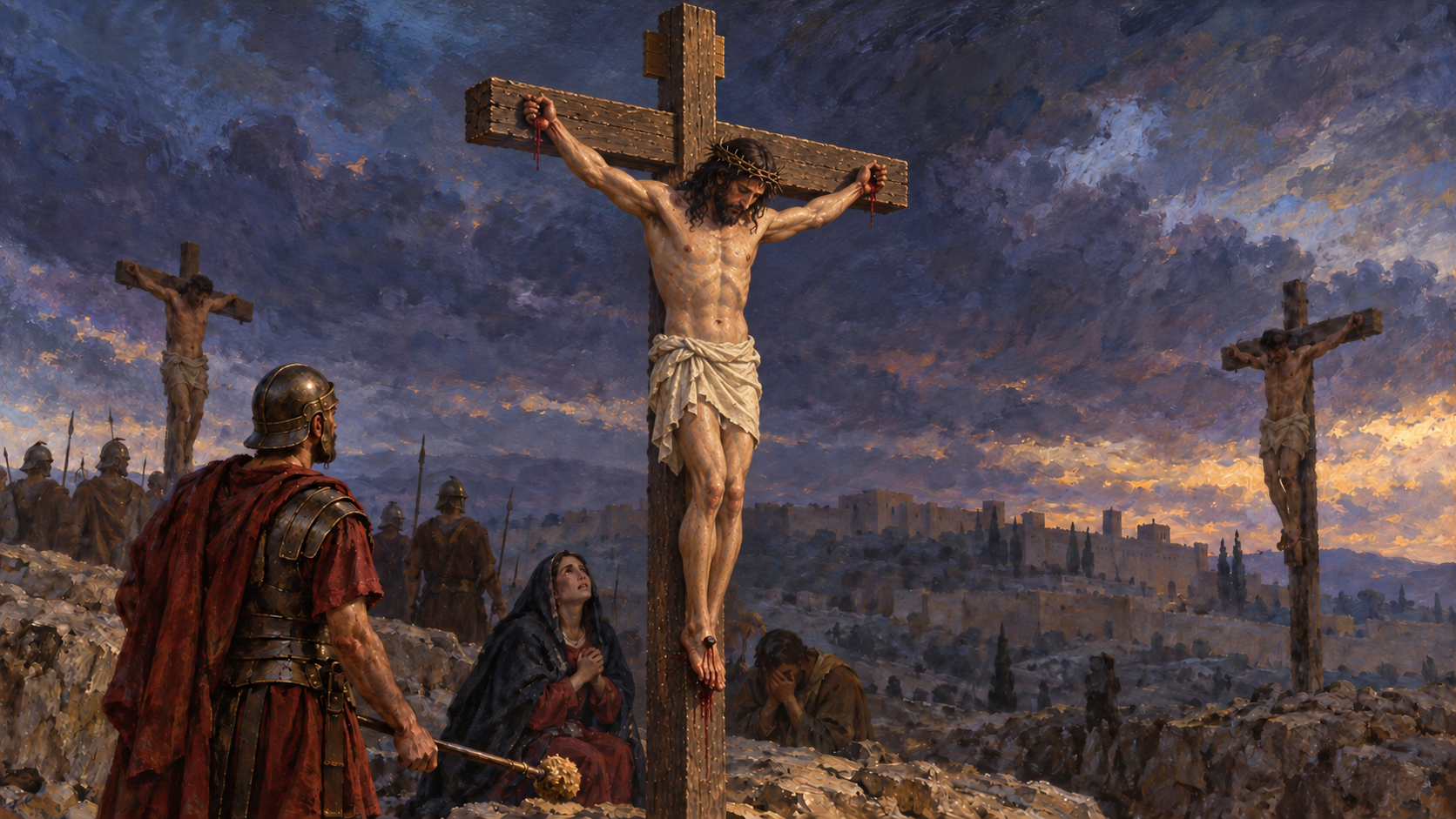
What did Jesus mean when He said, “It is finished”? John gives us one Greek word behind that English sentence, but I do not want to lift it out of the scene or turn it into a slogan. We need to watch what happens at the cross and then let the rest of Scripture explain what Christ completed.
John Places the Word at the Cross
The word often written as tetelestai comes from John 19:30, where the NKJV gives its English meaning: “It is finished!” It does not print the Greek word itself. I want to keep that distinction clear so we quote the Bible as it stands and use the original language to understand what Jesus said.
John places these words after Jesus had been betrayed and falsely accused. Wicked men had mocked and scourged Him, pressed a crown of thorns onto His head, and nailed Him to the cross. Jesus then entrusted Mary to John. Knowing that all things were now accomplished, He said, “I thirst,” so that Scripture would be fulfilled. After receiving the sour wine, He gave His final declaration.
After this, Jesus, knowing that all things were now accomplished, that the Scripture might be fulfilled, said, "I thirst!" Now a vessel full of sour wine was sitting there; and they filled a sponge with sour wine, put it on hyssop, and put it to His mouth. So when Jesus had received the sour wine, He said, "It is finished!" And bowing His head, He gave up His spirit.
Jesus was saying more than that His pain was about to end. The work appointed for that hour had reached its goal through His unfailing obedience. Scripture had not broken, and His sacrifice was not left unfinished. Having declared its completion, He bowed His head and gave up His spirit.
Earlier in John, Jesus had explained that He would give His life willingly, in obedience and love. That does not lessen the guilt of those who arrested and killed Him. They were fully responsible for their evil, yet they did not turn Jesus into a helpless victim whose mission had slipped out of His control.
"Therefore My Father loves Me, because I lay down My life that I may take it again. No one takes it from Me, but I lay it down of Myself. I have power to lay it down, and I have power to take it again. This command I have received from My Father."
I cannot read Jesus’ words as though the cross were a tragedy God later found a use for. Jesus came for this hour and willingly gave Himself. Nor does His death mean the Father turned against Him and divided the Trinity. The Father sent the Son, who came willingly, and the Holy Spirit remained eternally united with them in God’s saving work.
I want to keep the language of the atonement concrete. Jesus physically bore the punishment for our sins in His innocent body on the cross. Wicked men mocked Him and beat Him. They scourged, crucified, and killed Him. He willingly endured that real punishment, shed His blood, died, was buried, and rose bodily. The Father did not punish, curse, abandon, strike, bruise, or pour wrath upon Jesus.
The Greek word behind “It is finished” is tetelestai, from the verb teleo. The verb can mean to finish, complete, accomplish, bring to an end, or carry out. In John 19:30, it is a perfect passive indicative in the third person singular. Put simply, the form points to something brought to completion with a result that continues.
That grammar helps us understand the words, but John’s account and the rest of Scripture tell us what Jesus finished. Some teachers illustrate tetelestai with a receipt marked “paid in full.” A completed obligation can be a useful comparison, but I would not make the passage depend on that receipt claim. John has already given us the meaning, finished or accomplished, and shown the Son completing the work appointed for His cross.
What Jesus Finished
The Scriptures concerning His suffering had been fulfilled. John says Jesus knew all things were now accomplished and then spoke so that Scripture might be fulfilled. God had not been caught unprepared by the cross. The Lamb of God and the Passover pattern point to Christ, as do the suffering Servant and Psalm 22. The sacrifices God gave Israel also lead us to Him. We can see these passages coming together in what He accomplished.
Throughout His earthly mission, Jesus lived without sin as He revealed the Father and fulfilled righteousness. He preached truth and called sinners to Himself. He also healed those who suffered and exposed hypocrisy, all while moving toward the hour for which He came. That obedient life reached its appointed goal in His sacrifice at the cross.
Romans 8 says that sin was condemned in the flesh. God sent His own Son in the likeness of sinful flesh, on account of sin, yet the Son never became sinful. In His innocent body, sin received the judgment it deserved. Believers are then given new life, and the righteous requirement of the law is fulfilled in those who walk according to the Spirit. This is not a vague improvement in human effort. God acted through His Son where sinners could not save themselves.
Jesus offered Himself as the sacrifice for sins, rather than taking animal blood into an earthly sanctuary. His offering is sufficient because the sinless Son of God truly became man, and His own blood obtained eternal redemption.
Not with the blood of goats and calves, but with His own blood He entered the Most Holy Place once for all, having obtained eternal redemption.
The new covenant was also established in His blood. Jeremiah had promised a covenant in which God would write His law within His people and forgive their iniquity. Jesus took the cup and said, “This is My blood of the new covenant, which is shed for many for the remission of sins” (Matthew 26:28). His cry of completion belongs to that covenant blood.
Christ’s blood laid the sacrificial foundation of the new covenant. That does not mean every blessing had appeared in its final outward fullness before resurrection morning. It means forgiveness and access to God rest on a completed sacrifice. Inward renewal and the Spirit’s work do not depend on an unfinished religious system waiting for human strength to supply what is lacking.
The apostles preached forgiveness on the basis of what the crucified and risen Christ had accomplished. That gives me a firm basis for reading their teaching. The cross was not a hopeful beginning waiting for the church to add enough zeal to make it succeed. Because we are joined to Christ, God adopts and cleanses us, reconciling us to Himself and giving us final hope. Sinners are commanded to repent and believe because the Savior has done the saving work none of us could perform. The related study on the gospel follows that whole message in greater detail.
The Finished Work Is Physical and Once for All
Jesus showed His love through His incarnation and sinless obedience, and Scripture makes us face the physical cost. His body truly suffered and His blood was shed. He died and was buried, then rose bodily on the third day. When I speak of His finished work, I must not reduce it to a general thought about love and leave His body and blood out of the explanation.
being justified freely by His grace through the redemption that is in Christ Jesus, whom God set forth as a propitiation by His blood, through faith, to demonstrate His righteousness, because in His forbearance God had passed over the sins that were previously committed,
knowing that you were not redeemed with corruptible things, like silver or gold, from your aimless conduct received by tradition from your fathers, but with the precious blood of Christ, as of a lamb without blemish and without spot.
Romans joins grace and redemption to Christ’s blood, received through faith. Peter likewise says believers were redeemed with His precious blood, and Hebrews says His own blood obtained eternal redemption. With those passages before me, I cannot take “It is finished” to mean spiritual inspiration detached from sacrifice. The study on the blood of Christ for salvation develops that biblical witness further.
Christ’s death happened once for all, but it is not isolated from His resurrection. His burial confirms that He truly died, while the empty tomb confirms that He bodily rose. The completed saving work belongs to the crucified and risen Savior. It cannot be reduced to one line from the cross separated from the rest of the gospel.
Hebrews gives us the fullest sustained explanation of why Christ’s offering is final. God had commanded the old covenant sacrifices, and they carried real meaning, but their repetition showed that they could not finally perfect the worshiper. Christ offered Himself once and then sat down. His sacrifice accomplished what those repeated offerings could not.
By that will we have been sanctified through the offering of the body of Jesus Christ once for all.
For by one offering He has perfected forever those who are being sanctified.
Hebrews names the body of Jesus Christ and says His one offering remains sufficient. Salvation does not wait for sinners to add something to it; Christ has supplied the saving offering itself. Yet the same passage speaks of those perfected forever as still being sanctified. I can trust the completeness of His sacrifice while recognizing that the Spirit is still forming believers in holiness.
That is how I understand the place of Communion. The bread and cup help us remember and proclaim Christ’s body and blood without repeating His sacrifice. No priest or minister brings Him down to be offered again, nor can a church or ritual do so. We receive what Christ has done and remember it together. Our proclamation and obedience follow from a sacrifice that is already finished.
What “It Is Finished” Does Not Mean
Jesus did not mean that every promise in Scripture had reached its final fulfillment that afternoon. His burial and bodily resurrection on the third day still lay ahead. He would ascend and intercede for His people. Gathering His church also lay ahead. He would also return bodily to judge and reign. The finished work of the cross gives these acts their foundation without erasing their order.
Nor did He mean that believers no longer need to grow or obey. The Spirit continues forming us in holiness through the work Scripture calls sanctification. We are not completing Christ’s sacrifice by growing in obedience. Grace does not make rebellion safe or leave a believer comfortable in the old life. Good works are the fitting fruit of new life in Christ, never the purchase price of salvation.
Nor did Jesus need to suffer after death to finish redemption. He did not descend into a hidden place to make a second payment after declaring that the work was complete. He committed His spirit to the Father, His body was buried, and He rose bodily in victory.
John’s record agrees with the other sayings from the cross. Matthew and Mark record Jesus quoting Psalm 22: “My God, My God, why have You forsaken Me?” Luke records, “Father, into Your hands I commit My spirit.” And John records, “It is finished!” I hear real suffering and trust in the Father in these accounts, together with Scripture being fulfilled and Christ’s work reaching completion. They do not compete with one another.
And about the ninth hour Jesus cried out with a loud voice, saying, "Eli, Eli, lama sabachthani?" that is, "My God, My God, why have You forsaken Me?"
And when Jesus had cried out with a loud voice, He said, "Father, ‘into Your hands I commit My spirit.’" Having said this, He breathed His last.
In quoting Psalm 22, Jesus speaks Scripture as the righteous sufferer surrounded by enemies. The psalm moves from that suffering toward vindication and praise, so it does not prove that the Trinity broke or that the Father stopped loving the Son. Luke shows Jesus entrusting His spirit to the Father, and John shows His appointed work complete. His anguish was real, but there was no confusion within God. The Son remained obedient to His Father and trusted Him as He completed His work in victory.
These passages do not teach that Jesus had more redemptive suffering to complete after death or that the Father personally punished or abandoned Him. They identify wicked men as those who inflicted the violence, while Christ willingly bore the punishment for sins in His body. His sacrifice is the complete ground of salvation. Human works supply nothing missing from it, yet obedience remains necessary as the fruit of the life that follows. It is never payment for salvation.
Living in the Light of a Completed Sacrifice
If Christ’s sacrifice is finished, I have nothing to add to it. My moral record cannot make His blood more sufficient. Baptism and church membership cannot purchase salvation, nor can emotional intensity or a particular confession formula. Even labor in ministry supplies nothing His offering lacks. These things do not all have the same place in Christian life, but none purchases salvation. Jesus left nothing lacking in His sacrifice.
Hebrews invites believers to draw near through Christ’s blood with a true heart and full assurance of faith. His finished work gives us a reason to approach God, rather than remain passive or distant. I do not have to base that access on a steady mood or a flawless week. It rests on the blood of Jesus and His continuing priestly work.
Therefore, brethren, having boldness to enter the Holiest by the blood of Jesus, by a new and living way which He consecrated for us, through the veil, that is, His flesh,
The same passage that invites us to draw near also tells us to hold fast and care for one another. Resting in Christ’s completed sacrifice cannot mean drifting into lawlessness. As we endure in hope, grace produces love and good works in our lives. We obey because we belong to the crucified and risen Lord, not because His sacrifice needs our help.
When we speak to people who do not yet believe, we should offer them the crucified and risen Christ. They do not need to climb a religious ladder or repair themselves enough to become savable. Christ died for the whole world, and God’s offer of salvation is genuine. People may resist Him, but whoever believes receives forgiveness and everlasting life.
A tender conscience may look at remaining weakness and wonder whether salvation has failed. The answer is not to pretend sin is harmless. We should confess it honestly and return to Christ. The sacrifice that saves us does not depend on our changing emotions. The risen Lord who intercedes for His people is the same Lord who said the work was finished before He bowed His head.
The Son of God gave Himself in real flesh and blood. His suffering was not a performance, and His final declaration was no religious decoration. Knowing what redemption cost should make our worship reverent and our songs and prayers grateful. His sufficient work gives us confidence to serve and forgive. We can also endure with that same confidence in our Savior. The study on the Word, or Logos, helps us see more fully who this eternal Son is.
My Final Thoughts
When I follow John’s account, I believe “It is finished” means that Jesus completed the sacrificial work appointed for His cross. The sinless Son willingly bore real punishment in His body, shed His precious blood, and gave up His spirit after Scripture had been fulfilled. Nothing can be added to that offering or repeated through a ritual. Jesus did not need further suffering after death to complete redemption. He was buried and rose bodily, so our hope rests in the crucified and risen Savior rather than in our power to repair ourselves. We receive salvation by grace through faith, then live and worship as people whose Lord truly finished what He came to do.