
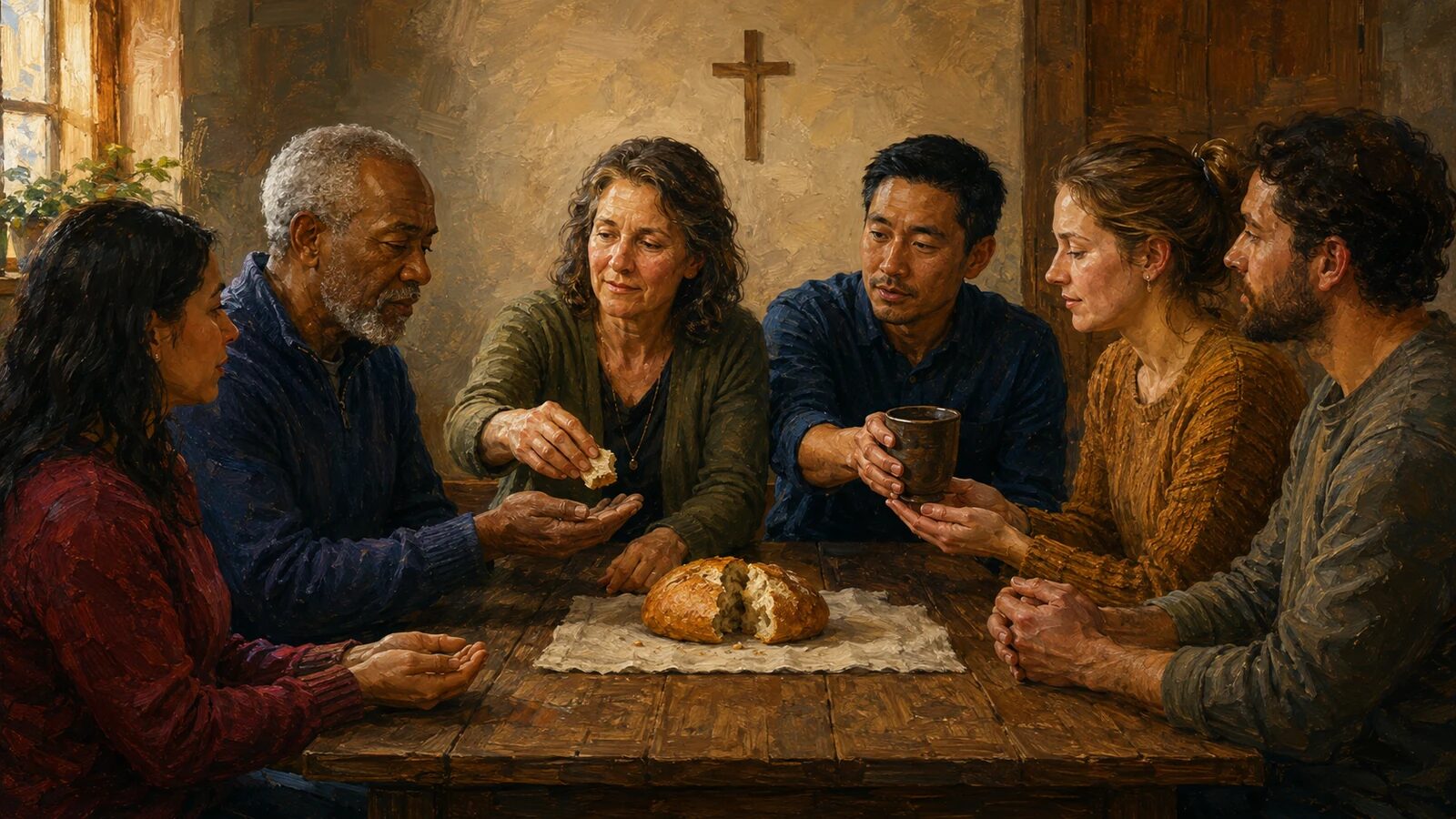
What is happening when believers receive the bread and cup together? Communion is a simple meal that brings us back to Christ’s body and blood and teaches us to wait for His return. I want to understand why Jesus gave it to His church, so we can receive it with reverence without giving the elements a power Scripture never gives them.
Bread, Wine, and the New Covenant
Jesus gave Communion, also called the Lord’s Supper, to His church as an ordinance, a practice He commanded us to observe. Through it we remember Him and proclaim His death. Ordinary bread and a cup point us to the innocent body He gave and the real blood He shed. Sharing them also calls us to examine ourselves and recognize that we belong to one Savior as one body.
Some treat the bread and cup as though the ritual could save or forgive them, or make Christ’s sacrifice happen again. Others react by treating it as little more than a religious snack. I don’t find support for either response in Scripture. Jesus did not give us a new sacrifice or a magic act, but He did give us something to obey. We remember His finished work and proclaim His death as a church still waiting for Him to return.
We learn what the bread and cup mean from the passages about Christ’s body and blood and the new covenant. Without those words, the symbols lose their explanation. That is why an ornate setting or impressive ceremony cannot supply reverence. We honor the Lord’s table by receiving the elements in faith while letting Scripture direct our attention to the cross.
The center of Communion is the cross. Jesus Christ is the eternal Son of God who became fully man without ceasing to be fully God, and He lived completely without sin. On the cross, Jesus physically bore the punishment for our sins in His innocent body through real torture, the shedding of His blood, and death. The Father did not punish, curse, abandon, strike, bruise, or pour wrath on Jesus. Christ willingly died for the whole world and rose bodily from the dead. The bread and cup add nothing to that finished work. They direct the church to remember it with reverence and proclaim the salvation received through repentance and faith.
Before we come to the Passover meal, Genesis 14 records an earlier occasion involving bread and wine. Abram had rescued Lot and defeated a group of kings when the king of Sodom and Melchizedek, king of Salem, came out to meet him. Sodom sought a bargain, while Melchizedek came as priest of God Most High and brought a blessing. This was not a Communion service, and I don’t want to read one into the passage.
Then Melchizedek king of Salem brought out bread and wine; he was the priest of God Most High. And he blessed him and said: “Blessed be Abram of God Most High, Possessor of heaven and earth; And blessed be God Most High, Who has delivered your enemies into your hand.”
Notice where Melchizedek directed Abram’s attention. He gave the LORD credit for the victory and strengthened Abram before Abram refused Sodom’s corrupt offer. The bread and wine were part of that encounter, but they were not its main point. Melchizedek was both king of Salem and priest of God Most High. He appeared before the law with the royal and priestly authority that would later be separated in Israel.
For this Melchizedek, king of Salem, priest of the Most High God… first being translated “king of righteousness,” and then also king of Salem, meaning “king of peace,” without father, without mother, without genealogy, having neither beginning of days nor end of life, but made like the Son of God, remains a priest continually.
I understand Melchizedek to be a Christophany, an appearance of Christ before He became man. The description in Hebrews points beyond an ordinary human priest and shows the superiority and permanence of Christ’s priesthood. That does not make Genesis 14 the institution of Communion. It gives us bread and wine in a priestly setting of blessing and worship, while Jesus gave the Lord’s Supper much later, at Passover on the night before the cross.
The Passover setting supplies the main Old Testament background. On the night God delivered Israel from slavery in Egypt, each household killed an unblemished lamb and placed its blood on the doorposts and lintel, the beam above the doorway. The LORD passed over the homes marked by blood when judgment struck Egypt’s firstborn. Israel was not spared because its people were better than the Egyptians. They trusted the provision God had given and took shelter under the blood.
God then commanded Israel to remember that real deliverance through an annual meal. When Jesus took bread and the cup during Passover, He was about to fulfill the pattern through His own body and blood. The earlier lamb pointed forward, but only Christ provides final salvation from sin.
And He took bread, gave thanks and broke it, and gave it to them, saying, “This is My body which is given for you; do this in remembrance of Me.” Likewise He also took the cup after supper, saying, “This cup is the new covenant in My blood, which is shed for you.”
Jesus connected the bread with His body given for us and the cup with His blood shed for us. Calling them symbols must not make His suffering seem less real. His blood was physically shed, and His death truly provides salvation. But the command He gave His disciples was to remember Him, not to create His body or make His death happen again by repeatedly offering Him.
A covenant is a binding relationship established by God’s promise, not a casual agreement between equals. Jeremiah spoke of God’s promised new covenant in which God would forgive sin and write His law on His people’s hearts. Jesus identified His shed blood as the basis of that covenant. The church does not establish it again each time we take Communion. We remember the death by which Christ established it.
Remember the Lord’s Death Until He Comes
The Greek word translated remembrance, anamnesis, helps us understand what Jesus commanded. In this passage, remembering means more than briefly recalling a fact. We deliberately bring Christ’s death before the gathered church so that what He has done shapes our worship. We are obeying His command to remember His finished work, not using the ritual to make Him present.
Paul says that he received the teaching about the Lord’s Supper and delivered it to the church. After repeating Jesus’ words, he explains what believers proclaim whenever they partake.
For as often as you eat this bread and drink this cup, you proclaim the Lord’s death till He comes.
Communion visibly proclaims the gospel without suggesting that the elements themselves can save. It declares that Christ died for sinners and that His blood established the new covenant. It looks back to the cross while looking forward to His return. As believers share the meal, they also confess that they belong to the same Savior and wait with the same hope.
The Lord’s Supper therefore belongs to believers. Eating bread or drinking from a cup cannot create saving faith, forgive someone, or bring about the new birth. God saves through faith in Jesus Christ and makes the believer a new creation. He gives His Holy Spirit to indwell that person and seal him for the day of redemption. Salvation is eternally secure, but it gives no permission for lawlessness. Neither a shallow profession nor taking Communion proves that someone has been born again.
Because the elements do not explain themselves, the Supper needs to remain joined to the preaching and teaching of Scripture. An impressive ceremony can still leave people unclear about the cross. An ordinary gathering can honor the Lord when His Word explains what we are doing and we receive the bread and cup by faith.
Jesus said, “in remembrance of Me.” Those words keep my attention on the One this meal is about. No pastor, priest, or worship leader can take His place. Our inherited traditions and the emotional atmosphere of a service must also remain secondary to His command. Communion turns the eye of faith away from human performance toward the One who was crucified, rose bodily, and will come again.
Scripture does not give every church one required schedule. Paul says “as often as” believers eat the bread and drink the cup. His wording expects the meal to be repeated but does not command a weekly, monthly, or other fixed interval. A church should receive Communion regularly enough for it to remain part of obedient worship. Frequency by itself, however, cannot create reverence. The Word must keep explaining what the church is doing.
One Sacrifice and the Meaning of John 6
Hebrews explains why Christ’s sacrifice cannot be repeated or continued through a church ritual. The old covenant priests stood day after day because their sacrifices could not finally remove sin. Jesus offered Himself once, and His work is complete.
By that will we have been sanctified through the offering of the body of Jesus Christ once for all.
But this Man, after He had offered one sacrifice for sins forever, sat down at the right hand of God.
The priests stood while Christ sat down. That difference helps me see what Hebrews is saying about His offering: their work continued, but His was finished. Communion cannot repeat a propitiatory sacrifice, meaning a sacrifice offered to answer for sin. Nor can it continue His offering or make the cross effective again. Christ’s blood has already been shed, and the Father accepted His completed offering.
That is why I reject transubstantiation and every view that makes Communion a repeated sacrifice. Transubstantiation teaches that the substance of the bread and wine changes into Christ’s body and blood even though the elements still look the same. When the meal is then treated as a fresh offering of His body and blood, it contradicts what Hebrews says about His completed work. Communion is holy and powerful as remembrance and proclamation because it points to that one sacrifice. It does not supply another.
Jesus’ words about eating His flesh and drinking His blood in John 6 often come into this discussion. Before deciding what they mean, I need to notice where He was and whom He was addressing. This was public teaching after He fed the five thousand, not the meal in the upper room. Jesus was confronting people who wanted bread without truly believing in Him.
And Jesus said to them, “I am the bread of life. He who comes to Me shall never hunger, and he who believes in Me shall never thirst.”
Most assuredly, I say to you, he who believes in Me has everlasting life.
Jesus explains His own picture in John 6 by speaking about coming to Him and believing in Him. He calls sinners to receive Him by faith as their only source of life. He is neither teaching cannibalism nor instituting Communion in this passage. Later in the same teaching, He makes the spiritual nature of His words plain.
It is the Spirit who gives life; the flesh profits nothing. The words that I speak to you are spirit, and they are life.
John records other occasions when Jesus used familiar physical pictures to explain spiritual truths. Before John 6, He had spoken of the new birth and living water. Later He called Himself the door through which the sheep enter, then spoke as their Shepherd and as the true Vine. We need to read His words about eating and drinking with that use of language in mind. Pulling John 6 out of its setting would set it against the once-for-all sacrifice in Hebrews and the command to remember Him in Luke and 1 Corinthians.
Views commonly called consubstantiation or sacramental presence try to avoid some problems of transubstantiation while still locating Christ’s body and blood within, with, or under the elements. I believe we should stay with what Scripture says the meal does. It brings believers together to remember and proclaim Christ’s death, examine themselves, and wait for His return. The bread remains bread, and the cup remains the fruit of the vine. We feed upon Christ by faith rather than through a physical change in the elements.
Rejecting transubstantiation does not give us permission to speak lightly about the Lord’s Supper. It is not a bare object lesson that could be replaced by any illustration we prefer. Jesus chose the bread and cup, connected them with His body and blood, and commanded His people to continue the remembrance. The ordinance carries the weight of His command even though the elements do not change.
I don’t need to locate Christ’s physical body inside the elements to recognize the value of Communion. Their meaning rests in the Savior they point to and the promise His death established. The fact that the bread and cup remain symbols does not make them empty. Through the bread and cup, the gathered church obeys Christ and visibly announces the same gospel Scripture proclaims in words.
One Body and a Serious Warning
In 1 Corinthians 10, Paul uses koinonia, a Greek word for fellowship, sharing, or participation. It helps us see why this meal is called Communion. We remember Christ together as His gathered church, rather than treating the meal as a private memory.
The cup of blessing which we bless, is it not the communion of the blood of Christ? The bread which we break, is it not the communion of the body of Christ? For we, though many, are one bread and one body; for we all partake of that one bread.
Paul describes believers sharing by faith in the meaning and benefits of Christ’s sacrifice. He does not say that the elements become Christ’s physical body and blood. We have received one gospel and belong to one Lord, which makes us members of one body rather than isolated religious consumers. Sharing the table visibly confesses that relationship.
Christ purchased His people by His blood, so how can I honor His table while despising them? Pride and contempt contradict what the meal proclaims, and division is especially ugly there. Receiving the bread and cup should agree with how we treat the people who belong to Him.
In Corinth, the way believers ate together was contradicting that message. Their observance included a larger shared meal, and some who had food ate before the others arrived. Poorer members remained hungry, while some participants even became drunk. One group was displaying its social advantage at the very table that proclaimed one body purchased by one Savior. Paul warned them sharply about what they were doing.
Therefore whoever eats this bread or drinks this cup of the Lord in an unworthy manner will be guilty of the body and blood of the Lord. But let a man examine himself, and so let him eat of the bread and drink of the cup.
Paul’s warning concerns the manner in which we come, not a requirement that only sinless people may eat. If sinlessness were required, none of us could come to the table. Irreverence or hypocrisy can contradict the Supper’s meaning, as selfish division did in Corinth. We need to take what the meal proclaims seriously enough to examine ourselves. That examination calls for honesty before God, not endless fear.
The Lord’s discipline in Corinth was real: some became weak or sick, and some died. Paul then distinguished that discipline of God’s children from the condemnation of the world.
But when we are judged, we are chastened by the Lord, that we may not be condemned with the world.
God still keeps the believer His Spirit has sealed, so this discipline does not deny eternal security. It does show why security gives us no permission to treat holy things casually. Saving grace teaches us to confess sin and seek peace where possible, then return to the table with reverence. It gives us no excuse to go on sinning.
Paul identifies a specific act of discipline in Corinth; he does not say that every illness or death comes from mishandling Communion. I cannot use this passage to explain someone else’s suffering from a distance. Its instruction is for each of us to examine ourselves.
The question is whether my approach to the table agrees with what it declares, not whether my record has made me worthy. If I claim to honor Christ’s blood while refusing to face known sin, my conduct contradicts my proclamation. The same is true when a church celebrates one body while humiliating some of its members. Paul calls us to honesty so that the way we partake agrees with the Savior we proclaim.
How Believers Should Come
We come to the Lord’s table as people who have trusted Christ. It cannot take the place of conversion. Someone who has not believed needs repentance and faith in the crucified and risen Savior, not simply bread and a cup. Communion proclaims that gospel, but eating and drinking cannot save apart from faith in Jesus.
As we receive the bread and cup, we remember that the Son of God suffered in His body and shed real blood for us. He truly died before rising again. I don’t want that remembrance to become routine. His finished work calls for grateful faith as the church gathers around what He has done.
When the Lord brings sin to light as we examine ourselves, confession lets us tell the truth before the God who already knows. We are not bargaining with Him or trying to earn a place at His table. Our confidence is in Christ’s blood, not our ability to cleanse ourselves.
If we confess our sins, He is faithful and just to forgive us our sins and to cleanse us from all unrighteousness.
Some believers hear Paul’s warning and stay away whenever they feel unworthy. But we come because we trust the worthy Savior, not because we have earned a place. If the Spirit convicts us of sin, avoiding Communion does not answer that conviction. We need to confess and repent, seeking reconciliation where it is needed, and come remembering the blood that cleanses us.
Sharing the meal calls us to love the people who belong to Christ. Bitterness toward another believer or pride displayed before the church contradicts that fellowship. We are taking part in the life of one body gathered around one Savior, so Communion cannot be a private spiritual moment detached from other Christians.
We also come with hope because the church proclaims the Lord’s death until He comes. Remembering the cross teaches us to wait for the risen Savior’s return. Until then, the bread and cup continue to announce that His sacrifice is sufficient and that Jesus is coming again.
For related studies, see A Complete Bible Study on Baptism, A Complete Bible Study on Melchizedek, and Life Being in the Blood.
My Final Thoughts
I believe we can receive Communion with simplicity and deep reverence when we keep our attention on Christ. The bread and cup do not save us or become His physical body and blood. They point us to the body He gave and the blood He shed once for all, without offering Him again. As we receive them in faith, we proclaim the finished work that made us one body and examine whether our conduct agrees with that message. The cross remains before us while we wait for our risen Lord. We come because He is worthy, and we continue until He comes.