
Why were Jesus’ disciples eating while other religious people were fasting? That was the question Jesus answered when He spoke about new wine and old wineskins. I understand His answer to be about receiving Him and the work He had come to do, and the conversation helps us see why He could not simply be added to a religious life that remained on our own terms.
The Bridegroom’s Presence Changed the Fasting Question
In Luke’s account, the question comes after Jesus calls a tax collector named Levi to follow Him. Levi gets up, leaves what he had been doing, and follows Jesus. He then gives a great feast for Him in his house, where many tax collectors and other guests gather at the table.
The Pharisees, a Jewish religious group concerned with the Law and inherited religious traditions, object to the company Jesus and His disciples are keeping. The scribes, who studied and taught the Law, join in the complaint. They ask the disciples why they eat and drink with tax collectors and sinners.
Jesus answers by comparing His work to the work of a physician. People who are sick need a doctor, and He has come to call sinners to repentance. His presence at the meal does not mean He approves of sin. He is calling the people who need Him to turn from it, so the meal has to be understood in relation to that purpose.
The question about fasting follows. Fasting means going without food for a time, and in the question Luke records, it is associated with prayer. John the Baptist, the preacher who prepared people for Jesus’ coming, had disciples of his own. Mark tells us that John’s disciples and the Pharisees were fasting. Luke’s account puts their practice alongside the eating and drinking of Jesus’ disciples. Matthew identifies John’s disciples as the ones who came to ask Jesus about the difference.
“Then the disciples of John came to Him, saying, ‘Why do we and the Pharisees fast often, but Your disciples do not fast?’ And Jesus said to them, ‘Can the friends of the bridegroom mourn as long as the bridegroom is with them? But the days will come when the bridegroom will be taken away from them, and then they will fast.’”
Jesus asks them to consider a wedding. The bridegroom is the man getting married, and his friends have come to share the occasion with him. As long as he is there with them, their response should fit the celebration. It would be strange to demand that they mourn as though they had lost him while he was still in their company.
I understand Jesus to be identifying Himself as the Bridegroom in that comparison. His disciples have reason to rejoice because He is with them. The people questioning their behavior are comparing religious practices, but Jesus directs their attention to the Person whose presence explains what they are doing. A fasting schedule cannot by itself tell them whether His disciples are responding rightly to God.
Jesus also tells them that the Bridegroom will be taken away, and then His disciples will fast. He is not dismissing fasting as something His followers should never practice. In Matthew 6:16-18, He teaches them to fast before their Father instead of making their appearance a way to attract admiration. Acts 13 also describes the church at Antioch fasting and praying before sending out two of its leaders, Barnabas and Saul, for the work the Holy Spirit has called them to do.
Those passages help us hear the difference between rejecting fasting and explaining its proper place. Jesus does not allow a religious practice to become more authoritative than the reason for practicing it. His disciples are with Him, and their conduct fits His presence. Their circumstances will change when He is taken away.
I understand that coming separation to look ahead to His rejection and death. Wicked men would betray and arrest Him, mock and scourge Him, and then crucify Him. Yet Jesus willingly gave His innocent body as the perfect sacrifice for our sins. He shed His blood and completed His saving work through His death, after which He was buried and rose bodily from the dead.
Christian fasting expresses our dependence on that Savior. Going without a meal cannot purchase the righteousness He gives or add something missing to His sacrifice. We come before Him because we need His grace, and that need remains even when we are very disciplined in our religious habits.
The Garment and Wineskins Expose an Impossible Mixture
Jesus continues His answer by describing what happens when someone tries to use something new to repair something old. Luke calls this a parable, a comparison through which Jesus explains His point. The first example concerns clothing.
“No one puts a piece from a new garment on an old one; otherwise the new makes a tear, and also the piece that was taken out of the new does not match the old.”
To make this repair, someone has taken a piece out of a new garment. Now the new garment is damaged, and the piece taken from it does not even match the old one. Matthew and Mark also describe the problem of putting unshrunk cloth on an old garment: the patch pulls away, and the tear becomes worse. The attempt to fix the clothing has created more damage.
Jesus is still answering the people who want His disciples to fit their expectations about fasting. I understand the garment comparison to show why His ministry cannot be treated as a useful addition to a religious arrangement that refuses His authority. He has come to call sinners to Himself. Taking a part of His teaching while insisting that He leave our way of approaching God intact would fail to receive what He is giving.
The wineskins describe another attempt that ruins the things someone is trying to preserve.
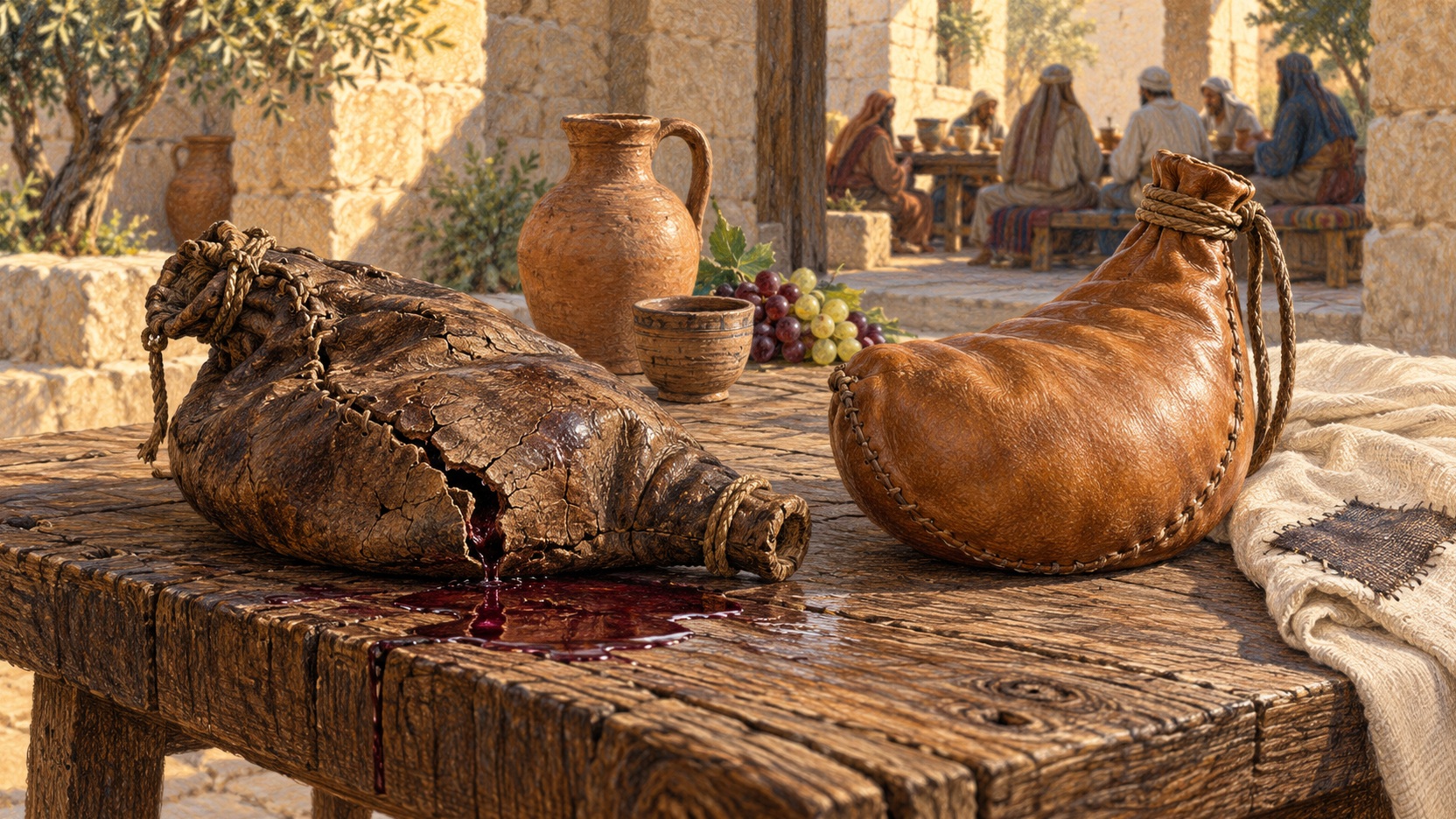
“And no one puts new wine into old wineskins; or else the new wine will burst the wineskins and be spilled, and the wineskins will be ruined. But new wine must be put into new wineskins, and both are preserved.”
A wineskin was a container made from animal skin. As fresh wine fermented, it created pressure inside the container, and a fresh skin could stretch to accommodate it. An old skin that had already stretched could no longer expand enough. It would split, spilling the wine and ruining the container. The NET Bible’s note on Luke 5:37 explains this background.
Notice that Jesus speaks about preserving both the wine and the skin. The answer is to use a container suited to the wine, rather than demand that an old skin stretch beyond what it can hold. His listeners can understand the practical problem without needing a separate hidden meaning for every detail of making or storing wine.
I take His two comparisons together as a warning against trying to receive Christ while keeping control over the terms on which we will receive Him. In the immediate conversation, His critics want His ministry to conform to their religious expectations. As we compare this with what Scripture later explains about the new covenant, we can also see why what He brings cannot be reduced to a small adjustment to the old order.
That connection needs to be explained from those passages. Jesus does not pause here to label every piece of cloth or part of a wineskin with a doctrine. He has answered the fasting question by explaining who He is, and His comparisons show why His work cannot simply be forced into the pattern His questioners already prefer.
Luke then records something Jesus says about the person who has become accustomed to old wine.
“And no one, having drunk old wine, immediately desires new; for he says, ‘The old is better.’”
The person prefers the wine he already knows, and he does not immediately want to try the new. I understand that observation to help explain the resistance Jesus is encountering. Familiar religious practices can feel sufficient to someone who has built his confidence around them. He may be reluctant to receive Christ because he is comfortable with the way he has approached God up to that point.
Jesus is describing that person’s preference. He is not taking back what He has just said about the ruined garment and the bursting skins. Nor does a preference for the old prove that the old arrangement can give someone the salvation he needs. The question is whether the person will receive the One who has come, even when doing so requires him to surrender confidence in his own religious standing.
Jesus Fulfilled the Law and Brought the Promised Covenant
Before we connect those comparisons with the covenants, we should distinguish God’s commands from the ways people misused them. God gave the Law to Israel through Moses after bringing the nation out of Egypt. That covenant, often called the Mosaic covenant, governed Israel’s life before Him. It was not a mistake God had made and was now trying to repair.
Jesus Himself explained how His coming related to the Law and the Prophets, the earlier Scriptures that had prepared people for Him.
“Do not think that I came to destroy the Law or the Prophets. I did not come to destroy but to fulfill.”
He came to fulfill what God had revealed. He obeyed the Law perfectly, and He accomplished what its sacrifices and priesthood had pointed forward to. The priests offered sacrifices on behalf of the people, but Hebrews 10 explains that the blood of bulls and goats could not take away sins, even though the sacrifices were offered again and again. The repetition itself showed that those offerings had not brought the worshipers to a completed cleansing.
Christ offered Himself once for sins. He is our Mediator, the One who brings sinners into a right relationship with God through His own saving work. When He shared the meal with His disciples before His death, He identified the cup with the new covenant in His blood, as Luke 22:20 records. The fulfillment rests in His sacrifice, rather than in our ability to keep offering God a better religious record.
That does not mean the Law was sinful. In Romans 7, the apostle Paul explains that the command against coveting made him recognize coveting as sin, and he calls the commandment holy, just, and good. A command can expose what is wrong without giving a guilty person the life he needs. The failure lies in people who disobey God, not in the holiness of what He commands.
Human traditions could make that disobedience harder to recognize. In Mark 7, Jesus confronts a practice that allowed a person to declare resources a gift to God and then withhold the help those resources could have provided for his parents. The religious explanation was being used to evade God’s command to honor father and mother. We should not confuse that misuse of tradition with obedience to the Law itself.
God had already promised a new covenant through the prophet Jeremiah. In Jeremiah 31:31-34, He names the houses of Israel and Judah as the people with whom He will make it. He recalls the earlier covenant their fathers broke, then promises to write His law within them and forgive their iniquity. I do not read that promise as God discovering a problem He had failed to anticipate. He had told His people what He would do.
Paul recalls this promise in Hebrews 8, and another prophet, Ezekiel, describes the inward change God would give His people. In Ezekiel 36, God speaks to Israel about gathering them from the nations and cleansing them from their idolatry. His promise includes what He will do within them.
“I will give you a new heart and put a new spirit within you; I will take the heart of stone out of your flesh and give you a heart of flesh.”
A heart of stone gives us an image of someone unresponsive to God. A heart of flesh, in this comparison, is a living and responsive heart. Ezekiel is not promising a more sinful nature when he uses the word flesh. God is promising to replace their hardness, and the next verse says that He will put His Spirit within them and cause them to walk in His statutes.
The obedience follows God’s work within His people. Simply adding another demand would not accomplish what He promises to give. A command can tell me that hatred is wrong while I continue to hate the person who has offended me. I need forgiveness for my guilt, and I also need God to change the heart from which that hatred comes.
Paul describes his own dependence on God when he explains his ministry in 2 Corinthians 3. He says that his sufficiency comes from God, who has enabled him to serve under the new covenant.
“Who also made us sufficient as ministers of the new covenant, not of the letter but of the Spirit; for the letter kills, but the Spirit gives life.”
The reference to the letter can sound confusing if we detach it from what Paul is discussing. He goes on to speak about the ministry engraved on stones and calls it a ministry of condemnation. He is describing the Law’s judgment upon sin and comparing it with the life and righteousness given through the Spirit.
I do not understand him to be warning that the written Bible is harmful or that carefully studying its wording makes someone spiritually dead. The problem is the sinner’s guilt under a Law he has broken. The Law exposes that guilt; it cannot impart the life he needs. The Spirit gives life, and the new covenant provides what the condemned person could not produce for himself.
In Hebrews 8, Paul draws attention to God’s description of the promised covenant as new. He explains what that means for the first covenant.
“In that He says, ‘A new covenant,’ He has made the first obsolete. Now what is becoming obsolete and growing old is ready to vanish away.”
The first covenant had served the purpose God gave it, and He was bringing that earlier arrangement to its end. Going back under it as our covenant would mean turning back from the fulfillment Christ has brought. God was not asking His people to reject His earlier revelation. He was calling them to receive the One to whom it had directed them.
This is the connection I see with Jesus’ warning about trying to fit what He brings into an arrangement that cannot contain it. The forgiveness and life He gives require more than an adjustment to outward religious practice. In 2 Corinthians 5:17, Paul describes the person who is in Christ as a new creation. A change in reputation may impress other people, but only God’s work can make someone new in that way.
Christian Liberty Rejects Legalism and Lawlessness
In Galatians, Paul writes to churches facing demands that would add requirements to Christ’s saving work. The issue concerned Gentiles, people who were not Jews, who had believed in Christ. Teachers were insisting that they needed circumcision and observance of the Mosaic Law to be accepted by God. Circumcision was a physical covenant sign God had given to Abraham, the forefather of Israel, and it was required for males under Israel’s Law.
Paul asks these believers in Galatians 3 whether they received the Spirit through works of the Law or through hearing with faith. He also explains that God’s promise to Abraham came before the Law given through Moses, so the later Law could not cancel that promise. Their acceptance before God did not begin with keeping the Law, and they should not turn to it as though Christ had left their salvation unfinished.
“Stand fast therefore in the liberty by which Christ has made us free, and do not be entangled again with a yoke of bondage.”
A yoke is something placed on an animal to bring it under a load or direct its labor. Paul uses that picture to describe the bondage into which these believers were being urged. They would be taking on the Law as the basis of being right before God, even though its demands could only expose their failure to meet them. Christ had freed them from trying to establish their righteousness in that way.
When I speak about legalism here, I mean making religious works the basis of our acceptance before God. The particular demand in Galatia involved circumcision and the Law, but the same misplaced confidence can take other forms. I could rely on my family heritage, my record of keeping religious observances, or my ability to discipline myself. If I treat those things as necessary to complete Christ’s saving work, I am no longer resting in what He has accomplished.
Paul does not answer that error by telling the Galatians that their conduct is unimportant. In Galatians 5:13, he tells them to serve one another through love rather than use freedom as an opportunity for the flesh. By flesh in that setting, he means the sinful desires that oppose the Spirit, and he goes on to describe the conduct those desires produce.
Someone who uses grace to defend dishonesty, sexual sin, or cruelty has misunderstood the freedom Paul is teaching. The Spirit does not give life so that we can be comfortable resisting Him. He teaches us to live as people who belong to Christ, and love for others should become evident in how we treat them. That obedience grows from the life we have received; it does not purchase our acceptance.
The same care is needed when we apply the wineskins to church practices. A practice is not a form of bondage merely because a previous generation used it. If it is faithful to Scripture and helps people obey the Lord, its age is no reason to discard it. Likewise, a new method does not become faithful simply because someone calls it new wine.
A church may need to change how it organizes a ministry so that it can serve people well. Those decisions deserve thought because they affect real people, but Jesus was answering a question about His own presence and work. I cannot make His words chiefly about changing a program or choosing a worship style without replacing His subject with mine. Both the familiar practice and the proposed change must be examined by Scripture and submitted to Christ.
The Passage Calls for More Than Religious Repair
Before I use this passage to evaluate anyone else’s church, I need to consider the confidence I bring before God myself. The opposition of the Pharisees shows how religious standing can coexist with resistance to Jesus. Their complaint about the meal began with the kind of people He was receiving. They were looking at His company while He was explaining that He had come to call sinners to repentance.
I cannot make my outward separation from other people the reason God should accept me. Nor can I offer Him my moral achievements and then add Jesus to make up whatever I think is missing. The guilt I bring before Him needs forgiveness that I cannot give myself. I need the Savior, even if other people already regard me as respectable.
Jesus addressed that need with a religious man named Nicodemus in John 3. Nicodemus was a Pharisee and a ruler among the Jews. He came to Jesus acknowledging that His signs showed God was with Him, but Jesus told him that he needed to be born again. Recognizing something true about Jesus did not remove his need for the life that comes from the Spirit.
That is what I mean by regeneration, or the new birth. God gives spiritual life; a person does not acquire it simply by learning how Christians are expected to behave. Someone can admire Christian teaching, adopt its moral standards, and feel at home among believers while still relying on himself. Those changes may affect his reputation without answering the question of whether he has trusted Christ.
We receive forgiveness through Christ’s blood, and the Holy Spirit gives life and dwells within those who belong to Him. Titus 3:3-7 explains that God saves according to His mercy, through regeneration and the Spirit’s renewing work, rather than because of righteous deeds we have performed. The answer to our need is to repent and believe in Christ, rather than try to become impressive enough to deserve Him.
That new life should also become evident in our response to His word. A willingness to receive correction and turn from sin belongs with the faith we profess. I am not speaking about sinless perfection or saying that our conduct earns salvation. I am asking whether the heart beneath our religious language has been made new, because the Spirit’s work cannot be reduced to helping us look better to others.
Believers are not under the covenant given to Israel at Mount Sinai, but we remain under Jesus’ authority. Titus 2:11-14 describes grace as teaching us to deny ungodliness and live in a way that honors God. The Lord who saves us also has the right to correct us, including the habits we have learned to protect with religious explanations.
We can therefore fast and pray because we depend on Him. We can love and serve people because He has given us life. Those responses have a place in following Christ, but none of them makes God owe us His favor. I want to receive what He gives and learn to obey Him, rather than ask Him to endorse the righteousness I claim for myself.
My Final Thoughts
Jesus answered the fasting question by identifying Himself as the Bridegroom whose presence gave His disciples reason to rejoice. The garment and wineskins then showed why His work could not simply be fitted into religious expectations that refused His authority. I understand those comparisons in light of the fulfillment He brought: He obeyed the Law, gave Himself for our sins, and established the promised new covenant in His blood.
What I need from Him is forgiveness and the life His Spirit gives. A better religious reputation cannot provide either one, and a preference for familiar practices cannot make them sufficient. Neither can enthusiasm for something new. The change I need begins with receiving Christ Himself.
I want the freedom He gives to shape the way I obey Him. That means giving up the claim that my performance earns His acceptance, and it also means listening when He corrects me. The Savior who has given me reason to rejoice is the One whose authority I need to welcome in the ordinary choices of my life.