
We use water every day, so it is easy to overlook how often Scripture uses it to expose the limits of human strength. A cup can preserve life, but a flood can swallow a rebellious world, and a sea that stops an army becomes a road when God commands it. I want to follow those different uses carefully because the Bible points us beyond the water itself to the God who rules it and the Savior who brings sinners from death into life.
Water Under God’s Rule
The Bible never treats water as an independent spiritual force. God created it and set its boundaries, so it moves according to His command. Many passages describe literal water in real history. Other passages use water as a picture of danger, cleansing, judgment, or life. It can also take part in a pattern that points forward to Christ. The surrounding passage must guide us instead of forcing every mention of water to mean the same thing.
Then God said, “Let there be a firmament in the midst of the waters, and let it divide the waters from the waters.”
Genesis begins with God ruling creation by His word. The waters are not His rivals, and they do not exist as another divine power beside Him. They belong to the created order and answer to their Creator. This truth governs every water passage that follows. The sea may terrify people, but it never threatens God’s throne. Rivers can overflow their banks without moving beyond His authority.
The same Creator stands over every later scene. The waters that rise in the flood are under the authority of the One who shuts Noah into the ark. The sea divides when He rescues Israel, and the Jordan stops when His people enter the land. Centuries later, the winds and waves of Galilee obey Jesus. Even the river of life in Revelation flows from God’s throne. The passages differ, but none of them presents creation acting outside its Maker’s rule.
The Hebrew word mayim is simply a common word for waters. There is no secret definition that unlocks the theology. The meaning comes from what God does in each context. At creation He gives the waters their order and boundaries. Elsewhere the water serves His purpose in judgment or rescue, and He also uses it to sustain life.
Later Scripture often uses the sea as a picture of unrest and danger. That does not make saltwater evil. The sea works as an image of upheaval because people cannot master it. Prophecy can therefore portray turbulent nations and the rise of beastly power as something coming from the sea.
Then I stood on the sand of the sea. And I saw a beast rising up out of the sea, having seven heads and ten horns, and on his horns ten crowns, and on his heads a blasphemous name.
Isaiah turns that picture toward the heart by comparing the wicked to troubled waters. Inner restlessness casts disorder into a person’s life. Surface habits may improve for a while, but peace with God requires more than self-control. It requires reconciliation through Christ.
But the wicked are like the troubled sea, When it cannot rest, Whose waters cast up mire and dirt.
Scripture does not pretend the waters are harmless. Instead, it shows that God is greater than their danger. What people cannot tame remains completely under the LORD’s rule.
You rule the raging of the sea; When its waves rise, You still them.
Judgment and Rescue Through the Waters
The flood shows water as judgment in a direct and frightening way. Scripture does not describe it as an uncontrolled divine outburst. The world had become corrupt and violent before God, but He patiently gave people time to heed His warning before His righteous judgment came.
And the LORD said, “My Spirit shall not strive with man forever, for he is indeed flesh; yet his days shall be one hundred and twenty years.”
Judgment and mercy appear within the same scene. Outside the ark, the waters bring death. Inside it, God preserves life while the wicked world is judged. Noah was not saved by clever planning. Genesis first says that he found grace in the eyes of the LORD, and obedient faith followed that grace.
And behold, I Myself am bringing floodwaters on the earth, to destroy from under heaven all flesh in which is the breath of life; everything that is on the earth shall die.
The ark was the refuge God appointed through judgment, not a general symbol of human optimism. That pattern points forward to Christ. Sinners need more than advice about improving themselves because guilt and judgment are real. Jesus is their refuge. Wicked men physically tortured, punished, and killed Him. He willingly bore that real punishment for our sins in His innocent body. He shed His blood, died, was buried, and rose bodily. The Father did not punish, curse, abandon, strike, bruise, or pour wrath on Jesus. The related study A Complete Bible Study on Noah and the Ark follows that account more fully.
I think the flood helps us hold together two truths people often separate. God did not ignore the violence and corruption of the world, so His judgment cannot be reduced to an empty warning. Yet He also gave warning and provided a refuge before the waters came. Grace did not pretend evil was harmless. It brought Noah into the place God had appointed for preservation.
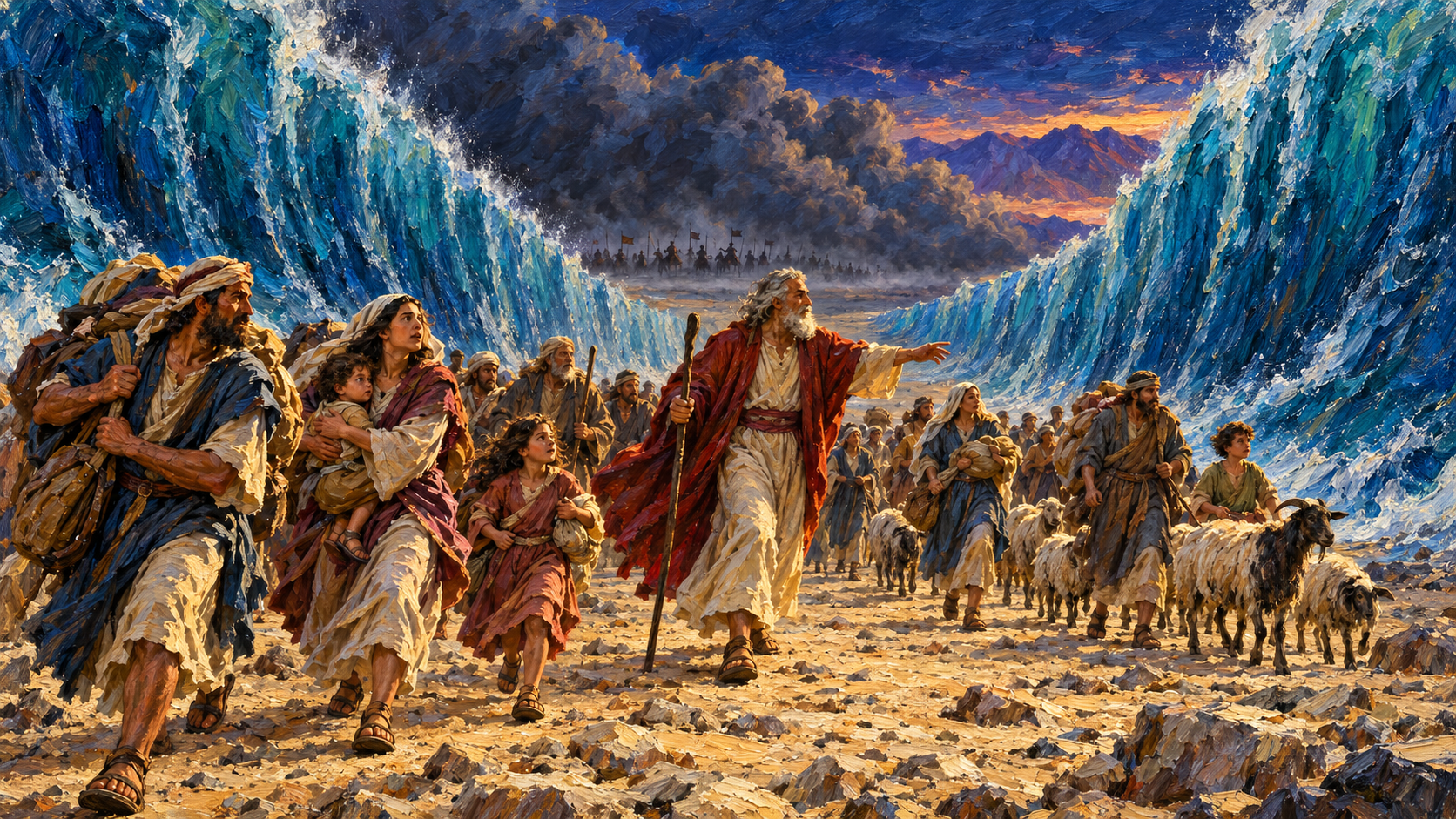
Exodus 14 gives us another clear water scene. Israel is trapped between Pharaoh’s army and the sea, with no human strategy able to solve the crisis. God commands His people to move forward and makes a path where no path existed.
Then Moses stretched out his hand over the sea; and the LORD caused the sea to go back by a strong east wind all that night, and made the sea into dry land, and the waters were divided. So the children of Israel went into the midst of the sea on the dry ground, and the waters were a wall to them on their right hand and on their left.
The same water becomes Israel’s passage of rescue and Egypt’s place of judgment. Water has no moral personality of its own. The LORD rules the moment and makes a way for His people. Those who have hardened themselves against Him meet judgment in the place where Israel finds rescue. A Complete Bible Study on the Exodus develops the larger deliverance and its place in Israel’s history.
Paul later says that Israel was baptized into Moses in the cloud and in the sea. He is not claiming that the Red Sea washed away their sins. He is describing their public identification under Moses as God’s appointed leader. Paul then uses Israel’s later failures to warn believers that spiritual privilege never gives permission for carelessness.
Moreover, brethren, I do not want you to be unaware that all our fathers were under the cloud, all passed through the sea, all were baptized into Moses in the cloud and in the sea,
The Jordan crossing repeats part of the lesson in another setting. As Israel enters the land, the swollen river blocks the way. The priests carry the ark as the sign of God’s covenant presence, and the waters stop before them. Israel receives the promise through God’s presence and command rather than its own power.
that the waters which came down from upstream stood still, and rose in a heap very far away at Adam, the city that is beside Zaretan. So the waters that went down into the Sea of the Arabah, the Salt Sea, failed, and were cut off; and the people crossed over opposite Jericho.
Israel still had to step where God commanded, so obedience was not unnecessary. Yet those steps did not purchase the miracle; they received what God did. In the same way, repentance and faith are real responses to God’s word, but neither buys salvation. Salvation is mercy received by faith, and obedience follows as its fruit.
What catches my attention is that Israel did not create a dry path by showing enough courage, and the priests did not gain control over the river through a ritual. God acted according to His promise, then His people walked where He opened the way. Biblical faith is not passive indifference, but neither is it a work that places God in our debt. It trusts His word and responds to what He has provided.
not by works of righteousness which we have done, but according to His mercy He saved us, through the washing of regeneration and renewing of the Holy Spirit,
Baptism and True Cleansing
Water is naturally connected with washing, which makes baptism easy to misunderstand. The New Testament gives water baptism to believers as a public identification with Christ after salvation. The act does not cause the new birth or remove guilt through physical power. It can never replace faith in the Lord Jesus.
The Greek verb baptizō can describe dipping, washing, or immersion, depending on the context. A dictionary entry by itself cannot settle the doctrine. The passages show baptism as a sign of identification with Christ, not the cause of regeneration. The separate study A Complete Bible Study on Baptism in the Bible examines those passages in greater detail.
1 Peter 3 is often used to argue that the act of baptism saves, but Peter carefully guards his point. Noah and his family were not saved because floodwater cleaned their bodies. The water judged the old world while the ark God provided carried eight people safely through that judgment. Peter says baptism corresponds to that deliverance and then directly denies that removing dirt from the body is the saving issue. The saving power is through the resurrection of Jesus Christ.
There is also an antitype which now saves us–baptism (not the removal of the filth of the flesh, but the answer of a good conscience toward God), through the resurrection of Jesus Christ,
The Greek expression translated “the answer of a good conscience toward God” can carry the sense of an appeal, request, pledge, or answer directed toward God. Its exact sense is debated, and I would be careful not to claim more than the wording settles. None of the serious options, however, turns dirt-removing water into the source of new life.
Baptism publicly portrays the believer’s union with Christ in burial and resurrection. It expresses the response of a conscience turned toward God. Water cannot save someone who trusts a ritual while rejecting Christ. For a person who has truly been born again, baptism is an act of obedience and testimony rather than the price of eternal life.
Peter’s comparison with Noah keeps both the judgment and the refuge in view. The flood did not become harmless water because eight people survived. They were carried safely through it by the provision God gave. In the same way, Christian baptism does not announce confidence in water. It confesses that the believer’s hope rests in the crucified and risen Christ. Peter’s own explanation directs our attention away from the surface of the body and toward a conscience answering God through Jesus’ resurrection.
This also helps us read other washing language in the New Testament. God can use cleansing imagery for salvation without giving a priest, pastor, or pool the power to regenerate a soul. Titus 3:5 describes the washing of regeneration as the Holy Spirit’s renewing work within the believer. Water baptism should agree with that inward reality without being confused with it. The sign speaks truthfully when it confesses what God has done through Christ.
Jesus Over the Waters and Death
When Jesus walks on the sea, the theme becomes more personal. The Old Testament says that God rules the waters and stills their waves. Jesus comes to His disciples across the water while the wind is against them. This is not a random display of power. It reveals His authority and His presence with men who are afraid.
Now in the fourth watch of the night Jesus went to them, walking on the sea. And when the disciples saw Him walking on the sea, they were troubled, saying, “It is a ghost!” And they cried out for fear. But immediately Jesus spoke to them, saying, “Be of good cheer! It is I; do not be afraid.”
The words translated “It is I” are ego eimi. They can often identify a speaker in an ordinary way. Within the Gospels, the context may give them greater weight because of the way God reveals Himself. We do not need to build the entire conclusion on those two words. The scene already shows Jesus standing where no mere man has authority and bringing peace to fearful disciples. A Bible Study of Jesus Walking on Water works through the full account.
Peter’s sinking also gives us a vivid picture of faith that is genuine even though it is weak. When he looks toward the wind, he begins to sink and cries directly to the Lord for salvation. Jesus catches him immediately. The believer’s safety rests on the Savior rather than on the steadiness of human emotion.
That does not make doubt unimportant, since Jesus addresses it directly. It does show where a fearful believer must turn. Peter does not save himself by recovering perfect composure in the water. His short cry reaches the One who is already near enough and strong enough to take hold of him. Jesus exposes Peter’s weak faith, but He keeps the answer centered on Himself.
And immediately Jesus stretched out His hand and caught him, and said to him, “O you of little faith, why did you doubt?”
Another real water account becomes a resurrection pattern in Jesus’ teaching. After scribes and Pharisees ask for a sign while resisting the words and works already before them, Jesus points to Jonah. As Jonah was three days and three nights in the great fish, the Son of Man would be three days and three nights in the heart of the earth.
Jonah truly went down into the sea under judgment. God appointed the fish that preserved him, and Jonah returned to the land alive. Jesus applies that pattern to His own death, burial, and bodily resurrection. The comparison has limits that must remain clear. Jonah did not atone for anyone’s sin, and his suffering followed his own disobedience. Christ was completely sinless and willingly accomplished the saving work to which Jonah’s experience pointed. A Complete Bible Study on Jonah follows those distinctions through the full book.
Living Water and Everlasting Life
John’s Gospel uses water language with special care. When Jesus offers living water to the Samaritan woman, He is not offering a better way to draw from Jacob’s well. He is speaking about the eternal life that He alone gives.
Jesus answered and said to her, “Whoever drinks of this water will thirst again, but whoever drinks of the water that I shall give him will never thirst. But the water that I shall give him will become in him a fountain of water springing up into everlasting life.”
The woman has no religious achievement to boast about. Jesus exposes her sin, but He does not leave her with shame as the final word. He reveals Himself and offers what she cannot draw from the well. Living water is not an abstract religious substance. It is the life of God given through the Messiah to sinners who discover that their thirst is deeper than an ordinary need. A Complete Bible Study on Living Water explores that promise further.
Later, during the Feast of Tabernacles in Jerusalem, the crowds are divided over Jesus and the authorities oppose Him. On the last day of the feast, He publicly calls the thirsty to come to Him and drink. He speaks of rivers of living water, and John does not leave the image unexplained. Jesus was speaking about the Holy Spirit whom believers would receive.
He who believes in Me, as the Scripture has said, out of his heart will flow rivers of living water.
Living water is grace given by Christ. A thirsty sinner comes to Him empty rather than bringing life of his own. The Lord gives life, and the Holy Spirit comes to dwell within everyone who believes. Scripture presents the new birth as God’s work received through faith, with a changed life following from it.
The feast setting makes Jesus’ invitation public and urgent. Religious leaders are opposing Him, while people in the crowd are trying to decide who He is. Jesus does not direct the thirsty toward a sacred object or ask them to trust the ceremony of the feast. He calls them to Himself. The water image finds its meaning in the Spirit whom Christ gives, so cleansing and life cannot be separated from personal faith in Him.
The Deepest Crossing
John 5:24 gathers the study into a plain promise without using water imagery. The one who hears Christ’s word and believes the Father who sent Him already has everlasting life. He will not come into judgment as condemnation because he has passed from death into life.
“Most assuredly, I say to you, he who hears My word and believes in Him who sent Me has everlasting life, and shall not come into judgment, but has passed from death into life.
This is the deepest crossing in the study. The Red Sea and Jordan were real historical events, and Noah was truly preserved through the flood. Jonah also went down and returned alive. Yet none of those events can form the foundation of salvation. That place belongs to Christ alone. His completed death, burial, and bodily resurrection are the historical ground of the believer’s passage into life.
Christ died for the whole world, and God’s offer is genuine even though people can resist it. Everyone who repents and believes is forgiven and declared righteous before God. He gives that person the new birth and makes him new. The Holy Spirit comes to live within the believer and seals him, so he is eternally secure. Jesus does not say that he might gain life if he performs well enough; He says that he has everlasting life. This security never makes lawlessness harmless, and a surface profession does not prove that the new birth has taken place. Obedience is the fruit of life rather than the price paid to receive it.
Keeping these passages in context protects us from treating water baptism as the cause of salvation. The act itself does not remove sin. That same care keeps us from forcing every mention of water into one meaning. Noah, Jonah, and the Red Sea are real history before they teach any pattern, and Scripture itself shows us what those events may picture.
Revelation 21 adds one more careful distinction. John sees a new heaven and new earth where there is no more sea, but that does not mean the former oceans were morally evil. He does not give us a technical geography of the new earth or explain every physical result. Within Revelation, the sea has been connected with threat and upheaval. It also marks separation and becomes the setting from which beastly power rises. At minimum, its absence belongs to the passing of the old order where death and danger operated.
I would not go further than John does and build a detailed map of the new earth from that one statement. His vision places the phrase within a much larger promise. The former order passes away and death is gone. God now dwells openly with His people. The point is not that created water was secretly corrupt. The danger and separation associated with the old world no longer define the life God brings.
The Bible then ends with the river of the water of life flowing from the throne of God and of the Lamb. Scripture has shown floodwater bringing judgment and the sea placing people in danger. Its stories also know the fear of storms and the pain of thirst. The Bible closes with life under God’s unveiled rule. The final word for those who belong to Christ is the life the Lamb gives, not judgment.
These passages should humble us because we cannot command the sea or cleanse our own guilt. We also have no power to raise ourselves from spiritual death and cause a new birth. Our limits direct us toward the refuge God has provided.
That refuge must be received by faith. Noah entered the ark God gave. Later, Israel walked across the path He opened through the sea. When Peter began to sink, he cried to the right Savior, while the woman at the well listened as Christ spoke words of life to her. John 5:24 now calls every reader to hear the Son and believe the Father who sent Him.
A believer’s response includes obedience. If you have trusted Christ but have not been baptized, baptism is the right public step of identification with Him. If you have been baptized, never trust the sign while neglecting the Savior it confesses. The sign is precious because Christ is precious.
My Final Thoughts
After following water from creation to the river of life, I keep coming back to the difference between the sign and the Savior. Water may display God’s judgment or become a path of rescue, and Scripture also uses it to picture cleansing and life. Yet the water never becomes a spiritual power apart from Him. The greatest crossing is the one Jesus names in John 5:24, when a person who believes passes from death into everlasting life. That gives us reason to obey without trusting a ceremony and to face judgment without pretending we can save ourselves. Our hope rests in Jesus Christ, who alone gives the living water and brings sinners safely into life.