
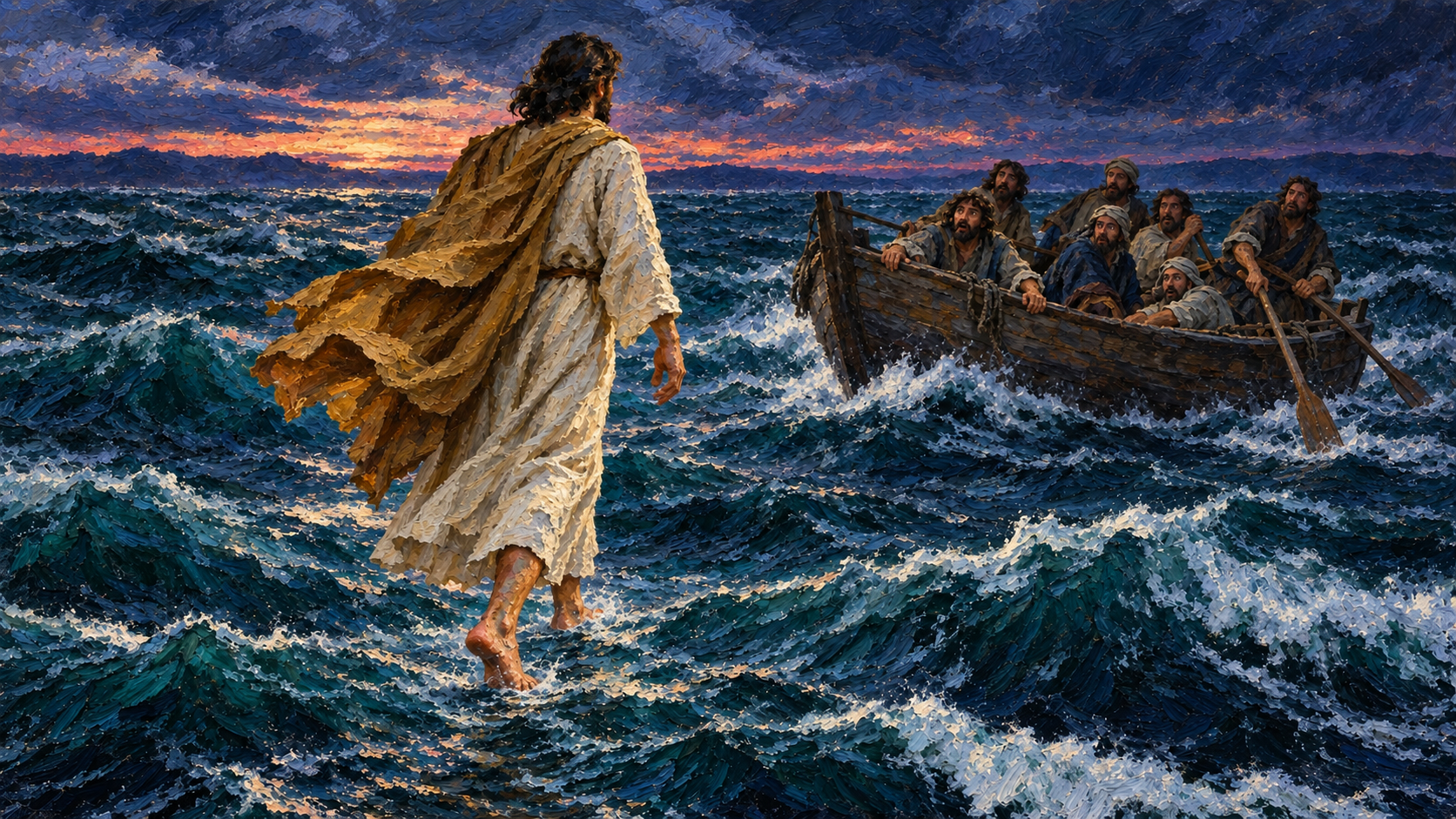
Why did Jesus walk across the sea, and why do the Gospels place this miracle right after He fed the five thousand? Matthew describes Peter’s steps toward Him, while Mark draws attention to the disciples’ hardened hearts. John connects these signs with Jesus’ teaching about the bread of life. Reading them together helps me see why our attention needs to remain on Jesus Himself throughout that night.
The Feeding, the Crowd, and the Contrary Wind
Matthew and Mark place Jesus walking on the Sea of Galilee immediately after the feeding of the five thousand. That number counts the men, and Matthew also mentions women and children. John gives the same sequence. All three describe the same historical miracle, choosing details according to the emphasis each was inspired to give.
Only Matthew describes Peter leaving the boat to walk toward Jesus, becoming afraid, and beginning to sink before Christ caught him. Mark draws attention to the disciples’ failure to understand the loaves because their hearts were hardened. John tells us about the crowd’s attempt to make Jesus king and how far the disciples had rowed. He also records their immediate arrival at land after receiving Jesus into the boat.
After feeding the crowd, Jesus refused their attempt to control His kingship and sent the disciples ahead by boat. He went off alone to pray while they spent hours laboring on the sea. Near dawn He came to them across the water. Peter walked at His command, and when he began to sink, Jesus rescued him. They then entered the boat, and the wind stopped.
I don’t want to reduce this miracle to advice about feeling confident when life is difficult. Jesus saw His disciples’ distress and came to them walking on the sea. His command sustained Peter, and His hand rescued him. When He entered the boat, the wind stopped and the disciples worshiped Him. He brought them through the crossing He had appointed, revealing who He is through everything that happened.
When Jesus heard it, He departed from there by boat to a deserted place by Himself. But when the multitudes heard it, they followed Him on foot from the cities. And when Jesus went out He saw a great multitude; and He was moved with compassion for them, and healed their sick. When it was evening, His disciples came to Him, saying, “This is a deserted place, and the hour is already late. Send the multitudes away, that they may go into the villages and buy themselves food.” But Jesus said to them, “They do not need to go away. You give them something to eat.” And they said to Him, “We have here only five loaves and two fish.” He said, “Bring them here to Me.” Then He commanded the multitudes to sit down on the grass. And He took the five loaves and the two fish, and looking up to heaven, He blessed and broke and gave the loaves to the disciples; and the disciples gave to the multitudes. So they all ate and were filled, and they took up twelve baskets full of the fragments that remained. Now those who had eaten were about five thousand men, besides women and children.
After hearing about John the Baptist’s death, Jesus withdrew, but the crowds followed Him. He had compassion on them and healed their sick before feeding thousands with only five loaves and two fish. The disciples handed out the food He multiplied and afterward gathered twelve baskets of fragments.
The Gospel writers give us reasons to read the feeding and the crossing together. Mark explains that the disciples had failed to understand the loaves, and John follows the crossing with Jesus correcting people who wanted another meal without recognizing what the sign showed them.
The signs call people to believe in Jesus, not treat Him as a wonder-worker who will carry out their plans. He feeds His people as their Shepherd and rules creation as Lord. As the Son, He gives eternal life.
Then those men, when they had seen the sign that Jesus did, said, “This is truly the Prophet who is to come into the world.” Therefore when Jesus perceived that they were about to come and take Him by force to make Him king, He departed again to the mountain by Himself alone.
The people rightly recognized a prophetic sign, but then tried to take control of its meaning by seizing Jesus and making Him king on their terms. He withdrew alone instead of accepting the place they intended to give Him.
Matthew and Mark tell us that Jesus immediately compelled the disciples to get into the boat while He dismissed the crowd. Was He keeping them from being drawn into the people’s political enthusiasm? The sequence makes that reasonable to consider, but neither writer explicitly gives it as His reason.
Jesus truly is Israel’s Messiah and future King, but He would not accept a crown that bypassed His saving mission. He neither submitted His authority to the mob nor shaped His mission around their material expectations. His kingdom will come according to the Father’s will and the timetable given in prophecy.
Immediately Jesus made His disciples get into the boat and go before Him to the other side, while He sent the multitudes away. And when He had sent the multitudes away, He went up on the mountain by Himself to pray. Now when evening came, He was alone there.
After making the disciples get into the boat and dismissing the people, Jesus went up the mountain to pray. By evening He was there alone with the Father. This was neither a performance nor an unnecessary act. The Son who had become man lived in perfect dependence on His Father and obedience to Him.
The disciples’ struggle began on a crossing Jesus Himself had directed them to make. I need to remember that before treating difficulty as evidence of having missed God’s will. Obedience can bring costly resistance and deep weariness, even circumstances beyond anything our own effort can overcome.
While the crowd wanted to impose a public kingship on Jesus, He withdrew to seek the Father in prayer. Popularity did not determine what He would do. He followed His Father’s will in obedience.
Matthew describes waves battering the boat in the middle of the sea because the wind was against it. Mark tells us that Jesus saw the disciples straining at the oars, and John describes the great wind that had stirred up the sea. By the time they saw Jesus approaching, they had rowed twenty-five or thirty stadia, roughly three to four miles.
This is distinct from the earlier storm in which Jesus slept in the boat and then rebuked the winds and sea. Here Jesus remained on land while the disciples rowed deep into the night. His physical distance did not prevent Him from seeing their distress.
The fourth watch fell roughly between three and six in the morning, so the disciples had been working for hours. I don’t read their rowing as a failure of faith. They were doing what experienced boatmen could do, and Jesus came to them in a way no amount of human effort could imitate.
Jesus Came as the Lord Who Rules the Sea
Now when evening came, the boat was in the middle of the sea; and He was alone on the land. Then He saw them straining at rowing, for the wind was against them. Now about the fourth watch of the night He came to them, walking on the sea, and would have passed them by. And when they saw Him walking on the sea, they supposed it was a ghost, and cried out; for they all saw Him and were troubled. But immediately He talked with them and said to them, “Be of good cheer! It is I; do not be afraid.” Then He went up into the boat to them, and the wind ceased. And they were greatly amazed in themselves beyond measure, and marveled. For they had not understood about the loaves, because their heart was hardened.
The disciples were still rowing far from land when Jesus came across the surface of the sea. A hidden shoreline would not explain His approach, nor would a figure standing in shallow water and appearing through fog. The account describes Him walking on the water itself.
Mark says Jesus would have passed by them, which can sound as though He intended to ignore their boat. But the accounts of God “passing by” Moses and Elijah describe Him revealing His glory to His servants. With that background in view, I can understand Mark’s wording as an approach that revealed who Jesus was, rather than an intention to abandon them.
The disciples cried out because they thought they were seeing a phantasma, an apparition. That word describes their frightened impression, not a teaching that disembodied ghosts roam the sea. Jesus answered their fear immediately by speaking to them.
Now when evening came, His disciples went down to the sea, got into the boat, and went over the sea toward Capernaum. And it was already dark, and Jesus had not come to them. Then the sea arose because a great wind was blowing. So when they had rowed about three or four miles, they saw Jesus walking on the sea and drawing near the boat; and they were afraid. But He said to them, “It is I; do not be afraid.” Then they willingly received Him into the boat, and immediately the boat was at the land where they were going.
Jesus said, “It is I; do not be afraid.” The Greek words ego eimi can simply identify the person speaking. Yet in John’s Gospel, with this scene recalling the Old Testament, they strongly suggest His divine identity as well.
I would not ask those Greek words alone to prove everything Scripture teaches about Christ. What Jesus did and the setting in which He did it agree with the Old Testament, and the wider Gospel witness supports the same conclusion. He walked where Scripture describes the Lord’s path and brought His frightened disciples to safety.
Jesus gave them a reason for courage in who He was and in His presence with them. They did not have to pretend the wind was weak. He grounded the command, “Do not be afraid,” in the assurance, “It is I.” Our peace likewise begins with knowing who has come to us.
God is wise in heart and mighty in strength. Who has hardened himself against Him and prospered? He removes the mountains, and they do not know When He overturns them in His anger; He shakes the earth out of its place, And its pillars tremble; He commands the sun, and it does not rise; He seals off the stars; He alone spreads out the heavens, And treads on the waves of the sea; He made the Bear, Orion, and the Pleiades, And the chambers of the south; He does great things past finding out, Yes, wonders without number.
Job describes God alone spreading out the heavens and treading the waves of the sea. His rule extends to the sun and stars. He moves mountains and performs wonders we cannot fully fathom. That description of God’s authority helps us understand what Jesus revealed by walking across the water.
The waters saw You, O God; The waters saw You, they were afraid; The depths also trembled. The clouds poured out water; The skies sent out a sound; Your arrows also flashed about. The voice of Your thunder was in the whirlwind; The lightnings lit up the world; The earth trembled and shook. Your way was in the sea, Your path in the great waters, And Your footsteps were not known. You led Your people like a flock By the hand of Moses and Aaron.
Psalm 77 remembers the exodus as God’s path through the sea, though His footsteps were not known. Isaiah 43 joins passing through waters with the Lord’s saving presence.
Jesus did not invoke a higher power before attempting to cross the water. He came as the sovereign Son, with the sea beneath His feet showing creation’s submission to its Maker.
Peter Walked at Christ’s Command and Needed His Rescue
Peter said, “Lord, if it is You, command me to come to You on the water.” Matthew records him asking for confirmation through Christ’s word. He was not claiming that his own confidence could produce a miracle.
Jesus answered, “Come.” Peter then climbed out of the boat and walked toward Him on the authority of that command.
Peter’s request helps me distinguish faith from presumption. Biblical faith responds to what God has said, rather than choosing an extraordinary act and demanding that He support it. Calling the attempt courageous would not make it faith. Without Jesus’ command, Peter’s step into deep water would have been presumption.
No other ordinary person is recorded in Scripture doing what Peter did when he walked on the water toward Jesus. Christ sustained him by His power. Peter’s faith was his dependent response to that command, not an invisible force he generated within himself.
I notice where Peter was going: toward Jesus. He was neither putting on a performance for the disciples nor trying to prove his spiritual rank. There was genuine trust in his response, even though what happened next exposed how little and divided that trust was.
Before treating Peter’s action as a demand to “leave the boat” whenever something feels daring, we should remember that Jesus had told the disciples to be there. Peter received an individual command from Christ. Our application needs to stay with God’s revealed commands rather than the appeal of an adventurous opportunity.
And Peter answered Him and said, “Lord, if it is You, command me to come to You on the water.” So He said, “Come.” And when Peter had come down out of the boat, he walked on the water to go to Jesus. But when he saw that the wind was boisterous, he was afraid; and beginning to sink he cried out, saying, “Lord, save me!” And immediately Jesus stretched out His hand and caught him, and said to him, “O you of little faith, why did you doubt?” And when they got into the boat, the wind ceased. Then those who were in the boat came and worshiped Him, saying, “Truly You are the Son of God.”
Matthew says Peter saw the strength of the wind and became afraid, then began to sink. He does not say that Peter “took his eyes off Jesus.” That familiar expression can illustrate diverted attention, but I want to keep the illustration distinct from what Matthew actually wrote.
The Greek verb distazo, translated “doubt,” can refer to hesitation or a divided response. Peter’s actions help us understand that meaning here: he trusted enough to leave the boat, then became afraid when he saw the danger. Jesus called it little faith. His faith was real even in its weakness, but that does not make the weakness something to commend.
Peter did not fail merely by acknowledging his circumstances. The wind was strong, and faith did not require him to deny it. His error was letting that danger compete with the authority of Jesus, who had told him to come.
Peter cried out briefly because he was in immediate danger, and Jesus reached out at once to catch him. The Lord rescued him before correcting his doubt.
Peter’s plea to “save me” meant rescue from drowning in this setting. It shows his complete dependence on Christ, but it cannot carry the whole explanation of salvation. The gospel includes repentance and Jesus shedding His blood on the cross, as well as the new birth God gives the believer. We should not reduce that good news to words spoken in a crisis.
Jesus did not require Peter to produce stronger feelings before He helped him. At the same time, He took Peter’s fear seriously enough to correct it. He held Peter securely while asking the question that would teach him.
Worship, Landfall, and the Bread of Life
When Jesus and Peter got into the boat, the wind stopped. The disciples worshiped Jesus and confessed, “Truly You are the Son of God.” Matthew shows us the response this whole sign called for.
Jesus accepted their worship instead of refusing it as a created being should. In Matthew, the title “Son of God” expresses more than admiration for someone who works miracles. He is the royal and divine Messiah, whose authority the Gospel continues to reveal.
The men who had been terrified by what they thought was an apparition now worshiped the Son who had come to them. That change helps me see what the account is chiefly revealing. Peter’s few steps deserve our attention, but they should never draw it away from who Jesus is.
Mark explains why the disciples were so astonished: they had not understood the loaves because their hearts were hardened. Seeing miracles repeatedly had not automatically brought understanding. We need to hear that explanation as well as Matthew’s description of their worship.
The feeding had already shown Jesus’ authority over creation. That authority did not end with the bread He provided in the wilderness, but the disciples’ amazement on the water showed how little of it they had understood.
I understand their hardness here as spiritual dullness among true disciples, not final apostasy. Believers can be slow to grasp what Christ teaches and can become controlled by fear. We still need Him to correct and teach us, while our security rests on His saving work rather than perfect understanding.
John says they willingly received Jesus into the boat and were immediately at the land where they were going. His wording emphasizes how promptly the dangerous crossing ended once Jesus was received.
Matthew and Mark place their arrival in Gennesaret, a fertile district on the lake’s northwestern shore. Earlier, Mark says Jesus sent them toward Bethsaida, while John describes them setting out toward Capernaum. These nearby place names can refer to the intended direction and route as well as the broader area where they landed. We do not have to read them as contradictory accounts.
The writers give us enough geography to understand that this was an actual crossing, though they do not supply a modern navigation log. The differences in what they emphasize also help us recognize each writer’s purpose.
Some readers take “immediately the boat was at the land” to mean that Jesus instantly transported the boat and everyone in it, performing another miracle. John’s use of the adverb and his description of their sudden arrival allow that reading as a possibility.
It is also possible that John describes a prompt end to a crossing already close to its destination. He does not explain how it happened or say that the boat vanished. Neither does he say it passed through space without crossing it or transcended time.
I would not make instant transportation certain by appealing to Jesus appearing in locked rooms or vanishing after His resurrection. Those events really happened, but they do not establish what happened to this boat. John’s description of the arrival deserves our attention without our adding a mechanism he never explains.
When they had crossed over, they came to the land of Gennesaret. And when the men of that place recognized Him, they sent out into all that surrounding region, brought to Him all who were sick, and begged Him that they might only touch the hem of His garment. And as many as touched it were made perfectly well.
After the miracle on the sea, Jesus continued His public ministry on land. People recognized Him and sent word through the surrounding region so that the sick were brought to Him. Everyone who touched the hem of His garment was made well.
The Lord with authority over creation also gave His attention to people who were suffering. I don’t want to miss that compassion while considering His deity. He was not remote from their needs, yet neither can we reduce Him to a healer whose purpose is to keep people comfortable.
Matthew takes us from Jesus’ private prayer to His care for the exhausted disciples on the sea. Jesus rescued Peter before they entered the boat, where He received the disciples’ worship. On shore He showed mercy to the crowds. As more people encountered Him in these different settings, He remained the same Lord.
And when they found Him on the other side of the sea, they said to Him, “Rabbi, when did You come here?” Jesus answered them and said, “Most assuredly, I say to you, you seek Me, not because you saw the signs, but because you ate of the loaves and were filled. Do not labor for the food which perishes, but for the food which endures to everlasting life, which the Son of Man will give you, because God the Father has set His seal on Him.” Then they said to Him, “What shall we do, that we may work the works of God?” Jesus answered and said to them, “This is the work of God, that you believe in Him whom He sent.” Therefore they said to Him, “What sign will You perform then, that we may see it and believe You? What work will You do? Our fathers ate the manna in the desert; as it is written, ‘He gave them bread from heaven to eat.'” Then Jesus said to them, “Most assuredly, I say to you, Moses did not give you the bread from heaven, but My Father gives you the true bread from heaven. For the bread of God is He who comes down from heaven and gives life to the world.” Then they said to Him, “Lord, give us this bread always.” And Jesus said to them, “I am the bread of life. He who comes to Me shall never hunger, and he who believes in Me shall never thirst. But I said to you that you have seen Me and yet do not believe. All that the Father gives Me will come to Me, and the one who comes to Me I will by no means cast out. For I have come down from heaven, not to do My own will, but the will of Him who sent Me. This is the will of the Father who sent Me, that of all He has given Me I should lose nothing, but should raise it up at the last day. And this is the will of Him who sent Me, that everyone who sees the Son and believes in Him may have everlasting life; and I will raise him up at the last day.”
When the crowd found Jesus, He addressed the material motive behind their search. They had eaten the loaves and been satisfied without understanding the sign. He directed them toward food that endures to everlasting life and told them that God’s work for them was to believe in the One He had sent.
Jesus is the bread of life, and coming to Him in faith answers a hunger that another meal cannot satisfy. Yet later in the chapter, many disciples turned back because His teaching offended them.
John places the walk on the sea within this larger confrontation with shallow enthusiasm. The miracle is not an isolated display of power. Alongside the other events in the chapter, it calls people to saving faith in the Son.
Faith Depends on the Creator Who Came to Save
Jesus had compelled the disciples to enter the boat, so the contrary wind met them while they were obeying Him. They had not taken that route in rebellion. I cannot judge faithfulness by how easy the journey becomes.
We cannot promise that Jesus always removes a believer’s “storm.” He may calm the circumstances, sustain us through them, or lead us in a different direction. He may also allow suffering to end in death. We can be certain of His presence and saving faithfulness without being promised the earthly outcome we would choose.
We also should not make every hardship a symbolic storm brought on by doubt. These events happened in history and revealed who Christ is. Any application we draw needs to grow out of that account, not replace it with an allegory.
Peter trusted Jesus’ word and then needed His rescuing hand and correction when he became afraid. The other disciples worshiped because of who Jesus was. Faith in each of these responses was directed toward Christ Himself.
Faith does not grow powerful enough to suspend natural law simply because we become intensely confident. Nor does it guarantee every goal we choose or always make our fear disappear at once. Biblical faith responds to what Christ has said with obedience because we trust who He is.
If my faith feels weak, I can cry out to Christ without pretending to be strong. And when I feel steadier, I still have no reason for pride. Salvation depends on the Lord’s power, not on how consistently I can hold my emotions steady.
God, who at various times and in various ways spoke in time past to the fathers by the prophets, has in these last days spoken to us by His Son, whom He has appointed heir of all things, through whom also He made the worlds; who being the brightness of His glory and the express image of His person, and upholding all things by the word of His power, when He had by Himself purged our sins, sat down at the right hand of the Majesty on high, having become so much better than the angels, as He has by inheritance obtained a more excellent name than they.
Paul explains in Hebrews that the Son made the worlds and still upholds everything by His powerful word. He is the express image of God’s person. Jesus walked on the sea with the feet of a real human body, displaying the authority that belongs to the eternal Son.
He is the image of the invisible God, the firstborn over all creation. For by Him all things were created that are in heaven and that are on earth, visible and invisible, whether thrones or dominions or principalities or powers. All things were created through Him and for Him. And He is before all things, and in Him all things consist.
Jesus remains fully God and became fully man. He was born of a virgin and lived completely without sin. Wicked men tortured Him and put Him to death, and He willingly bore that physical punishment for our sins in His innocent body. He shed His blood and died before being buried and rising bodily. The Father did not punish or curse Jesus. He neither abandoned His Son nor struck or bruised Him, and He did not pour wrath on Him.
Christ died for the whole world, and God’s offer of salvation is genuine even though people can resist and reject it. Whoever repents and believes is forgiven and justified. God gives that person new birth and makes him new. The Holy Spirit dwells within the believer and seals him, so he is eternally secure in Christ. This never permits lawlessness, and merely professing faith does not prove that someone has been born again.
If you want to follow these connected themes further, read our studies on The Apostle Peter, The Deity of Jesus, and Jesus Is the Truth.
My Final Thoughts
I do not want to turn this night on the sea into a slogan about taking bold chances. Peter stepped out because Jesus called him, and Christ supplied the power that kept him on the water. The Lord saw the disciples’ weariness and came to them across the sea. After rescuing Peter, He received their worship in the boat and brought them to shore. When obedience becomes hard or fear divides my attention, I need to remember who sustained them. Faith does not put me in control of the wind. It calls me to trust the Son of God who rules creation and gives eternal life.