
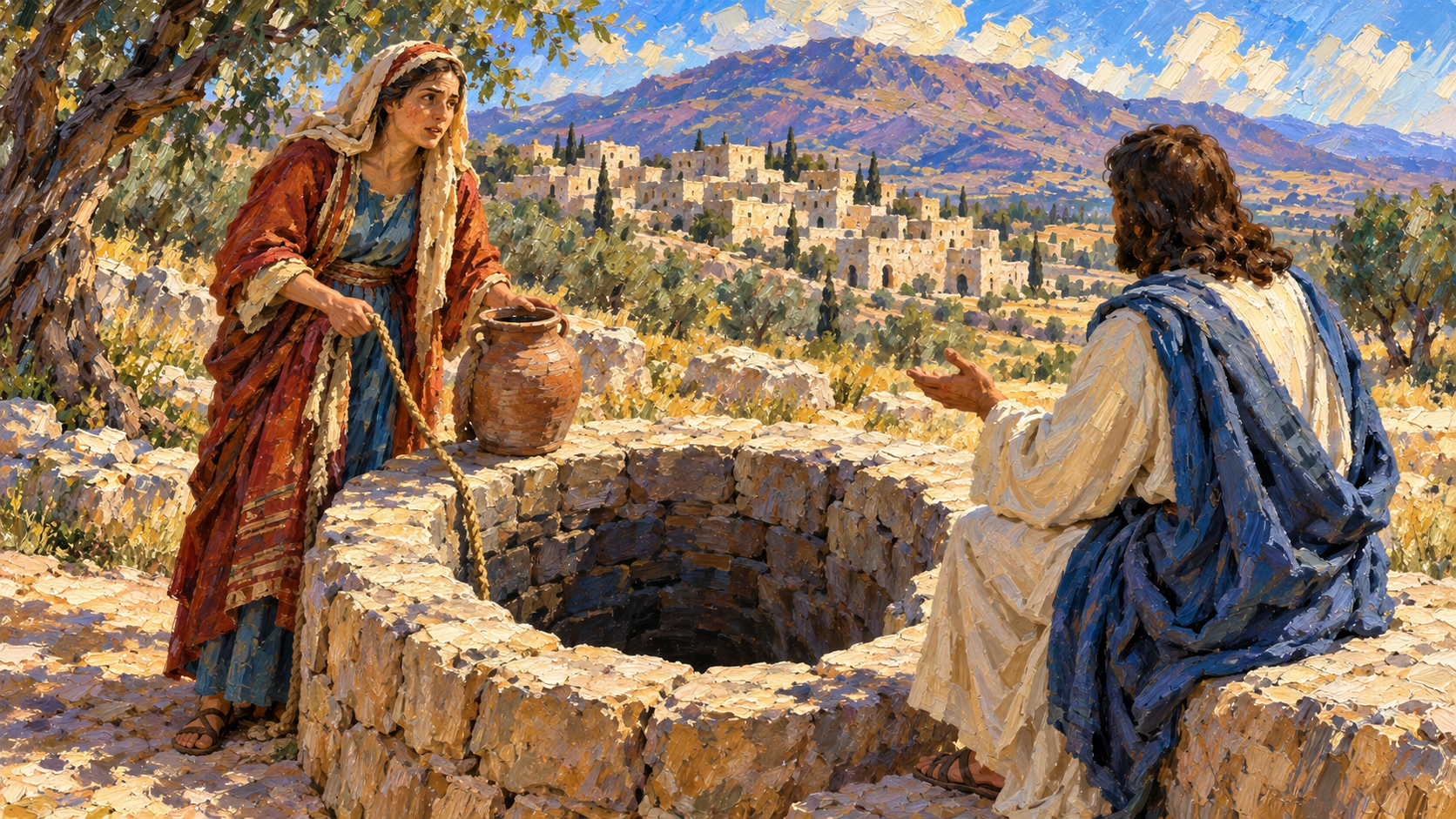
When Jesus offered living water to the Samaritan woman, she asked for it so she would no longer need to return to the well to draw water. That would have spared her some work, but Jesus was offering far more than an easier daily routine. He was promising everlasting life. To understand His words, we need to consider what Scripture says about people turning away from the God who gives them life and how He calls them back to Himself.
The Thirst Only God Can Meet
In Jeremiah 2, the Lord confronts Judah over its betrayal of Him. He had brought their fathers out of Egypt, sustained them through the wilderness, and given them a fruitful land. Yet the priests had stopped seeking Him, the rulers had transgressed against Him, and the prophets were speaking by Baal. The people were giving their allegiance to idols after receiving so much from the God who had delivered them.
For My people have committed two evils: They have forsaken Me, the fountain of living waters, And hewn themselves cisterns – broken cisterns that can hold no water.
A spring supplies fresh water, while a cistern is a pit that stores water collected from elsewhere. Digging a cistern was useful work, provided it could hold what went into it. But these people had abandoned a flowing fountain to depend on cracked storage pits. God uses that absurd exchange to expose what Judah had done in forsaking Him for idols that could not sustain them.
The Hebrew phrase mayim chayyim means living waters, a description used for fresh or flowing water. Jeremiah calls the Lord the maqor, meaning fountain or source. He is the One who gives life, and His people had chosen to turn elsewhere.
I need to be honest about the two evils God names here. I might admit that something has become a distraction or that I have allowed a bad habit to get out of hand, yet avoid admitting that I am turning away from Him. Judah’s problem went much deeper than poor judgment about what would make life comfortable. They had abandoned the Lord, and confessing their disappointment with the substitutes would not excuse that disloyalty.
Hewing a cistern took considerable effort, which means we should be careful about assuming that a hardworking person is necessarily heading in the right direction. Someone can spend years pursuing financial security and still refuse to entrust his life to God. Money can pay his bills, but it cannot forgive his sins or reconcile him to the Lord. If protecting his income becomes a reason to disregard what God has said, he has made financial security more important than obeying Him.
The same thing happens with approval. If I am willing to lie because I cannot bear having people think poorly of me, their opinion has become more important to me than obeying God. We can also use pornography or endless entertainment to avoid facing what is wrong, seeking relief while refusing to repent. Even something good, such as family or ministry, can become an idol when we use it to justify disobedience. Being devoted to a good thing does not give us permission to push God aside.
I also need some discernment when examining where I turn for help. Asking a friend for counsel when I am lonely or ashamed is perfectly reasonable, and God often helps us through other people. But if I keep looking for someone who will reassure me that a sin is acceptable, I am seeking permission to avoid repentance. Another person’s agreement cannot make my disobedience right. God is merciful to expose that, even when I would rather defend myself than admit it.
Long before Jeremiah rebuked Judah, Israel had learned through actual thirst how dependent they were on the Lord. After crossing the Red Sea, they traveled for three days through the Wilderness of Shur without finding water. When they finally reached Marah, the water there was undrinkable.
Now when they came to Marah, they could not drink the waters of Marah, for they were bitter. Therefore the name of it was called Marah. And the people complained against Moses, saying, “What shall we drink?”
Moses cried out to the Lord, who showed him a tree. When he cast it into the water, the bitter water became sweet. God miraculously changed the water so the people could drink it. After their search through the wilderness had left them with nothing they could drink, He supplied what they needed to survive.
I do not need to pretend a painful circumstance is pleasant before I ask God for help. The people complained against Moses, and Moses cried out to the Lord with the need they were all facing. Marah does not promise that every difficulty will immediately disappear when we pray, but I can bring my distress to God honestly without accusing Him of failing me. Cheerful religious language is a poor substitute for that kind of prayer.
At Rephidim, the people again had no water. They quarreled with Moses and questioned whether the Lord was even among them, despite the provision they had already received. God told Moses to go ahead of the people with the elders of Israel and gave him a specific instruction concerning the rock at Horeb.
Behold, I will stand before you there on the rock in Horeb; and you shall strike the rock, and water will come out of it, that the people may drink.
Moses did as God commanded, and the people received water through the miracle the Lord had promised. He named the place Massah and Meribah because of their testing and contention. Although their accusation against the Lord was wrong, He mercifully provided for them.
We should keep this event distinct from the later water crisis at Kadesh in Numbers 20. At Kadesh, God told Moses to speak to the rock, but Moses angrily addressed the congregation and struck it twice. God gave the people water while also reprimanding Moses for failing to believe Him and honor Him as holy before them. His frustration with the people did not authorize him to change God’s instructions. We can obtain a result and still be wrong in how we acted, so success alone is a poor defense of disobedience.
Paul refers to Israel’s wilderness provision when warning the Corinthians about idolatry. They needed to understand that receiving God’s blessings did not make them immune to the consequences of rebellion.
and all drank the same spiritual drink. For they drank of that spiritual Rock that followed them, and that Rock was Christ.
I understand Paul to be identifying Christ as the divine source of Israel’s provision throughout their journey. He sustained the people who drank the water that came from the physical rock. Paul is not describing Jesus as a literal stone or saying a magical boulder traveled behind Israel. He is explaining that they depended on Christ, even though they repeatedly quarreled with Moses and questioned the Lord’s care for them.
The Son of God who sustained Israel is also the Savior who gave His life for sinners. Wicked men tortured and crucified Jesus, yet He willingly bore the punishment for our sins in His innocent body. His shed blood and death accomplished our redemption before He was buried and rose bodily from the grave. The Father and Son remained united in this saving work. When Jesus offers us life freely, He is giving what we could never secure for ourselves through a sacrifice He willingly made for us.
Centuries after Israel’s wilderness journey, and long before Jesus’ earthly ministry, Isaiah announced God’s invitation to receive what we cannot buy.
Ho! Everyone who thirsts, Come to the waters; And you who have no money, Come, buy and eat.
Someone without money cannot bargain his way into a purchase, yet God tells the thirsty to come. His generosity leaves us no room to claim that we have earned the life He gives. Ezekiel describes another need we cannot remedy through our own efforts: cleansing from sin and a change within us.
Then I will sprinkle clean water on you, and you shall be clean; I will cleanse you from all your filthiness and from all your idols. I will give you a new heart and put a new spirit within you.
God addressed this promise to Israel, including His pledge to gather His people into their land. He would cleanse them from their idols, give them a new heart, and put His Spirit within them. An outward washing or an improvement in their circumstances would not accomplish that. They needed God to change them inwardly, and Jesus later spoke about that need when a teacher of Israel came to see Him.
Nicodemus was a Pharisee and ruler of the Jews who visited Jesus at night in John 3. He acknowledged that Jesus’ signs showed God was with Him. But recognizing those signs did not mean Nicodemus already possessed the life Jesus was about to describe. For all his religious knowledge and standing, he needed to be born again.
Jesus answered, “Most assuredly, I say to you, unless one is born of water and the Spirit, he cannot enter the kingdom of God.”
I understand the water in Jesus’ explanation in light of God’s promise of cleansing in Ezekiel 36. Jesus was speaking of the cleansing and new life God gives through His Spirit, rather than teaching that water baptism produces regeneration. Baptism is an act of obedience after salvation; going into the water cannot give someone the inward life that only God can supply.
Jesus had introduced this need for new birth earlier in the conversation, in John 3:3. The Greek word translated again there and in John 3:7 is anothen, which can also mean from above. Nicodemus asked how a grown man could enter his mother’s womb and be born a second time. Jesus explained that the Spirit gives a life that natural birth cannot produce.
Paul explains in Titus that salvation comes through God’s mercy rather than our record of righteous deeds.
not by works of righteousness which we have done, but according to His mercy He saved us, through the washing of regeneration and renewing of the Holy Spirit.
When I use the word regeneration, I mean that someone has genuinely been born again. A person can call himself a Christian and improve some habits without receiving new life from God. In regeneration, God makes the believer alive, and the Holy Spirit indwells and seals him. His assurance rests in Christ, but we should also expect evidence of that new life in his conduct. Obedience does not earn salvation, and being born again does not mean a person never sins. It does mean we cannot treat a Christian label as sufficient while dismissing the need for any change in how we live.
Jesus Gives Living Water
In John 4, Jesus speaks with someone whose circumstances are very different from those of Nicodemus. He stops at Jacob’s well in Samaria while His disciples go to buy food and asks a Samaritan woman for a drink. She is surprised that a Jewish man would ask her, because hostility had divided Jews and Samaritans for generations. Their disagreement included competing claims about where God should be worshiped.
Jesus tells her that if she knew God’s gift and who was speaking to her, she would ask Him for living water. She wonders how He can supply it without a vessel to draw from the deep well. He explains that His gift will meet a need Jacob’s well cannot.
Jesus answered and said to her, “Whoever drinks of this water will thirst again, but whoever drinks of the water that I shall give him will never thirst. But the water that I shall give him will become in him a fountain of water springing up into everlasting life.”
Ordinary water satisfies thirst for a while, and then we need another drink. Jesus promises everlasting life, with the water He gives becoming a fountain within the person who receives it. The woman asks for this water so she will not thirst or need to keep coming to the well. She is still thinking about the work of drawing water, but Jesus proceeds to address her life before God.
He tells her to call her husband, and she answers that she has none. Jesus acknowledges the truth in her reply, then tells her that she has had five husbands and that the man she now has is not her husband. We are not told how those earlier marriages ended, but Jesus knew the truth about her present situation. He did not need her to give Him a respectable version of her life before He could offer her grace. At the same time, His kindness gave her no reason to conceal her sin.
Recognizing Him as a prophet, she raises the dispute over worship on Mount Gerizim or in Jerusalem. Jesus explains that salvation is of the Jews; the Messiah comes through God’s covenant promises to Israel. Yet the hour is coming when true worshipers will worship the Father in spirit and truth, without worship being confined to either place. When she mentions the coming Messiah, Jesus identifies Himself to her.
She had been speaking with the very One who could give the life He described. She could not obtain it by proving that her people had worshiped at the right mountain, any more than Nicodemus could obtain new birth through his standing among the Jews. Both needed what Christ gives. When we come to Him in faith, we are receiving His gift rather than presenting credentials that oblige Him to save us.
Later, in John 7, Jesus gives a public invitation during the Feast of Tabernacles, when Israel remembered God’s care in the wilderness. He calls the thirsty to Himself, just as He had offered living water to the woman at the well.
On the last day, that great day of the feast, Jesus stood and cried out, saying, “If anyone thirsts, let him come to Me and drink. He who believes in Me, as the Scripture has said, out of his heart will flow rivers of living water.”
Jesus connects coming to Him and drinking with believing in Him. He does not restrict His invitation to people with an impressive religious background. Christ died for the sins of the world, and His offer of salvation is genuine for every person who hears it. People can resist His grace and reject Him, but I should never tell a sinner that Christ’s invitation was not meant for him. We can call people to repent and trust the Savior without wondering whether He is willing to receive them.
John then explains what Jesus meant by the rivers of living water.
But this He spoke concerning the Spirit, whom those believing in Him would receive; for the Holy Spirit was not yet given, because Jesus was not yet glorified.
The Holy Spirit had already been active in creation and had spoken through the prophets and empowered God’s servants. John’s words look ahead to His promised New Covenant ministry following Jesus’ glorification. Jesus would first die and rise bodily, then ascend to the Father and send the Spirit.
Living water is therefore more than the relief we feel after an encouraging conversation or a good worship service. The divine Person of the Holy Spirit comes to dwell within the believer because of Christ’s accomplished redemption. God Himself has taken up residence in him. The believer has not become self-sufficient or acquired a supply of spiritual life that he can manage apart from the Lord.
When Jesus speaks of rivers flowing from within the believer, I understand Him to be describing a life that will benefit others too. The Spirit produces holiness and love in us, which should affect how we treat people. If I speak about being filled with the Spirit while treating someone cruelly or refusing to tell the truth, I need to repent of that conduct. His work should be evident as we pray for others, speak truthfully about Christ, and serve people who need help.
Every genuine believer is indwelt and sealed by the Spirit, and believers are also commanded to be filled with Him and not to grieve Him. These instructions do not mean we must keep earning His presence or wait for a particular feeling to prove He is there. They require us to depend on Him and obey His Word. Assurance in Christ gives me reason to trust the Lord through discouragement, without giving me an excuse to ignore what He says.
Alongside these promises of inward renewal, God has made promises concerning the earth itself. Ezekiel 47 describes water flowing from the temple and bringing life along its course. Zechariah 14 places living waters flowing from Jerusalem in the setting of the Lord’s return and reign over the earth. I understand these as future events in His earthly kingdom, consistent with a premillennial reading of Scripture. Reducing them to descriptions of our feelings or of church growth would overlook what God has promised concerning Israel and the land.
Revelation then takes us beyond Christ’s return and final judgment to the new heaven and new earth. In the New Jerusalem, John sees the river of life flowing from the throne of God and the Lamb.
And he showed me a pure river of water of life, clear as crystal, proceeding from the throne of God and of the Lamb.
Life in that city comes from God Himself. As Revelation closes, the invitation to receive life freely is addressed to those who hear its words now.
And the Spirit and the bride say, “Come!” And let him who hears say, “Come!” And let him who thirsts come. Whoever desires, let him take the water of life freely.
The Spirit and the bride say, “Come!” and the hearer is also to say, “Come!” Having heard His invitation, I should be willing to bring it to others, including people whose past I might be tempted to hold against them. Christ offers mercy that none of us could earn, and we have no right to withhold His invitation from someone we dislike.
That generosity does not mean our salvation cost nothing. The Lamb who was slain is the risen Lord who gives us life. He calls us to turn from sin and trust Him, and no one needs to accumulate enough merit before coming. The person who receives His gift has every reason to be grateful to the Savior who paid so dearly to provide it.
My Final Thoughts
When God exposed Judah’s broken cisterns, He was calling His people back to Himself. I need to hear that rebuke when I begin excusing disobedience to protect something I am afraid to lose. Whatever relief I gain from doing that cannot reconcile me to God or give me new life. Jesus gives the life I cannot produce, and His invitation is to come to Him in faith. If you have been trying to make yourself deserving of salvation, you do not need to repair your life before you can ask Him to save you. He knows what needs cleansing and offers the mercy you cannot earn.