
Why does Scripture keep bringing the twelve tribes and the twelve apostles together? There is a real pattern here, especially when we reach the New Jerusalem, but we need to stay within what the Bible actually says. I want to follow that pattern without inventing a one-to-one chart that Scripture never gives us.
The Twelve Tribes and the Twelve Apostles
The tribes began with Jacob’s sons, real men who headed the families from which Israel’s tribes descended. Genesis 49 records Jacob blessing them and speaking prophetically over them. Judah was marked for rule, while Levi later received a priestly role under the Law. Joseph received a special fruitfulness through Ephraim and Manasseh. God formed the organized covenant nation of Israel from this family.
And the sons of Jacob were twelve: the sons of Leah were Reuben, Jacob’s firstborn, and Simeon, Levi, Judah, Issachar, and Zebulun; the sons of Rachel were Joseph and Benjamin; the sons of Bilhah, Rachel’s maidservant, were Dan and Naphtali; and the sons of Zilpah, Leah’s maidservant, were Gad and Asher. These were the sons of Jacob who were born to him in Padan Aram.
Before looking for symbolism in the number twelve, I want to keep those families in view. God brought them out of Egypt and made a covenant with them at Sinai. He arranged their camp around His sanctuary and later gave them inheritances in the land. Twelve carries the idea of ordered fullness because God built Israel as a twelve-tribe people.
Exodus 24 shows that order when the covenant was confirmed. Moses built an altar and raised twelve pillars, one for each tribe. The pillars represented the whole nation under the word and blood of the covenant. Their number expressed who stood in that covenant with God.
And Moses wrote all the words of the LORD. And he rose early in the morning, and built an altar at the foot of the mountain, and twelve pillars according to the twelve tribes of Israel.
Numbers describes the tribes being counted and arranged around the tabernacle. The LORD placed His dwelling at the center and ordered their life around His presence. That background helps me connect Israel’s camp with the city in Revelation, where the tribal names appear on its gates. God will dwell there with His people, just as His presence stood at the center of Israel’s camp. The related study on the twelve tribes of Israel follows their history in greater detail.
Jesus deliberately chose twelve apostles after praying. He called His disciples and selected twelve of them for that office, pointing back to Israel’s covenant structure. Yet He was not creating a replacement set of tribes. These men were the Messiah’s authorized witnesses, sent by Him. He later used their witness to lay the doctrinal foundation of the church.
And when it was day, He called His disciples to Himself; and from them He chose twelve whom He also named apostles: Simon, whom He also named Peter, and Andrew his brother; James and John; Philip and Bartholomew; Matthew and Thomas; James the son of Alphaeus, and Simon called the Zealot; Judas the son of James, and Judas Iscariot who also became a traitor.
Matthew 10 records Jesus first sending these men to the lost sheep of the house of Israel. Their calling was connected to the people to whom the Messiah had come: He gathered twelve apostles and sent them to announce the kingdom. After His death and bodily resurrection, their witness went to the nations. Their authority still rested in Christ. Revelation calls them the apostles of the Lamb because their message rests upon the Lamb who was slain and rose again.
Jesus gives us the strongest direct connection when He promises the apostles a future role in judging the twelve tribes of Israel. I would give that clear promise far more weight than any attempt to match each apostle with a particular tribe. We have His own words about how the two groups will be related.
So Jesus said to them, "Assuredly I say to you, that in the regeneration, when the Son of Man sits on the throne of His glory, you who have followed Me will also sit on twelve thrones, judging the twelve tribes of Israel."
Here, “the regeneration” refers to the renewed order when the Son of Man sits on His glorious throne. Jesus says the apostles will judge the twelve tribes, so He is not describing tribes that will disappear or be replaced by the apostles. The apostles will serve under Christ in relation to them. Luke 22 connects this promise with responsibility in the kingdom and fellowship at the Lord’s table. Jesus would give that responsibility to the men who continued with Him through His trials. Judas forfeited his place by betraying the Lord.
Judas, Matthias, and the Restored Twelve
Judas had been numbered among the apostles and had received a share in their ministry. Yet he betrayed Jesus, died under judgment, and left an office that needed to be filled. The study on Judas Iscariot examines his betrayal and judgment more fully. Here, Acts 1 shows what his fall meant for the Twelve.
"For it is written in the Book of Psalms: ‘Let his dwelling place be desolate, And let no one live in it’; and, ‘Let another take his office.’ Therefore, of these men who have accompanied us all the time that the Lord Jesus went in and out among us, beginning from the baptism of John to that day when He was taken up from us, one of these must become a witness with us of His resurrection."
Peter was looking for more than a way to keep the number at twelve. The man who filled Judas’s office had to be a qualified witness of the resurrection who had accompanied the disciples throughout Jesus’ earthly ministry. That meant being with them from John’s baptism through the ascension. The believers prayed and then cast lots, and Matthias was chosen and numbered with the eleven.
And they cast their lots, and the lot fell on Matthias. And he was numbered with the eleven apostles.
Paul was also a true apostle, specially commissioned to the Gentiles. I can recognize his later apostolic authority without overlooking what Acts 1 says about Matthias. Matthias filled Judas’s place among the Twelve before Pentecost. Those distinct callings preserve the unique role of the Twelve without diminishing Paul’s authority.
Judas had heard Christ teach and traveled with the other apostles. He carried responsibility in their ministry, yet none of that was the same as saving faith. I need to take that warning seriously without thinking his betrayal defeated Christ’s plan. Another man filled the office, restoring the Twelve before the Lord continued their witness through Pentecost.
Dan and the Limits of the Comparison
Dan and Judas can be compared in their betrayal and unfaithfulness, but I would not treat them as identical. Dan is a tribe with a long and complicated history. Judas was one man who betrayed Christ and was replaced as an apostle. The comparison gives us a sober warning without erasing that difference.
Judges 18 records how the Danites took an image and established worship outside God’s command. That painful account of idolatry gives us reason to notice Dan’s absence from the list of sealed tribes in Revelation 7.
And I heard the number of those who were sealed. One hundred and forty-four thousand of all the tribes of the children of Israel were sealed:
Revelation lists twelve groups of twelve thousand, beginning with Judah. Reuben follows, then Gad, Asher, Naphtali, Manasseh, Simeon, Levi, Issachar, Zebulun, Joseph, and Benjamin. Dan is absent, and Ephraim is not named either, although Joseph appears and Manasseh is included. Revelation does not explain why the list takes this form.
Dan’s history of idolatry may help us understand the seriousness of that omission. But I cannot say that Revelation 7 teaches that Manasseh permanently took Dan’s place. It gives us a sealing list for a particular prophetic scene, and we should not present a possible explanation as something Scripture explicitly teaches.
We also need to read that list alongside Ezekiel 48, where Dan appears by name in the future tribal allotment. Its omission from Revelation 7 remains significant. Yet Dan’s place in Ezekiel keeps me from concluding that the tribe has been permanently erased from every future promise.
"These are the names of the tribes: from the northern border along the road to Hethlon at the entrance of Hamath, to Hazar Enan, the border of Damascus northward, in the direction of Hamath, there shall be one section for Dan from its east to its west side;
Dan’s false worship and Judas’s personal betrayal both warn us that God judges unfaithfulness. Human failure cannot overthrow His larger purpose. We can learn from both without making a tribe and an apostle into an exact prophetic match.
New Jerusalem Brings the Pattern Together
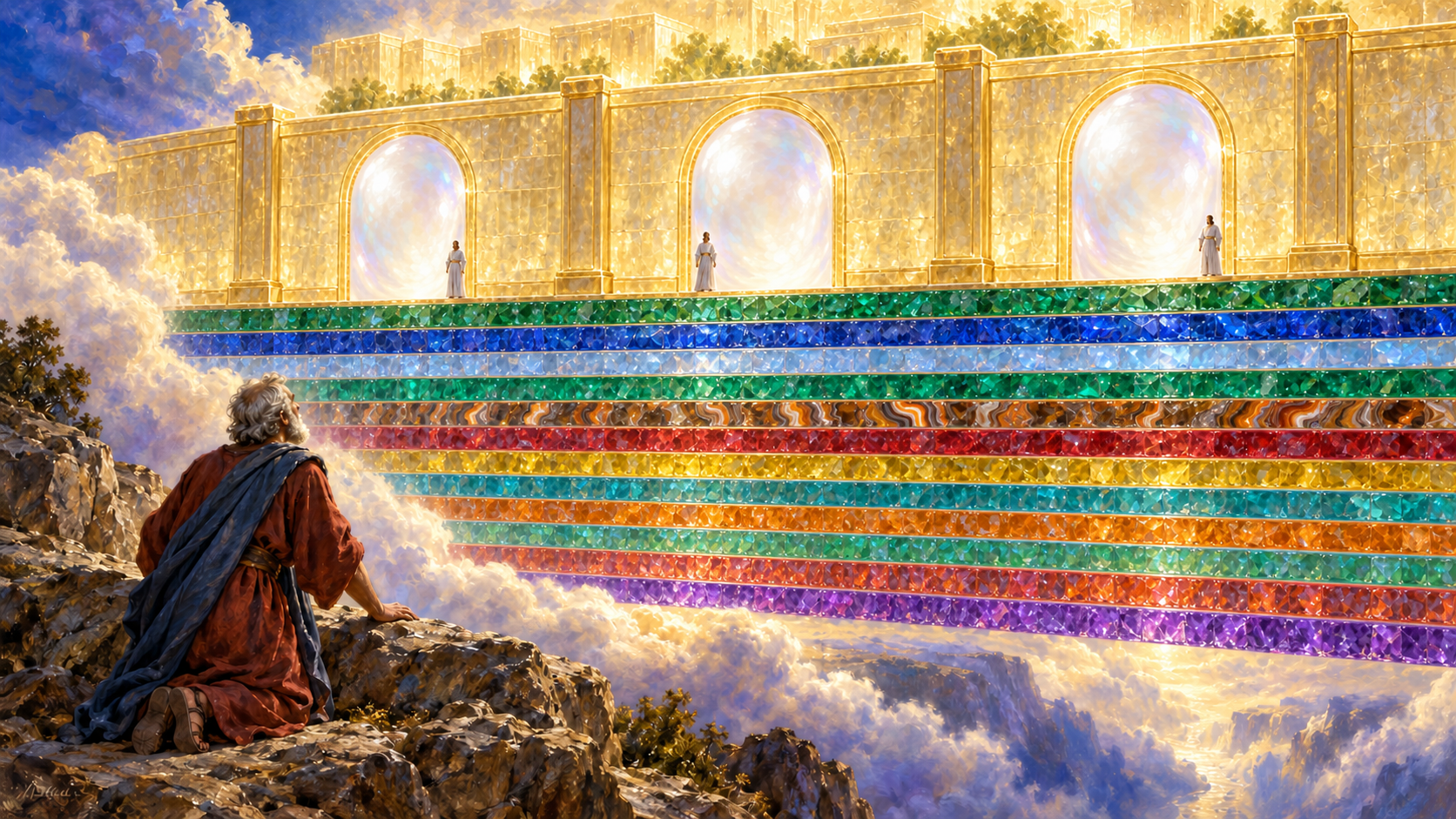
Revelation 21 brings the tribes and apostles together most clearly. John saw the holy city, New Jerusalem, coming down from God out of heaven. Its wall had twelve gates with an angel at each one, and the names on those gates belonged to the twelve tribes of the children of Israel.
Also she had a great and high wall with twelve gates, and twelve angels at the gates, and names written on them, which are the names of the twelve tribes of the children of Israel.
The city also has twelve foundations, but these carry a different set of names. They bear the names of the twelve apostles of the Lamb.
Now the wall of the city had twelve foundations, and on them were the names of the twelve apostles of the Lamb.
I notice that the two sets of names remain distinct. The tribes are named on the gates and the apostles on the foundations. Israel’s place in God’s redemptive history has not been erased, nor has the apostles’ witness been minimized. Each group keeps the place God gave it as His plan moves from promise to fulfillment. The related study on the Heavenly Jerusalem looks more fully at the city itself.
Twelve appears again in the city’s measurements. Its length is twelve thousand furlongs, and the wall measures one hundred forty-four cubits, or twelve times twelve. Along with the names on the gates and foundations, these measurements show order and completion under the glory of God and the Lamb.
The city is laid out as a square; its length is as great as its breadth. And he measured the city with the reed: twelve thousand furlongs. Its length, breadth, and height are equal.
Even with all of this rich structure, God and the Lamb remain the center. The city has no temple because the Lord God Almighty and the Lamb are its temple. It does not need the sun or moon because God’s glory gives it light, and the Lamb is its lamp. The tribes and apostles have their assigned places in the city, but the glory belongs to God and the Lamb.
What the Pattern Teaches—and What It Does Not
Those tribal names keep me from reading the New Jerusalem as evidence that the church has erased Israel. Revelation names the tribes of the children of Israel in the final city. It has not exchanged their gates for church gates, and a claim that Israel simply vanishes must account for the names that remain.
The apostles have a different role from Jacob’s sons. They are not new tribal heads in the same sense. Their witness to Christ grounds the church’s doctrine, which explains their place as foundations. Ephesians 2 describes God’s household as built on the foundation of the apostles and prophets, with Jesus Christ as the chief cornerstone.
having been built on the foundation of the apostles and prophets, Jesus Christ Himself being the chief cornerstone,
Scripture connects the two groups through the number twelve and through the apostles’ future judgment of Israel. Revelation also places their names on the gates and foundations of the city. None of those connections gives us a complete chart assigning Peter to one tribe, John to another, and Matthew to a third. I would rather leave that chart unwritten than give my guesses the authority of Scripture.
God’s faithfulness does not make betrayal harmless. Judas was replaced, but he was not excused. Dan’s future allotment in Ezekiel does not make the tribe’s idolatry any less shameful. God keeps His promises through human failure while still judging rebellion.
These passages belong to the same unfolding work of God. He called Abraham and formed Israel, and the Messiah came through Judah. Christ appointed His apostles and sent the gospel to the nations. God will bring His redeemed people into the New Jerusalem. The two groups of twelve help us see His order throughout that work, rather than a collection of disconnected symbols.
I want to understand the history before drawing conclusions about the symbolism. Jacob’s sons were real men whose families formed Israel’s covenant tribes. The apostles lived with Jesus and heard Him teach. They saw His works and testified that He rose bodily from the dead. The symbolism grows out of those events; it does not stand apart from them.
The tribes and apostles belong to the same plan without having the same role. Fulfillment has not canceled either group, and the names of both remain in the places God assigned them. Christ reigns over them all. The city displays His ordered glory while preserving those distinctions.
That should make me patient enough to let each group keep the place Scripture gives it. I do not need to erase Israel to honor the church or turn the apostles into tribes to honor their authority. God has named each group and given it a place in His purpose. Faith receives those distinctions instead of forcing every part of the Bible into the same role.
Revelation calls these men “apostles of the Lamb.” That title keeps Christ’s saving work at the center. The Lamb is Jesus Christ, the eternal Son of God who is fully God and fully man. He physically bore the punishment for our sins in His innocent body on the cross. Wicked men mocked and beat Him, then scourged and crucified Him. They killed Him, and He willingly shed His blood and died. He was buried and rose bodily.
The Father did not punish or curse Jesus. He did not abandon, strike, or bruise His Son, and He did not pour wrath upon Him. Father, Son, and Holy Spirit remained united in the saving purpose. The related study on the blood of Christ for salvation develops why His physical blood is essential to redemption.
Only those written in the Lamb’s Book of Life enter the city. So this pattern should lead us to the gospel rather than to numerology. Christ died for the whole world, and God’s offer of salvation is genuine. A person may resist Him, but everyone who repents and believes is forgiven and born again. The Holy Spirit indwells and seals that believer, whose salvation is eternally secure.
Judas and Dan also remind us that religious privilege is not saving faith. Judas stayed near Jesus and carried responsibility among the Twelve, but he betrayed the Lord. Dan received a tribal inheritance, yet Judges 18 records deep corruption. Proximity to holy things does not produce the new birth. What comforts me is not the thought that failure has no consequences, but the truth that God remains faithful. He can judge rebellion without losing control of His purpose.
The two cases also help me see how carefully God deals with unfaithfulness. Judas left an apostolic office that had to be filled, and Matthias was numbered with the eleven. Dan was absent from one prophetic sealing list but appears in Ezekiel’s future allotment. God’s promises withstand human failure, and His judgments are more careful than our guesses. We should take His warnings seriously and give equal attention to the restoration He shows.
My Final Thoughts
After following these passages, I do not believe Scripture gives us a hidden chart pairing each tribe with an apostle. It gives us a clearer distinction: Israel’s twelve tribes are the historic covenant family, while the twelve apostles are Christ’s appointed witnesses. Jesus Himself connects the apostles with judging those tribes, and Revelation preserves both sets of names in the city of the Lamb. Judas and Dan warn us that privilege does not make rebellion safe, but their failures never become sovereign over God’s plan. The pattern should leave us trusting the God who orders and keeps His promises, while our hope of entering that city rests in the Lamb who shed His blood and rose again.