
Judas lived close to Jesus and shared in the work of the Twelve, yet he became the man who betrayed Him. I want to understand how that could happen without assuming that his apostolic office meant he was saved. His later regret also raises a question we need to consider carefully: was it repentance, or was something still missing? Scripture gives us enough to examine those questions without guessing about the details of his death.
Judas Stood Among the Twelve Without Saving Faith
Judas is the Greek form of the Jewish name Judah, which is associated with praise. The Gospels call him Judas Iscariot but never explain the surname. A long-standing view connects Iscariot with Kerioth, a Judean town named in Joshua 15:25, giving the meaning “man of Kerioth.” If that explanation is right, he may have been the only Judean among disciples usually associated with Galilee. Other explanations have been proposed, so I would keep his suggested place of origin as a possibility rather than a fact.
We are not told about Judas’s childhood or what he did for work before following Jesus. Scripture does not identify him with a political party, and it never gives a complete explanation of every motive behind his betrayal. What it does give us is his place among the Twelve and the choices he made with that privilege.
Now it came to pass in those days that He went out to the mountain to pray, and continued all night in prayer to God. And when it was day, He called His disciples to Himself; and from them He chose twelve whom He also named apostles: Simon, whom He also named Peter, and Andrew his brother; James and John; Philip and Bartholomew; Matthew and Thomas; James the son of Alphaeus, and Simon called the Zealot; Judas the son of James, and Judas Iscariot who also became a traitor.
After praying through the night, Jesus chose twelve of His disciples and named them apostles, authorized representatives sent in His name. Luke lists Judas last and tells us that he became a traitor. That later betrayal does not change the fact that Jesus really appointed him to this office.
I need to distinguish that appointment from the new birth. A person may hold a recognized ministry role and listen to excellent teaching while remaining without saving faith. Other believers may trust him because they cannot see his heart. Neither a title nor unusual access to Christian truth can take the place of repentance and faith in Christ.
Jesus knew what was in man and knew the betrayer from the beginning, so Judas’s appointment did not mean Jesus had been deceived. Nor did His foreknowledge make Him the author of Judas’s sin. Judas remained responsible for what he chose to do.
And when He had called His twelve disciples to Him, He gave them power over unclean spirits, to cast them out, and to heal all kinds of sickness and all kinds of disease. Now the names of the twelve apostles are these: first, Simon, who is called Peter, and Andrew his brother; James the son of Zebedee, and John his brother; Philip and Bartholomew; Thomas and Matthew the tax collector; James the son of Alphaeus, and Lebbaeus, whose surname was Thaddaeus; Simon the Cananite, and Judas Iscariot, who also betrayed Him. These twelve Jesus sent out and commanded them, saying: “Do not go into the way of the Gentiles, and do not enter a city of the Samaritans. But go rather to the lost sheep of the house of Israel. And as you go, preach, saying, ‘The kingdom of heaven is at hand.’ Heal the sick, cleanse the lepers, raise the dead, cast out demons. Freely you have received, freely give.
Matthew includes Judas among the Twelve sent to Israel. The group preached that the kingdom of heaven was at hand, having received authority concerning sickness and unclean spirits. Judas took part in that public mission, but Scripture does not describe any individual miracle he performed. I would not fill that silence with an imagined example.
Judas’s ministry was real, but it did not prove that he knew Christ savingly. I don’t want to turn that fact into a reason for endless suspicion of Christian leaders. Scripture exposes Judas through evidence, and churches should also work from evidence rather than rumor. Biblical qualifications should govern appointments, with transparent practices in the work itself, especially where money is concerned. Patient due process protects the church.
But there are some of you who do not believe.” For Jesus knew from the beginning who they were who did not believe, and who would betray Him. And He said, “Therefore I have said to you that no one can come to Me unless it has been granted to him by My Father.” From that time many of His disciples went back and walked with Him no more. Then Jesus said to the twelve, “Do you also want to go away?” But Simon Peter answered Him, “Lord, to whom shall we go? You have the words of eternal life. Also we have come to believe and know that You are the Christ, the Son of the living God.” Jesus answered them, “Did I not choose you, the twelve, and one of you is a devil?” He spoke of Judas Iscariot, the son of Simon, for it was he who would betray Him, being one of the twelve.
Jesus said that some of those present did not believe, and John makes Judas’s unbelief plain. Jesus knew from the beginning who the unbelievers were and who would betray Him. That is why I do not understand Judas as a man who lost salvation he once possessed. The problem was unbelief from the beginning.
John identifies Judas as the one Jesus called a devil. The description reveals his adversarial course, not a change from a human being into a fallen angel. He was accountable for his unbelief and betrayal. Yet the other apostles still did not recognize him, so outwardly credible membership could conceal unbelief for a time. We need to proclaim the gospel clearly and examine ourselves without pretending we can see everyone’s heart.
Secret Greed Prepared Judas for Open Betrayal
Then, six days before the Passover, Jesus came to Bethany, where Lazarus was who had been dead, whom He had raised from the dead. There they made Him a supper; and Martha served, but Lazarus was one of those who sat at the table with Him. Then Mary took a pound of very costly oil of spikenard, anointed the feet of Jesus, and wiped His feet with her hair. And the house was filled with the fragrance of the oil. But one of His disciples, Judas Iscariot, Simon’s son, who would betray Him, said, “Why was this fragrant oil not sold for three hundred denarii and given to the poor?” This he said, not that he cared for the poor, but because he was a thief, and had the money box; and he used to take what was put in it. But Jesus said, “Let her alone; she has kept this for the day of My burial. For the poor you have with you always, but Me you do not have always.”
At Bethany, Mary anointed Jesus with expensive perfume. Judas objected as though he were concerned for the poor, but John tells us he was a thief. He kept the money box, the common fund for Jesus and the disciples, and regularly took from what others put into it.
John gives us the clearest stated pattern in Judas’s conduct with money. He used a respectable appeal to hide his greed while misusing what had been entrusted to him. When he later bargained for silver, he was continuing a course he had already chosen. His secret theft had taught him to put money ahead of faithfulness.
Jesus defended Mary while still affirming care for the poor, and He connected her anointing with His coming burial. Judas heard Him speak about His approaching death even as he used compassion to cover his theft. That troubles me because his words sounded charitable while his conduct showed how little he meant them.
Then one of the twelve, called Judas Iscariot, went to the chief priests and said, “What are you willing to give me if I deliver Him to you?” And they counted out to him thirty pieces of silver. So from that time he sought opportunity to betray Him. Now on the first day of the Feast of the Unleavened Bread the disciples came to Jesus, saying to Him, “Where do You want us to prepare for You to eat the Passover?” And He said, “Go into the city to a certain man, and say to him, ‘The Teacher says, “My time is at hand; I will keep the Passover at your house with My disciples.”‘” So the disciples did as Jesus had directed them; and they prepared the Passover. When evening had come, He sat down with the twelve. Now as they were eating, He said, “Assuredly, I say to you, one of you will betray Me.” And they were exceedingly sorrowful, and each of them began to say to Him, “Lord, is it I?” He answered and said, “He who dipped his hand with Me in the dish will betray Me. The Son of Man indeed goes just as it is written of Him, but woe to that man by whom the Son of Man is betrayed! It would have been good for that man if he had not been born.” Then Judas, who was betraying Him, answered and said, “Rabbi, is it I?” He said to him, “You have said it.”
Judas went to the chief priests, the senior temple authorities already plotting Jesus’ death, and asked what they would pay him to deliver Jesus. They counted out thirty pieces of silver, and he began looking for an opportunity. Matthew gives us the number but does not identify the coin type, so we cannot calculate an exact modern value. The leaders wanted to arrest Jesus away from the crowds, where they could control the situation, and Judas offered them inside access.
Exodus 21:32 sets thirty shekels as compensation when an ox kills a slave. Zechariah 11:12-13 also records thirty pieces weighed out as the insulting value placed on the rejected shepherd. Those backgrounds deepen Matthew’s account without supplying a modern purchasing-power figure that Scripture never gives.
At Passover, the feast remembering Israel’s deliverance from Egypt, Jesus announced that someone at the table would betray Him. Each disciple asked, “Lord, is it I?” Judas addressed Him as Rabbi instead. Jesus knew exactly what lay ahead, yet He pronounced woe on the man responsible. I cannot take the fulfillment of prophecy as a reason to call Judas’s betrayal obedience.
The Supper and Arrest Reveal Both Satanic Influence and Human Choice
“I do not speak concerning all of you. I know whom I have chosen; but that the Scripture may be fulfilled, ‘He who eats bread with Me has lifted up his heel against Me.’ Now I tell you before it comes, that when it does come to pass, you may believe that I am He. Most assuredly, I say to you, he who receives whomever I send receives Me; and he who receives Me receives Him who sent Me.” When Jesus had said these things, He was troubled in spirit, and testified and said, “Most assuredly, I say to you, one of you will betray Me.” Then the disciples looked at one another, perplexed about whom He spoke. Now there was leaning on Jesus’ bosom one of His disciples, whom Jesus loved. Simon Peter therefore motioned to him to ask who it was of whom He spoke. Then, leaning back on Jesus’ breast, he said to Him, “Lord, who is it?” Jesus answered, “It is he to whom I shall give a piece of bread when I have dipped it.” And having dipped the bread, He gave it to Judas Iscariot, the son of Simon. Now after the piece of bread, Satan entered him. Then Jesus said to him, “What you do, do quickly.” But no one at the table knew for what reason He said this to him. For some thought, because Judas had the money box, that Jesus had said to him, “Buy those things we need for the feast,” or that he should give something to the poor. Having received the piece of bread, he then went out immediately. And it was night.
Jesus applied the Scripture about a table companion lifting his heel against Him. By announcing the betrayal before it happened, He gave the disciples reason for stronger faith in who He is when His words came true. The prophecy revealed God’s truthful foreknowledge without excusing the treachery it foretold.
Jesus gave Judas a dipped morsel from the shared dish. In that setting, the gesture could express honored fellowship even while identifying the betrayer to John. I notice that Judas received food from the very hand of the One he had already decided to deliver to His enemies.
When Jesus said, “What you do, do quickly,” He exposed Judas’s chosen course and released him to carry it out. He did not morally compel Judas to devise the betrayal. The others still thought their treasurer might be buying supplies or giving something to the poor. Judas went out, and John ended the scene by telling us that it was night.
John tells us that the devil had put betrayal into Judas’s heart and that Satan entered him after the morsel. Luke also says Satan entered Judas before he consulted the chief priests. These are serious statements about spiritual evil, but Scripture never says Judas “sold his soul.” I would stay with their words rather than let that familiar phrase take the place of the inspired account.
Judas’s own choices remain visible throughout. He stole from the common fund before negotiating with the chief priests and looking for an opportunity to betray Jesus. He then led the arresting force to Him and later admitted what he had done. Scripture does not use Satan’s real influence to excuse any of those decisions.
As Judas kept making room for greed, he also gave the devil room to work. Hiding his sin allowed the danger to deepen until it became open betrayal. If I am tolerating sin, I need to take that warning seriously before it becomes a hardened pattern. Hidden wrongdoing needs to be confessed and brought into the light, with help sought early. We do not need occult speculation to recognize what secrecy and cherished sin can do.
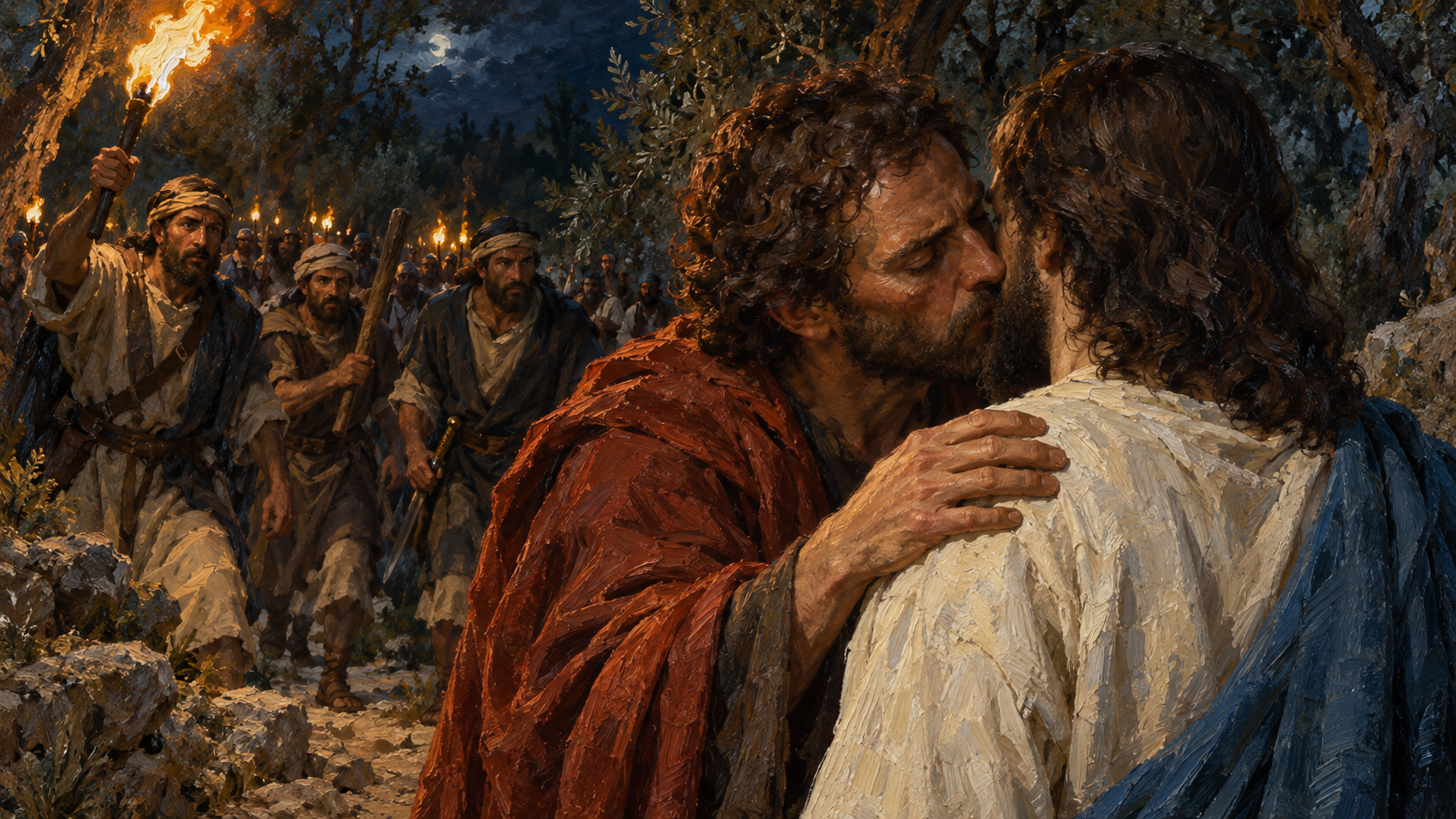
And while He was still speaking, behold, Judas, one of the twelve, with a great multitude with swords and clubs, came from the chief priests and elders of the people. Now His betrayer had given them a sign, saying, “Whomever I kiss, He is the One; seize Him.” Immediately he went up to Jesus and said, “Greetings, Rabbi!” and kissed Him. But Jesus said to him, “Friend, why have you come?” Then they came and laid hands on Jesus and took Him.
Judas arrived at Gethsemane, where Jesus had been praying, with an armed crowd sent by the chief priests and elders. He had arranged for them to seize the man he kissed. That familiar greeting identified Jesus in the darkness. Judas called Him Rabbi and used the outward gesture of a disciple to hand his Teacher over to hostile leaders.
Jesus addressed Judas as friend while confronting him about why he had come. I do not read that word as a declaration that Judas was spiritually reconciled to Him. Jesus was speaking within the very relationship Judas was violating.
And while He was still speaking, behold, a multitude; and he who was called Judas, one of the twelve, went before them and drew near to Jesus to kiss Him. But Jesus said to him, “Judas, are you betraying the Son of Man with a kiss?” When those around Him saw what was going to happen, they said to Him, “Lord, shall we strike with the sword?” And one of them struck the servant of the high priest and cut off his right ear. But Jesus answered and said, “Permit even this.” And He touched his ear and healed him. Then Jesus said to the chief priests, captains of the temple, and the elders who had come to Him, “Have you come out, as against a robber, with swords and clubs? When I was with you daily in the temple, you did not try to seize Me. But this is your hour, and the power of darkness.”
Jesus confronted the contradiction of betraying the Son of Man with a kiss. When a disciple cut off the high priest’s servant’s ear, He stopped the violence and healed the wounded man. He then exposed the leaders’ choice to act in darkness: they had watched Him teach publicly in the temple, yet they came at night with weapons.
The leaders were allowed their hour, but control had not passed from God or Christ into their hands. Judas could not force an unwilling Savior to the cross. Jesus had already said that no one takes His life from Him because He lays it down Himself. His willing sacrifice did not lessen Judas’s guilt for betraying Him.
Judas Felt Remorse but Did Not Turn to Christ
Then Judas, His betrayer, seeing that He had been condemned, was remorseful and brought back the thirty pieces of silver to the chief priests and elders, saying, “I have sinned by betraying innocent blood.” And they said, “What is that to us? You see to it!” Then he threw down the pieces of silver in the temple and departed, and went and hanged himself. But the chief priests took the silver pieces and said, “It is not lawful to put them into the treasury, because they are the price of blood.” And they consulted together and bought with them the potter’s field, to bury strangers in. Therefore that field has been called the Field of Blood to this day. Then was fulfilled what was spoken by Jeremiah the prophet, saying, “And they took the thirty pieces of silver, the value of Him who was priced, whom they of the children of Israel priced, and gave them for the potter’s field, as the LORD directed me.”
When Judas saw that Jesus had been condemned, he felt remorse and returned the silver. He admitted, “I have sinned by betraying innocent blood.” His words acknowledged both Jesus’ innocence and his own responsibility.
We cannot settle the difference between regret and repentance from the Greek verb for remorse or regret alone. Judas’s response shows us what was missing here. He acknowledged guilt to priests who had shared in the crime, threw down the money, and left. Instead of turning to Jesus in believing dependence, he took his own life.
The priests told him, “You see to it,” refusing any pastoral responsibility. Yet they would not put the returned silver into the treasury because it was the price of blood. I find their concern over that rule hard to read alongside their part in condemning the innocent Messiah. They were careful about where the money went while refusing responsibility for the blood it had purchased.
Matthew tells us soberly that Judas went and hanged himself. Taking his life could neither atone for his sin nor repair what he had done, and it was not repentance. Judas was lost because he remained in unbelief and rejected Christ, not because suicide is uniquely unforgivable. Scripture does not give us grounds to assign his spiritual history to every person who dies by suicide. We should not burden survivors with claims about someone’s final moments that God has not revealed.
Despair lies when it tells a person that help is absent. While life remains, Christ’s mercy is genuinely offered.
Matthew says the chief priests bought the potter’s field with Judas’s returned money. Acts attributes the purchase to Judas because his wages of iniquity paid for it. We use similar language when administrators make a purchase with an estate’s money or forfeited funds. I see no conflict between naming the people who made the purchase and naming the man whose money paid for it.
Matthew records Judas’s hanging, and Acts describes his body falling headlong and bursting open. A fall after the hanging could explain what Acts reports, but we are not given the precise sequence. I would not add a broken rope or branch, or claim to know when the fall occurred, since Scripture supplies none of those details.
Matthew calls the property the Potter’s Field and says it became the Field of Blood because blood money bought it. Acts connects the Aramaic name Akel Dama, meaning Field of Blood, with Judas’s notorious death. Those linked events can account for the same name without requiring us to choose one explanation and reject the other.
Matthew names Jeremiah as the prophet associated with the field prophecy, although the closest wording resembles Zechariah 11:12-13. Jeremiah also includes the themes of a potter and a field in chapters 18, 19, and 32. Matthew may be bringing a combined prophetic pattern under the more prominent prophet’s name. I would leave that as a possible explanation and preserve what Matthew actually wrote. We should not change Jeremiah to Zechariah simply to remove the difficulty.
Acts applies Psalm 69:25 to the desolate dwelling and Psalm 109:8 to someone else taking Judas’s office. Peter understood Judas’s fall through Scripture, but he also identified Judas as the guide for the men who arrested Jesus. God had announced what He foreknew. Judas still acted from his own corrupt desires under Satanic influence, so the fulfillment of prophecy did not remove his culpability.
Judas’s Vacant Office Was Given to Matthias
“I have manifested Your name to the men whom You have given Me out of the world. They were Yours, You gave them to Me, and they have kept Your word. Now they have known that all things which You have given Me are from You. For I have given to them the words which You have given Me; and they have received them, and have known surely that I came forth from You; and they have believed that You sent Me. “I pray for them. I do not pray for the world but for those whom You have given Me, for they are Yours. And all Mine are Yours, and Yours are Mine, and I am glorified in them. Now I am no longer in the world, but these are in the world, and I come to You. Holy Father, keep through Your name those whom You have given Me, that they may be one as We are. While I was with them in the world, I kept them in Your name. Those whom You gave Me I have kept; and none of them is lost except the son of perdition, that the Scripture might be fulfilled.
In His prayer, Jesus distinguished the men who received His words and believed from the son of perdition whose course fulfilled Scripture. “Son of perdition” identifies Judas with destruction. I do not see a regenerated child of God becoming unborn in that description. Judas belonged outwardly to the Twelve without sharing the saving relationship Jesus described in the others.
Judas does not disprove eternal security because John expressly says that he did not believe. John never describes him as having eternal life and then losing it. A true believer is born again and made new, with the Holy Spirit living within and sealing that person.
Eternal security does not make every profession genuine or prevent someone in office from being exposed. Churches baptize and appoint people on credible evidence because we cannot read hearts without error. Over time, a person’s fruit may show that he never trusted Christ. When I examine myself, the question is whether my confidence rests in the true Jesus and His gospel. I am not looking for sinless performance or treating one failure as proof that the Spirit’s seal has been broken.
And in those days Peter stood up in the midst of the disciples (altogether the number of names was about a hundred and twenty), and said, “Men and brethren, this Scripture had to be fulfilled, which the Holy Spirit spoke before by the mouth of David concerning Judas, who became a guide to those who arrested Jesus; for he was numbered with us and obtained a part in this ministry.” (Now this man purchased a field with the wages of iniquity; and falling headlong, he burst open in the middle and all his entrails gushed out. And it became known to all those dwelling in Jerusalem; so that field is called in their own language, Akel Dama, that is, Field of Blood.) “For it is written in the Book of Psalms: ‘Let his dwelling place be desolate, And let no one live in it’; and, ‘Let another take his office.’ “Therefore, of these men who have accompanied us all the time that the Lord Jesus went in and out among us, beginning from the baptism of John to that day when He was taken up from us, one of these must become a witness with us of His resurrection.” And they proposed two: Joseph called Barsabas, who was surnamed Justus, and Matthias. And they prayed and said, “You, O Lord, who know the hearts of all, show which of these two You have chosen to take part in this ministry and apostleship from which Judas by transgression fell, that he might go to his own place.” And they cast their lots, and the lot fell on Matthias. And he was numbered with the eleven apostles.
Peter addressed about 120 disciples and applied the Psalms to Judas’s vacant office. The replacement needed to have accompanied the Lord from John’s baptism through His ascension and to be a witness of His resurrection. Both Joseph Barsabas and Matthias met that requirement.
The believers prayed to the Lord who knows every heart and then cast lots. The lot fell to Matthias, and Acts says he was numbered with the eleven apostles. The book records the result without correcting Peter’s action.
For that reason, I find no support for the claim that Peter acted too soon and should have waited for Paul to become the twelfth. Paul was a genuine apostle called later by the risen Christ, but he did not meet the eyewitness requirement for this particular replacement. Matthias took Judas’s place among the restored Twelve.
Peter’s failure helps us distinguish a believer who falls from someone who remains outside Christ. He had boasted of his courage, yet he slept in Gethsemane. He misused a sword during the arrest and denied knowing Jesus three times before the night was over. His difference from Judas was not natural strength. Peter was a real believer, and Jesus interceded for him.
Peter wept bitterly after denying the Lord and later met the risen Christ. Jesus restored him, and he continued in faithful service. Judas felt regret but turned to self-destruction rather than to Jesus. If I fail as a believer, Peter’s restoration gives me reason to confess my sin and seek help from faithful Christians. Shame urges me to hide, but the gospel calls me into the light where the Savior forgives and restores.
Judas Warns the Church and Points Us Back to Christ
Judas’s life warns us that nearness to Christian truth is not the new birth. A person can hear sermons and witness answered prayer while working on a ministry team. Even handling church money or holding an office cannot replace personal faith in Jesus Christ.
Judas repeatedly gave greed room to grow, and his handling of the money helps us see why financial safeguards are needed. They protect donors and the ministry, including the person handling the funds and those the ministry serves. Receipts allow others to account for the money, especially when the whole process is not controlled by one person. A clear budget explains how funds should be used, and independent review helps establish whether that is happening. Genuine concerns deserve a prompt, fair investigation. These are ordinary practices of stewardship, not accusations that every treasurer is another Judas.
Judas’s affectionate greeting concealed betrayal, so churches need to consider conduct alongside a person’s claims. That calls for truthful judgment, not gossip or a mob’s verdict. Jesus dealt patiently with Judas, and Scripture still names his theft and treachery for what they were.
Regret over consequences is not the whole of repentance. Biblical repentance turns from sin toward God and receives the Savior rather than trying to pay for guilt through personal suffering.
Jesus entered Gethsemane knowing who would come and what He would face at the trial and cross. Judas’s betrayal could not defeat His saving work. The sinless Son willingly submitted so that Scripture would be fulfilled.
Wicked men physically tortured and punished Jesus before killing Him, and He willingly bore that real punishment for our sins in His innocent body. He shed His blood and died, but after He was buried, He rose bodily. The Father did not punish or curse Jesus. He did not abandon Him, and Scripture does not say the Father struck or bruised His Son or poured wrath on Him.
Christ died for the whole world, and God’s offer of salvation is genuine even though people can resist it as Judas did. Whoever repents and believes is forgiven and justified, which means declared righteous before God. That person is born again and made new. The Holy Spirit comes to live within the believer and seals him as eternally secure apart from works. This security never excuses lawlessness, and a superficial profession never proves that someone was truly born again.
Judas did not create redemption or make evil good and necessary. God overruled guilty choices within His promised plan, while Jesus accomplished salvation through His own willing obedience.
My Final Thoughts
Judas’s life makes me look beyond religious position and consider whether my confidence is truly in Jesus Christ. He lived near the Lord and shared in the mission of the Twelve. Yet his hidden greed grew into betrayal because he never believed. His remorse could not save him, and his despair could not pay for his guilt. Peter’s restoration shows anyone ashamed of failure why he should come into the light and turn toward the living Savior. Judas’s treachery never overcame Jesus, who willingly gave Himself and rose bodily. He still offers real mercy to everyone who will repent and believe.