
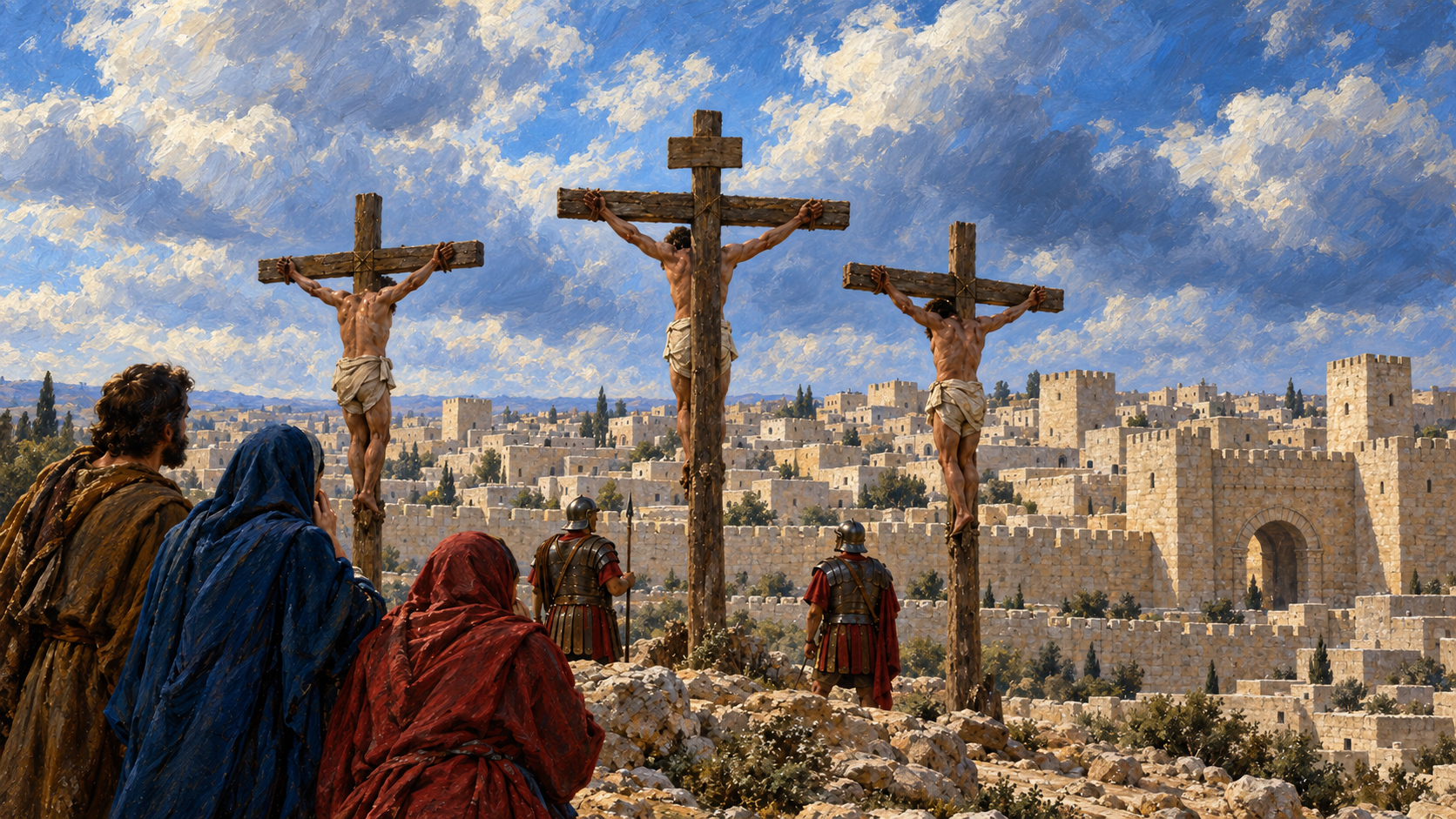
Golgotha was a real place, but Scripture never lets us study it as geography alone. Jesus was publicly crucified there outside Jerusalem; He shed His blood and died. I want to look at what the Gospels tell us about the location, then let Hebrews explain why suffering outside the gate carries such weight.
The Gospels Locate Golgotha in History
Matthew, Mark, and John use the name Golgotha and explain it for their readers. Luke uses the name Calvary in the NKJV and calls it Skull. All four accounts agree that Jesus was led to this place and crucified there.
“And when they had come to a place called Golgotha, that is to say, Place of a Skull…”
“And they brought Him to the place Golgotha, which is translated, Place of a Skull.”
“And He, bearing His cross, went out to a place called the Place of a Skull, which is called in Hebrew, Golgotha…”
The Gospel writers give us a place we can identify, and that helps me keep the crucifixion firmly in history. Jesus was fastened to a cross near a city filled with Passover pilgrims. Soldiers carried out a Roman execution with two criminals hanging beside Him, while people passed by and read the inscription above Him. The writers name the place and explain its name because they are describing where Jesus actually suffered. They have not left us with an idea of suffering somewhere in a vague spiritual realm.
Each Gospel writer gives a different part of the same event. Matthew and Mark preserve the name Golgotha while recording the mockery surrounding the King of the Jews. Luke calls it Skull and records Jesus praying for those who did not know what they were doing. John tells us that Jesus bore His cross and went out, then later connects the execution site to a nearby garden tomb. Their theology comes through what happened in public, rather than through religious ideas given an imaginary setting.
The soldiers divided Jesus’ garments while rulers and bystanders spoke within hearing of the cross. Pilate’s accusation named Him as the King of the Jews, and He hung between two criminals in a public execution. Those details leave no room to mistake Golgotha for a private religious ceremony. Our faith rests on what God did in history, which is why the Gospel writers give us these particulars instead of a devotional picture invented afterward.
At Golgotha, Jesus endured far more than embarrassment or misunderstanding. He was mocked and tortured before being crucified and killed. In His innocent body He physically bore the punishment for our sins, and His blood was truly shed. He really died and was buried, then rose bodily from the dead on the third day. We should care about the place, but never detach it from the Savior who suffered there.
The Place of the Skull and the Limits of Our Knowledge
The Gospel writers explain Golgotha as the Place of a Skull. John says the name was called in Hebrew, using the ordinary way of describing the local Semitic speech familiar in that Jewish setting. Many readers also know the name Calvary, which entered English through a Latin word connected with a skull.
The related Hebrew word gulgoleth means a skull or head, which helps us understand the place name accurately. Knowing the word’s meaning does not tell us why this particular site received that name. Scripture gives us the first answer and leaves the second unstated, so I would not use the word as an invitation to mystical speculation.
Some people suggest that the land had a skull-like shape, while others think the name may be associated with execution and death. Either explanation could be true. I cannot preach either one as certain, though, because the Gospels explain the name without describing how the site came to be called that.
There is still something sobering about the Son of God being taken to the Place of a Skull. Instead of receiving earthly honor, He was nailed to a cross between criminals and mocked by people passing by. He was numbered with transgressors. Even without knowing the name’s precise origin, we can see how it fits the death and shame surrounding His crucifixion.
I don’t need a hidden doctrine drawn from the sound of a word or a proposed shape in the landscape to understand the weight of this name. Scripture includes it in the record of Jesus willingly entering a place of shame and death for sinners. We can take that seriously without claiming an explanation Scripture hasn’t given us.
Questions about the exact modern site call for the same restraint. Traditional proposals include the area around the Church of the Holy Sepulchre and the location often called Gordon’s Calvary or the Garden Tomb. I cannot settle the full archaeological argument in this study. What Scripture does establish is that Jesus was crucified at Golgotha near the city and outside the gate. We can understand what His suffering there means without claiming modern coordinates the Bible doesn’t supply. Our certainty should follow what God has actually told us.
That leaves room for useful historical investigation. A traditional location may have serious evidence in its favor without becoming part of the gospel itself. If later research changes how people weigh those proposals, it will not undo the biblical testimony that Jesus was crucified at a real place called Golgotha. My confidence in that event rests on Scripture, even where questions about the modern site remain.
Near the City, Yet Outside the Gate
One geographical detail in John deserves our attention. Pilate placed the title “Jesus of Nazareth, the King of the Jews” over Jesus. Many people could read it because the place was near Jerusalem, and the notice appeared in the languages commonly used around them.
“Then many of the Jews read this title, for the place where Jesus was crucified was near the city; and it was written in Hebrew, Greek, and Latin.”
The nearness to the city helps us see how public this suffering was. Roman crucifixion shamed the condemned person and warned those watching about Rome’s power. Jesus endured that shame before soldiers and rulers, with religious leaders and ordinary passersby looking on. Grieving people who loved Him were there as well. His death took place in their sight, far from the privacy of a quiet room.
John later says that a garden stood in the place where Jesus was crucified. The garden contained a new tomb, and its nearness mattered because it was the Preparation Day and the Sabbath was approaching.
“Now in the place where He was crucified there was a garden, and in the garden a new tomb in which no one had yet been laid.”
John follows what happened to the body that had been nailed to the cross: it was taken down and laid in the nearby tomb. His account identifies the place and its garden, then explains why Jesus was buried there. These details keep us with an actual burial rather than leaving the crucifixion to fade into legend. The same body that was buried rose again, so Golgotha and the empty tomb belong together in the historical witness to the gospel.
Hebrews takes us from the physical location to its Old Testament meaning. Under the Law, the bodies of certain sacrificial animals were burned outside the camp after their blood had been carried into the sanctuary. The writer connects that pattern directly with Jesus.
“For the bodies of those animals, whose blood is brought into the sanctuary by the high priest for sin, are burned outside the camp. Therefore Jesus also, that He might sanctify the people with His own blood, suffered outside the gate.”
Hebrews gives me a reason to pay attention to Jesus suffering outside the gate. That was a place of exclusion and reproach, but the passage also connects it with sacrifice. Jesus suffered there to sanctify His people with His own blood, which means setting them apart for God. His humility and courage were real, yet neither is enough to explain Golgotha. The sinless Son shed His blood there to make His people God’s own.
Leviticus 16 gives us the background in the Day of Atonement. Sacrificial blood was brought into the holy place while the remains were carried outside the camp. Hebrews shows how that pattern pointed ahead to what Christ fulfilled. Those old covenant ceremonies were not empty observances: they taught Israel to recognize God’s holiness and the seriousness of sin. A worshiper needed a sacrifice and could not become that sacrifice for himself.
Notice how Hebrews holds both parts of the sacrifice together. The blood was brought before God for sin, and the remains were taken outside to a place marked by uncleanness and reproach. That helps me understand why the passage speaks of Jesus’ own blood while describing His suffering beyond the city wall. His location fits the sacrificial pattern. He accepted that place and its shame so that His people could be sanctified.
Jesus was not merely one more sacrifice in a continuing line. He fulfilled the sacrificial system through His once-for-all death. He remained the holy and spotless Son and never became sinful in His nature. Yet He truly bore the punishment for our sins in His body. The place outside the gate shows the shame He accepted, while His blood is the price by which He sanctifies His people.
His Blood and His Finished Sacrifice
To understand Golgotha, we have to give as much attention to what Jesus suffered as to where He suffered it. Otherwise, an interest in the location can leave the meaning of His atonement unclear. He was scourged and mocked, with a crown of thorns forced upon Him. His hands and feet were nailed to the cross before He was lifted up, and He was pierced. He shed His physical blood and died in His real, innocent body. These are the events that give the place its meaning.
Isaiah 53 helps us understand what that suffering meant. The Servant is despised and rejected. He is wounded for transgressions, while the LORD lays on Him the iniquity of us all. The New Testament shows that Jesus fulfilled this prophecy at Golgotha.
“But He was wounded for our transgressions, He was bruised for our iniquities; The chastisement for our peace was upon Him, And by His stripes we are healed.”
Isaiah describes an innocent Savior wounded for guilty people. Jesus did not deserve chastisement, yet He bore it for our peace. That is why I cannot explain His suffering merely as an inspiring act of love or an influence meant to make us better people. Nor was it only a political tragedy. The Servant bore what sinners could not remove from themselves.
Bearing what belonged to sinners did not make Jesus guilty or corrupt in His own nature. He remained the spotless Son. We also need to keep the physical suffering in view when we speak about His rejection: wicked men wounded and killed Him as He willingly gave His body and shed His blood. Isaiah explains why those wounds were for us.
When Jesus cried, “It is finished,” He was not announcing a failed mission. He had accomplished the work the Father gave Him. He then bowed His head and willingly gave up His spirit.
“So when Jesus had received the sour wine, He said, ‘It is finished!’ And bowing His head, He gave up His spirit.”
Golgotha therefore stands at the center of redemption. The eternal Son gave His body and blood for sinners and truly died. The Father and Son remained united in this saving work as Jesus willingly offered Himself. His saving work was complete and sufficient, and the grave did not hold Him. He rose bodily from the dead.
When I consider that the innocent Christ shed His blood for the guilty, I have to take sin seriously. I also have every reason to be grateful, because His work needs no addition from me. A moral life or church attendance cannot earn salvation. Neither family ancestry nor religious emotion can purchase it, and human effort cannot accomplish what His blood has done. Jesus sanctifies His people with His own blood, so our confidence must rest in Him.
Going to Christ and Bearing His Reproach
Hebrews does not stop after explaining why Jesus suffered outside the gate. It calls believers to go to Him there and bear His reproach.
“Therefore let us go forth to Him, outside the camp, bearing His reproach.”
Going to Him outside the camp means identifying with the rejected Christ, even when the world rejects those who belong to Him. It cannot mean repeating His sacrifice or adding anything to it, because that sacrifice is already finished and sufficient.
Following Jesus can cost more than inconvenience. We may lose approval or status, and in some circumstances even our safety. I need to take that cost seriously when Hebrews calls me to value Christ above the honor offered by the city. Even religious respectability can become a snare if keeping it requires me to distance myself from the Savior a religious order has rejected.
“Outside the gate” does not tell believers to despise the church or gathered worship. Hebrews calls us away from confidence in a religious system that rejects Christ, which is quite different from withdrawing into prideful isolation. Faithfulness may bring reproach, but we can bear it knowing that we are openly standing with Him.
The next verse gives the reason: “For here we have no continuing city, but we seek the one to come.” Earthly approval cannot become the Christian’s master. Jesus was rejected outside the gate, so His people should not be surprised when obedience to Him puts them outside the favor of those around them.
Knowing where Golgotha was cannot save me, and neither can my own suffering. Jesus’ sacrifice is unique; our pain never atones for sin. I should not turn Golgotha into a symbol of my own sacrifice and lose sight of what He alone accomplished. Believers share His reproach; we do not share His saving work.
We go to Christ because He has already finished the saving work, not because choosing hardship earns God’s favor. Pain is not automatically holy. If following Him costs us approval we once valued, we can bear that loss in faith without treating it as payment for sin. Keeping His sacrifice distinct from our obedience prevents us from turning discipleship into another way of trying to save ourselves.
Golgotha should make us sober about sin and grateful for the blood of Christ. It should also free us from living for human approval. Still, we should not stop with the skull or even with the nearby tomb as though death won. The Savior who died at Golgotha rose bodily. The place of death became part of the witness that death could not hold Him.
For fuller studies of these connected truths, readers can examine the blood of Christ for salvation, the moment Jesus died, and the darkness at Jesus’ crucifixion. The words Jesus spoke are considered in Tetelestai, It Is Finished, while the atonement of Jesus Christ develops the doctrinal distinctions further.
My Final Thoughts
When I bring these passages together, I do not think Golgotha should leave us fascinated mainly with a possible modern location. Scripture leads us to the real Savior who suffered outside the gate and shed His blood to sanctify His people. He finished the work He came to do. His followers cannot repeat that sacrifice, but we should be willing to stand with Him when faithfulness brings reproach. Golgotha exposes the seriousness of sin, while the nearby empty tomb keeps us from despair. The crucified Christ rose bodily, and our hope rests in Him.