
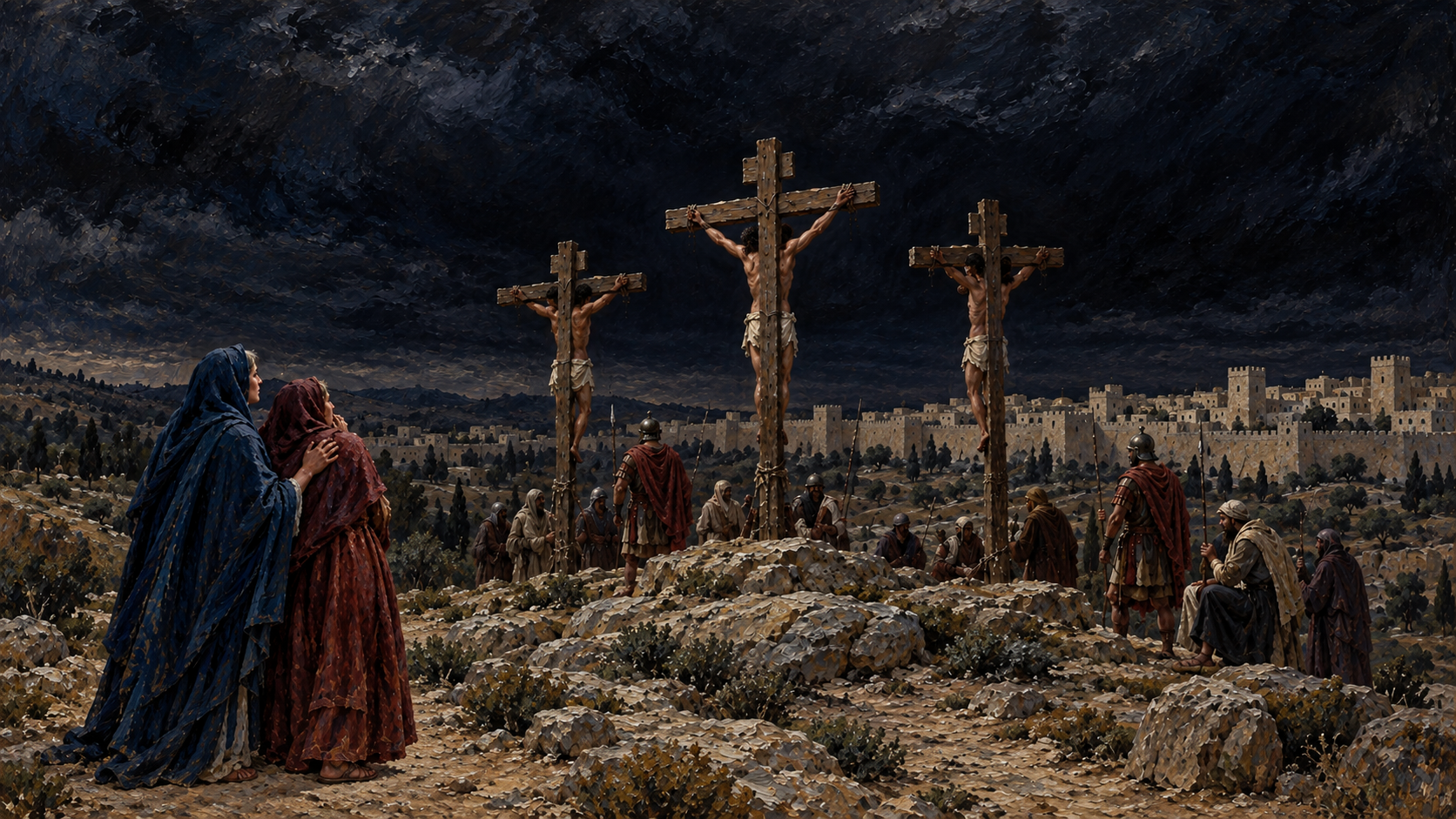
Darkness covered the land for three hours while Jesus hung on the cross. The Gospel writers place it alongside His final words, His death, and the tearing of the temple veil. I want to read those events together, because the darkness occurred while the Son of God was willingly giving His life to save sinners.
What the Four Gospels Actually Record
Before the crucifixion, Roman soldiers scourged Jesus, mocked Him as a king, pressed a crown of thorns onto His head, and struck Him. After nailing Him to the cross, they divided His garments. Religious leaders and people passing the execution site taunted Him, and the criminals crucified beside Him joined in the abuse. Then, during the middle of the day, darkness spread across the land.
Matthew, Mark, and Luke all record that darkness. These three are called the Synoptic Gospels because they frequently describe Jesus’ ministry from a shared or parallel viewpoint. They include different details about His death, but each places the darkness between the sixth and ninth hours. Matthew gives the fullest description of the accompanying signs:
Then the soldiers of the governor took Jesus into the Praetorium and gathered the whole garrison around Him. And they stripped Him and put a scarlet robe on Him. When they had twisted a crown of thorns, they put it on His head, and a reed in His right hand. And they bowed the knee before Him and mocked Him, saying, "Hail, King of the Jews!" Then they spat on Him, and took the reed and struck Him on the head. And when they had mocked Him, they took the robe off Him, put His own clothes on Him, and led Him away to be crucified. Now as they came out, they found a man of Cyrene, Simon by name. Him they compelled to bear His cross. And when they had come to a place called Golgotha, that is to say, Place of a Skull, they gave Him sour wine mingled with gall to drink. But when He had tasted it, He would not drink. Then they crucified Him, and divided His garments, casting lots, that it might be fulfilled which was spoken by the prophet: "They divided My garments among them, And for My clothing they cast lots." Sitting down, they kept watch over Him there. And they put up over His head the accusation written against Him: THIS IS JESUS THE KING OF THE JEWS. Then two robbers were crucified with Him, one on the right and another on the left. And those who passed by blasphemed Him, wagging their heads and saying, "You who destroy the temple and build it in three days, save Yourself! If You are the Son of God, come down from the cross." Likewise the chief priests also, mocking with the scribes and elders, said, "He saved others; Himself He cannot save. If He is the King of Israel, let Him now come down from the cross, and we will believe Him. He trusted in God; let Him deliver Him now if He will have Him; for He said, 'I am the Son of God.'" Even the robbers who were crucified with Him reviled Him with the same thing. Now from the sixth hour until the ninth hour there was darkness over all the land. And about the ninth hour Jesus cried out with a loud voice, saying, "Eli, Eli, lama sabachthani?" that is, "My God, My God, why have You forsaken Me?" Some of those who stood there, when they heard that, said, "This Man is calling for Elijah!" Immediately one of them ran and took a sponge, filled it with sour wine and put it on a reed, and offered it to Him to drink. The rest said, "Let Him alone; let us see if Elijah will come to save Him." And Jesus cried out again with a loud voice, and yielded up His spirit. Then, behold, the veil of the temple was torn in two from top to bottom; and the earth quaked, and the rocks were split, and the graves were opened; and many bodies of the saints who had fallen asleep were raised; and coming out of the graves after His resurrection, they went into the holy city and appeared to many. So when the centurion and those with him, who were guarding Jesus, saw the earthquake and the things that had happened, they feared greatly, saying, "Truly this was the Son of God!" And many women who followed Jesus from Galilee, ministering to Him, were there looking on from afar, among whom were Mary Magdalene, Mary the mother of James and Joses, and the mother of Zebedee's sons.
Matthew describes the darkness first, then Jesus’ cry near the ninth hour, and finally His death. The temple veil tore from top to bottom, the earth shook, and rocks split. His account also includes opened graves and raised saints. Although Matthew brings these extraordinary events together in his account of the crucifixion, he places their appearance in Jerusalem after Jesus’ resurrection.
Mark supplies the hour of the crucifixion as well as the hours of darkness:
Then they compelled a certain man, Simon a Cyrenian, the father of Alexander and Rufus, as he was coming out of the country and passing by, to bear His cross. And they brought Him to the place Golgotha, which is translated, Place of a Skull. Then they gave Him wine mingled with myrrh to drink, but He did not take it. And when they crucified Him, they divided His garments, casting lots for them to determine what every man should take. Now it was the third hour, and they crucified Him. And the inscription of His accusation was written above: THE KING OF THE JEWS. With Him they also crucified two robbers, one on His right and the other on His left. So the Scripture was fulfilled which says, "And He was numbered with the transgressors." And those who passed by blasphemed Him, wagging their heads and saying, "Aha! You who destroy the temple and build it in three days, save Yourself, and come down from the cross!" Likewise the chief priests also, mocking among themselves with the scribes, said, "He saved others; Himself He cannot save. Let the Christ, the King of Israel, descend now from the cross, that we may see and believe." Even those who were crucified with Him reviled Him. Now when the sixth hour had come, there was darkness over the whole land until the ninth hour. And at the ninth hour Jesus cried out with a loud voice, saying, "Eloi, Eloi, lama sabachthani?" which is translated, "My God, My God, why have You forsaken Me?" Some of those who stood by, when they heard that, said, "Look, He is calling for Elijah!" Then someone ran and filled a sponge full of sour wine, put it on a reed, and offered it to Him to drink, saying, "Let Him alone; let us see if Elijah will come to take Him down." And Jesus cried out with a loud voice, and breathed His last. Then the veil of the temple was torn in two from top to bottom. So when the centurion, who stood opposite Him, saw that He cried out like this and breathed His last, he said, "Truly this Man was the Son of God!" There were also women looking on from afar, among whom were Mary Magdalene, Mary the mother of James the Less and of Joses, and Salome, who also followed Him and ministered to Him when He was in Galilee, and many other women who came up with Him to Jerusalem.
Mark says Jesus was crucified at the third hour, approximately nine in the morning. The darkness began at the sixth hour, approximately noon, and lasted until the ninth, near three in the afternoon. Daylight hours were reckoned from around sunrise, so ancient timekeeping and seasonal variation do not allow us to assign an exact modern minute. The writers nevertheless describe an extended darkness during the brightest part of the day. Jesus remained alive through those hours and spoke near their end.
Luke also records how one of the criminals came to acknowledge his own guilt and defend Jesus’ innocence, even as the other continued to revile Him. The man who acknowledged his guilt asked Jesus to remember him in His kingdom. Jesus promised him life with Him in Paradise. Luke then records the darkness and Jesus’ final prayer:
Now as they led Him away, they laid hold of a certain man, Simon a Cyrenian, who was coming from the country, and on him they laid the cross that he might bear it after Jesus. And a great multitude of the people followed Him, and women who also mourned and lamented Him. But Jesus, turning to them, said, "Daughters of Jerusalem, do not weep for Me, but weep for yourselves and for your children. For indeed the days are coming in which they will say, 'Blessed are the barren, wombs that never bore, and breasts which never nursed!' Then they will begin 'to say to the mountains, "Fall on us!" and to the hills, "Cover us!"' For if they do these things in the green wood, what will be done in the dry?" There were also two others, criminals, led with Him to be put to death. And when they had come to the place called Calvary, there they crucified Him, and the criminals, one on the right hand and the other on the left. Then Jesus said, "Father, forgive them, for they do not know what they do." And they divided His garments and cast lots. And the people stood looking on. But even the rulers with them sneered, saying, "He saved others; let Him save Himself if He is the Christ, the chosen of God." The soldiers also mocked Him, coming and offering Him sour wine, and saying, "If You are the King of the Jews, save Yourself." And an inscription also was written over Him in letters of Greek, Latin, and Hebrew: THIS IS THE KING OF THE JEWS. Then one of the criminals who were hanged blasphemed Him, saying, "If You are the Christ, save Yourself and us." But the other, answering, rebuked him, saying, "Do you not even fear God, seeing you are under the same condemnation? And we indeed justly, for we receive the due reward of our deeds; but this Man has done nothing wrong." Then he said to Jesus, "Lord, remember me when You come into Your kingdom." And Jesus said to him, "Assuredly, I say to you, today you will be with Me in Paradise." Now it was about the sixth hour, and there was darkness over all the earth until the ninth hour. Then the sun was darkened, and the veil of the temple was torn in two. And when Jesus had cried out with a loud voice, He said, "Father, 'into Your hands I commit My spirit.'" Having said this, He breathed His last. So when the centurion saw what had happened, he glorified God, saying, "Certainly this was a righteous Man!" And the whole crowd who came together to that sight, seeing what had been done, beat their breasts and returned. But all His acquaintances, and the women who followed Him from Galilee, stood at a distance, watching these things.
Notice whom Jesus addressed as He died. He committed His spirit into His Father’s hands. The disappearing sunlight did not prevent Him from entrusting Himself to the Father, and Luke does not describe the darkness as a separation between them. He also records the centurion praising God and acknowledging Jesus as righteous.
John does not mention the darkness. He supplies other details, including Jesus’ care for His mother, His declaration that the work was finished, and the soldier’s action after His death:
Then he delivered Him to them to be crucified. Then they took Jesus and led Him away. And He, bearing His cross, went out to a place called the Place of a Skull, which is called in Hebrew, Golgotha, where they crucified Him, and two others with Him, one on either side, and Jesus in the center. Now Pilate wrote a title and put it on the cross. And the writing was: JESUS OF NAZARETH, THE KING OF THE JEWS. Then many of the Jews read this title, for the place where Jesus was crucified was near the city; and it was written in Hebrew, Greek, and Latin. Therefore the chief priests of the Jews said to Pilate, "Do not write, 'The King of the Jews,' but, 'He said, "I am the King of the Jews."'" Pilate answered, "What I have written, I have written." Then the soldiers, when they had crucified Jesus, took His garments and made four parts, to each soldier a part, and also the tunic. Now the tunic was without seam, woven from the top in one piece. They said therefore among themselves, "Let us not tear it, but cast lots for it, whose it shall be," that the Scripture might be fulfilled which says: "They divided My garments among them, And for My clothing they cast lots." Therefore the soldiers did these things. Now there stood by the cross of Jesus His mother, and His mother's sister, Mary the wife of Clopas, and Mary Magdalene. When Jesus therefore saw His mother, and the disciple whom He loved standing by, He said to His mother, "Woman, behold your son!" Then He said to the disciple, "Behold your mother!" And from that hour that disciple took her to his own home. After this, Jesus, knowing that all things were now accomplished, that the Scripture might be fulfilled, said, "I thirst!" Now a vessel full of sour wine was sitting there; and they filled a sponge with sour wine, put it on hyssop, and put it to His mouth. So when Jesus had received the sour wine, He said, "It is finished!" And bowing His head, He gave up His spirit. Therefore, because it was the Preparation Day, that the bodies should not remain on the cross on the Sabbath (for that Sabbath was a high day), the Jews asked Pilate that their legs might be broken, and that they might be taken away. Then the soldiers came and broke the legs of the first and of the other who was crucified with Him. But when they came to Jesus and saw that He was already dead, they did not break His legs. But one of the soldiers pierced His side with a spear, and immediately blood and water came out. And he who has seen has testified, and his testimony is true; and he knows that he is telling the truth, so that you may believe. For these things were done that the Scripture should be fulfilled, "Not one of His bones shall be broken." And again another Scripture says, "They shall look on Him whom they pierced."
John describes Jesus fulfilling Scripture and declaring, “It is finished.” He then gave up His spirit. When the soldiers came to break the crucified men’s legs, they found Him already dead and did not break His. The piercing of His side followed His death; it did not cause a death John had already reported. John’s attention to these events complements the other accounts without requiring him to repeat every sign they record.
The darkness happened publicly. Soldiers guarded the cross, opponents mocked Jesus, and women who had followed Him watched from a distance. This was an event surrounding His execution, rather than a private vision experienced by one disciple.
Its geographical extent is less certain. The Greek word ge can mean land, earth, ground, or a region, depending on context. Matthew and Mark are often translated “all the land” while Luke may read “all the earth.” The wording describes widespread darkness, but it does not give us a boundary we can mark on a map. It would be too narrow to confine it to the cross itself, and too confident to claim that the writers documented night on every continent.
An ordinary solar eclipse cannot explain it. Passover falls around the full moon, whereas a solar eclipse requires a new moon between the earth and the sun. Those are opposite lunar phases. Furthermore, the complete blocking of the sun at one place lasts minutes, not three hours. A whole eclipse can take considerably longer as the moon moves across the sun, but that is different from three hours of darkness at the same location. NASA’s explanation of eclipse geometry describes the alignment and the brief duration of totality.
There is also a wording difference in Greek copies of Luke 23:45. The Textus Receptus, the received Greek text underlying the New King James wording quoted above, says the sun was darkened. The Byzantine manuscript tradition also preserves that wording. Other copies use a verb meaning to fail or cease, which can describe an eclipse in some settings. It does not require that technical meaning here. Even the NET Bible’s note on Luke 23:45, which favors the other reading, explains that the verb can mean the sun ceased to shine. Neither wording obliges us to force an ordinary eclipse into a Passover setting.
Thallus and Phlegon are sometimes cited as outside witnesses to the darkness, but their surviving references need care. A surviving fragment attributed to Julius Africanus discusses Thallus’s explanation of the darkness as an eclipse, and Origen refers to Phlegon when discussing an eclipse and earthquakes in Tiberius’s reign. Those later discussions should not be presented as though we had complete contemporary reports documenting three hours of darkness everywhere on earth. The Gospel testimony deserves to be heard on its own terms without exaggerating the outside evidence.
The Creator of the lights can darken the land without an eclipse. Scripture records thick darkness in Egypt, an extended day in Joshua, and a shadow moving backward in Isaiah. What it does not provide is the physical mechanism of the darkness at Calvary. A special cloud, a change in the sun, or some other means would be speculation. I understand the timing and the surrounding signs as God’s action marking the death of His Son, while leaving the means where the Gospel writers leave it.
How the Old Testament Helps Us Understand the Darkness
Darkness does not carry one meaning everywhere in Scripture. It appears before God orders the light at creation and later surrounds Sinai. Elsewhere it describes judgment, grief, danger, or moral blindness. At the crucifixion, its connection with judgment is particularly serious: people were mocking and killing the innocent Messiah while God was accomplishing redemption through His willing sacrifice. Earlier passages help us understand that setting, beginning with the darkness that preceded the first Passover.
Then the LORD said to Moses, "Stretch out your hand toward heaven, that there may be darkness over the land of Egypt, darkness which may even be felt." So Moses stretched out his hand toward heaven, and there was thick darkness in all the land of Egypt three days. They did not see one another; nor did anyone rise from his place for three days. But all the children of Israel had light in their dwellings. Then Pharaoh called to Moses and said, "Go, serve the LORD; only let your flocks and your herds be kept back. Let your little ones also go with you." But Moses said, "You must also give us sacrifices and burnt offerings, that we may sacrifice to the LORD our God. Our livestock also shall go with us; not a hoof shall be left behind. For we must take some of them to serve the LORD our God, and even we do not know with what we must serve the LORD until we arrive there." But the LORD hardened Pharaoh's heart, and he would not let them go. Then Pharaoh said to him, "Get away from me! Take heed to yourself and see my face no more! For in the day you see my face you shall die!" So Moses said, "You have spoken well. I will never see your face again."
This was the ninth plague against Egypt. The darkness lasted three days, while the Israelites had light in their dwellings. Pharaoh still tried to dictate the terms of their departure, allowing the people to go while demanding that their livestock remain. Moses refused because they needed their animals to serve the Lord. Pharaoh’s refusal continued, and the final plague followed. At Passover, the blood of the lamb marked the homes where God would spare the firstborn.
Jesus died at Passover as the true Passover Lamb. That connection gives us good reason to see the earlier darkness, judgment, and deliverance as a pattern anticipating His saving work. Still, three days in Egypt do not “mirror” three hours at Calvary as though the durations were identical. Nor does every participant have an exact counterpart. Jesus was the innocent Lamb who willingly shed His blood to save. The earlier judgment on Egypt does not establish that the Father condemned His Son.
Amos brings us closer to the particular image of darkness at noon. He was warning the northern kingdom of Israel, where people trampled the poor, cheated their customers, and resented holy days because worship interrupted business. Their prosperity did not conceal their conduct from the Lord:
Thus the Lord GOD showed me: Behold, a basket of summer fruit. And He said, "Amos, what do you see?" So I said, "A basket of summer fruit." Then the LORD said to me: "The end has come upon My people Israel; I will not pass by them anymore. And the songs of the temple Shall be wailing in that day," Says the Lord GOD– "Many dead bodies everywhere, They shall be thrown out in silence." Hear this, you who swallow up the needy, And make the poor of the land fail, Saying: "When will the New Moon be past, That we may sell grain? And the Sabbath, That we may trade wheat? Making the ephah small and the shekel large, Falsifying the scales by deceit, That we may buy the poor for silver, And the needy for a pair of sandals– Even sell the bad wheat?" The LORD has sworn by the pride of Jacob: "Surely I will never forget any of their works. Shall the land not tremble for this, And everyone mourn who dwells in it? All of it shall swell like the River, Heave and subside Like the River of Egypt. "And it shall come to pass in that day," says the Lord GOD, "That I will make the sun go down at noon, And I will darken the earth in broad daylight; I will turn your feasts into mourning, And all your songs into lamentation; I will bring sackcloth on every waist, And baldness on every head; I will make it like mourning for an only son, And its end like a bitter day. "Behold, the days are coming," says the Lord GOD, "That I will send a famine on the land, Not a famine of bread, Nor a thirst for water, But of hearing the words of the LORD. They shall wander from sea to sea, And from north to east; They shall run to and fro, seeking the word of the LORD, But shall not find it. "In that day the fair virgins And strong young men Shall faint from thirst. Those who swear by the sin of Samaria, Who say, 'As your god lives, O Dan!' And, 'As the way of Beersheba lives!' They shall fall and never rise again."
The Lord would bring an end to their corrupt prosperity. Feasting would give way to mourning, and the darkness of the announced judgment would fall in broad daylight. Amos compares their grief to mourning an only son. He goes on to describe a famine of hearing God’s words, as people search for the instruction they had disregarded.
The noonday darkness and bitter mourning are striking when we read them beside the crucifixion. I see a prophetic pattern that helps us recognize the gravity of Jesus’ death. However, Amos was addressing Israel’s actual sins, and the Gospels do not introduce the darkness by saying it fulfilled Amos 8. Reading the passages together does not require us to erase Amos’s first hearers or treat every resemblance as an expressly identified prediction.
Joel also joins darkness with the Day of the Lord, when God intervenes in judgment. His warning leads directly into an appeal to return to the Lord:
Blow the trumpet in Zion, And sound an alarm in My holy mountain! Let all the inhabitants of the land tremble; For the day of the LORD is coming, For it is at hand: A day of darkness and gloominess, A day of clouds and thick darkness, Like the morning clouds spread over the mountains. A people come, great and strong, The like of whom has never been; Nor will there ever be any such after them, Even for many successive generations. A fire devours before them, And behind them a flame burns; The land is like the Garden of Eden before them, And behind them a desolate wilderness; Surely nothing shall escape them. Their appearance is like the appearance of horses; And like swift steeds, so they run. With a noise like chariots Over mountaintops they leap, Like the noise of a flaming fire that devours the stubble, Like a strong people set in battle array. Before them the people writhe in pain; All faces are drained of color. They run like mighty men, They climb the wall like men of war; Every one marches in formation, And they do not break ranks. They do not push one another; Every one marches in his own column. Though they lunge between the weapons, They are not cut down. They run to and fro in the city, They run on the wall; They climb into the houses, They enter at the windows like a thief. The earth quakes before them, The heavens tremble; The sun and moon grow dark, And the stars diminish their brightness. The LORD gives voice before His army, For His camp is very great; For strong is the One who executes His word. For the day of the LORD is great and very terrible; Who can endure it? "Now, therefore," says the LORD, "Turn to Me with all your heart, With fasting, with weeping, and with mourning." So rend your heart, and not your garments; Return to the LORD your God, For He is gracious and merciful, Slow to anger, and of great kindness; And He relents from doing harm. Who knows if He will turn and relent, And leave a blessing behind Him– A grain offering and a drink offering For the LORD your God? Blow the trumpet in Zion, Consecrate a fast, Call a sacred assembly; Gather the people, Sanctify the congregation, Assemble the elders, Gather the children and nursing babes; Let the bridegroom go out from his chamber, And the bride from her dressing room. Let the priests, who minister to the LORD, Weep between the porch and the altar; Let them say, "Spare Your people, O LORD, And do not give Your heritage to reproach, That the nations should rule over them. Why should they say among the peoples, 'Where is their God?'"
The trembling land, darkened heavens, and approaching army leave the people facing a judgment they cannot fend off. Yet the Lord calls them to return wholeheartedly because He is gracious and merciful. Even the newly married are to interrupt their celebrations and join the gathered people. The priests are to plead for God’s mercy on His people, whose sins have brought them to this crisis.
Joel’s prophecy reaches beyond Calvary to future judgment, cosmic signs, and Israel’s deliverance under Messiah’s kingdom. Jesus’ death did not exhaust that future Day. The darkness at the cross belongs within God’s work of confronting evil and providing salvation, but we should not use it to declare every prophecy of the Day already fulfilled. Zephaniah likewise describes a judgment from which wealth and military defenses cannot rescue the guilty:
The great day of the LORD is near; It is near and hastens quickly. The noise of the day of the LORD is bitter; There the mighty men shall cry out. That day is a day of wrath, A day of trouble and distress, A day of devastation and desolation, A day of darkness and gloominess, A day of clouds and thick darkness, A day of trumpet and alarm Against the fortified cities And against the high towers. "I will bring distress upon men, And they shall walk like blind men, Because they have sinned against the LORD; Their blood shall be poured out like dust, And their flesh like refuse." Neither their silver nor their gold Shall be able to deliver them In the day of the LORD's wrath; But the whole land shall be devoured By the fire of His jealousy, For He will make speedy riddance Of all those who dwell in the land.
Zephaniah names the reason for the distress: the people have sinned against the Lord. Thick darkness accompanies His judgment, and neither silver nor gold can buy an escape. Along with Exodus, Amos, and Joel, this passage makes it reasonable to understand the darkness at Calvary as a sign connected with God’s judgment of evil. None of those connections says the Father turned against His innocent Son. Nor do the Gospels explain the darkness as divine mourning or as sin physically entering Jesus.
Isaiah 50 brings judgment and the suffering of God’s obedient Servant into the same passage. The Lord rebukes His people’s transgressions and declares His power to darken the heavens. The Servant then speaks of the abuse He willingly endures while relying on God’s help:
Thus says the LORD: "Where is the certificate of your mother's divorce, Whom I have put away? Or which of My creditors is it to whom I have sold you? For your iniquities you have sold yourselves, And for your transgressions your mother has been put away. Why, when I came, was there no man? Why, when I called, was there none to answer? Is My hand shortened at all that it cannot redeem? Or have I no power to deliver? Indeed with My rebuke I dry up the sea, I make the rivers a wilderness; Their fish stink because there is no water, And die of thirst. I clothe the heavens with blackness, And I make sackcloth their covering." "The Lord GOD has given Me The tongue of the learned, That I should know how to speak A word in season to him who is weary. He awakens Me morning by morning, He awakens My ear To hear as the learned. The Lord GOD has opened My ear; And I was not rebellious, Nor did I turn away. I gave My back to those who struck Me, And My cheeks to those who plucked out the beard; I did not hide My face from shame and spitting. "For the Lord GOD will help Me; Therefore I will not be disgraced; Therefore I have set My face like a flint, And I know that I will not be ashamed. He is near who justifies Me; Who will contend with Me? Let us stand together. Who is My adversary? Let him come near Me. Surely the Lord GOD will help Me; Who is he who will condemn Me? Indeed they will all grow old like a garment; The moth will eat them up. "Who among you fears the LORD? Who obeys the voice of His Servant? Who walks in darkness And has no light? Let him trust in the name of the LORD And rely upon his God. Look, all you who kindle a fire, Who encircle yourselves with sparks: Walk in the light of your fire and in the sparks you have kindled– This you shall have from My hand: You shall lie down in torment.
The Servant gives His back to those who strike Him and does not hide His face from shame and spitting. He is obedient throughout, confident that the Lord God will help and vindicate Him. Jesus fulfilled that obedient suffering when He submitted to the abuse that led to the cross.
Isaiah then addresses someone who fears the Lord and obeys His Servant yet walks in darkness without light. That person is told to trust the Lord and rely on Him. Darkness, therefore, does not automatically mean that God has abandoned the person within it. The Servant’s trust prepares us to hear Jesus’ own words near the end of the three dark hours.
Psalm 22 Does Not Teach That the Father Abandoned Jesus
My God, My God, why have You forsaken Me? Why are You so far from helping Me, And from the words of My groaning? O My God, I cry in the daytime, but You do not hear; And in the night season, and am not silent. But You are holy, Enthroned in the praises of Israel. Our fathers trusted in You; They trusted, and You delivered them. They cried to You, and were delivered; They trusted in You, and were not ashamed. But I am a worm, and no man; A reproach of men, and despised by the people. All those who see Me ridicule Me; They shoot out the lip, they shake the head, saying, "He trusted in the LORD, let Him rescue Him; Let Him deliver Him, since He delights in Him!" But You are He who took Me out of the womb; You made Me trust while on My mother's breasts. I was cast upon You from birth. From My mother's womb You have been My God. Be not far from Me, For trouble is near; For there is none to help. Many bulls have surrounded Me; Strong bulls of Bashan have encircled Me. They gape at Me with their mouths, Like a raging and roaring lion. I am poured out like water, And all My bones are out of joint; My heart is like wax; It has melted within Me. My strength is dried up like a potsherd, And My tongue clings to My jaws; You have brought Me to the dust of death. For dogs have surrounded Me; The congregation of the wicked has enclosed Me. They pierced My hands and My feet; I can count all My bones. They look and stare at Me. They divide My garments among them, And for My clothing they cast lots. But You, O LORD, do not be far from Me; O My Strength, hasten to help Me! Deliver Me from the sword, My precious life from the power of the dog. Save Me from the lion's mouth And from the horns of the wild oxen! You have answered Me. I will declare Your name to My brethren; In the midst of the assembly I will praise You. You who fear the LORD, praise Him! All you descendants of Jacob, glorify Him, And fear Him, all you offspring of Israel! For He has not despised nor abhorred the affliction of the afflicted; Nor has He hidden His face from Him; But when He cried to Him, He heard. My praise shall be of You in the great assembly; I will pay My vows before those who fear Him. The poor shall eat and be satisfied; Those who seek Him will praise the LORD. Let your heart live forever! All the ends of the world Shall remember and turn to the LORD, And all the families of the nations Shall worship before You. For the kingdom is the LORD's, And He rules over the nations. All the prosperous of the earth Shall eat and worship; All those who go down to the dust Shall bow before Him, Even he who cannot keep himself alive. A posterity shall serve Him. It will be recounted of the Lord to the next generation, They will come and declare His righteousness to a people who will be born, That He has done this.
Near the ninth hour, Jesus spoke the opening words of this psalm: “My God, My God, why have You forsaken Me?” That is a cry of real anguish. Jesus had been scourged, nailed to a cross, mocked, and left hanging in agony. Acknowledging His confidence in the Father does not require us to soften what He suffered.
But the first question is not the end of the psalm. The righteous sufferer describes his enemies surrounding him, shaking their heads, and taunting him about his trust in God. His body is poured out, his hands and feet are pierced, and his garments are divided by lot. Those details correspond to what happened to Jesus, and the Gospels explicitly connect the dividing of His garments with Scripture. When He quoted the opening line, He identified Himself with the sufferer whose humiliation and eventual vindication the whole psalm describes.
Verse 24 says that God did not despise the afflicted One or hide His face from Him. When He cried, God heard. I cannot take the opening question as proof that the Father refused to hear His Son when the same psalm says the afflicted One was heard. The sufferer’s plea for help gives way to praise, proclamation among his brethren, and the prospect of the nations worshiping the Lord. I see Christ’s death and resurrection in that movement from terrible suffering to vindication and worldwide worship. I discuss the psalm’s suffering and vindication further in Psalm 22.
Jesus continued to address “My God” in faith. Before the crucifixion, He had told His disciples that they would leave Him alone, yet the Father would be with Him (John 16:32). At His death, He entrusted His spirit to the Father. The Trinity means that the one God eternally exists as Father, Son, and Holy Spirit, three distinct Persons. Jesus’ suffering did not break the eternal relationship between Father and Son. He remained the Light of the world even while daylight disappeared around Him.
John presents the cross as an hour in which Jesus would be glorified (John 12:23–33). His willing death revealed His identity and love while people treated Him with contempt. The physical darkness did not undo that revelation or turn Him into a spiritually defeated Savior.
The Darkness Surrounded a Bloody, Once-for-All Sacrifice
The suffering Jesus endured was bodily and brutal. Roman soldiers scourged and struck Him, drove nails through His body, and exposed Him publicly on the cross. He willingly underwent that punishment as the sinless substitute for the whole world. In His innocent body He bore the punishment for our sins as wicked men tortured Him, shed His blood, and killed Him. Our salvation is in His blood.
The Father did not punish, curse, abandon, strike, bruise, or pour wrath on Jesus. The violence came from wicked human beings. God foreknew their choices and accomplished His saving purpose through the Son’s willing sacrifice, without excusing those responsible for the killing (Acts 2:23; 4:27–28). Through the eternal Spirit, Jesus offered Himself to God (Hebrews 9:14). Father, Son, and Spirit were not working against one another. The Atonement of Jesus Christ deserves to be understood from that biblical explanation of His sacrifice.
Jesus had authority to lay down His life, and no one took it against His ultimate will (John 10:17–18). His loud final cry and His commitment of His spirit into the Father’s hands fit that willing obedience. He fulfilled Scripture and cared for His mother even as He approached death. His saving work through His shed blood and death was complete before His bodily resurrection; the resurrection did not supply a further sacrifice. Paul explains the sufficiency of that one offering in Hebrews:
For the law, having a shadow of the good things to come, and not the very image of the things, can never with these same sacrifices, which they offer continually year by year, make those who approach perfect. For then would they not have ceased to be offered? For the worshipers, once purified, would have had no more consciousness of sins. But in those sacrifices there is a reminder of sins every year. For it is not possible that the blood of bulls and goats could take away sins. Therefore, when He came into the world, He said: "Sacrifice and offering You did not desire, But a body You have prepared for Me. In burnt offerings and sacrifices for sin You had no pleasure. Then I said, 'Behold, I have come– In the volume of the book it is written of Me– To do Your will, O God.'" Previously saying, "Sacrifice and offering, burnt offerings, and offerings for sin You did not desire, nor had pleasure in them" (which are offered according to the law), then He said, "Behold, I have come to do Your will, O God." He takes away the first that He may establish the second. By that will we have been sanctified through the offering of the body of Jesus Christ once for all. And every priest stands ministering daily and offering repeatedly the same sacrifices, which can never take away sins. But this Man, after He had offered one sacrifice for sins forever, sat down at the right hand of God, from that time waiting till His enemies are made His footstool. For by one offering He has perfected forever those who are being sanctified. But the Holy Spirit also witnesses to us; for after He had said before, "This is the covenant that I will make with them after those days, says the LORD: I will put My laws into their hearts, and in their minds I will write them," then He adds, "Their sins and their lawless deeds I will remember no more." Now where there is remission of these, there is no longer an offering for sin. Therefore, brethren, having boldness to enter the Holiest by the blood of Jesus, by a new and living way which He consecrated for us, through the veil, that is, His flesh, and having a High Priest over the house of God, let us draw near with a true heart in full assurance of faith, having our hearts sprinkled from an evil conscience and our bodies washed with pure water. Let us hold fast the confession of our hope without wavering, for He who promised is faithful. And let us consider one another in order to stir up love and good works, not forsaking the assembling of ourselves together, as is the manner of some, but exhorting one another, and so much the more as you see the Day approaching.
The repeated animal sacrifices reminded worshipers of sins they could not remove. Jesus offered His own body once for all, and His blood gives believers access to God’s presence. Paul describes the new and living way through the veil, which he identifies with Christ’s flesh. Jesus is our Mediator, the One through whom sinners are brought into a right relationship with God and can draw near to Him.
That teaching helps us understand the torn temple veil recorded in the Gospels. Matthew and Mark place its tearing immediately after Jesus’ death. Luke mentions it with the darkness before reporting His final prayer. The writers group these closely connected events with their own emphases, rather than supplying an identical moment-by-moment transcript. Matthew and Mark specify that the veil tore from top to bottom, indicating God’s action. In Hebrews, the explanation of our access rests on Jesus’ blood and His completed sacrifice.
At the execution site, the signs also confronted the men guarding Him. Matthew records their fear at the earthquake and the things that happened, along with their confession that Jesus was God’s Son. Mark draws attention to the way He cried out and died; Luke records the centurion praising God and acknowledging Him as righteous. These responses can all belong to the same event. I would not go beyond them and declare the centurion a born-again disciple, because the accounts record his acknowledgment at the cross without telling us whether he came to saving faith.
Luke’s crowd went home beating their breasts, an expression of grief. We are not told that everyone who grieved repented and believed. What they witnessed did confront them with the death of the innocent Jesus. The darkness cannot be reduced to an astronomy puzzle while we pass over the Person dying beneath it.
Jesus was buried before sundown and rose bodily on the third day. The Gospel writers do not assign a separate theological meaning to the return of afternoon light, so I would not teach that the returning daylight announced the completion of redemption. They do proclaim His bodily resurrection. The empty tomb and His appearances to witnesses establish that death could not hold Him. His resurrection confirms His identity and saving work, assures believers of their future resurrection, and gives warning of the judgment to come (Acts 17:31).
Come Through the Opened Way and Walk in the Light
The One who gave His life for us is the eternal Son, fully God and fully man. Born of a virgin and completely sinless, He willingly shed His blood and died for the whole world, was buried, and rose bodily. God’s offer of salvation is genuine, although people can resist His grace and reject Him. Whoever repents and believes is forgiven and justified, declared righteous before God, and born again through His saving work.
The Holy Spirit indwells and seals every true believer, who is eternally secure in Christ. We do not earn that salvation by good conduct or keep it by maintaining a sufficiently impressive record. Yet being born again produces a real change. A shallow profession cannot substitute for new life, and assurance gives us no permission to excuse lawlessness. Paul connects Christ’s sacrifice with the conduct of those who belong to Him:
Therefore be imitators of God as dear children. And walk in love, as Christ also has loved us and given Himself for us, an offering and a sacrifice to God for a sweet-smelling aroma. But fornication and all uncleanness or covetousness, let it not even be named among you, as is fitting for saints; neither filthiness, nor foolish talking, nor coarse jesting, which are not fitting, but rather giving of thanks. For this you know, that no fornicator, unclean person, nor covetous man, who is an idolater, has any inheritance in the kingdom of Christ and God. Let no one deceive you with empty words, for because of these things the wrath of God comes upon the sons of disobedience. Therefore do not be partakers with them. For you were once darkness, but now you are light in the Lord. Walk as children of light (for the fruit of the Spirit is in all goodness, righteousness, and truth), finding out what is acceptable to the Lord. And have no fellowship with the unfruitful works of darkness, but rather expose them. For it is shameful even to speak of those things which are done by them in secret. But all things that are exposed are made manifest by the light, for whatever makes manifest is light. Therefore He says: "Awake, you who sleep, Arise from the dead, And Christ will give you light."
Paul tells believers that they were once darkness but are now light in the Lord. He names conduct that does not fit that new life: sexual immorality, greed, corrupt speech, and participation in concealed evil. The warning about having no inheritance in God’s kingdom should stop anyone from using a Christian label to make peace with a life governed by those sins. The Spirit produces goodness, righteousness, and truth in people whom Christ has made new.
I need to let that instruction reach the things I can rationalize. If I hide dishonest dealings, indulge sexual sin, or use filthy speech to win approval, I cannot defend those choices by pointing to my knowledge of the crucifixion. Paul calls us to find out what pleases the Lord and expose the works of darkness. That requires honest confession and a willingness to leave the sin, including conduct that people around us find acceptable. Following Jesus involves obedience in those ordinary decisions, as I explain further in Taking Up Your Cross.
Hebrews calls us to draw near to God with a true heart and hold fast our hope. Access to God comes through faith in Christ, not simply through witnessing the signs at His death or knowing about them. Gathering with believers gives us opportunities to pray, speak truth, and help one another practice love and good works as the Day approaches. When someone is struggling, encouragement should lead them toward Christ and faithful obedience, without pretending that serious sin is harmless. Jesus has opened the way for people who once stood guilty to approach God through Him.
My Final Thoughts
I understand the darkness as God’s sign marking the hour when Jesus willingly gave His life for sinners. Scripture leaves its physical means and geographical limits unexplained, but it tells us whom the darkness surrounded and what He accomplished. Psalm 22 leads us through His anguish to the assurance that God heard Him. His blood has opened the way for us to draw near, and His bodily resurrection assures us that our trust in Him is well placed. I want to respond by trusting the crucified and risen Son and living in keeping with the life He gives.