
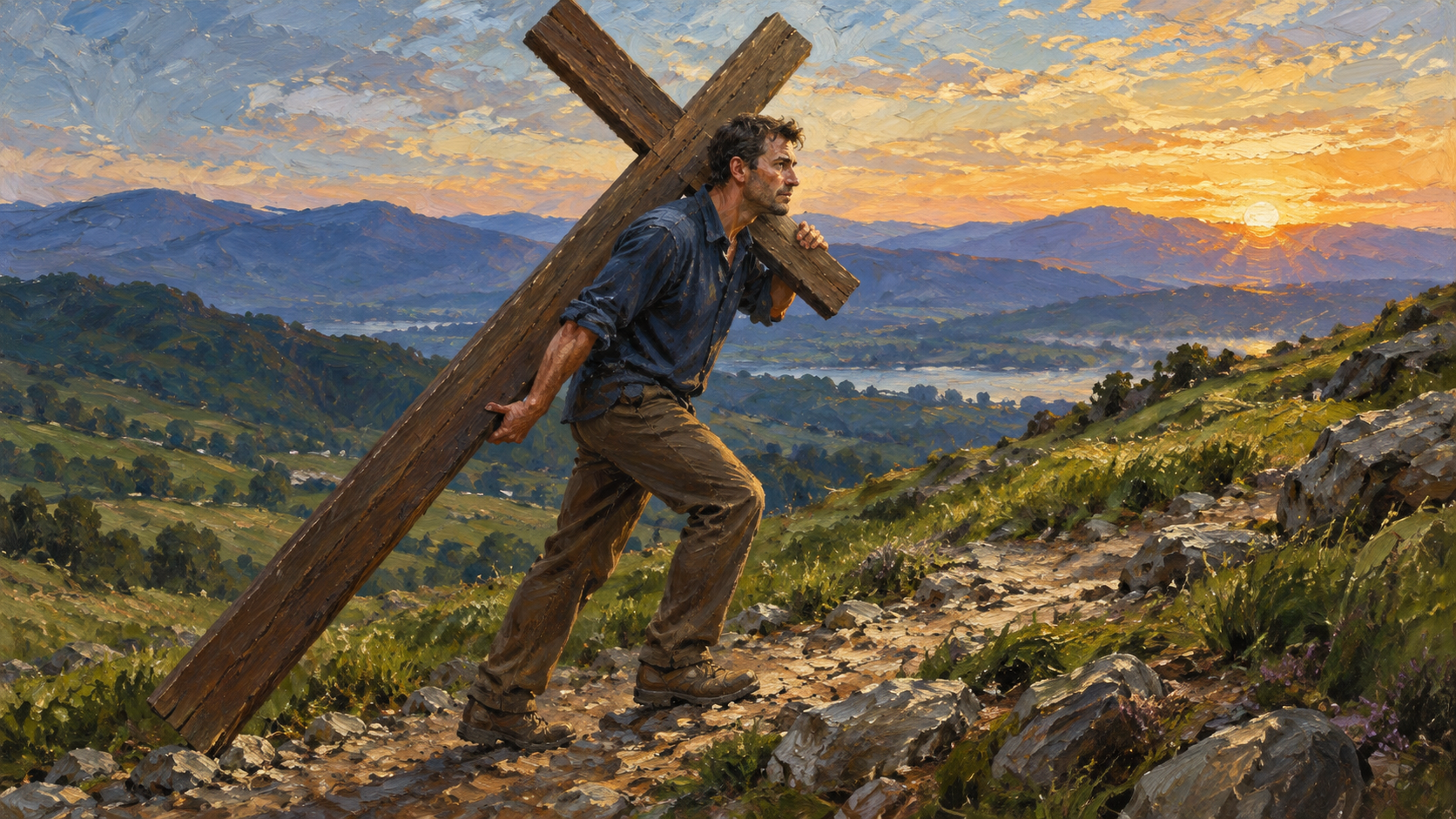
When Jesus told His disciples to deny themselves and take up the cross, He had just spoken about His own coming death. I want to keep that setting in view as we ask what following Him requires of us. He was not calling us to hate ourselves or regard every hardship as holy. His journey toward Jerusalem helps us understand the cost of discipleship and the grace that makes it possible.
Jesus Calls Us to Follow Behind His Cross
From that time Jesus began to show to His disciples that He must go to Jerusalem, and suffer many things from the elders and chief priests and scribes, and be killed, and be raised the third day. Then Peter took Him aside and began to rebuke Him, saying, “Far be it from You, Lord; this shall not happen to You!” But He turned and said to Peter, “Get behind Me, Satan! You are an offense to Me, for you are not mindful of the things of God, but the things of men.” Then Jesus said to His disciples, “If anyone desires to come after Me, let him deny himself, and take up his cross, and follow Me. For whoever desires to save his life will lose it, but whoever loses his life for My sake will find it. For what profit is it to a man if he gains the whole world, and loses his own soul? Or what will a man give in exchange for his soul? For the Son of Man will come in the glory of His Father with His angels, and then He will reward each according to his works. Assuredly, I say to you, there are some standing here who shall not taste death till they see the Son of Man coming in His kingdom.”
Jesus had begun explaining what awaited Him in Jerusalem: suffering at the hands of the leaders, death, and resurrection on the third day. Peter wanted the promised kingdom without the suffering appointed for the Messiah. Jesus called that alternative satanic because Peter was putting human interests above God’s purpose.
Jesus spoke about the disciple’s cross only after explaining His own. That order helps me understand what He is asking. He went first to His unique saving death and bodily resurrection, and we follow Him as the crucified and risen Lord even when our allegiance brings loss. We are not inventing a private path of pain, and our suffering does not help save anyone.
The phrase “die to yourself” can bring several biblical truths together, but it is not Jesus’ exact command here. He told us to deny self, take up the cross, and follow Him. Paul later wrote that the believer’s old man was crucified with Christ, and he also told Christians to put sinful deeds to death by the Spirit. Those truths are related, but I do not want to confuse them. The crucifixion of the old man describes the new identity God decisively gives at salvation. Putting sinful deeds to death describes our continuing battle against sin.
For Jesus’ first hearers, a cross meant public condemnation and a shameful death at Rome’s hands. A person carrying a crossbeam was on the way to execution, so this was far more than an image of inconvenience. Jesus was describing allegiance that would not turn back because of its cost. Following Him might mean losing approval or a respected position. It could disturb peace in a family or bring the loss of possessions. In some places, a believer’s freedom or safety is at stake, and following Christ can even cost physical life. We follow knowing that obedience to Him is worth more than what we may lose.
I would not call every painful experience a cross in that sense. Sickness or an unpleasant coworker is not automatically a cross, and neither is the painful result of my own foolish decision. We can honor God in any hardship, but the cross specifically pictures a loss we accept because we belong to Christ.
When He had called the people to Himself, with His disciples also, He said to them, “Whoever desires to come after Me, let him deny himself, and take up his cross, and follow Me. For whoever desires to save his life will lose it, but whoever loses his life for My sake and the gospel’s will save it. For what will it profit a man if he gains the whole world, and loses his own soul? Or what will a man give in exchange for his soul? For whoever is ashamed of Me and My words in this adulterous and sinful generation, of him the Son of Man also will be ashamed when He comes in the glory of His Father with the holy angels.”
Denying self means giving up my claim to be the final authority over my life. A desire does not overrule Jesus because it feels urgent, and even an ambition that seems worthwhile must yield when He says otherwise. Fear cannot decide whether I obey Him. Any loyalty I cherish must become secondary when it competes with Christ.
Giving up a pleasure for a while does not reach the whole issue, since even impressive discipline can leave a person ruled by pride. Biblical self-denial lets Christ correct our thinking and govern how we use everything He has entrusted to us. That includes our sexuality and speech as well as our relationships and work. His authority still holds when obedience changes how others see us.
Jesus did not ask His disciples to stop thinking or making responsible choices. Self-denial leaves room for creativity and rest, and it does not prevent us from loving people well or fulfilling our duties before God. Grace does not erase the personality He made. It teaches that person to live truthfully under the Lord.
And it happened, as He was alone praying, that His disciples joined Him, and He asked them, saying, “Who do the crowds say that I am?” So they answered and said, “John the Baptist, but some say Elijah; and others say that one of the old prophets has risen again.” He said to them, “But who do you say that I am?” Peter answered and said, “The Christ of God.” And He strictly warned and commanded them to tell this to no one, saying, “The Son of Man must suffer many things, and be rejected by the elders and chief priests and scribes, and be killed, and be raised the third day.” Then He said to them all, “If anyone desires to come after Me, let him deny himself, and take up his cross daily, and follow Me. For whoever desires to save his life will lose it, but whoever loses his life for My sake will save it. For what profit is it to a man if he gains the whole world, and is himself destroyed or lost? For whoever is ashamed of Me and My words, of him the Son of Man will be ashamed when He comes in His own glory, and in His Father’s, and of the holy angels.
Luke adds a word that catches my attention: “daily.” Allegiance to Christ can be settled decisively, yet each day gives us fresh occasions to act on it. Telling the truth may cost me standing that a lie would protect. Sexual temptation may call for fleeing, while a desire for revenge calls for forgiveness. If I fail, I need to confess honestly instead of hiding. Obedience may mean giving generously or accepting ridicule for standing by Scripture. It may also mean continuing a faithful task that receives no applause.
Jesus calls us to take up the cross and follow, so admiration from a safe distance is not enough. He chooses the direction. As disciples, we follow behind Him with His words governing our steps.
When Jesus speaks of losing life to save it, He is asking which life we regard as ultimate, not encouraging us to desire death. A person may keep comfort and popularity by insisting on the right to rule himself, yet lose fellowship with Christ. Someone else may lose every earthly advantage by following Jesus and still have everlasting life that death cannot touch. I see hope in that choice rather than despair. Christ calls us out of a life too small to survive judgment and into life secured in Him.
Gaining the whole world would be a terrible exchange for the soul, because wealth cannot ransom it. Achievement and religious labor cannot pay that price either, and our suffering has no saving merit. The Son of Man will return in His Father’s glory to reward each person. I need to make today’s decisions with that King in view, instead of letting people whose approval will soon disappear have the final say.
Count the Cost Without Turning Grace Into Wages
Now great multitudes went with Him. And He turned and said to them, “If anyone comes to Me and does not hate his father and mother, wife and children, brothers and sisters, yes, and his own life also, he cannot be My disciple. And whoever does not bear his cross and come after Me cannot be My disciple. For which of you, intending to build a tower, does not sit down first and count the cost, whether he has enough to finish it– lest, after he has laid the foundation, and is not able to finish, all who see it begin to mock him, saying, ‘This man began to build and was not able to finish’? Or what king, going to make war against another king, does not sit down first and consider whether he is able with ten thousand to meet him who comes against him with twenty thousand? Or else, while the other is still a great way off, he sends a delegation and asks conditions of peace. So likewise, whoever of you does not forsake all that he has cannot be My disciple. “Salt is good; but if the salt has lost its flavor, how shall it be seasoned? It is neither fit for the land nor for the dunghill, but men throw it out. He who has ears to hear, let him hear!”
Jesus told the crowds plainly that even love for family and the preservation of earthly life must not outrank loyalty to Him. His word “hate” makes that comparison forcefully. It does not authorize hostility or neglect, for He also upheld honoring parents and loving our neighbors. When obedience to Christ is at stake, every other attachment must take second place.
The builder and the king in Jesus’ examples both have to consider what lies ahead. Their examples make me question a profession based only on excitement or wanting to belong, because that profession may collapse when following Jesus becomes costly. He deserves deliberate and complete allegiance. Forsaking all likewise means surrendering our claim to final ownership, not requiring every disciple to abandon every lawful possession. We hold what we have as stewards under Christ’s authority.
Counting that cost does not make eternal life a wage for impressive sacrifices. It remains God’s gift. The thief beside Jesus had no lifetime left in which to prove himself through costly service, yet he believed and received Christ’s promise. We are justified by faith, not by giving up enough possessions or enduring enough rejection.
A cheap profession claims Jesus while reserving the right to self-rule. Legalism goes wrong in the other direction by treating self-denial as something that earns salvation. The Gospel teaches neither. Grace freely saves the person who believes and then teaches that saved person to live under the Savior’s lordship. Good works grow out of that life; they never purchase it.
The Old Man Was Crucified When God Gave New Life
We who are Jews by nature, and not sinners of the Gentiles, knowing that a man is not justified by the works of the law but by faith in Jesus Christ, even we have believed in Christ Jesus, that we might be justified by faith in Christ and not by the works of the law; for by the works of the law no flesh shall be justified. “But if, while we seek to be justified by Christ, we ourselves also are found sinners, is Christ therefore a minister of sin? Certainly not! For if I build again those things which I destroyed, I make myself a transgressor. For I through the law died to the law that I might live to God. I have been crucified with Christ; it is no longer I who live, but Christ lives in me; and the life which I now live in the flesh I live by faith in the Son of God, who loved me and gave Himself for me. I do not set aside the grace of God; for if righteousness comes through the law, then Christ died in vain.”
In Galatians 2, Paul defends justification by faith in Jesus Christ against seeking righteousness through works of the law. He died to the law as a way of establishing his standing before God so that he could live to God. When he says, “I have been crucified with Christ,” he describes union with Jesus in His death and a decisive change of identity.
Paul had not disappeared, for he spoke in the same sentence of “the life which I now live.” Christ lived in him, and he lived by faith in the Son of God who loved him and gave Himself for him. I understand that as a person made new, not a person erased. Nor was Paul asking believers to repeat Jesus’ saving death or add their pain to His atonement. We receive His completed work and live from it.
What shall we say then? Shall we continue in sin that grace may abound? Certainly not! How shall we who died to sin live any longer in it? Or do you not know that as many of us as were baptized into Christ Jesus were baptized into His death? Therefore we were buried with Him through baptism into death, that just as Christ was raised from the dead by the glory of the Father, even so we also should walk in newness of life. For if we have been united together in the likeness of His death, certainly we also shall be in the likeness of His resurrection, knowing this, that our old man was crucified with Him, that the body of sin might be done away with, that we should no longer be slaves of sin. For he who has died has been freed from sin. Now if we died with Christ, we believe that we shall also live with Him, knowing that Christ, having been raised from the dead, dies no more. Death no longer has dominion over Him. For the death that He died, He died to sin once for all; but the life that He lives, He lives to God. Likewise you also, reckon yourselves to be dead indeed to sin, but alive to God in Christ Jesus our Lord. Therefore do not let sin reign in your mortal body, that you should obey it in its lusts. And do not present your members as instruments of unrighteousness to sin, but present yourselves to God as being alive from the dead, and your members as instruments of righteousness to God. For sin shall not have dominion over you, for you are not under law but under grace.
Romans 6 rejects the idea that grace permits us to continue in sin. Those united with Christ have a new relationship to sin because of His death and resurrection. They cannot treat it as their rightful home. Paul says the old man “was crucified” so believers would no longer be sin’s slaves. That happened at salvation. We do not recreate that crucifixion each morning.
Sin still seeks our obedience, but it no longer has dominion over us. That is why we are told to reckon ourselves dead to sin and alive to God. Instead of offering our bodies as tools for unrighteousness, we present ourselves to Him as people alive from the dead and ready for His righteous purposes.
Water baptism pictures burial and resurrection with Christ. It is commanded after salvation as a public identification with Him, but the water does not create this union or regenerate the heart.
There was a man of the Pharisees named Nicodemus, a ruler of the Jews. This man came to Jesus by night and said to Him, “Rabbi, we know that You are a teacher come from God; for no one can do these signs that You do unless God is with him.” Jesus answered and said to him, “Most assuredly, I say to you, unless one is born again, he cannot see the kingdom of God.” Nicodemus said to Him, “How can a man be born when he is old? Can he enter a second time into his mother’s womb and be born?” Jesus answered, “Most assuredly, I say to you, unless one is born of water and the Spirit, he cannot enter the kingdom of God. That which is born of the flesh is flesh, and that which is born of the Spirit is spirit. Do not marvel that I said to you, ‘You must be born again.’ The wind blows where it wishes, and you hear the sound of it, but cannot tell where it comes from and where it goes. So is everyone who is born of the Spirit.” Nicodemus answered and said to Him, “How can these things be?” Jesus answered and said to him, “Are you the teacher of Israel, and do not know these things? Most assuredly, I say to you, We speak what We know and testify what We have seen, and you do not receive Our witness. If I have told you earthly things and you do not believe, how will you believe if I tell you heavenly things? No one has ascended to heaven but He who came down from heaven, that is, the Son of Man who is in heaven. And as Moses lifted up the serpent in the wilderness, even so must the Son of Man be lifted up, that whoever believes in Him should not perish but have eternal life. For God so loved the world that He gave His only begotten Son, that whoever believes in Him should not perish but have everlasting life. For God did not send His Son into the world to condemn the world, but that the world through Him might be saved. “He who believes in Him is not condemned; but he who does not believe is condemned already, because he has not believed in the name of the only begotten Son of God.
Jesus told Nicodemus he must be born again, or born from above. Neither his religious standing nor his own efforts could gradually improve spiritual death into life. The Holy Spirit gives an entirely new beginning.
A birth is decisive even though growth takes time. An immature believer is still someone God has made a new creation and given everlasting life. The Spirit dwells within that person and has sealed him. Jesus connected the new birth with believing in the Son who would be lifted up. Faith receives Christ and the gift He genuinely offers the world; it does not earn that life.
If I treat regeneration as a lifelong process, I can leave a person trying to become alive through discipleship. Scripture gives the opposite order: grace gives life, and the person who is alive then grows. We take up the cross because we have been born again, not to cause that birth.
Put Sinful Deeds to Death by the Spirit
There is therefore now no condemnation to those who are in Christ Jesus, who do not walk according to the flesh, but according to the Spirit. For the law of the Spirit of life in Christ Jesus has made me free from the law of sin and death. For what the law could not do in that it was weak through the flesh, God did by sending His own Son in the likeness of sinful flesh, on account of sin: He condemned sin in the flesh, that the righteous requirement of the law might be fulfilled in us who do not walk according to the flesh but according to the Spirit. For those who live according to the flesh set their minds on the things of the flesh, but those who live according to the Spirit, the things of the Spirit. For to be carnally minded is death, but to be spiritually minded is life and peace. Because the carnal mind is enmity against God; for it is not subject to the law of God, nor indeed can be. So then, those who are in the flesh cannot please God. But you are not in the flesh but in the Spirit, if indeed the Spirit of God dwells in you. Now if anyone does not have the Spirit of Christ, he is not His. And if Christ is in you, the body is dead because of sin, but the Spirit is life because of righteousness. But if the Spirit of Him who raised Jesus from the dead dwells in you, He who raised Christ from the dead will also give life to your mortal bodies through His Spirit who dwells in you. Therefore, brethren, we are debtors–not to the flesh, to live according to the flesh. For if you live according to the flesh you will die; but if by the Spirit you put to death the deeds of the body, you will live. For as many as are led by the Spirit of God, these are sons of God. For you did not receive the spirit of bondage again to fear, but you received the Spirit of adoption by whom we cry out, “Abba, Father.” The Spirit Himself bears witness with our spirit that we are children of God, and if children, then heirs–heirs of God and joint heirs with Christ, if indeed we suffer with Him, that we may also be glorified together.
Paul speaks to people who are in Christ and under no condemnation. The Spirit of life has freed them from the law of sin and death and dwells in everyone who belongs to Christ. His command to put the body’s sinful deeds to death by the Spirit comes within that assurance.
This continuing fight against sin is sometimes called mortification, which means putting sin to death. We actively resist particular sins through the Holy Spirit’s power. He uses truth to convict us and works within us so that we desire obedience. We are not fighting to earn adoption, because those led by the Spirit are already God’s children. We fight from within a secure relationship with our Father.
Saying that I am dying to self is no substitute for naming a sinful pattern and confessing it honestly. If something repeatedly opens the door to that sin, I need to remove it rather than pretend it is harmless. Scripture renews our thinking, and a struggle that keeps returning may need the help of a trustworthy person who can hold us accountable. Repentance turns us from the old practice toward a specific act of obedience.
I say then: Walk in the Spirit, and you shall not fulfill the lust of the flesh. For the flesh lusts against the Spirit, and the Spirit against the flesh; and these are contrary to one another, so that you do not do the things that you wish. But if you are led by the Spirit, you are not under the law. Now the works of the flesh are evident, which are: adultery, fornication, uncleanness, lewdness, idolatry, sorcery, hatred, contentions, jealousies, outbursts of wrath, selfish ambitions, dissensions, heresies, envy, murders, drunkenness, revelries, and the like; of which I tell you beforehand, just as I also told you in time past, that those who practice such things will not inherit the kingdom of God. But the fruit of the Spirit is love, joy, peace, longsuffering, kindness, goodness, faithfulness, gentleness, self-control. Against such there is no law. And those who are Christ’s have crucified the flesh with its passions and desires. If we live in the Spirit, let us also walk in the Spirit. Let us not become conceited, provoking one another, envying one another.
The flesh is fallen desire acting independently of God, and it opposes the Spirit. Every growing Christian knows something of that conflict. Because those who belong to Christ have crucified the flesh with its passions and desires, they are to walk by the Spirit instead of making room for sin.
Paul includes sexual immorality and idolatry among the works of the flesh, but he also names hatred and jealousy. Selfish ambition belongs there too, along with drunkenness and the other sins in his warning. Yet becoming holy involves more than refusing sin. The Spirit produces love and joy grounded in God, and His peace teaches us patient endurance. As He works, we become kinder and more faithful, responding with gentleness and self-control. This is abundant life, not the destruction of the person. Refusing sin’s rule allows the person God intended to flourish.
Paul also brings this way of life into ordinary relationships. Conceit provokes people, and envy keeps us comparing ourselves with others. I need to recognize those desires if I demand recognition or try to control someone. Walking by the Spirit means dealing with them before they govern how I treat that person.
If then you were raised with Christ, seek those things which are above, where Christ is, sitting at the right hand of God. Set your mind on things above, not on things on the earth. For you died, and your life is hidden with Christ in God. When Christ who is our life appears, then you also will appear with Him in glory. Therefore put to death your members which are on the earth: fornication, uncleanness, passion, evil desire, and covetousness, which is idolatry. Because of these things the wrath of God is coming upon the sons of disobedience, in which you yourselves once walked when you lived in them. But now you yourselves are to put off all these: anger, wrath, malice, blasphemy, filthy language out of your mouth. Do not lie to one another, since you have put off the old man with his deeds, and have put on the new man who is renewed in knowledge according to the image of Him who created him, where there is neither Greek nor Jew, circumcised nor uncircumcised, barbarian, Scythian, slave nor free, but Christ is all and in all. Therefore, as the elect of God, holy and beloved, put on tender mercies, kindness, humility, meekness, longsuffering; bearing with one another, and forgiving one another, if anyone has a complaint against another; even as Christ forgave you, so you also must do. But above all these things put on love, which is the bond of perfection. And let the peace of God rule in your hearts, to which also you were called in one body; and be thankful. Let the word of Christ dwell in you richly in all wisdom, teaching and admonishing one another in psalms and hymns and spiritual songs, singing with grace in your hearts to the Lord. And whatever you do in word or deed, do all in the name of the Lord Jesus, giving thanks to God the Father through Him.
Colossians tells believers that they died and their life is hidden with Christ in God. Christ is their life, and their future glory is certain. On that basis, Paul tells them to put earthly sinful practices to death. He names sexual sin and evil desire, as well as covetousness that becomes idolatry, before addressing anger and malice. Filthy speech and lying must go too. Taking up the cross concerns that actual conduct, not merely a dramatic feeling of surrender.
We also put on a new way of life. Having received Christ’s forgiveness, we learn to forgive others and show them mercy and kindness. Humility changes how we carry ourselves, while patient endurance makes room for other people. Love holds that life together, and God’s peace rules in the believing community. The Word of Christ dwells among God’s people as gratitude grows.
Doing everything in Jesus’ name with thanksgiving reaches well beyond public worship. His authority governs work and family life, including ordinary conversations and decisions. Faithful service in those places lets others see our allegiance to Him.
Cross-Bearing Is Not Self-Destruction
Otherwise, what will they do who are baptized for the dead, if the dead do not rise at all? Why then are they baptized for the dead? And why do we stand in jeopardy every hour? I affirm, by the boasting in you which I have in Christ Jesus our Lord, I die daily. If, in the manner of men, I have fought with beasts at Ephesus, what advantage is it to me? If the dead do not rise, “Let us eat and drink, for tomorrow we die!” Do not be deceived: “Evil company corrupts good habits.” Awake to righteousness, and do not sin; for some do not have the knowledge of God. I speak this to your shame.
I would be careful about using “I die daily” as Paul’s definition of daily inward mortification. He is discussing bodily resurrection and asking why he and other Gospel workers face danger every hour if the dead do not rise. He accepted continual exposure to physical death because the resurrection is true.
Paul’s example certainly shows costly allegiance, but it is not the main definition of putting sinful desires to death. Romans 8 and Colossians 3 give that direct command. In the passage about daily danger, Paul explains why a disciple can face death with hope: it does not have the final word.
Now there were certain Greeks among those who came up to worship at the feast. Then they came to Philip, who was from Bethsaida of Galilee, and asked him, saying, “Sir, we wish to see Jesus.” Philip came and told Andrew, and in turn Andrew and Philip told Jesus. But Jesus answered them, saying, “The hour has come that the Son of Man should be glorified. Most assuredly, I say to you, unless a grain of wheat falls into the ground and dies, it remains alone; but if it dies, it produces much grain. He who loves his life will lose it, and he who hates his life in this world will keep it for eternal life. If anyone serves Me, let him follow Me; and where I am, there My servant will be also. If anyone serves Me, him My Father will honor. “Now My soul is troubled, and what shall I say? ‘Father, save Me from this hour’? But for this purpose I came to this hour. Father, glorify Your name.” Then a voice came from heaven, saying, “I have both glorified it and will glorify it again.”
When Greeks came seeking Jesus, He announced that the hour for the Son of Man to be glorified had arrived. His image of a grain falling into the ground and dying points first to His approaching death and the abundant fruit it would produce. He then extended the pattern to His servants. Whoever serves Him must follow Him, and the Father will honor that servant.
I would not turn the grain into a promise that every painful loss will lead to success. Jesus’ saving mission stands at the center of the image. We bear fruit by following the crucified Lord, not by treating suffering itself as something to worship.
Dying to self does not mean despising the person God created in His image and redeemed through Christ. We reject sin rather than hate that person. Injuring the body is not what Jesus means by taking up the cross.
Self-denial does not require giving up joy or wise boundaries. Jesus withdrew to rest at times and did not entrust Himself to everyone. He confronted evil instead of pretending it was harmless. Along with meaningful work and relationships, God gives food and rest to receive gratefully. Beauty and celebration can belong in a holy life, and humility lets us enjoy a gift without making it a source of pride. We can also refuse manipulation when someone demands what God has not required. Caring for the body can itself be faithful stewardship.
Being exhausted does not prove that I am holy. Rest can be obedience, while overcommitment may come from pride or fear of disappointing people. I may be trying to finish work no one person can do instead of trusting God with it.
Self-denial must not become a way to excuse another person’s sin. A demand from someone else does not carry Christ’s authority simply because meeting it would cost me something.
Forgiveness rejects personal vengeance without erasing truth or rightful consequences. It does not mean denying protection to a vulnerable person or restoring a leader after biblical disqualification. Jesus accepted the suffering required by His saving mission, but He did not treat every threat as a cross He must passively endure.
Most cross-bearing is less dramatic than a threat to life. A career goal or a desire for marriage is not automatically selfish. Parenting and education can be good gifts held under Christ’s authority, as can exercise and art. Business and careful financial planning belong under His authority too. The question is whether the pursuit agrees with His truth and can be received with thanksgiving.
At times, denying self means leaving a dishonest opportunity or a relationship that keeps demanding disobedience. It may expose how much our identity depends on applause. We may need to confess a habit of controlling others or bring our spending under biblical stewardship. In another situation, obedience means accepting a good responsibility instead of avoiding the work it requires.
Before deciding, I want to ask what Scripture says and which desire is ruling me. Who would this choice serve, and whom might it harm? Fear of losing approval deserves an honest look too. The decision needs to be something I can carry out in Christ’s name with thanksgiving. That may mean telling the truth when lying is easier or practicing sexual faithfulness and doing patient work. When we fail, we repent instead of hiding, and throughout the struggle we continue steadfastly in prayer.
Resurrection Hope Keeps the Cross in Its Proper Place
If Jesus had stayed dead, taking up the cross would end only in loss. He rose bodily, though, and the living Lord we follow will raise His people and reward faithful service. That hope frees me from having to protect every temporary advantage. No obedient sacrifice can take away the everlasting life He gives. Death is still an enemy, but its defeat is certain.
A truly born-again believer is indwelt and sealed by the Holy Spirit, but that security does not make obedience optional. Sin still grieves the Spirit and can deeply harm others. Continued disobedience brings the Father’s discipline and damages Christian witness; it can also cost reward. Our battle rests on grace, without making sin harmless.
Our crosses cannot atone for sin. Jesus is the eternal Son, fully God and fully man. He was born of a virgin and remained completely sinless. Christ died for the whole world as wicked men physically tortured, punished, and killed Him. Jesus willingly bore that real punishment for our sins in His innocent body. He shed His blood and died before being buried and rising bodily. The Father did not punish, curse, abandon, strike, bruise, or pour wrath upon His Son.
People can resist and reject God’s genuine offer, but everyone who repents and believes is forgiven and justified. God gives that person new birth and makes him a new creation. The Holy Spirit indwells and seals the believer, whose life in Christ is eternally secure. That does not excuse lawlessness, and a shallow profession does not prove that the new birth has occurred.
Discipleship becomes our grateful response only after grace gives us life. We take up the cross because Jesus has saved us, never to persuade Him to save us. His saving cross accomplished what no disciple’s cross could do.
My Final Thoughts
Dying to self means giving up sinful self-rule so we can follow Jesus in the life He has already given us. Our old man was crucified with Him at salvation. Each day, we resist particular sins by the Holy Spirit and obey when faithfulness costs us something. My obedience cannot earn eternal life or add anything to Jesus’ saving cross. He does not ask me to despise myself or remain in preventable harm. Because He rose bodily, I can entrust every temporary loss to Him. Our real life is safe in the risen Lord as we take the next faithful step.