
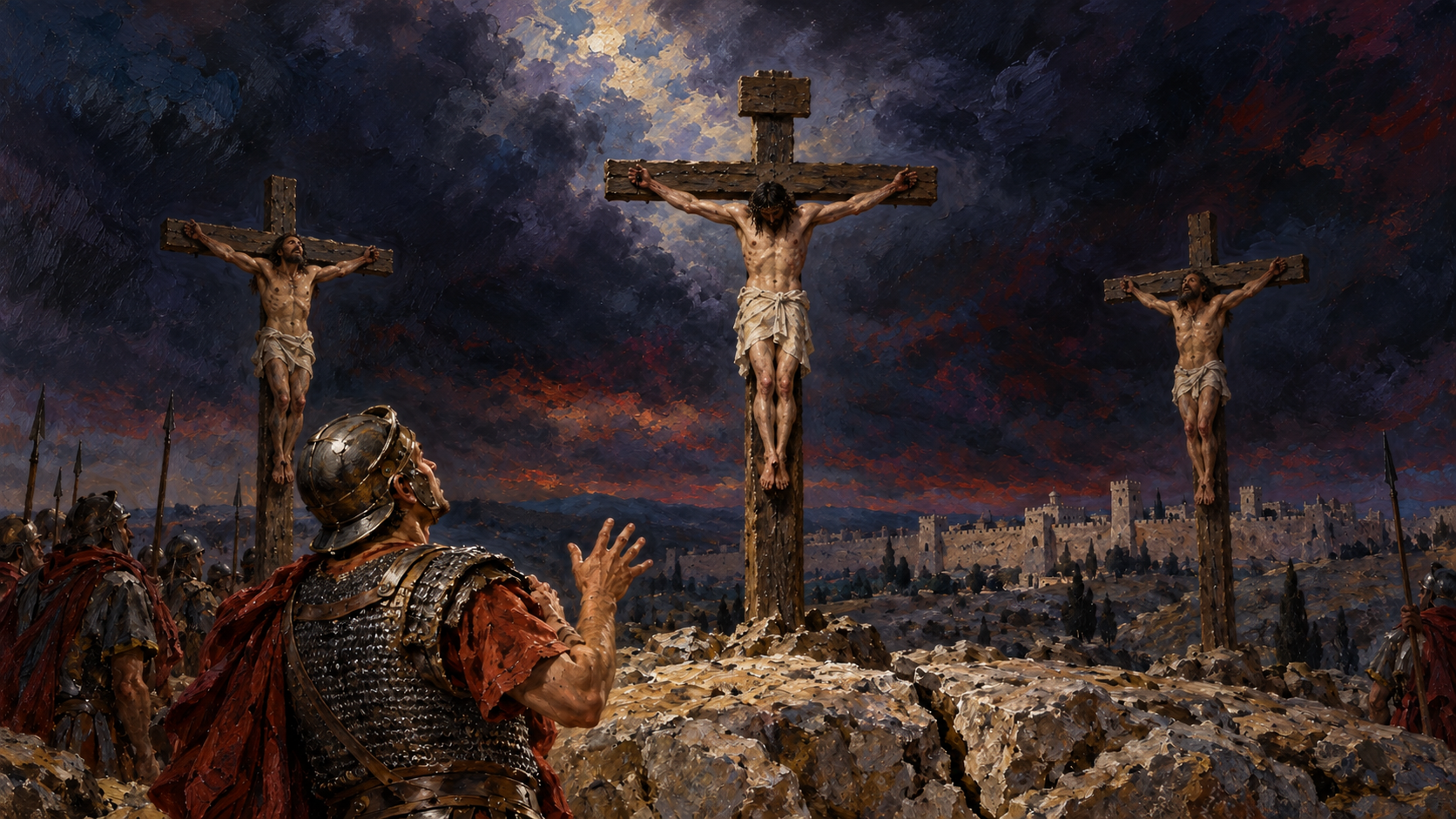
When I read the Gospel accounts of Jesus’ death, I want to give each detail the attention it deserves. The darkness and His final words bring us to that terrible moment, and the events that followed confirmed who He is and what His willing sacrifice accomplished. We have much to consider in what Scripture actually records without adding details it never gives us.
Darkness, His Final Words, and a Willing Death
By the time darkness covered the land, Jesus had already been betrayed and arrested. He was condemned and mocked before soldiers scourged Him and led Him outside Jerusalem to Golgotha. There Roman soldiers nailed Him to a cross between two criminals while rulers and people passing by mocked Him. The Gospels then give us time to hear His words and consider the signs that surrounded His death.
Each Gospel gives details that serve its inspired purpose. Matthew draws our attention to fulfilled Scripture and the earthquake, then reports the opened tombs and the guards’ fear. Mark focuses on the way Jesus cried out and died. Luke records His trust in the Father and tells us how the centurion and the crowd responded, while John gives eyewitness details about His unbroken legs and the soldier who pierced His side as fulfillments of Scripture. I don’t need to treat these accounts as competing versions that must be repaired. Reading them together allows me to hear more of the testimony God has given us.
Now from the sixth hour until the ninth hour there was darkness over all the land. And about the ninth hour Jesus cried out with a loud voice, saying, “Eli, Eli, lama sabachthani?” that is, “My God, My God, why have You forsaken Me?” Some of those who stood there, when they heard that, said, “This Man is calling for Elijah!” Immediately one of them ran and took a sponge, filled it with sour wine and put it on a reed, and offered it to Him to drink. The rest said, “Let Him alone; let us see if Elijah will come to save Him.” And Jesus cried out again with a loud voice, and yielded up His spirit. Then, behold, the veil of the temple was torn in two from top to bottom; and the earth quaked, and the rocks were split, and the graves were opened; and many bodies of the saints who had fallen asleep were raised; and coming out of the graves after His resurrection, they went into the holy city and appeared to many. So when the centurion and those with him, who were guarding Jesus, saw the earthquake and the things that had happened, they feared greatly, saying, “Truly this was the Son of God!”
Matthew places the darkness from the sixth hour until the ninth hour, and Mark gives the same span. Luke tells us that the sun was darkened. In the ordinary Jewish way of counting daylight, the sixth hour was about noon and the ninth hour was about three in the afternoon. Mark says Jesus was crucified at the third hour, about nine in the morning, so the darkness covered roughly the last three of the six hours He hung on the cross. These times help us follow what happened, though we should understand them as approximations rather than modern timestamps.
The word translated land can also mean earth, so the word alone does not settle how far the darkness reached. Scripture tells us that the darkness was real without naming a natural cause or defining its extent. A normal solar eclipse does not fit either the full moon at Passover or three hours of darkness. I see no need to depend on uncertain claims about ancient writers such as Thallus or Phlegon to make the event more convincing. The Gospel testimony gives us sufficient reason to believe it happened.
To understand the darkness, I also need to listen to what Jesus said about His Father. He had already said the Father was with Him, and His final prayer placed His spirit into the Father’s hands. The darkness shows the terrible weight of the crucifixion, but it does not mean the Father turned against His Son. Jesus’ own words express trust and perfect unity with the Father.
Now when the sixth hour had come, there was darkness over the whole land until the ninth hour. And at the ninth hour Jesus cried out with a loud voice, saying, “Eloi, Eloi, lama sabachthani?” which is translated, “My God, My God, why have You forsaken Me?” Some of those who stood by, when they heard that, said, “Look, He is calling for Elijah!” Then someone ran and filled a sponge full of sour wine, put it on a reed, and offered it to Him to drink, saying, “Let Him alone; let us see if Elijah will come to take Him down.” And Jesus cried out with a loud voice, and breathed His last. Then the veil of the temple was torn in two from top to bottom. So when the centurion, who stood opposite Him, saw that He cried out like this and breathed His last, he said, “Truly this Man was the Son of God!”
Jesus’ cry was real agony, not a detached lesson delivered from the cross. Mark preserves an Aramaic form of His words, while Matthew records a form shaped by Hebrew. Both translate the opening of Psalm 22: “My God, My God, why have You forsaken Me?” Some people nearby mistook His words for a call to Elijah. Even their misunderstanding helps us recognize that He spoke publicly and that His words were remembered with care.
Luke adds another part of these final moments by recording the prayer that showed Jesus still entrusting Himself to the Father.
Now it was about the sixth hour, and there was darkness over all the earth until the ninth hour. Then the sun was darkened, and the veil of the temple was torn in two. And when Jesus had cried out with a loud voice, He said, “Father, ‘into Your hands I commit My spirit.'” Having said this, He breathed His last. So when the centurion saw what had happened, he glorified God, saying, “Certainly this was a righteous Man!” And the whole crowd who came together to that sight, seeing what had been done, beat their breasts and returned. But all His acquaintances, and the women who followed Him from Galilee, stood at a distance, watching these things.
Matthew and Mark record the cry from Psalm 22, followed by another loud cry. Luke tells us that Jesus addressed the Father and committed His spirit into His hands, while John records His thirst and the declaration, “It is finished.” I would not try to arrange every word into a second-by-second sequence beyond what the writers tell us. Together they show Jesus fulfilling Scripture through real suffering and completing His work. He continued to trust the Father as He willingly surrendered His life. Rather than simply fading away, He spoke with purpose and cried out loudly before He breathed His last.
Psalm 22 Shows That the Father Heard Him
Jesus’ words lead us into Psalm 22, where the righteous sufferer endures dreadful physical pain while enemies surround and mock him. The Psalm looks beyond that suffering to vindication and praise among the nations. By quoting it, Jesus showed that His real crucifixion fulfilled the pattern already given in Scripture. He was not asking us to regard His suffering as merely symbolic.
My God, My God, why have You forsaken Me? Why are You so far from helping Me, And from the words of My groaning? O My God, I cry in the daytime, but You do not hear; And in the night season, and am not silent. But You are holy, Enthroned in the praises of Israel. Our fathers trusted in You; They trusted, and You delivered them. They cried to You, and were delivered; They trusted in You, and were not ashamed.
The Psalm begins with the felt distance of terrible suffering, yet the sufferer immediately confesses God’s holiness and remembers His deliverance of those who trusted Him. Jesus entered the full anguish described in this inspired song without ceasing to be the beloved Son. I don’t want to stop at the opening cry and miss what the rest of the Psalm tells us about it.
I will declare Your name to My brethren; In the midst of the assembly I will praise You. You who fear the LORD, praise Him! All you descendants of Jacob, glorify Him, And fear Him, all you offspring of Israel! For He has not despised nor abhorred the affliction of the afflicted; Nor has He hidden His face from Him; But when He cried to Him, He heard.
The later verses help me understand the opening cry without concluding that the LORD rejected the afflicted one. Psalm 22 expressly says He did not despise the sufferer’s affliction or hide His face from him. God heard when he cried. Jesus was not punished or abandoned by the Father; they remained united as Christ offered Himself through the eternal Spirit.
John brings this same willing purpose into focus by preserving what Jesus had already said about laying down His life.
“Therefore My Father loves Me, because I lay down My life that I may take it again. No one takes it from Me, but I lay it down of Myself. I have power to lay it down, and I have power to take it again. This command I have received from My Father.”
Matthew says Jesus yielded His spirit. Luke says He committed it to the Father, and John says He gave it up. The wording differs, but each expression agrees with what Jesus had already taught about His willing surrender. No one could take His life apart from that surrender. Under the Father’s command, He had authority both to lay it down and to take it again.
His willingness does not make the violence against Him any less real. Lawless men arrested and mocked Him, then scourged and pierced His innocent body before killing Him. Their cruelty did not surprise God or overpower His saving purpose. We can recognize the evil of what they did while also understanding that the Shepherd chose to give His life for the sheep.
“It Is Finished,” the Torn Veil, and the Signs
John places Jesus’ declaration beside fulfilled Scripture and the physical proof of His death.
After this, Jesus, knowing that all things were now accomplished, that the Scripture might be fulfilled, said, “I thirst!” Now a vessel full of sour wine was sitting there; and they filled a sponge with sour wine, put it on hyssop, and put it to His mouth. So when Jesus had received the sour wine, He said, “It is finished!” And bowing His head, He gave up His spirit. Therefore, because it was the Preparation Day, that the bodies should not remain on the cross on the Sabbath (for that Sabbath was a high day), the Jews asked Pilate that their legs might be broken, and that they might be taken away. Then the soldiers came and broke the legs of the first and of the other who was crucified with Him. But when they came to Jesus and saw that He was already dead, they did not break His legs. But one of the soldiers pierced His side with a spear, and immediately blood and water came out. And he who has seen has testified, and his testimony is true; and he knows that he is telling the truth, so that you may believe. For these things were done that the Scripture should be fulfilled, “Not one of His bones shall be broken.” And again another Scripture says, “They shall look on Him whom they pierced.”
The Greek word translated “It is finished” is tetelestai, a form of teleo. It describes something brought to completion that now stands accomplished. That meaning fits what John has already told us about the work the Father gave Jesus to do. Jesus was announcing that He had completed that mission and reached the appointed end of His mortal suffering.
People sometimes say tetelestai was commonly stamped on receipts to mean “paid in full.” That claim is repeated with more confidence than the available early evidence allows. I would rather let John’s account explain Jesus’ words than make the receipt claim carry more than it can support. Jesus fulfilled Scripture and completed the work His Father gave Him, so nothing is lost by keeping our explanation grounded in the biblical setting.
When Jesus died, the temple veil was torn from top to bottom. Both Matthew and Mark give that direction, pointing us to God’s action rather than a person cutting it down. Scripture gives neither the veil’s size nor its thickness, and it does not say horses could not tear it. Those later claims should not be presented as Gospel testimony. What Scripture records is powerful enough: God tore the barrier connected with access to the sanctuary as His Son completed His sacrifice.
Therefore, brethren, having boldness to enter the Holiest by the blood of Jesus, by a new and living way which He consecrated for us, through the veil, that is, His flesh, and having a High Priest over the house of God, let us draw near with a true heart in full assurance of faith, having our hearts sprinkled from an evil conscience and our bodies washed with pure water. Let us hold fast the confession of our hope without wavering, for He who promised is faithful. And let us consider one another in order to stir up love and good works, not forsaking the assembling of ourselves together, as is the manner of some, but exhorting one another, and so much the more as you see the Day approaching.
Under the Mosaic covenant, the inner veil separated the Holy Place from the Most Holy Place. Only on the yearly Day of Atonement did the high priest go beyond it, and he entered with sacrificial blood. Ordinary worshipers could not pass through whenever they wished. Once we understand who could go beyond that barrier, we can see why its tearing speaks about access to God rather than merely damage to a building.
Hebrews explains that believers may enter through Jesus’ blood by a new and living way through the veil, which is His flesh. Jesus is also the High Priest over God’s house, and the visible tearing in the temple agrees with this greater truth. I can draw near to God through Christ without depending on repeated animal sacrifices or a line of mortal priests. His faithfulness gives us reason to hold firmly to our confession and to gather with other believers to encourage them.
The temple building did not disappear that afternoon. It remained until AD 70, and early believers still entered its courts. Yet its sacrificial order had reached its fulfillment in Christ. No temple ritual could add to His once-for-all offering.
Matthew also records that the earth quaked and rocks split, and that tombs opened as another sign connected with Jesus’ death. He does not give its magnitude or identify its center and geographic reach. Neither does he describe creation as panicking or mourning. We can follow the event as Matthew describes it without supplying those details: the earth shook, and the guards recognized that this death was unlike any other.
Rock-cut tombs around Jerusalem help us picture the opened graves, though Matthew does not say that every grave opened. I also notice a distinction in timing that we should preserve. The graves opened when Jesus died, but the bodies of many saints who had been raised came out after His resurrection and entered Jerusalem, where they appeared to many people. Matthew names none of them and does not tell us how long they lived. Paul calls Christ the firstfruits, so we should not transfer that title to these saints. We also cannot say the centurion saw their later appearance, because his confession came before it. The few details Scripture gives us deserve careful attention without filling in what it leaves unsaid.
Witnesses Confirmed His Death and Burial
The earthquake and the other events terrified the centurion and the guards. Matthew records their confession, “Truly this was the Son of God!” Mark connects the centurion’s words with the way Jesus cried out and died, while Luke says he glorified God and called Jesus righteous. Read together, these reports show the witnesses recognizing both His innocence and His identity. We are not told how many crucifixions the centurion had seen or what he did afterward, so our understanding of his response must rest on what the Gospels record.
Jesus’ acquaintances and the women who had followed Him from Galilee watched from a distance. Matthew and Mark name women including Mary Magdalene and other Marys who had cared for Him and stayed nearby when many disciples were gone. Their presence helps me follow the testimony from the cross to the tomb. They saw the crucifixion and watched where His body was placed, then prepared spices and returned to that same location. These witnesses had not lost track of His body or gone to an unknown grave when the resurrection message began.
Because the coming Sabbath was a high day, the authorities asked for the men’s legs to be broken to hasten death so their bodies could be removed. The soldiers did this to the two men beside Jesus, but they found Him already dead and left His legs unbroken. Mark adds that Pilate was surprised Jesus had died so soon and asked the centurion to confirm His death. Only after receiving that confirmation did Pilate release His body to Joseph of Arimathea for burial.
Before Pilate released the body, a soldier had pierced Jesus’ side, and blood and water came out. John emphasizes that he gives eyewitness testimony so his readers may believe, and he connects the unbroken bones and pierced body with fulfilled Scripture. Medical writers have proposed physical explanations for the blood and water, but I don’t need to settle on a diagnosis to understand what John establishes. Jesus truly died, and the soldier pierced His body, from which His blood was physically shed.
Joseph asked Pilate for the body, wrapped Jesus in clean linen, and placed Him in his own new tomb cut into rock. John tells us that Nicodemus helped him by bringing a large amount of myrrh and aloes. The women saw the burial place before a stone closed the entrance.
Burial belongs to the gospel because Jesus’ death was real. He had not simply lost consciousness or cast off His body as an unwanted shell. People handled and wrapped the very body that had hung on the cross, then laid it in a known tomb that was later guarded. When that tomb was found empty, the same body was gone.
His Death Leads to Bodily Resurrection and Redemption
Paul’s statement of the gospel he received carries us from Jesus’ death and burial to His bodily resurrection. The good news does not leave Him in the grave, but tells us that witnesses saw Him alive.
Moreover, brethren, I declare to you the gospel which I preached to you, which also you received and in which you stand, by which also you are saved, if you hold fast that word which I preached to you–unless you believed in vain. For I delivered to you first of all that which I also received: that Christ died for our sins according to the Scriptures, and that He was buried, and that He rose again the third day according to the Scriptures, and that He was seen by Cephas, then by the twelve. After that He was seen by over five hundred brethren at once, of whom the greater part remain to the present, but some have fallen asleep. After that He was seen by James, then by all the apostles. Then last of all He was seen by me also, as by one born out of due time.
Christ died for our sins according to the Scriptures and was truly buried. On the third day He rose as Scripture had foretold, then appeared to named witnesses and a group of more than five hundred people. He invited people to touch Him and ate in front of His disciples. His glorified body still bore recognizable wounds. Those details help us understand what His bodily resurrection means. As the firstfruits of those who have fallen asleep, He guarantees the future bodily resurrection of His people.
There is also a distinction in Peter’s preaching that I want us to understand: God’s purpose in Jesus’ death and the guilt of those who inflicted His punishment.
“Men of Israel, hear these words: Jesus of Nazareth, a Man attested by God to you by miracles, wonders, and signs which God did through Him in your midst, as you yourselves also know– Him, being delivered by the determined purpose and foreknowledge of God, you have taken by lawless hands, have crucified, and put to death; whom God raised up, having loosed the pains of death, because it was not possible that He should be held by it.
Peter says Jesus was delivered according to God’s determined purpose and foreknowledge, and he holds the men who crucified Him responsible for what they did. I need to keep both parts of that explanation together. God’s providence did not turn their evil into violence committed by the Father or remove their guilt. Lawless hands crucified and killed Jesus, and God raised Him because death could not hold Him.
For to this you were called, because Christ also suffered for us, leaving us an example, that you should follow His steps: “Who committed no sin, Nor was deceit found in His mouth”; who, when He was reviled, did not revile in return; when He suffered, He did not threaten, but committed Himself to Him who judges righteously; who Himself bore our sins in His own body on the tree, that we, having died to sins, might live for righteousness–by whose stripes you were healed. For you were like sheep going astray, but have now returned to the Shepherd and Overseer of your souls.
Peter directs suffering believers to the way Christ endured unjust treatment without sinning. When wicked men reviled and hurt Him, He committed Himself to the One who judges righteously instead of answering with threats. He bore our sins in His own body on the tree so that we might die to sin and live for righteousness. Peter then describes sheep who had gone astray returning to their Shepherd. That connection explains the healing here as a saving return to Him, not a promise that every physical illness will be cured immediately.
Wicked men physically tortured and punished the Lord before killing Him. Jesus willingly bore that real punishment for our sins in His innocent body and shed His blood. The Father did not punish or curse Jesus, nor did He abandon His Son. He did not strike, bruise, or pour wrath on Him. The spotless Son remained one with the Father and offered Himself through the eternal Spirit.
But Christ came as High Priest of the good things to come, with the greater and more perfect tabernacle not made with hands, that is, not of this creation. Not with the blood of goats and calves, but with His own blood He entered the Most Holy Place once for all, having obtained eternal redemption. For if the blood of bulls and goats and the ashes of a heifer, sprinkling the unclean, sanctifies for the purifying of the flesh, how much more shall the blood of Christ, who through the eternal Spirit offered Himself without spot to God, cleanse your conscience from dead works to serve the living God? And for this reason He is the Mediator of the new covenant, by means of death, for the redemption of the transgressions under the first covenant, that those who are called may receive the promise of the eternal inheritance.
Christ entered the greater sanctuary with His own blood and obtained eternal redemption. His death also cleanses the believer’s conscience. Animal sacrifices could only point ahead, but Jesus actually gave His innocent life and physically shed His blood. When we speak of that blood, we are not using a metaphor detached from His body. Through that death He established the new covenant, and as its Mediator He brings sinners to God.
Jesus fulfills both parts of the Day of Atonement pattern. He is the sinless offering and the eternal High Priest who presented the sacrifice. Because He offered Himself once and now lives forever, we need no new altar or repeated sacrifice. No earthly priesthood must stand between us and the Father, and no ritual can reenact the cross. I approach God through the Son’s finished offering while depending on His continuing intercession.
Jesus tasted death for everyone and is the propitiation, the sacrifice that deals with sin, for the whole world. Neither ancestry nor religious office can replace His blood, and we cannot obtain salvation through moral reform or any other human work. God genuinely offers it to all, and anyone who repents and believes receives forgiveness and everlasting life. People may nevertheless resist and finally reject that offer. The signs surrounding Jesus’ death call for more than our admiration: we must trust the crucified and risen Christ.
Everyone who is truly born again becomes a new creation, indwelt and sealed by the Holy Spirit. That believer is eternally secure in Christ. I cannot use that assurance to justify lawlessness or assume it proves every shallow profession of faith genuine. The blood that cleanses us also brings us under the lordship of the risen King.
For a closer look at connected parts of this subject, see the studies on Golgotha, Tetelestai: It Is Finished, and The Atonement of Jesus Christ.
My Final Thoughts
At the moment Jesus died, darkness covered the land as He spoke the words Scripture had prepared and willingly gave up His spirit. God tore the veil, and the earth shook. Witnesses confirmed His death before His pierced body was placed in a known tomb. Yet the grave did not keep Him, for He rose bodily on the third day. His innocent blood secured redemption and opened the way to God without the Father ever punishing or abandoning His Son. Knowing how He gave Himself and that He lives should move me to hold fast to Him and live under the rule of the risen King.