
Alexander the Great is never named directly in Daniel, so why do Bible students connect him with Daniel’s prophecies? I want to begin with the kingdoms Gabriel identifies, then compare the vision with Alexander’s rise and the division of his empire. The connection rests on more than a resemblance between a powerful king and a large horn. Daniel names Greece, describes its defeat of Media-Persia, and tells us what would happen when its first great ruler fell.
Alexander and Daniel’s Kingdom Framework
Alexander III of Macedon was born in 356 B.C., the son of Philip II. Aristotle was among his teachers. After Philip’s death, Alexander became king in 336 B.C. and used the formidable army his father had developed to launch a campaign against Persia. His conquests took him through Asia Minor, Syria, Egypt, Mesopotamia, and Persia, eventually reaching the region of India before his army turned back. The Metropolitan Museum’s account of his conquests provides a useful outline of that expansion.
He died in Babylon in 323 B.C., before reaching his thirty-third birthday. His victories had created an enormous empire, but his descendants did not inherit it as a durable, united kingdom. Rival successors fought over its territories. Both the rapid conquest and the fractured succession help us understand why readers recognize him in Daniel.
The men named Alexander in the New Testament are different people. Daniel’s identification comes through the explanation of his visions, not through finding Alexander’s name in a verse. We need to distinguish the names Scripture supplies from the historical identification we make on that basis.
Daniel 2 gives the larger framework. Nebuchadnezzar dreamed of a great image made from several metals, and Daniel identified its head of gold with that king and his Babylonian kingdom. Other kingdoms would follow:
And after you shall arise another kingdom inferior to yours; then another, a third kingdom of bronze, which shall rule over all the earth.
I understand the third kingdom of bronze as Greece, reading this sequence alongside the fuller visions in Daniel 7 and 8. Daniel 2 does not give the Greek ruler’s name or describe each campaign. Its concern extends beyond any one conqueror to the kingdom God will establish when the rule represented by the image is brought to an end.
And in the days of these kings the God of heaven will set up a kingdom which shall never be destroyed; and the kingdom shall not be left to other people; it shall break in pieces and consume all these kingdoms, and it shall stand forever.
The stone cut without hands strikes the image and becomes a mountain filling the earth. Human rulers cannot manufacture the kingdom God promises or prevent its coming by strengthening their empires. That gives the Greek conquests their proper place in this study: they belong to the succession of kingdoms God revealed, but they are not the culmination of His purpose. The studies on Nebuchadnezzar and King Cyrus follow the earlier Babylonian and Persian rulers in this succession.
The Leopard, the Ram, and the Goat
Daniel 7 portrays the kingdoms through beasts rising from the sea. The third resembles a leopard with additional features:
After this I looked, and there was another, like a leopard, which had on its back four wings of a bird. The beast also had four heads, and dominion was given to it.
I understand this beast as the Greek kingdom. A leopard already suggests speed, and the four wings reinforce the extraordinary rapidity of the conquest. Its four heads also indicate divided power. That interpretation fits Alexander and the kingdoms that followed him, but Daniel 7 does not name Greece in this verse. Daniel 8 supplies an explicit identification that helps us read the wider sequence.
In that next vision, Daniel saw a powerful ram whose two horns were unequal:
Then I lifted my eyes and saw, and there, standing beside the river, was a ram which had two horns, and the two horns were high; but one was higher than the other, and the higher one came up last.
I saw the ram pushing westward, northward, and southward, so that no animal could withstand him; nor was there any that could deliver from his hand, but he did according to his will and became great.
Then an animal from the west crossed the ground with astonishing speed:
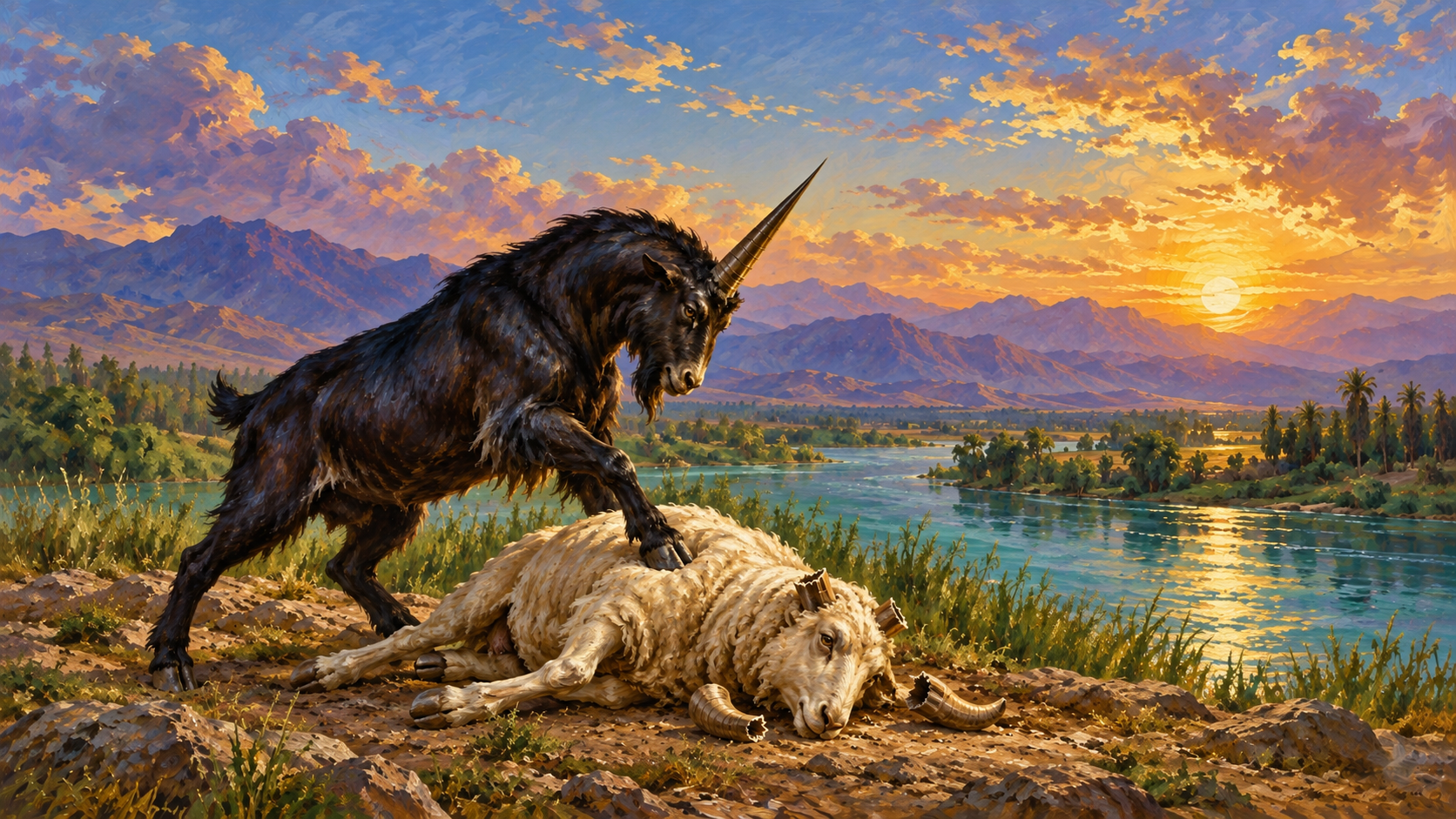
And as I was considering, suddenly a male goat came from the west, across the surface of the whole earth, without touching the ground; and the goat had a notable horn between his eyes.
The movement “without touching the ground” also fits the pace of Alexander’s victories. The image portrays the speed with which a new power overtook the ram. Within a remarkably short period, Alexander had broken the empire whose reach had seemed so formidable.
In Daniel’s vision, the goat attacked the ram, broke its horns, knocked it down, and trampled it. The ram that had previously seemed beyond anyone’s power to resist could no longer defend itself. Gabriel identifies the animals and the goat’s prominent horn:
The ram which you saw, having the two horns, they are the kings of Media and Persia.
And the male goat is the kingdom of Greece. The large horn that is between its eyes is the first king.
Media and Persia are identified in the ram, while Greece is identified in the goat. I do not have to derive those names from an imaginative reading of the animals. They are in the inspired explanation. Alexander’s armies came from the west and shattered Persian power, matching the conflict in Daniel’s vision.
The phrase “first king” does not mean Alexander founded the Macedonian monarchy. Philip had ruled before him, and there had been Macedonian kings before Philip. Alexander was the first great ruler of the Greek empire that defeated Persia in this prophetic sequence. His prominence in that conquest explains why I identify him with the single large horn.
The Broken Horn and Four Successor Kingdoms
The goat’s success did not leave its great horn permanently in place. Daniel saw it broken at the height of its strength:
Therefore the male goat grew very great; but when he became strong, the large horn was broken, and in place of it four notable ones came up toward the four winds of heaven.
Gabriel explains both the breaking and the replacement:
As for the broken horn and the four that stood up in its place, four kingdoms shall arise out of that nation, but not with its power.
Alexander died young while his power was still immense. His death was not followed by the stable transfer of his whole dominion to a son. The successors who contested his lands formed kingdoms of their own, without reproducing his united empire. That is the historical outcome I understand Daniel to be describing.
The familiar four-part division is associated with Cassander in Macedonia and Greece, Lysimachus in Thrace and parts of Asia Minor, Seleucus in Syria and the eastern territories, and Ptolemy in Egypt. A historical map preserved by the Library of Congress shows these four principal kingdoms after the Battle of Ipsus in 301 B.C. That date is more than twenty years after Alexander’s death. We should not describe four generals peacefully receiving four neatly bounded kingdoms the moment he died.
Wars, shifting alliances, and assassinations shaped the division, and boundaries continued to change afterward. Daniel’s vision condenses the outcome into four horns arising from the broken horn’s place. It does not claim that these were the only rulers involved in every stage of the struggle or that their borders would remain fixed indefinitely.
Daniel 11 gives another description of the same change from one mighty king to a divided kingdom:
Then a mighty king shall arise, who shall rule with great dominion, and do according to his will.
And when he has arisen, his kingdom shall be broken up and divided toward the four winds of heaven, but not among his posterity nor according to his dominion with which he ruled; for his kingdom shall be uprooted, even for others besides these.
Here the prophecy expressly says that the kingdom would not pass to the ruler’s posterity, meaning his descendants. Alexander’s heirs did not preserve his empire, and the successor powers shaped later events affecting Israel. The contests between the Seleucid rulers to the north and the Ptolemaic rulers in Egypt provide the setting for much of the subsequent conflict in Daniel 11. His death therefore leads into the events the later vision follows; it is not an isolated prediction with no connection to God’s people.
The Greek World and the Trustworthiness of Prophecy
Alexander’s conquests also helped spread Greek language and culture across the eastern Mediterranean and Near East. The period following his death is called Hellenistic, referring to the spread and development of Greek culture among these peoples. The Metropolitan Museum’s survey of the Hellenistic age describes that wider world of Greek-speaking kingdoms and cultural exchange.
By New Testament times, Greek provided a common language across many regions of the Roman world. People retained local languages, but the widespread use of Greek helped the apostles communicate in different cities and write to churches across considerable distances. It also helps explain why the New Testament was written in Greek. Centuries after Alexander’s campaigns, the language his conquests had helped spread was being used to proclaim Jesus Christ.
Recognizing that use of Greek does not change my position on the Old Testament text. The Septuagint is a Greek translation of the Hebrew Scriptures; the Masoretic Text is the received Hebrew text. I use the Hebrew Scriptures as the proper base for Old Testament language work, rather than make a Greek translation an authority that corrects them. The historical spread of Greek and the textual authority of Hebrew are different questions.
Greek helped the apostles communicate, but only Christ could save the people who heard them. God could use those historical circumstances to carry His message beyond the boundaries of one nation. That does not make Alexander’s pride or the violence of conquest righteous. A ruler remains accountable for his actions even when God uses their aftermath for purposes the ruler did not direct.
Daniel’s detailed descriptions also raise a question about when the book was written. Many readers who date it late understand its accounts of Greece and the Hellenistic conflicts as descriptions written after the events and presented as prediction. Historical and language questions need to be examined honestly, but the mere fact that a prophecy is specific cannot prove that it was written afterward.
I reject the assumption that God cannot reveal a ruler’s rise and fall before it happens. Daniel is presented as a prophet living in the Babylonian and Persian setting, and Jesus refers to “Daniel the prophet.” The book itself gives this explanation of God’s knowledge and authority:
And He changes the times and the seasons; He removes kings and raises up kings; He gives wisdom to the wise And knowledge to those who have understanding.
If God raises and removes kings, accurate knowledge of their future is not beyond Him. Gabriel’s explanation names Media-Persia and Greece, then describes the first great Greek king, the breaking of the great horn, and the division that follows. I receive that as inspired prophecy. Historical study should help us understand the fulfillment, rather than begin by ruling out the possibility of what Scripture says God revealed.
The study on the seventy weeks of Daniel examines another prophecy in the book. These passages need their own careful reading; identifying Alexander in chapter 8 does not relieve us of the work of understanding the other visions.
The Most High Rules Human Kingdoms
Alexander’s military ability was real, and his victories caused real upheaval. Neither his brilliance nor his fame made him independent of God. Daniel had already recorded the lesson Nebuchadnezzar needed to learn:
This decision is by the decree of the watchers, And the sentence by the word of the holy ones, In order that the living may know That the Most High rules in the kingdom of men, Gives it to whomever He will, And sets over it the lowest of men.
Paul later spoke of God’s authority over nations when he addressed the Athenians:
And He has made from one blood every nation of men to dwell on all the face of the earth, and has determined their preappointed times and the boundaries of their dwellings.
These passages do not remove the decisions made by kings, generals, and nations. They tell us that those people cannot put themselves beyond God’s authority. Borders change, armies advance, and rulers die, while the God who knows their times and boundaries continues to govern. His knowledge of their actions does not excuse their cruelty or turn their victims’ suffering into something trivial.
Alexander could conquer enormous territories without being able to preserve his own life. He could leave Greek culture spread across many lands without controlling what later generations would do with it. His successors could claim portions of his empire without possessing the whole dominion he had exercised. Those are specific limits on the greatness people so readily admire.
I need to remember those limits when a modern power seems unstoppable. Daniel was living under Gentile rule when he received visions of more empires still to come. God did not promise that His people would never suffer beneath them. He did reveal that their rise and fall were known to Him and that their rule would not last forever. I can take political danger seriously without treating any ruler as the final authority over our future.
The kingdom God establishes will outlast the powers represented by the image and the beasts. I understand its fulfillment in Jesus Christ, who will return bodily and reign as King. The study on the end-times timeline follows the wider prophetic sequence. Alexander’s career explains part of Daniel’s vision; Christ’s everlasting kingdom supplies the hope toward which it leads.
Jesus first came as the sinless Son, fully God and fully man. Wicked people inflicted the bodily suffering He willingly endured, and He shed His blood and died for sinners. His saving work through His blood and death was complete before He rose bodily from the grave. We receive His salvation through repentance and faith, not by attaching ourselves to a powerful nation or celebrating a conqueror.
My Final Thoughts
I recognize Alexander in Daniel because the inspired explanation names Greece and describes a sequence his career fits: the defeat of Persia, the prominence of the first great ruler, his fall, and the emergence of lesser kingdoms. We can study those connections carefully without pretending that Daniel names every successor or provides an instant map of the empire’s division.
The result should be confidence in God’s Word and a clearer understanding of the limits of human power. Alexander could win battles but could not secure an everlasting kingdom. Jesus Christ will reign in the kingdom that cannot be destroyed. I want that promise to govern my hope more than the rise or collapse of any earthly empire.