
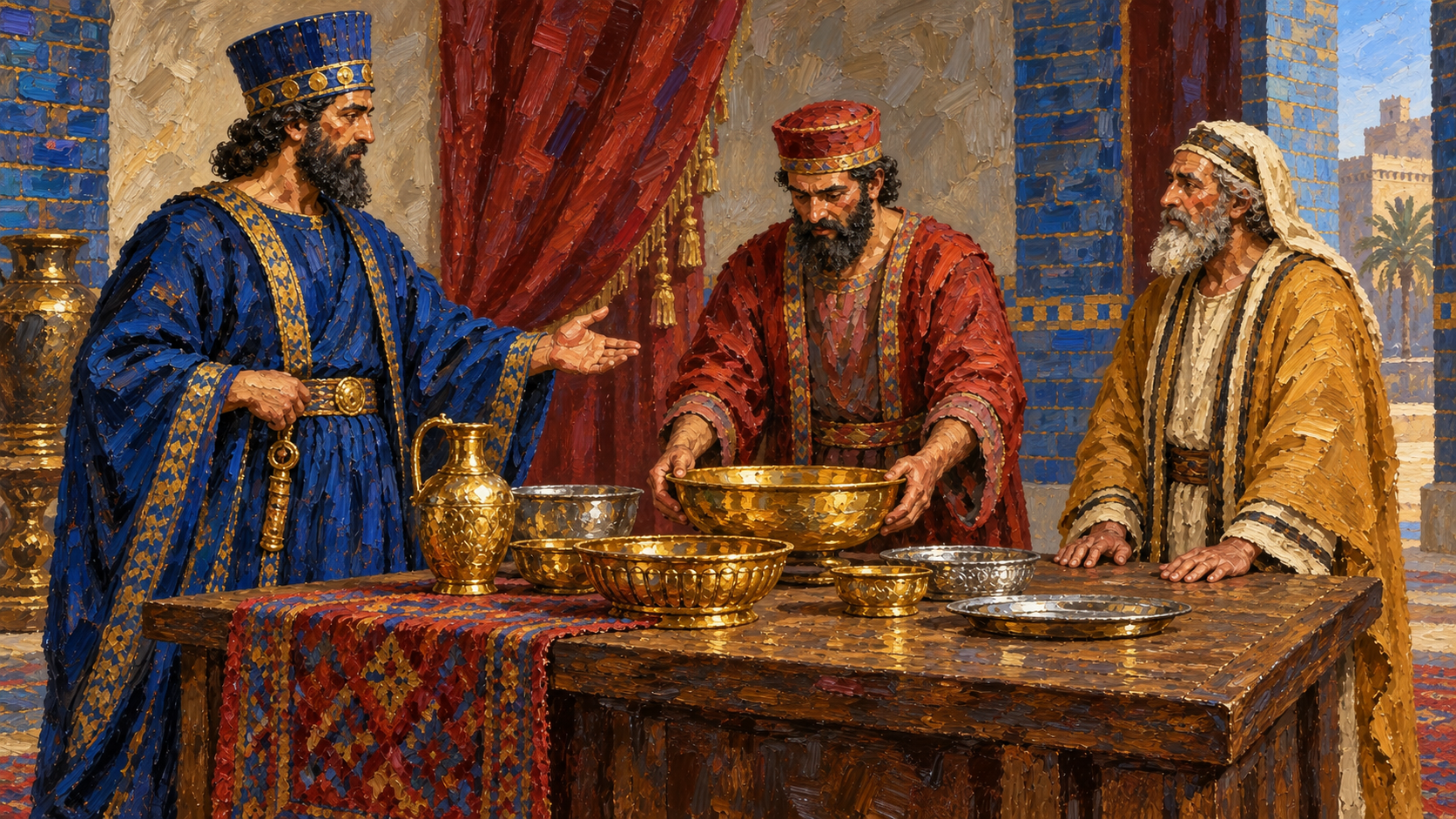
God called Cyrus His shepherd and His anointed while also saying that Cyrus did not know Him. This foreign king would overthrow Babylon and authorize the exiles to return to Jerusalem. I take both parts of that description seriously. God appointed him to a particular work, but the appointment did not make him a believer or another Messiah. To understand why God gave him those titles, we need to follow the commission through Isaiah’s prophecy, Babylon’s fall, and the rebuilding that continued after Cyrus died.
Cyrus Was Named and Commissioned by God
Cyrus II, usually called Cyrus the Great, began as king of Anshan in what is now southwestern Iran. He defeated Media around 550 BC and established the empire known as Achaemenid, a name referring to his royal dynasty. He also conquered Lydia in western Asia Minor, now part of Turkey, before taking Babylon in 539 BC. His territories stretched through Mesopotamia, the region around the Tigris and Euphrates Rivers, across Iran and toward Central and South Asia. He died in 530 BC while campaigning in the east.
Those dates help explain a detail in Ezra. Cyrus had already ruled in Persia for years when Babylon fell. Ezra’s reference to his first year concerns his rule over the conquered Babylonian kingdom, with the decree generally dated around 538 BC. It does not mean that Cyrus first became a king then. Likewise, his description of receiving “all the kingdoms of the earth” is the language of an emperor describing his enormous dominion, without requiring us to put every modern continent under Persian administration.
Isaiah ministered in the eighth century BC, well over a century before Cyrus rose to power. God named the king before the events and specified what would happen to Jerusalem and the temple. Cyrus’s precise birth year is uncertain, so I would not advertise an exact number of years before his birth. The prophecy is plainly predictive without an inflated number. Here is what God said:
Thus says the LORD, your Redeemer, And He who formed you from the womb: “I am the LORD, who makes all things, Who stretches out the heavens all alone, Who spreads abroad the earth by Myself; Who frustrates the signs of the babblers, And drives diviners mad; Who turns wise men backward, And makes their knowledge foolishness; Who confirms the word of His servant, And performs the counsel of His messengers; Who says to Jerusalem, ‘You shall be inhabited,’ To the cities of Judah, ‘You shall be built,’ And I will raise up her waste places; Who says to the deep, ‘Be dry! And I will dry up your rivers’; Who says of Cyrus, ‘He is My shepherd, And he shall perform all My pleasure, Saying to Jerusalem, “You shall be built,” And to the temple, “Your foundation shall be laid.”‘
The LORD is answering the claims of idols and diviners, people who claim to uncover hidden knowledge. He made the heavens and earth, frustrates false predictions, and confirms the words of His own messengers. His promise about Cyrus is therefore more than an impressive prediction of a man’s name. God is announcing what He will accomplish through that man when Jerusalem lies ruined and rebuilding appears out of reach. The larger study on Isaiah follows that argument throughout the book.
God calls Cyrus “My shepherd” because He is assigning the king work on behalf of His people. A ruler can be described as shepherding those under his care without becoming their spiritual pastor or their Savior. Cyrus would bring down Babylon, release the exiles, and authorize the work that led to a restored temple and city. Those things unfolded over time. The title describes his commission; it does not endorse every war, ambition, or religious practice of his reign.
Isaiah then uses the more surprising title, “His anointed.” The Hebrew word is mashiach, from which we get “Messiah.” Anointing with oil marked people out for offices such as king or priest. Here God applies the language to a foreign ruler whom He has set apart for a task; the passage does not describe an Israelite priest actually pouring oil on Cyrus.
“Thus says the LORD to His anointed, To Cyrus, whose right hand I have held– To subdue nations before him And loose the armor of kings, To open before him the double doors, So that the gates will not be shut: ‘I will go before you And make the crooked places straight; I will break in pieces the gates of bronze And cut the bars of iron. I will give you the treasures of darkness And hidden riches of secret places, That you may know that I, the LORD, Who call you by your name, Am the God of Israel. For Jacob My servant’s sake, And Israel My elect, I have even called you by your name; I have named you, though you have not known Me. I am the LORD, and there is no other; There is no God besides Me. I will gird you, though you have not known Me, That they may know from the rising of the sun to its setting That there is none besides Me. I am the LORD, and there is no other; I form the light and create darkness, I make peace and create calamity; I, the LORD, do all these things.’ “Rain down, you heavens, from above, And let the skies pour down righteousness; Let the earth open, let them bring forth salvation, And let righteousness spring up together. I, the LORD, have created it. “Woe to him who strives with his Maker! Let the potsherd strive with the potsherds of the earth! Shall the clay say to him who forms it, ‘What are you making?’ Or shall your handiwork say, ‘He has no hands’? Woe to him who says to his father, ‘What are you begetting?’ Or to the woman, ‘What have you brought forth?'” Thus says the LORD, The Holy One of Israel, and his Maker: “Ask Me of things to come concerning My sons; And concerning the work of My hands, you command Me. I have made the earth, And created man on it. I–My hands–stretched out the heavens, And all their host I have commanded. I have raised him up in righteousness, And I will direct all his ways; He shall build My city And let My exiles go free, Not for price nor reward,” Says the LORD of hosts.
God explains the commission by describing His hold on Cyrus’s right hand. He will subdue nations and open barriers before him for the sake of Jacob and Israel. Cyrus will release the exiles and serve the rebuilding of God’s city. His appointment is not a reward for first becoming a faithful worshiper of the LORD. Twice God says he had not known Him. The initiative belongs to God, who names and equips the king without depending on his prior knowledge of Him. Through this work, people from east to west would learn that the LORD alone is God. His purpose extends beyond Cyrus’s success to Israel’s restoration and the acknowledgment of His own name.
Being called anointed in this setting does not make Cyrus the promised Christ. He is not the eternal Son, the sinless Savior, Israel’s Davidic King, or the priest who brings us to God. Scripture uses a title according to the office and work being described. Cyrus’s earthly assignment cannot be expanded into all that belongs to Jesus. Nor can we read a conversion into this prophecy. It leaves open what Cyrus might have come to believe later, but Scripture does not tell us his final spiritual condition.
Within the same passage, Isaiah 45:7 says God creates calamity. Some English versions use “evil,” which can sound as though God is claiming to create moral wickedness. The Hebrew word ra can describe either evil or disaster; here it stands opposite peace or well-being. God is speaking about bringing calamity in judgment, including the overthrow of kingdoms. He is holy, never commits or approves sin, and never tempts anyone to do evil. A human aggressor still answers for his motives and deeds even when God directs the outcome toward a promised judgment or deliverance.
Cyrus, Babylon, and the Historical Record
Babylon fell to Persian forces in 539 BC. The Nabonidus Chronicle, an ancient Babylonian record, describes fighting at Opis before Cyrus’s army entered Babylon without a battle. A peaceful entry into the capital should therefore not be confused with a campaign in which nobody fought or died. Isaiah’s language about opened doors tells us that God would remove the barriers before Cyrus.
Daniel records what happened to Belshazzar on the night Babylon fell. The king had profaned the vessels taken from Jerusalem’s temple, drinking from them while praising idols. Daniel confronted him with the humiliation of Nebuchadnezzar, which Belshazzar already knew about, and then explained the writing God had sent.
Then Daniel answered, and said before the king, “Let your gifts be for yourself, and give your rewards to another; yet I will read the writing to the king, and make known to him the interpretation. O king, the Most High God gave Nebuchadnezzar your father a kingdom and majesty, glory and honor. And because of the majesty that He gave him, all peoples, nations, and languages trembled and feared before him. Whomever he wished, he executed; whomever he wished, he kept alive; whomever he wished, he set up; and whomever he wished, he put down. But when his heart was lifted up, and his spirit was hardened in pride, he was deposed from his kingly throne, and they took his glory from him. Then he was driven from the sons of men, his heart was made like the beasts, and his dwelling was with the wild donkeys. They fed him with grass like oxen, and his body was wet with the dew of heaven, till he knew that the Most High God rules in the kingdom of men, and appoints over it whomever He chooses. “But you his son, Belshazzar, have not humbled your heart, although you knew all this. And you have lifted yourself up against the Lord of heaven. They have brought the vessels of His house before you, and you and your lords, your wives and your concubines, have drunk wine from them. And you have praised the gods of silver and gold, bronze and iron, wood and stone, which do not see or hear or know; and the God who holds your breath in His hand and owns all your ways, you have not glorified. Then the fingers of the hand were sent from Him, and this writing was written. “And this is the inscription that was written: MENE, MENE, TEKEL, UPHARSIN. This is the interpretation of each word. MENE: God has numbered your kingdom, and finished it; TEKEL: You have been weighed in the balances, and found wanting; PERES: Your kingdom has been divided, and given to the Medes and Persians.” Then Belshazzar gave the command, and they clothed Daniel with purple and put a chain of gold around his neck, and made a proclamation concerning him that he should be the third ruler in the kingdom. That very night Belshazzar, king of the Chaldeans, was slain. And Darius the Mede received the kingdom, being about sixty-two years old.
Belshazzar’s knowledge made his defiance deliberate. He had honored lifeless gods while refusing to humble himself before the God who held his breath and his ways. Babylon’s transfer to the Medes and Persians was therefore a judgment upon an accountable king, not merely the next change in imperial administration.
Later Greek accounts, particularly Herodotus, describe a diverted river and troops entering beneath the city’s defenses. Those details are often repeated as though Daniel supplied them. Daniel records Belshazzar’s death and Darius the Mede receiving the kingdom, without describing the army’s route into the city. The Babylonian record and the later Greek account also differ in what they emphasize. We should distinguish the biblical statements from attempts to reconstruct the military operation.
Daniel 6:28 says Daniel prospered during the reign of Darius and the reign of Cyrus the Persian, and Daniel 10:1 dates a revelation to Cyrus’s third year. The wording in Daniel 6 can distinguish successive administrations. Darius the Mede’s precise identity, however, remains debated. Proposals include a governor under Cyrus, a transitional ruler, or an alternate royal name; some identify him with Cyrus through a Median connection. The surviving evidence has not settled those proposals. Daniel says Darius received the kingdom, and the external records identify Cyrus as the conquering imperial king. Equating the two men as an established fact goes beyond what we presently know.
Another witness to the conquest is the Cyrus Cylinder in the British Museum. This clay inscription presents Cyrus’s rule in Babylonian religious language. It attributes his success to Marduk, describes returning religious images and displaced inhabitants, and records building work. The translated inscription illustrates the religious and restoration policies through which he presented his rule to conquered peoples.
The cylinder does not name the Jews, Judah, Jerusalem, or the decree to rebuild the temple. It supports our understanding of a broader restoration policy consistent with Ezra, but it is not the original copy of Ezra’s decree or direct archaeological proof of that particular proclamation. Calling it the first modern charter of human rights also asks an ancient royal inscription to carry a claim it was never written to make. Its value is substantial without exaggeration. The British Museum’s Cyrus Cylinder record provides the artifact’s collection details.
The Decree and the Return From Exile
Where the Babylonian inscription credits Marduk, Scripture tells us who actually brought about Judah’s release. The close of 2 Chronicles traces the exile back to God’s repeated warnings and Judah’s persistent refusal to listen. God had compassion on His people, but they mocked His messengers until judgment came. His later mercy through Cyrus did not mean those earlier warnings had been empty threats.
And the LORD God of their fathers sent warnings to them by His messengers, rising up early and sending them, because He had compassion on His people and on His dwelling place. But they mocked the messengers of God, despised His words, and scoffed at His prophets, until the wrath of the LORD arose against His people, till there was no remedy. Therefore He brought against them the king of the Chaldeans, who killed their young men with the sword in the house of their sanctuary, and had no compassion on young man or virgin, on the aged or the weak; He gave them all into his hand. And all the articles from the house of God, great and small, the treasures of the house of the LORD, and the treasures of the king and of his leaders, all these he took to Babylon. Then they burned the house of God, broke down the wall of Jerusalem, burned all its palaces with fire, and destroyed all its precious possessions. And those who escaped from the sword he carried away to Babylon, where they became servants to him and his sons until the rule of the kingdom of Persia, to fulfill the word of the LORD by the mouth of Jeremiah, until the land had enjoyed her Sabbaths. As long as she lay desolate she kept Sabbath, to fulfill seventy years. Now in the first year of Cyrus king of Persia, that the word of the LORD by the mouth of Jeremiah might be fulfilled, the LORD stirred up the spirit of Cyrus king of Persia, so that he made a proclamation throughout all his kingdom, and also put it in writing, saying, Thus says Cyrus king of Persia: All the kingdoms of the earth the LORD God of heaven has given me. And He has commanded me to build Him a house at Jerusalem which is in Judah. Who is among you of all His people? May the LORD his God be with him, and let him go up!
The conquest destroyed the temple, broke Jerusalem’s defenses, and carried its people into captivity. Yet the LORD who judged their rebellion also kept His promise through Jeremiah. He stirred Cyrus to issue a written proclamation allowing the people to go up to Jerusalem. Ezra begins with that proclamation and then follows the people and property involved in the return:
Now in the first year of Cyrus king of Persia, that the word of the LORD by the mouth of Jeremiah might be fulfilled, the LORD stirred up the spirit of Cyrus king of Persia, so that he made a proclamation throughout all his kingdom, and also put it in writing, saying, Thus says Cyrus king of Persia: All the kingdoms of the earth the LORD God of heaven has given me. And He has commanded me to build Him a house at Jerusalem which is in Judah. Who is among you of all His people? May his God be with him, and let him go up to Jerusalem which is in Judah, and build the house of the LORD God of Israel (He is God), which is in Jerusalem. And whoever is left in any place where he dwells, let the men of his place help him with silver and gold, with goods and livestock, besides the freewill offerings for the house of God which is in Jerusalem. Then the heads of the fathers’ houses of Judah and Benjamin, and the priests and the Levites, with all whose spirits God had moved, arose to go up and build the house of the LORD which is in Jerusalem. And all those who were around them encouraged them with articles of silver and gold, with goods and livestock, and with precious things, besides all that was willingly offered. King Cyrus also brought out the articles of the house of the LORD, which Nebuchadnezzar had taken from Jerusalem and put in the temple of his gods; and Cyrus king of Persia brought them out by the hand of Mithredath the treasurer, and counted them out to Sheshbazzar the prince of Judah. This is the number of them: thirty gold platters, one thousand silver platters, twenty-nine knives, thirty gold basins, four hundred and ten silver basins of a similar kind, and one thousand other articles. All the articles of gold and silver were five thousand four hundred. All these Sheshbazzar took with the captives who were brought from Babylon to Jerusalem.
The decree authorized the rebuilding of the house of the LORD. Neighbors were to help the returning people with silver, gold, goods, livestock, and voluntary offerings. Cyrus also released the temple vessels Nebuchadnezzar had carried away. These included vessels Belshazzar had profaned at his feast. The temple articles were now counted and entrusted to Sheshbazzar, the prince of Judah, through Mithredath the royal treasurer. This was actual restitution of sacred property taken in conquest.
The returned vessels linked the community with the worship of the God of Israel before the exile. They were restoring worship under the written law, not inventing a religion to suit Persian rule. The new temple would differ from Solomon’s in its glory and furnishings, but it remained the house of the same God.
Cyrus’s permission began the restoration; it did not immediately produce a finished city, completed walls, or even a completed temple. Later rulers would confirm and support further work. Nor did every Jewish exile return. Families had established lives in Babylonia, and leaving meant preparing for a demanding journey and rebuilding in a damaged homeland. Ezra records those whom God moved to go, including priests, Levites, household leaders, servants, and other members of the community. This returning portion of the people is often called the remnant.
Sheshbazzar received the vessels, while Zerubbabel and Jeshua appear prominently in the restored community’s leadership. Zerubbabel served as governor and Jeshua as high priest. Both helped lead the work on the altar and temple. Some interpreters identify Sheshbazzar and Zerubbabel as the same man under different names; others understand them as distinct officials. Their precise relationship is uncertain, but the responsibilities Ezra assigns to each can be followed without resolving it.
The return fulfilled God’s word, but the remnant did not exhaust His remaining covenant promises. The complete national and spiritual restoration promised to Israel still awaits Messiah. We can recognize what God accomplished through this return without treating it as the completion of every promise about Israel’s future.
Rebuilding Through Opposition
Once the people were settled in their cities, they assembled in Jerusalem. Jeshua, Zerubbabel, and their fellow leaders rebuilt the altar so sacrifices could resume even before the temple foundation was laid. The surrounding peoples frightened them, but they proceeded according to the law of Moses. They also kept the Feast of Tabernacles, the festival of temporary shelters commemorating Israel’s wilderness years.
And when the seventh month had come, and the children of Israel were in the cities, the people gathered together as one man to Jerusalem. Then Jeshua the son of Jozadak and his brethren the priests, and Zerubbabel the son of Shealtiel and his brethren, arose and built the altar of the God of Israel, to offer burnt offerings on it, as it is written in the Law of Moses the man of God. Though fear had come upon them because of the people of those countries, they set the altar on its bases; and they offered burnt offerings on it to the LORD, both the morning and evening burnt offerings. They also kept the Feast of Tabernacles, as it is written, and offered the daily burnt offerings in the number required by ordinance for each day. Afterwards they offered the regular burnt offering, and those for New Moons and for all the appointed feasts of the LORD that were consecrated, and those of everyone who willingly offered a freewill offering to the LORD. From the first day of the seventh month they began to offer burnt offerings to the LORD, although the foundation of the temple of the LORD had not been laid. They also gave money to the masons and the carpenters, and food, drink, and oil to the people of Sidon and Tyre to bring cedar logs from Lebanon to the sea, to Joppa, according to the permission which they had from Cyrus king of Persia. Now in the second month of the second year of their coming to the house of God at Jerusalem, Zerubbabel the son of Shealtiel, Jeshua the son of Jozadak, and the rest of their brethren the priests and the Levites, and all those who had come out of the captivity to Jerusalem, began work and appointed the Levites from twenty years old and above to oversee the work of the house of the LORD. Then Jeshua with his sons and brothers, Kadmiel with his sons, and the sons of Judah, arose as one to oversee those working on the house of God: the sons of Henadad with their sons and their brethren the Levites. When the builders laid the foundation of the temple of the LORD, the priests stood in their apparel with trumpets, and the Levites, the sons of Asaph, with cymbals, to praise the LORD, according to the ordinance of David king of Israel. And they sang responsively, praising and giving thanks to the LORD: “For He is good, For His mercy endures forever toward Israel.” Then all the people shouted with a great shout, when they praised the LORD, because the foundation of the house of the LORD was laid. But many of the priests and Levites and heads of the fathers’ houses, old men who had seen the first temple, wept with a loud voice when the foundation of this temple was laid before their eyes. Yet many shouted aloud for joy, so that the people could not discern the noise of the shout of joy from the noise of the weeping of the people, for the people shouted with a loud shout, and the sound was heard afar off.
The foundation ceremony brought together praise, shouting, and weeping. Some older priests, Levites, and household leaders had seen the first temple. Their tears mingled with the celebration until listeners could no longer distinguish the sounds. Ezra records their response without explaining every thought behind it. I would not condemn all those who wept as unbelieving or assume that everyone experienced the occasion in the same way.
By this stage we are watching far more than an emperor’s decree. Returnees had built the altar, obtained timber and supplies, organized workers, and begun construction. Priests sounded trumpets, Levites praised the LORD, and families contributed what they had. God had stirred Cyrus, but He had also stirred His own people to leave Babylon and undertake the work. Giving the king credit for the entire restoration overlooks the men and women who actually carried it forward.
Local adversaries then offered to help with the temple. They claimed to seek Israel’s God and referred to their resettlement under the Assyrian king Esarhaddon. Zerubbabel and the other leaders refused the proposed partnership because the commission to rebuild belonged to the returned community. Their refusal concerned who would undertake this covenant work; it was not a command to treat every outsider as an enemy.
Now when the adversaries of Judah and Benjamin heard that the descendants of the captivity were building the temple of the LORD God of Israel, they came to Zerubbabel and the heads of the fathers’ houses, and said to them, “Let us build with you, for we seek your God as you do; and we have sacrificed to Him since the days of Esarhaddon king of Assyria, who brought us here.” But Zerubbabel and Jeshua and the rest of the heads of the fathers’ houses of Israel said to them, “You may do nothing with us to build a house for our God; but we alone will build to the LORD God of Israel, as King Cyrus the king of Persia has commanded us.” Then the people of the land tried to discourage the people of Judah. They troubled them in building, and hired counselors against them to frustrate their purpose all the days of Cyrus king of Persia, even until the reign of Darius king of Persia.
The adversaries answered the refusal by discouraging the builders and hiring counselors to frustrate them. Ezra traces this opposition from Cyrus’s reign into Darius’s. The following part of Ezra 4 then groups later complaints under Ahasuerus and Artaxerxes before verse 24 returns to the temple work under Darius. The chapter arranges those examples by subject rather than keeping every event in chronological order. Otherwise we can easily mistake the later accusations for events immediately following Cyrus’s decree.
Political permission had not removed fear, resistance, or the people’s own misplaced priorities. Haggai and Zechariah called them back to the unfinished temple. When construction resumed, Persian officials investigated and sent a report to Darius. He ordered a search for Cyrus’s original authorization. The memorandum was found at Achmetha, also known as Ecbatana, in Media, and Darius confirmed the earlier decree.
Then King Darius issued a decree, and a search was made in the archives, where the treasures were stored in Babylon. And at Achmetha, in the palace that is in the province of Media, a scroll was found, and in it a record was written thus: In the first year of King Cyrus, King Cyrus issued a decree concerning the house of God at Jerusalem: “Let the house be rebuilt, the place where they offered sacrifices; and let the foundations of it be firmly laid, its height sixty cubits and its width sixty cubits, with three rows of heavy stones and one row of new timber. Let the expenses be paid from the king’s treasury. Also let the gold and silver articles of the house of God, which Nebuchadnezzar took from the temple which is in Jerusalem and brought to Babylon, be restored and taken back to the temple which is in Jerusalem, each to its place; and deposit them in the house of God”– Now therefore, Tattenai, governor of the region beyond the River, and Shethar-Boznai, and your companions the Persians who are beyond the River, keep yourselves far from there. Let the work of this house of God alone; let the governor of the Jews and the elders of the Jews build this house of God on its site. Moreover I issue a decree as to what you shall do for the elders of these Jews, for the building of this house of God: Let the cost be paid at the king’s expense from taxes on the region beyond the River; this is to be given immediately to these men, so that they are not hindered. And whatever they need–young bulls, rams, and lambs for the burnt offerings of the God of heaven, wheat, salt, wine, and oil, according to the request of the priests who are in Jerusalem–let it be given them day by day without fail, that they may offer sacrifices of sweet aroma to the God of heaven, and pray for the life of the king and his sons. Also I issue a decree that whoever alters this edict, let a timber be pulled from his house and erected, and let him be hanged on it; and let his house be made a refuse heap because of this. And may the God who causes His name to dwell there destroy any king or people who put their hand to alter it, or to destroy this house of God which is in Jerusalem. I Darius issue a decree; let it be done diligently. Then Tattenai, governor of the region beyond the River, Shethar-Boznai, and their companions diligently did according to what King Darius had sent. So the elders of the Jews built, and they prospered through the prophesying of Haggai the prophet and Zechariah the son of Iddo. And they built and finished it, according to the commandment of the God of Israel, and according to the command of Cyrus, Darius, and Artaxerxes king of Persia. Now the temple was finished on the third day of the month of Adar, which was in the sixth year of the reign of King Darius.
Darius ordered the regional officials to stop interfering and to fund the building from royal revenues collected in the area. Supplies for the sacrifices were also to be provided. The decree includes severe penalties for anyone who altered it, along with the king’s request that the priests pray for him and his sons. The temple was finished in Darius I’s sixth year, commonly dated to 516 BC. Cyrus, who had died in 530 BC, did not live to see the result of his permission.
Ezra 6:14 also includes Artaxerxes in its summary of royal support. His later assistance belongs to the continued restoration, including Ezra’s mission in chapter 7; verse 15 explicitly dates the temple’s completion to Darius’s reign. We should not move Artaxerxes ahead of Darius to fit that summary into a single construction period. The study on the building of the second temple follows this work more closely.
God’s promise held through more than one reign, but the builders still needed correction and perseverance. The prophets called them back to obedience, officials investigated the legal authority, and the elders and workers finished the building. A favorable decision at the beginning had not spared them years of responsibility.
Jeremiah’s Seventy Years and God’s Rule Over Kings
Cyrus’s decree fulfilled a promise God had made before the exile ended. Jeremiah announced that Judah and the surrounding nations would serve Babylon for seventy years, after which God would punish Babylon itself. Nebuchadnezzar could carry out God’s judgment and still be answerable for his kingdom’s wickedness.
“Therefore thus says the LORD of hosts: ‘Because you have not heard My words, behold, I will send and take all the families of the north,’ says the LORD, ‘and Nebuchadnezzar the king of Babylon, My servant, and will bring them against this land, against its inhabitants, and against these nations all around, and will utterly destroy them, and make them an astonishment, a hissing, and perpetual desolations. Moreover I will take from them the voice of mirth and the voice of gladness, the voice of the bridegroom and the voice of the bride, the sound of the millstones and the light of the lamp. And this whole land shall be a desolation and an astonishment, and these nations shall serve the king of Babylon seventy years. ‘Then it will come to pass, when seventy years are completed, that I will punish the king of Babylon and that nation, the land of the Chaldeans, for their iniquity,’ says the LORD; ‘and I will make it a perpetual desolation. So I will bring on that land all My words which I have pronounced against it, all that is written in this book, which Jeremiah has prophesied concerning all the nations. (For many nations and great kings shall be served by them also; and I will repay them according to their deeds and according to the works of their own hands.)'”
In his letter to the exiles, Jeremiah also promised that God would visit them after the seventy years and bring them home. His assurance of a future and a hope was addressed to people who had to live through captivity. It did not erase the years of discipline or promise that everyone reading the letter would immediately return. God was assuring His people that He had not finished with them.
For thus says the LORD: After seventy years are completed at Babylon, I will visit you and perform My good word toward you, and cause you to return to this place. For I know the thoughts that I think toward you, says the LORD, thoughts of peace and not of evil, to give you a future and a hope. Then you will call upon Me and go and pray to Me, and I will listen to you. And you will seek Me and find Me, when you search for Me with all your heart. I will be found by you, says the LORD, and I will bring you back from your captivity; I will gather you from all the nations and from all the places where I have driven you, says the LORD, and I will bring you to the place from which I cause you to be carried away captive.
We need care when assigning historical dates to these passages. The interval from the early deportation in 605 BC to Babylon’s fall in 539 BC is sixty-six years, so those two dates alone do not demonstrate seventy years. One explanation counts Babylon’s regional dominance from the end of Assyrian resistance around 609 BC to its fall in 539 BC. That fits Jeremiah 25’s reference to the nations serving Babylon. Other calculations connect the beginning of Judah’s captivity with the actual return, whose precise date Ezra does not supply. A return in 536 BC, for example, permits an inclusive count of seventy years from 605 BC, but that proposed arrival date should not be presented as an explicit biblical statement.
A further seventy-year span is commonly counted from the temple’s destruction in 586 BC to its completion in 516 BC, in connection with Zechariah’s references to the desolation. These reckonings address related events with different starting and finishing points; they should not be collapsed into a claim that every verse dates exactly the same interval. Layton Talbert discusses the proposed periods and their assumptions. The historical questions do not change what Scripture identifies as fulfillment: Babylon’s allotted rule ended, God moved Cyrus to release the exiles, and His house was restored. The study on Jeremiah places the promises within the prophet’s ministry.
Ezra says God stirred Cyrus’s spirit, and Isaiah says He held the king’s right hand. Cyrus made actual decisions as a ruler, and those decisions brought about the release God had promised. Proverbs describes the LORD’s authority over a king’s heart while also insisting that God judges the heart and requires justice.
The king’s heart is in the hand of the LORD, Like the rivers of water; He turns it wherever He wishes. Every way of a man is right in his own eyes, But the LORD weighs the hearts. To do righteousness and justice Is more acceptable to the LORD than sacrifice.
A king may find his own conduct perfectly reasonable while God weighs it differently. God can direct circumstances, restrain ambition, bring counsel, or open an opportunity through which a ruler acts. He can also work through means He has not disclosed. None of that removes the ruler’s desires or his responsibility for his decisions. The command to do righteousness and justice still applies to the man whose heart is in God’s hand.
The LORD who directs a king’s heart can also ensure that the king carries out an announced purpose. Isaiah describes Him calling a ruler from far away for that work. In the setting of these prophecies, the man called from the east to execute His counsel points to Cyrus. Israel’s deliverance rests on God’s purpose, rather than on an idol’s supposed power or a king’s independent generosity.
“Remember this, and show yourselves men; Recall to mind, O you transgressors. Remember the former things of old, For I am God, and there is no other; I am God, and there is none like Me, Declaring the end from the beginning, And from ancient times things that are not yet done, Saying, ‘My counsel shall stand, And I will do all My pleasure,’ Calling a bird of prey from the east, The man who executes My counsel, from a far country. Indeed I have spoken it; I will also bring it to pass. I have purposed it; I will also do it. “Listen to Me, you stubborn-hearted, Who are far from righteousness: I bring My righteousness near, it shall not be far off; My salvation shall not linger. And I will place salvation in Zion, For Israel My glory.
God addresses people far from righteousness and promises to bring His salvation near to Zion. He is not congratulating Cyrus on making a plan that happened to suit Him. He has declared what He will do, and He will bring it to pass. Israel therefore has reason to trust Him even when the instrument of release is a foreign ruler.
What Cyrus Shows—and What He Does Not
Cyrus’s proclamation acknowledges the LORD God of heaven and His command concerning Jerusalem. We should receive the proclamation as Ezra records it. At the same time, the Babylonian inscription credits Marduk, and Isaiah says Cyrus did not know the LORD when God appointed him. Royal acknowledgment in a decree is not enough to establish exclusive faith in Israel’s God. Scripture records neither Cyrus’s rejection of idols nor his later conversion, so his eternal condition remains with God.
Nor did God’s use of Cyrus make every Persian campaign righteous. Assyria likewise served as the rod of God’s anger and then faced judgment for arrogance and cruelty. Babylon disciplined Judah and was later punished for its own violence and idolatry. God can accomplish His purpose through people whose sins He condemns. I can trust His government of events while still naming a ruler’s injustice and refusing to excuse it.
Christians sometimes call a modern political leader “Cyrus” because a policy benefits Israel or the church. As a loose comparison, the point may simply be that an imperfect ruler can make a useful decision. But Isaiah actually named Cyrus and specified his commission. We have no equivalent inspired passage naming a present president, prime minister, or monarch. An election victory, wealth, military success, a favorable court ruling, or access for religious groups cannot supply that missing revelation.
I can pray for those in authority, honor their lawful office, and thank God for a just decision without giving them blanket approval. When a leader lies, exploits people, or encourages wickedness, a beneficial policy elsewhere does not cancel the wrong. Calling someone Cyrus cannot place him beyond biblical judgment or turn political loyalty into a test of faithfulness to God.
Cyrus’s own work was temporary. He released people from geographic exile and authorized a physical temple, then died and left his empire to successors. Jesus is the eternal Son, the true Shepherd and promised Messiah. He is fully God and fully man, born of a virgin and completely sinless. Wicked men physically tortured and punished Him, then killed Him. He willingly endured that bodily punishment for our sins, shed His blood, and died. His saving work through His blood and death was complete before His burial and bodily resurrection. The Father did not punish, curse, abandon, strike, bruise, or pour wrath on Jesus.
Christ died for the whole world, and the offer of salvation is genuine to every person, though people can resist and reject His grace. Whoever repents and believes is forgiven and justified, declared righteous before God. That person is born again, with the Holy Spirit dwelling within and sealing them. Those who truly belong to Christ are eternally secure. Obedience is the fruit of that new life, not a payment that earns salvation or keeps us saved. Neither does security give permission for lawlessness or make a Christian label proof of regeneration. Jesus delivers His people from slavery to sin, will gather them to Himself, and will return bodily to reign forever.
My Final Thoughts
God named Cyrus before he rose to power and carried His promise through the king’s decree, the return, and years of rebuilding. The exiles could trust Him without confusing their benefactor with their Savior. I want to exercise the same discernment when a ruler does something good today: give thanks for the good, judge wrong honestly, and reserve the faith and devotion that belong to Jesus for Him. Every earthly ruler remains accountable to the eternal Shepherd and King.