
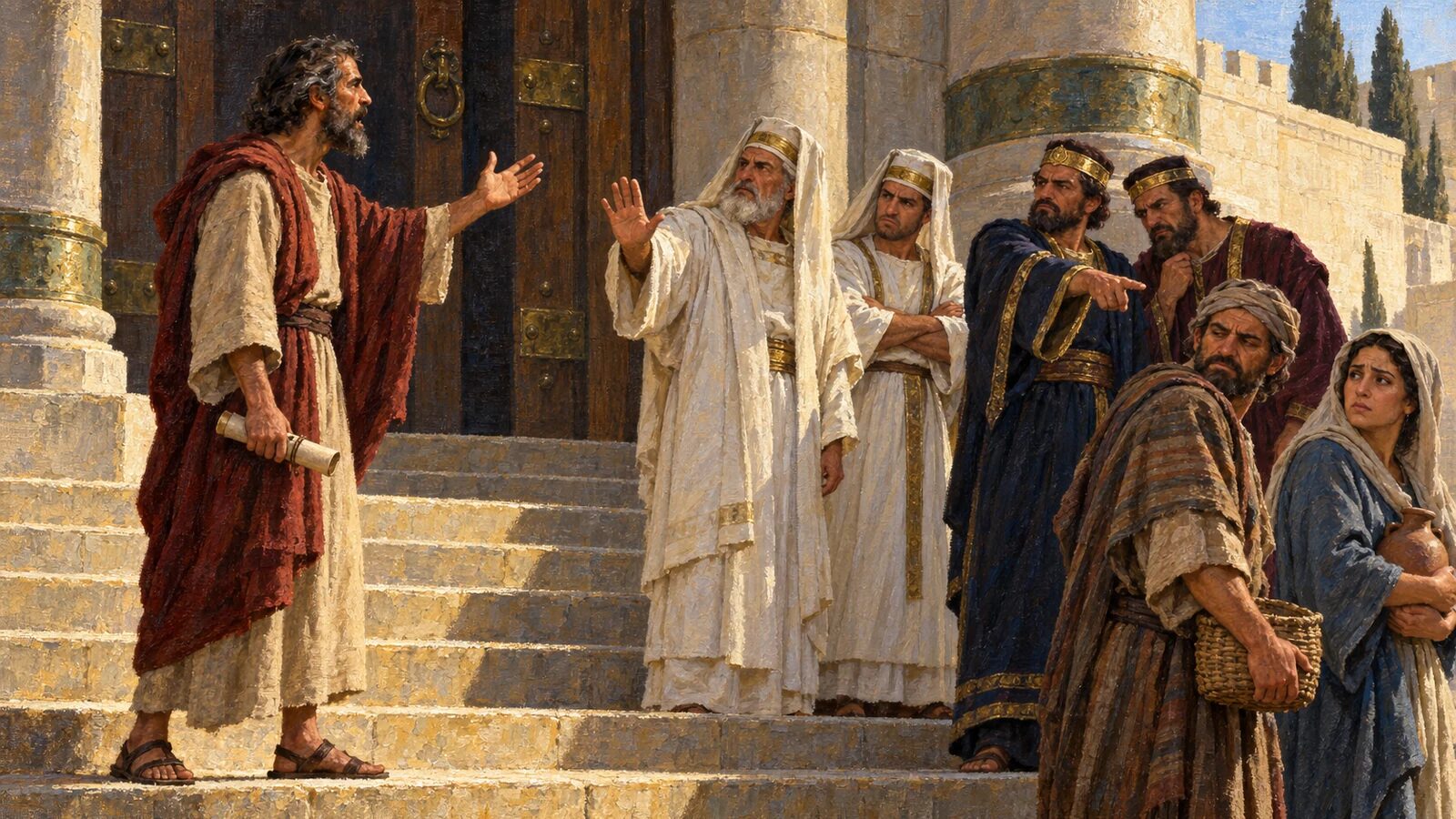
Jeremiah spent years speaking God’s word to people who did not want to hear it. Judah still had the temple and used religious language, yet the nation was moving toward Babylonian captivity because its heart had turned from the Lord. His life helps us understand both the cost of telling the truth and the hope God gives when judgment seems to have the final word.
God Formed, Knew, and Sent Jeremiah
Jeremiah kept warning the people while their leaders planned as though the nation were secure. The book lets us hear his grief without hiding the sin he confronted. I need to keep both in view to understand what God asked of him. Yet his message did not end in despair, because God also promised inward change and forgiven sin.
Jeremiah did not enter ministry to pursue a public cause or win admiration. God called him to work he would never have chosen for comfort. He had to speak to kings and priests, and also confront prophets and ordinary people. The warning he brought would involve grief and suffering, but the LORD still required him to speak.
God’s call was personal and specific. He appointed Jeremiah to a prophetic office with authority that came from His word. These were instructions for his work, not a motivational slogan.
Then the word of the LORD came to me, saying: “Before I formed you in the womb I knew you; Before you were born I sanctified you; I ordained you a prophet to the nations.”
God knew Jeremiah before forming him in the womb and set him apart before his birth. That order helps me understand why his life was not an accident that later became useful. The Lord knew whom He was sending and the nation he would face. He had chosen the time and given Jeremiah his assignment before he ever spoke. Judah would hear a prophet sent by God, not a frustrated citizen offering strong opinions.
God set Jeremiah apart for His use, which is what “sanctified” means here. It does not say that Jeremiah was sinless. The Hebrew verb yada, translated “knew,” can describe more than having information about someone. Here God’s knowledge was purposeful and connected to His appointment of Jeremiah before his birth.
I would be careful not to turn this commission into a promise that every believer is a prophet to the nations. The verse directly concerns Jeremiah and his particular office. It does reveal that life in the womb rests under God’s authority and that His purpose for Jeremiah did not depend on human permission.
Jeremiah said he could not speak because he was young. I can understand his fear when I think about whom he would have to face. He was not being asked to write private thoughts for friendly readers. He would confront people with power and tell them that God rejected the direction they had chosen.
But the LORD said to me: “Do not say, ‘I am a youth,’ For you shall go to all to whom I send you, And whatever I command you, you shall speak. Do not be afraid of their faces, For I am with you to deliver you,” says the LORD.
The Lord answered Jeremiah’s weakness with His own authority and the promise to be present and deliver him. He still required Jeremiah to go where He sent him and speak what He commanded. God had not reduced the assignment to make him comfortable or promised that the people would become easy to face.
The detail about their faces catches my attention. A king or priest could use an angry look to press Jeremiah toward silence. A hostile crowd could do the same, and disappointment from someone close might be harder still. God told Jeremiah beforehand that other people’s reactions must not govern his obedience.
The Lord then used two signs to teach Jeremiah how to understand his ministry. An almond branch showed that God was watching over His word, while a boiling pot tilted from the north pointed to judgment coming through Babylon. Jeremiah’s message dealt with Judah’s sin, but it would also unfold in real history.
Moreover the word of the LORD came to me, saying, “Jeremiah, what do you see?” And I said, “I see a branch of an almond tree.” Then the LORD said to me, “You have seen well, for I am ready to perform My word.”
The Hebrew word for almond, shaqed, sounds like shoqed, the verb for watching. God used that wordplay to explain the sign: Jeremiah saw an almond branch, and the Lord told him He was watching over His word to do it. I notice that the assurance concerned God’s faithfulness. Jeremiah could depend on Him regardless of how the audience responded.
The boiling pot pointed to judgment coming from the north as Babylon rose against Judah. Leaders could plan alliances or military responses, but none of those political measures could cure their covenant rebellion. The coming invasion had a cause deeper than politics, and God was showing it to Jeremiah.
The boiling pot made the coming disaster concrete, while the almond branch assured Jeremiah that God had not lost control. I find hope in the connection between those signs. The Lord would carry out the judgment Judah did not want to hear, and His same faithfulness would support every later promise of restoration.
Judah Kept Its Religion While Rejecting God
Jeremiah served during Judah’s last decades before the Babylonian captivity. He was called in the thirteenth year of Josiah, while the reforming king still ruled. Josiah’s reforms brought real moments of return, but the nation’s heart remained deeply compromised. After his death, the decline became unmistakable.
Jehoahaz ruled only briefly before Egypt removed him. Jehoiakim then governed under foreign pressure and openly despised Jeremiah’s message. When Jeremiah dictated God’s words to Baruch, Jehoiakim cut the scroll apart and burned it piece by piece. God told Jeremiah to produce the message again. A king could destroy the copy in front of him, but he could not destroy the Word he opposed.
Jehoiachin also ruled briefly before Babylon carried him into exile with leading citizens and craftsmen, as well as treasures. Judah’s final king, Zedekiah, sometimes asked Jeremiah for a word from the LORD. Fear of his officials, however, kept him from sustained obedience. When Babylon surrounded Jerusalem, Jeremiah called for surrender because it was the only path God had left open. Officials who trusted resistance heard that as treason. The city fell, and Zedekiah was captured while trying to escape. The temple was burned afterward.
Judah had the temple and its priesthood, along with the Scriptures and a long covenant history. These people had heard of the Lord and could not claim ignorance while refusing His correction. What they knew made their guilt more serious. I cannot take the presence of religious forms as proof that a community is obeying God.
The people spoke of the LORD while resisting what He said. Priests and prophets continued their public service, but many failed to carry out the responsibilities He had given them. Injustice was tolerated and idols welcomed among people who still knew the language of worship. That language gave no assurance of repentance.
Jeremiah compared Judah’s rebellion to building broken cisterns after abandoning the source of life. The people were trying to replace the Lord, so their sin went beyond a collection of isolated mistakes.
“For My people have committed two evils: They have forsaken Me, the fountain of living waters, And hewn themselves cisterns—broken cisterns that can hold no water.”
A fountain keeps giving fresh water, whereas a cistern stores rainwater in a place dug to catch it. If the cistern is cracked, it cannot hold what is poured into it, so all that work leaves the person thirsty. Jeremiah used this picture to explain idolatry: the heart turns from the living God and labors over a substitute that cannot give life.
I notice that God called both parts of this exchange evil. Judah first forsook the Lord who was already giving living water, then spent its strength building something cracked from the beginning. Calling that merely an inferior choice would miss the sin of forsaking Him. Idolatry replaces God with something that cannot save the person trusting it, so we cannot treat it as harmless decoration or a private preference.
Idolatry can involve a carved image, but the pattern reaches further. Money becomes a broken cistern when we ask it to provide ultimate safety, and power does the same when we trust it to protect us. Sexual sin promises satisfaction. The desire for control offers a different promise: that peace will come if everything bends to our will. Reputation or national identity can also receive the trust that belongs to God, as can the pursuit of pleasure. Even outward religion becomes a substitute when it is used in place of knowing and obeying the Lord. The connected study on what idolatry is develops that heart-level replacement more fully.
In his temple sermon, Jeremiah confronted people who trusted the building to keep them safe while they refused to repent. This was an especially dangerous substitute. God really had chosen Jerusalem and the temple was holy, but that did not guarantee safety to people who rejected Him. They were treating the building as a protective charm.
Do not trust in these lying words, saying, “The temple of the LORD, the temple of the LORD, the temple of the LORD are these.”
People who wanted reassurance heard Jeremiah’s warning as disloyalty. They entered the temple as though all was well, despite oppressing others and shedding innocent blood. They even followed other gods. Belonging to the covenant people could not shield them while they rebelled against that covenant.
God had chosen the temple’s location and given Israel its worship, so the temple itself was not the problem. The people wanted the symbol of His presence without submitting to Him. I see the lie in their belief that standing near a holy place could protect them from the very God who made it holy.
Church attendance and familiarity with Bible words cannot take the place of repentance and faith in our lives either. Having a religious family does not save anyone. Ministry activity can even become a hiding place if I use it to avoid honest correction from the Lord.
False prophets strengthened this false confidence by promising peace when there was no peace. They claimed divine authority for what people already wanted to hear, which made Jeremiah look needlessly harsh by comparison.
Thus says the LORD of hosts: “Do not listen to the words of the prophets who prophesy to you. They make you worthless; They speak a vision of their own heart, Not from the mouth of the LORD.”
False comfort harms people by assuring them that they are safe while they remain in rebellion. Pleasant words can make repentance seem unnecessary. But severity does not prove faithfulness either, since a preacher can speak harshly in the flesh. Jeremiah’s authority came from the word God gave him. I need to test a message by Scripture, rather than take its popularity, harshness, or the speaker’s loneliness and rejection as proof.
Jeremiah’s example gives no excuse to a speaker who enjoys being opposed. Unpopularity may come from being wrong or needlessly cruel. We need to ask whether the speaker handles God’s Word truthfully, as Jeremiah did even when Judah’s preferred teachers contradicted him.
The Word Cost Jeremiah Dearly
Jeremiah’s obedience brought mockery and threats, followed by beatings and imprisonment. His enemies called him a danger to the nation and accused him of weakening Judah. Officials eventually lowered him into a muddy cistern and left him to die.
So they took Jeremiah and cast him into the dungeon of Malchiah the king’s son, which was in the court of the prison, and they let Jeremiah down with ropes. And in the dungeon there was no water, but mire. So Jeremiah sank in the mire.
The Lord did not forget Jeremiah in the pit. Ebed-Melech, a Cushite official in the king’s house, showed more courage and compassion than Judah’s princes. He appealed directly to Zedekiah, then lowered old clothing with the ropes so Jeremiah could protect his armpits as he was pulled from the mud. Scripture remembers both his public intervention and his practical care. God later promised to preserve Ebed-Melech because he had trusted in the LORD.
Jeremiah’s enemies had influence, but leaving him in the pit did not give them final control. The Lord sent help through Ebed-Melech, someone Judah’s leaders might have regarded as an outsider. His care for Jeremiah gives us a tender moment in this painful account.
What I appreciate about Ebed-Melech is how carefully he acted on his concern. He named the evil before the king, then gathered help for the rescue after receiving permission. He even considered the pain the ropes would cause Jeremiah’s weakened body and used old clothing as padding. His trust in the LORD led to practical mercy at real personal risk.
God had warned Jeremiah from the beginning that people would fight him, so this resistance was part of his calling. Even here, though, opposition itself did not make him right. His faithfulness lay in speaking God’s word. Rejection alone proves nothing about a modern speaker, whose message must also be tested by Scripture.
Jeremiah grieved over the people and complained under the weight of his ministry. The book lets us hear how deeply the struggle affected him, rather than presenting a cold man who enjoyed confrontation. He once tried to remain silent, but that brought no relief.
Then I said, “I will not make mention of Him, Nor speak anymore in His name.” But His word was in my heart like a burning fire Shut up in my bones; I was weary of holding it back, And I could not.
God had entrusted Jeremiah with His message, and he could not bear to disobey by keeping silent. Conviction compelled him to speak. He was not seeking conflict to feel important, though faithfulness may require a servant to say what he would rather avoid.
I would not romanticize Jeremiah’s pain or treat his sadness as proof of spirituality. Conflict alone does not prove courage either. His life shows that obedience can be lonely, with few visible results even after a long time. He kept speaking because the Word belonged to God, rather than making rejection his identity.
After Jerusalem fell, the Babylonian commander released Jeremiah and let him choose where to live. Jeremiah remained with the poor remnant in Judah instead of seeking an easier life in Babylon. That remnant later asked him for God’s direction and promised to obey whatever He said. When the answer told them not to flee to Egypt, they rejected it and forced Jeremiah and Baruch to go with them. Scripture never records how Jeremiah died. His final biblical scenes leave him doing what he had done for years: speaking God’s Word among people who continued to resist it.
The remnant wanted God’s direction as long as it approved the plan they had already formed. Their promise sounded sincere until His answer required trust. That was the nation’s old pattern continuing among a smaller group. Jeremiah’s forced journey shows that surviving Jerusalem’s fall did not automatically bring people to repentance.
Judgment Did Not Cancel God’s Promise
The Lord gave the exiles work to do while they waited for the time He had appointed. They were to live faithfully in Babylon and seek the city’s peace, building homes and planting crops there. Their families could grow during those years. Jeremiah announced real discipline, but he also gave them hope because God’s covenant purposes remained alive.
For thus says the LORD: After seventy years are completed at Babylon, I will visit you and perform My good word toward you, and cause you to return to this place. For I know the thoughts that I think toward you, says the LORD, thoughts of peace and not of evil, to give you a future and a hope.
Jeremiah 29:11 is often separated from the promise of seventy years that surrounds it. That setting strengthens my confidence in the promise: God was speaking to exiles under His discipline. He was not offering immediate comfort or unlimited personal success. He was telling them that judgment could not cancel His Word and that He would visit them at the appointed time.
Although Babylon was not their covenant home, the exiles could obey God there while waiting for Him to keep His promise. They were not to freeze in panic or refuse ordinary responsibilities. Their hope was meant to steady them in that work, not make them passive.
By building homes and planting crops, the exiles would accept the length of God’s discipline without surrendering their identity to Babylon. False prophets promised a quick return, but the Lord had already appointed the time of restoration. Meanwhile, they were to raise their families and seek the city’s peace. Those responsibilities belonged to life under His discipline.
Judah’s failure showed that another outward reform would not be enough. The book’s highest promise therefore reaches beyond a return from Babylon to a new covenant. God would write His law within His people and give them true knowledge of Himself. He would also forgive their sin.
But this is the covenant that I will make with the house of Israel after those days, says the LORD: I will put My law in their minds, and write it on their hearts; and I will be their God, and they shall be My people. No more shall every man teach his neighbor, and every man his brother, saying, “Know the LORD,” for they all shall know Me, from the least of them to the greatest of them, says the LORD. For I will forgive their iniquity, and their sin I will remember no more.
The Hebrew phrase berit chadashah means “new covenant.” God was promising far more than a small adjustment to outward religion. He would write His law on the heart, and His people would know Him personally with their iniquity forgiven.
When God promises to remember their sin no more, He means He will no longer hold it against them because the debt has been dealt with. He is not becoming forgetful. I find assurance in that distinction: forgiveness means the person’s guilt is no longer charged against him. Jeremiah faced sin honestly, without pretending it was harmless, and promised mercy that could actually remove guilt.
Judah had God’s commands before them but repeatedly resisted them. The new covenant reaches within His people, beyond the possession of an outward religious name. God does not despise His law or lower His standard of holiness. He works in their hearts so that they know Him.
The new covenant is made with the house of Israel and the house of Judah. The New Testament shows Gentile believers sharing in its blessings through Christ, but that does not erase Israel or turn the named houses into something else. A fuller treatment appears in the study on the new covenant.
We cannot take this inward work as permission for lawlessness. The new covenant is no less holy than the old, and forgiveness does not make sin acceptable. God creates a people who know Him and belong to Him from the heart, which goes much further than a shallow understanding of grace.
Christ Brings the New Covenant Into Full Light
On the night before the cross, Jesus took the cup and connected Jeremiah’s new covenant promise directly with His own blood. Through His real suffering and death, Christ provided the basis for the forgiveness Jeremiah had announced.
Likewise He also took the cup after supper, saying, “This cup is the new covenant in My blood, which is shed for you.”
Jesus is the eternal Son, fully God and fully man. On the cross He physically bore the punishment for our sins in His innocent body. He shed His blood and died, was buried, and then rose bodily from the dead. Salvation is not earned by becoming courageous like Jeremiah. It is received by grace through faith in Jesus Christ alone.
The Father did not punish, curse, abandon, strike, bruise, or pour wrath on Jesus. Wicked people inflicted the real torture and death that Christ willingly bore for our sins. He died for the sins of the whole world, so God’s offer of salvation is genuine for every person. People can resist His grace and reject the Savior, but everyone who repents and believes in Jesus is forgiven and born again.
Paul quoted Jeremiah’s new covenant promise in Hebrews and applied it to Christ’s finished work. His sacrifice is sufficient, so no repeated sacrifice is needed.
For I will be merciful to their unrighteousness, and their sins and their lawless deeds I will remember no more.” In that He says, “A new covenant,” He has made the first obsolete. Now what is becoming obsolete and growing old is ready to vanish away.
A believer’s assurance rests on Christ rather than emotional strength or public courage. Everyone who is truly born again becomes a new creation and is forgiven. The Holy Spirit lives within that believer and seals him, and God keeps him eternally secure. Security is never permission for lawlessness. At the same time, a shallow profession without evidence of new life does not prove that someone was genuinely saved. Eternal security rests on Christ’s completed work.
Jeremiah’s endurance encourages me to obey, but neither his courage nor mine can purchase forgiveness. We can learn steadfast obedience from him without looking to him for salvation. He announced the covenant that Jesus established through His blood, so our salvation rests entirely on Christ.
Jeremiah lived through national collapse and carried deep personal grief, yet God’s promise reached beyond both. The study on the book of Lamentations continues that biblical movement through grief, judgment, mercy, and hope after Jerusalem’s fall.
My Final Thoughts
Jeremiah’s life keeps bringing me back to the strength of God’s Word. Jehoiakim burned the scroll, but the Lord gave the message again. When officials left Jeremiah in the mud, God sent someone to lift him out. Judah’s refusal never canceled what the Lord had spoken. Faithfulness is not proved by rejection; it is proved by holding to Scripture whether the truth is welcomed or resisted. Most of all, Jeremiah’s promise of the new covenant points us to Christ, whose blood provides the forgiveness Judah could never produce through outward religion. When obedience feels costly or hope seems delayed, we can keep listening to God and rest in the work His Son has finished.