
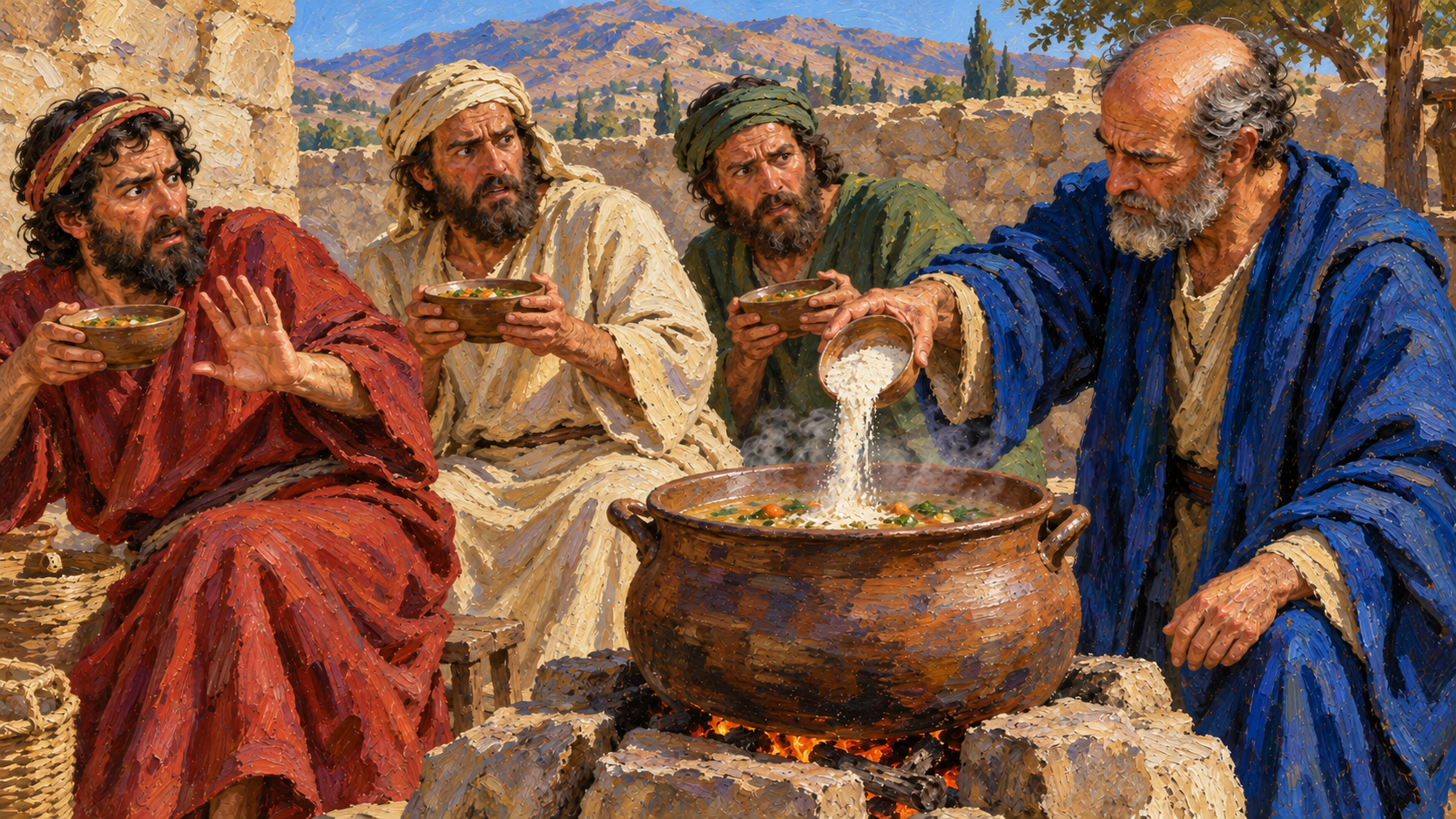
“There is death in the pot” is one of the most startling cries in Elisha’s ministry. How did a meal meant to feed God’s servants become dangerous, and why did Elisha put flour into it? I want to follow the account carefully because it has something to teach us about God’s provision and the discernment that protects hungry people.
A Hungry Time at Gilgal
Elisha had followed Elijah and now stood as a witness to the living God in a spiritually divided nation. During his ministry, a meal prepared to sustain the sons of the prophets became dangerous. What followed was God’s provision through His prophet, not a trick with ingredients.
The man who gathered the gourds appears to have acted in ignorance rather than malice, but that did not make the danger any less real. Nor was the flour a magical remedy. Elisha’s command had power because God was acting through His prophet.
And Elisha returned to Gilgal, and there was a famine in the land. Now the sons of the prophets were sitting before him; and he said to his servant, “Put on the large pot, and boil stew for the sons of the prophets.” So one went out into the field to gather herbs, and found a wild vine, and gathered from it a lapful of wild gourds, and came and sliced them into the pot of stew, though they did not know what they were. Then they served it to the men to eat. Now it happened, as they were eating the stew, that they cried out and said, “Man of God, there is death in the pot!” And they could not eat it. So he said, “Then bring some flour.” And he put it into the pot, and said, “Serve it to the people, that they may eat.” And there was nothing harmful in the pot.
Elisha returned to Gilgal during a famine. In Joshua’s day, Gilgal had been connected with Israel’s entrance into the land and circumcision. Israel had kept Passover there, and the reproach of Egypt had been rolled away. That history helps me see the sadness of this setting: a place associated with Israel’s covenant identity was now surrounded by hunger.
Under the law, famine could serve as a covenant warning when Israel turned from the Lord. That gives me reason to pay attention to the famine here, though the text does not explain every cause of it. The sons of the prophets were living where food was scarce and faithfulness was costly.
When I have cut off your supply of bread, ten women shall bake your bread in one oven, and they shall bring back your bread by weight, and you shall eat and not be satisfied.
Elisha’s instruction to prepare a large pot of stew was an act of care for hungry people. He told his servant to feed the sons of the prophets. The danger entered a meal that had been intended to provide for God’s servants.
The sons of the prophets were groups associated with prophetic ministry and instruction, rather than Elisha’s biological children. Their sitting before him suggests that they were receiving instruction from the man of God. They needed food, but they also needed the Word of the Lord while Israel was often tempted by Baal worship and false confidence.
We are seeing more than a group trying to survive a famine. These men represented a remnant learning to live under God’s Word, yet their connection to ministry did not put them beyond danger. A harmful ingredient entered the meal even among the sons of the prophets.
Famine exposes dependence as well as causing hunger. When the ordinary supply disappears, people discover where their confidence has been resting. Some grasp at anything that looks edible, and urgency can tempt others to compromise. Such a trial may lead someone to accuse God, but it can also teach him again to receive every meal as mercy.
The sons of the prophets lived in the same hungry land as everyone else. Receiving prophetic instruction did not spare them the famine. I need to remember that when I think about God’s provision: faithfulness does not guarantee a life without shortage, danger, or need. Elisha’s presence did not end the famine throughout the land at that moment, yet God provided in the midst of it.
Deuteronomy 8 helps me understand that dependence. God humbled Israel and allowed them to hunger, then fed them with manna so they would learn that man lives by every word from the Lord. A famine can bring that truth home when abundance has hidden it from view. God upholds us; the visible supply alone does not.
Need can make us eager to gather whatever we find without testing it, so God’s people should be careful. We also have reason to be grateful. The Lord can feed His people when the land is lean, even after the meal itself has been endangered.
How Death Entered the Pot
One man went into the field for herbs and found a wild vine. He gathered its gourds and sliced them into the pot, but Scripture adds: “though they did not know what they were.” He did not have to be openly rebellious to endanger the meal. Not knowing what he had gathered was enough.
The Hebrew word for the wild gourds is often represented as paqqu’ot. Many identify the plant as colocynth, a bitter gourd that can cause severe distress and even death. That may explain the danger, but I do not need to settle the plant identification to follow what the passage teaches. The men recognized death in the pot and could not eat it.
Good intentions cannot make unknown ingredients safe. I need to remember that in what I teach others and in my own habits, and the same care belongs in our homes and churches. Something useful-looking may seem harmless, especially when the need feels urgent. But it may still bring death into what should have nourished people.
The men began eating and cried out to Elisha, “Man of God, there is death in the pot!” They named the danger and brought it to the prophet of God. They did not pretend everything was fine or keep eating merely because the meal had been prepared with good intentions.
Their response helps me think about discernment. Politeness is no reason to ignore something that is harming the people it ought to nourish. We need to name that harm truthfully. False doctrine and worldly philosophy can corrupt what God’s people receive, as can careless teaching or manipulative leadership. Bitterness and secret sin can also make what should nourish people deadly.
There is a way that seems right to a man, But its end is the way of death.
Proverbs 14:12 fits here because the gourds seemed useful but proved harmful. The man’s sincerity could not settle whether his addition would give life or bring death. Discernment asks what we are actually serving people before the whole group is harmed.
God Removed the Harm
Elisha did not panic. He asked for flour and put it into the pot, then told the men to serve the food. Scripture records the result: “there was nothing harmful in the pot.” God acted through His prophet in this particular miracle. Scripture does not give us a ritual to repeat with contaminated food or corrupted teaching, and the flour should not be treated as magical.
Flour fits the setting of ordinary provision because it belongs to bread. The Lord who gave daily bread during famine also removed death from the pot. He made safe what man had made dangerous, and the sign directs our attention to His power.
So He humbled you, allowed you to hunger, and fed you with manna which you did not know nor did your fathers know, that He might make you know that man shall not live by bread alone; but man lives by every word that proceeds from the mouth of the LORD.
And Jesus said to them, “I am the bread of life. He who comes to Me shall never hunger, and he who believes in Me shall never thirst.
I can follow this account toward God’s greater provision in Christ, the bread of life, without making the flour itself a symbol the passage never names. 2 Kings 4 does not explicitly say the flour represents Jesus. The miracle shows God’s power to provide life where death threatened, and the fullness of His life-giving provision is found in Christ.
Elisha did not throw away the pot, but that observation must be stated carefully. The account does not teach that every contaminated situation must always be kept. God made this meal safe, and the people could eat because there was “nothing harmful in the pot.” Preservation came through real purification, not through denial.
That gives me a way to think about restoration without overlooking the harm. Something introduced in ignorance may damage a family or church, a ministry or a person’s conscience. If we identify it honestly and bring it under God’s truth, it can be removed or corrected. Once the harmful thing is no longer harmful, restoration may be a mercy. God can save what human carelessness endangered.
The situation is different if false doctrine is still being taught. Manipulation may still control what happens, or sin may remain protected. In those cases the poison is still active. Calling the pot “redeemed” while people keep eating poison is not faith. Biblical hope never requires us to pretend that danger is gone before God has actually dealt with it.
2 Kings 4 ends with people able to eat safely. That gives us hope without setting discernment aside. When we apply the account to spiritual life, we should want God’s people to receive what is true and clean, something that gives life rather than harm.
Discernment Guards What Feeds God’s People
Because the pot was meant to feed the sons of the prophets, the application to teaching and discipleship deserves particular care. Worship and counsel also feed people spiritually, as does the instruction that forms a family. We need to handle these responsibilities carefully because even a little corruption can spread through the whole meal.
A little leaven leavens the whole lump.
Beware lest anyone cheat you through philosophy and empty deceit, according to the tradition of men, according to the basic principles of the world, and not according to Christ.
Paul requires us to test what we hear, without becoming suspicious of every unfamiliar word. Popularity or drama cannot justify a church’s use of an untested idea. Neither can therapeutic language or a promise of growth. I need to compare the teaching with Scripture and the gospel, asking whether it agrees with God’s character and examining its fruit.
John gives the same command in another form: “test the spirits, whether they are of God” (1 John 4:1). Discernment is not fearfulness. It is an act of faithful love toward the people who will eat from the pot.
The man gathered from a wild vine because there was famine, and need can make dangerous things look useful. A church eager for growth may begin to regard a promising method as necessary. A tired parent may accept practical-sounding counsel without noticing that it ignores Scripture. A teacher may borrow cultural language because it seems to explain pain or identity, or to offer an understanding of justice and healing. In each case, we need to ask whether the teaching is true and safe under God, rather than whether it impresses us.
Testing begins with Scripture. Does the teaching agree with the plain meaning of the Bible in context? Does it honor the character of God and preserve the gospel of Christ’s body, blood, death, burial, and bodily resurrection? Its fruit should also agree with repentance and faith. True teaching helps people grow in holiness and love for God and others. It produces humility and courage, as well as mercy and obedience. Harmful teaching may instead feed pride and excuse sin. It can encourage sensuality or despair, or make people dependent on personalities. It may even teach them to despise Scripture.
The man in 2 Kings 4 did not know what he had gathered. If I discover that something I have served others is harmful, I need the humility to confess and correct it. I also need to care for those affected, rather than concentrate on defending myself. The meal is meant to feed them, not protect the gatherer’s reputation.
Discernment therefore belongs to love rather than serving as a hobby for suspicious people. It is a guard around the table where hungry people are being fed.
The miracle does not teach that churches should keep consuming known poison. In 2 Kings 4, God removed the harm. If false teaching or active sin remains, Scripture may require removal or correction. It may also require separation or a public warning. The hope of purification is biblical, but saying “the solution is never removal” would go beyond this account.
We should not expect every corrupted situation to be restored in the same outward way. God sometimes heals a ministry or family, or works healing in a person’s heart. At other times He exposes danger and leads His people away. In either case, He knows how to preserve His people and feed them with what gives life.
Those who teach still bear responsibility for what they offer. The man’s ignorance did not stop his ingredient from causing harm, and sincerity does not remove that responsibility. Whether we teach as parents, pastors, or counselors, we should know what we are placing before others.
The Gospel Is God’s Answer to Death
“Death in the pot” was an earthly crisis, but it points us toward a deeper problem. Sin brings death. Human ignorance, effort, and religious mixture cannot cure it. We need the life God gives in His Son.
Jesus is the eternal Son, fully God and fully man, virgin-born and completely sinless. He physically bore the punishment for our sins in His innocent body on the cross through real torture, the shedding of His blood, and death. He was buried and rose bodily. The Father did not punish, curse, abandon, strike, bruise, or pour wrath on Jesus. Christ died for the whole world, and people may resist God’s genuine offer of salvation.
Everyone who repents and believes is forgiven, born again, indwelt and sealed by the Holy Spirit, and eternally secure. Eternal security is not permission to keep poison in the pot. It means the risen Christ gives new life that learns to reject death and receive what truly nourishes.
The sons of the prophets named the danger instead of protecting the meal’s reputation at the expense of those eating it. That is part of loving people: tell the truth about what is harmful and bring it under God’s Word. Neither panic nor denial can purify it. Elisha’s authority came from the Lord, and we must test all things by Scripture.
Not knowing what the gourds were did not keep the man from making the stew dangerous. If my lack of knowledge has harmed someone else, I cannot confuse ignorance with innocence. Humility means receiving correction instead of defending what I added.
We can still hope in God’s power, because He made the pot safe. He can restore what has been damaged and cleanse what has been polluted. This account gives us reason to trust His ability to feed His people even in famine.
Related studies examine the life of Elisha, the gospel, false teachers, false gospels, and the Word Logos.
My Final Thoughts
After working through 2 Kings 4:38-41, I see both a warning and a reason for hope. Something gathered in ignorance brought real death into a meal meant to sustain God’s servants, so good intentions could not make the danger harmless. Yet God acted through Elisha, removed the harm, and fed His people during famine. We should test what we receive and what we place before others, while refusing to call active poison safe. Above all, we can trust the God who gives life in Jesus Christ and is able to nourish His people when every visible supply seems thin.