
Elisha first appears in Scripture behind a plow. How did that working man become Elijah’s successor, and what are we meant to learn from all the miracles that followed? I think his life makes the most sense when we keep looking to the God who prepared him through service and whose work did not stop when Elisha died.
Called from the Plow and Formed Through Service
When God called Elisha, Elijah was worn down and the northern kingdom of Israel remained spiritually sick. God had answered Elijah by fire on Mount Carmel and publicly exposed Baal as powerless. Then Jezebel threatened Elijah’s life, and the exhausted prophet fled into the wilderness believing he was alone.
The Lord cared for Elijah in his weakness and corrected his belief that he was alone. A faithful remnant remained, and there was still work for him to do, including calling Elisha. I don’t read this as God discarding a failed prophet. Elijah was a faithful man with a nature like ours, and the Lord was helping him see that His work extended beyond any one servant.
I find encouragement in the way the Lord cared for Elijah while preparing someone else to continue the prophetic work. Even a faithful servant can become tired or frightened, but that doesn’t diminish God’s strength. Each of us will eventually leave a place of ministry or be taken home. The Lord will still be able to fulfill His word.
Most of Elisha’s later ministry took place in the northern kingdom after Israel divided. Its rulers repeatedly led the people into idolatry, yet God continued sending His word. Elisha spoke among kings and soldiers as well as entering the homes of widows and families in distress. His ministry reached foreigners and communities of prophets too. God’s mercy and judgment concerned entire nations, but He also paid attention to one frightened person.
The main account runs from 1 Kings 19 through much of 2 Kings and ends in 2 Kings 13. Elisha began with ordinary work and spent years serving Elijah before God entrusted him with public authority as Elijah’s successor. I want to keep those years of preparation in mind as we look at his miracles. Receiving that authority never made him independent of the Lord, even at the end of his life.
The miracles follow that same progression. At the Jordan, God confirmed that Elisha would continue Elijah’s work. His word then brought help to a cursed city and to households facing debt and death. Naaman’s illness brought a foreign commander to Elisha, who later faced military danger and national famine. By the time we reach the prophet’s final days, we can see that the work still belonged to God, just as it had from the beginning.
So he departed from there, and found Elisha the son of Shaphat, who was plowing with twelve yoke of oxen before him, and he was with the twelfth. Then Elijah passed by him and threw his mantle on him.
Elijah found Elisha working in a field, not seeking influence in a palace. Twelve yoke of oxen suggest considerable responsibility and a stable livelihood. Following the Lord would mean leaving something substantial behind.
When Elijah threw his mantle over Elisha, it signaled that God was interrupting his life and calling him into prophetic service. Elisha understood that the Lord was laying claim to his future. This was a definite call to serve Him, not a vague invitation to express himself.
Elisha asked to kiss his father and mother before leaving. I don’t see a reason to call that request unbelief when he was honoring his parents and bringing his former work to a proper end. Still, Elijah’s answer pressed him to take the call seriously. He couldn’t follow as a side interest while keeping his former life ready as a backup.
So Elisha turned back from him, and took a yoke of oxen and slaughtered them and boiled their flesh, using the oxen’s equipment, and gave it to the people, and they ate. Then he arose and followed Elijah, and became his servant.
Elisha slaughtered the oxen and burned the wooden equipment to prepare a meal for the people. Everyone could see that he was leaving his old life behind. He wasn’t offering a sacrifice to buy God’s favor. He was acting on the call God had already given him.
Before moving on, notice that Elisha became Elijah’s servant. He didn’t begin by speaking to kings. Later, 2 Kings 3:11 identifies him as the man who poured water on Elijah’s hands, describing the ordinary work of a personal attendant. He cared for the older prophet’s needs and learned beside him long before he was publicly recognized as Elijah’s successor.
That work brought Elisha no public recognition. He served beside a better-known prophet and handled duties many people would consider small. I wouldn’t dismiss those years as a delay before his real calling began. He was learning faithfulness close to Elijah’s life and ministry, and serving quietly was already part of what God had called him to do.
The Hebrew verb sharat can describe attending or ministering in a practical role, which helps us understand the service Elisha gave. Those duties prepared him for responsibility he could not yet carry. The related study on the life of Elijah explains more about the burden Elijah carried and how God called Elisha to continue his work.
If I equate God’s calling with being recognized, Elisha’s years of service should make me reconsider. He obeyed before he became well known. We don’t appoint ourselves as celebrities in God’s service. The Lord prepares His servants in His own way before entrusting them with public responsibility.
The Double Portion and the God of Elijah
When Elijah was about to be taken away in 2 Kings 2, Elisha refused to leave him. Elijah finally asked what he could do for Elisha before departing, and Elisha requested a double portion of his spirit.
And so it was, when they had crossed over, that Elijah said to Elisha, “Ask! What may I do for you, before I am taken away from you?” Elisha said, “Please let a double portion of your spirit be upon me.”
The request can sound ambitious until we consider Israel’s inheritance law. Deuteronomy 21:17 gave the firstborn son a double portion because he carried the family’s responsibility forward. Elisha used that language as the man who would inherit Elijah’s prophetic work. He wasn’t asking for part of Elijah’s soul or for twice the fame. Nor was he requesting exactly twice as many miracles. He was asking God to equip him to take up Elijah’s responsibility.
Counting miracles would make me miss what Elisha was asking for. He knew he couldn’t carry this assignment through human ability, so he asked for the divine help he needed to continue what God had begun through Elijah. Understood as a request for an inheritance, this expressed dependence on God rather than pride or rivalry.
Elijah called it a hard thing because he couldn’t hand prophetic power to another man as though it were his property. Only God could grant the request. Elijah gave Elisha a sign: if Elisha saw him taken, the request would be fulfilled. Neither prophet could make that decision or supply the power himself.
Here the Holy Spirit was equipping a prophet for a particular office and task under the Old Covenant. We need to distinguish that from the New Covenant promise that the Spirit indwells and seals every true believer. The same Holy Spirit does both, but we shouldn’t treat these different covenant settings as identical.
After Elijah was taken, Elisha retrieved the mantle and returned to the Jordan. He deliberately struck the river as Elijah had done before they crossed. The garment had no power of its own, but God used that moment to show that His presence and word would continue through the new prophet.
Then he took the mantle of Elijah that had fallen from him, and struck the water, and said, “Where is the LORD God of Elijah?” And when he also had struck the water, it was divided this way and that; and Elisha crossed over.
Elisha wasn’t questioning whether the Lord existed. He was calling on the God who had worked through Elijah to act again. When the water parted, members of the prophetic communities recognized that the spirit of Elijah rested upon him. Scripture calls these men the sons of the prophets, though that doesn’t necessarily mean biological sons. They had witnessed God’s confirmation of Elisha, so he didn’t have to manufacture a reputation for himself.
As I look at Elisha standing at the Jordan with Elijah’s mantle, I don’t want to give the garment credit for what God did. We will encounter salt and oil later, along with Jordan water and other physical objects, but none of them supplied the power. God acted through these signs to confirm His word. Neither the object nor His servant should take His place in our attention.
Mercy at Jericho and Warning at Bethel
Elisha’s first public signs show us both God’s mercy and His judgment. At Jericho, the water was bad and the land barren. Elisha went to the source of the water and threw in salt as he spoke the word of the Lord.
Then he went out to the source of the water, and cast in the salt there, and said, “Thus says the LORD: ‘I have healed this water; from it there shall be no more death or barrenness.'”
Elisha attributed the healing to the Lord, not to the salt. God had spoken through His prophet and shown mercy to a place where people had known death and barrenness.
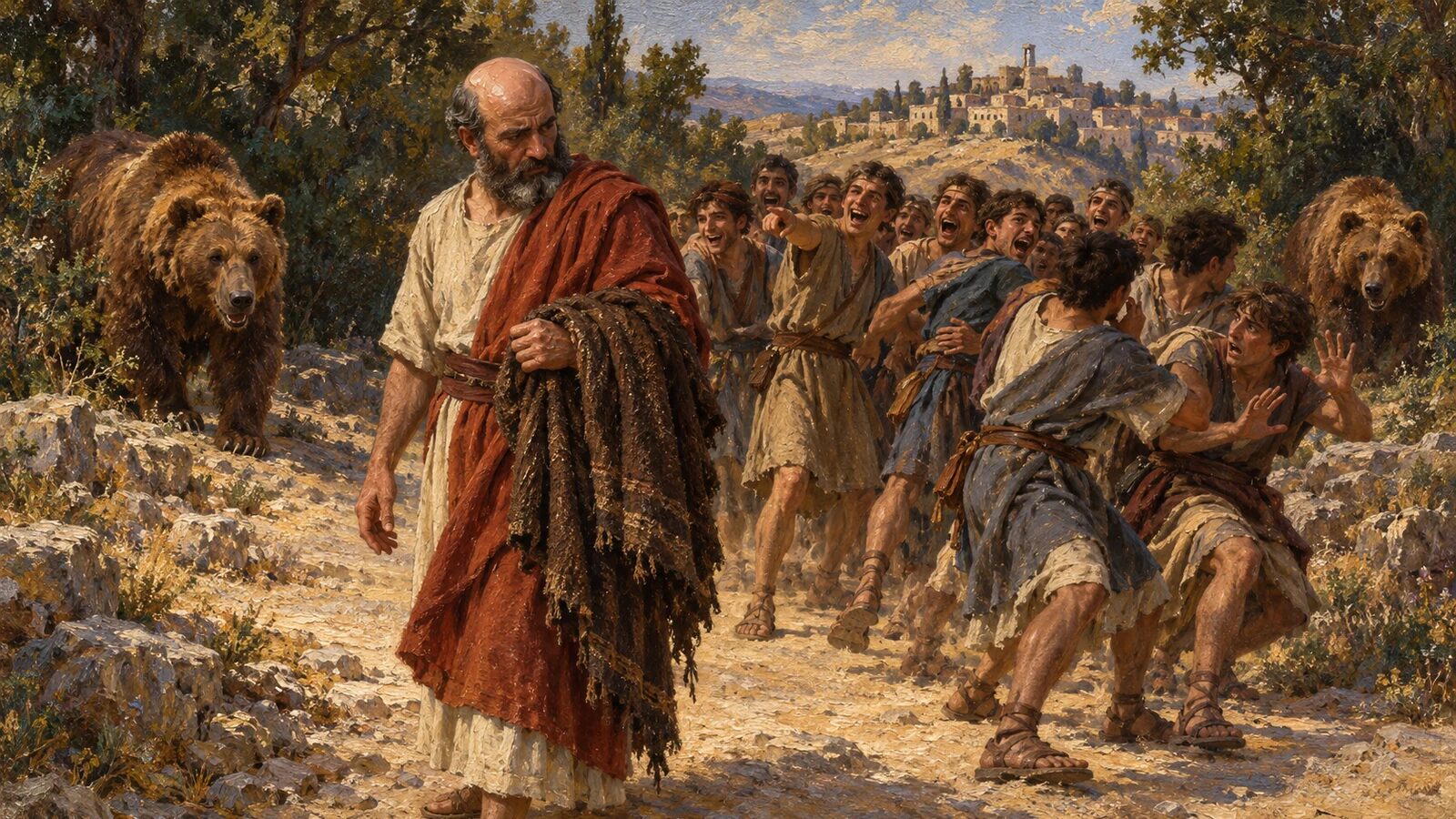
Near Bethel, Elisha encountered something very different. Jeroboam had established one of the northern kingdom’s false worship centers there. A large group of youths came out to mock Elisha and told him to “go up.” Their words may have echoed Elijah’s ascent as they rejected the successor God had just confirmed. The Hebrew word for the youths can describe young men, so we don’t have to picture small children making an innocent joke.
Elisha cursed them in the Lord’s name, and two female bears mauled forty-two from the group. This was divine judgment against contempt for the covenant at the beginning of his confirmed ministry. I don’t want to soften what happened until God’s holiness disappears from the account. At the same time, Elisha acted as the Lord’s prophet under the Old Testament covenant. That does not authorize personal vengeance for Christians, who are told to bless persecutors and leave vengeance to God.
Leviticus 26 had already warned the nation that continued contempt for the covenant would bring serious judgment. That helps explain the severity of the judgment at Bethel. In a town known for counterfeit worship, these youths rejected the Lord’s appointed messenger. They weren’t merely involved in a private quarrel over wounded feelings. Understanding the setting helps me take the judgment seriously without celebrating anyone’s suffering.
The lasting warning is that contempt for God’s word is not harmless. The salt at Jericho and the judgment near Bethel reveal the same holy Lord. He is able to show compassion, and He has the right to judge rebellion. The fuller study of Elisha and the youths examines this difficult passage without turning it into permission for retaliation.
God’s Mercy Enters Homes and Ordinary Crises
Many of Elisha’s miracles took place away from kings and armies. In 2 Kings 4, a prophet’s widow faced a debt she could not pay, and the creditor threatened to take her sons into service to claim their labor. When Elisha asked what she still had, she could name only a jar of oil.
Then he said, “Go, borrow vessels from everywhere, from all your neighbors-empty vessels; do not gather just a few. And when you have come in, you shall shut the door behind you and your sons; then pour it into all those vessels, and set aside the full ones.”
The oil kept flowing until no empty containers remained. By selling it, the widow was able to pay the debt and support herself and her sons with what was left. She obeyed the prophet’s instruction, but God supplied what her household needed.
Elisha had told her to shut the door behind herself and her sons while she poured. This happened within the family, away from a crowd, as several other signs in his ministry did. The oil met an actual need and stopped when there were no more vessels to receive it. God provided enough to settle the debt and preserve her household.
The widow’s husband had feared the Lord, and God had not forgotten his family after his death. Elisha could speak to a nation and still attend to a widow in her kitchen. We can appreciate that personal care without making this miracle a prosperity formula. God met this household in its crisis; He did not promise that collecting containers would create wealth.
The Shunammite woman also received God’s help, though she faced a different kind of grief. She was a woman of means who regularly fed Elisha and prepared a small furnished room for him without asking for a reward. When Elisha wanted to bless her, Gehazi pointed out that she had no son and her husband was old. God gave her the promised child. Years later, however, the boy suddenly died after crying out about his head.
She laid him on Elisha’s bed and went directly to the prophet, bringing her grief to the place where she knew God’s word had been spoken. Her faith did not require her to deny the pain of what had happened.
He went in therefore, shut the door behind the two of them, and prayed to the LORD.
Behind that closed door, Elisha prayed rather than putting on a performance. He depended on the Lord, who restored the child because life belongs to Him. We are being shown God’s power over death, not a method we can copy to produce a miracle.
I don’t want to overlook what this mother had endured before her son was restored. She had never demanded a child, yet after receiving him she watched him die. Her response helps me understand that faith can bring grief honestly to God without pretending the loss is unreal. She went where she believed He could act, trusting the Lord who had given her son rather than a technique Elisha might use.
God’s care for her continued after He restored her son. In 2 Kings 8, Elisha warned her about a coming seven-year famine, so her household left the land. When she returned and appealed to the king for her property, Gehazi was telling him how Elisha had restored her son. The king ordered her property returned along with the produce it had yielded. She had faced displacement and legal trouble, and God cared for her through those difficulties too.
Beside the restoration of a child’s life, making food safe may seem like a small miracle. During famine, someone unknowingly poisoned the communal stew by adding wild gourds, and God made it safe through Elisha. Soon afterward, twenty barley loaves fed one hundred men. There was even food left over, just as the Lord had promised.
These accounts help me see how personally God attends to people’s needs. He cared about a widow’s debt and a mother’s grief, as well as the hunger of a community of prophets. His compassion doesn’t put Him at the service of our comfort. It shows that He pays attention to people and needs that pride can lead us to overlook.
Naaman, Gehazi, and the Unseen Host
Naaman was an honored Syrian commander suffering from the serious skin disease Scripture calls leprosy. The first person to point him toward help was an unnamed Israelite girl whom Syrian raiders had taken captive. She served his wife and said that the prophet in Samaria could heal him. This powerful man needed to listen to testimony that began with a displaced servant girl.
Naaman arrived with a royal letter and gifts of silver, gold, and clothing. Israel’s king thought Syria was trying to provoke a dispute by demanding something impossible, but Elisha called for Naaman so he could learn that there was a prophet in Israel. The commander expected his position to influence how he was received. Instead, Elisha sent a messenger telling him to wash in the Jordan seven times. Such a plain command offended him because obeying it meant humbling himself.
And his servants came near and spoke to him, and said, “My father, if the prophet had told you to do something great, would you not have done it? How much more then, when he says to you, ‘Wash, and be clean’?”
His servants persuaded him to obey, and God cleansed him. Naaman then confessed what he had learned.
Indeed, now I know that there is no God in all the earth, except in Israel.
God showed mercy to this outsider without setting aside His covenant with Israel. He is not a local idol confined within a border, and He was able to humble and cleanse a foreign commander. Neither the Jordan’s water nor washing seven times had power of its own. God cleansed Naaman when he stopped demanding his own terms and obeyed the word he had received.
What interests me here is how much Naaman’s understanding changed. He came expecting his wealth and rank, backed by royal influence, to determine what happened. He left knowing that the LORD alone is God. The captive girl’s simple testimony proved more truthful than his assumptions about power.
Elisha refused payment so Naaman could see that God’s grace was not for sale. Gehazi then secretly pursued Naaman. By lying to him, he obtained silver and clothing for himself. Judgment followed his attempt to profit from what God had freely done. We cannot turn God’s name into a means of selling His grace.
Before 2 Kings describes Elisha’s encounter with the Syrian army, we read about a man distressed over a borrowed tool. While the prophetic community was cutting timber, his iron axe head fell into the water. Losing something that belonged to someone else troubled him.
But as one was cutting down a tree, the iron ax head fell into the water; and he cried out and said, “Alas, master! For it was borrowed.”
The Lord recovered the axe head through Elisha and relieved that man’s distress. An ordinary problem was not beneath His notice, though this miracle doesn’t promise believers freedom from property loss or financial pressure. The related study on the floating axe head examines this act of care more closely.
Restoring a child’s life plainly displays power over death, while recovering a borrowed tool relieves one man’s immediate fear. Both depended completely on God, and the smaller need was not meaningless to Him. I can trust His care without treating either miracle as a promise that He must do exactly the same for me.
The household needs we have already considered help us understand why this borrowed tool receives a place in the account. Ordinary pressures do not escape God’s attention.
Elisha also served amid national danger. God repeatedly revealed Syria’s planned military movements against Israel to him. Eventually the Syrian king sent a large force with horses and chariots to seize him at Dothan. When Elisha’s servant woke and saw the city surrounded, he panicked.
So he answered, “Do not fear, for those who are with us are more than those who are with them.” And Elisha prayed, and said, “LORD, I pray, open his eyes that he may see.” Then the LORD opened the eyes of the young man, and he saw. And behold, the mountain was full of horses and chariots of fire all around Elisha.
The servant wasn’t imagining the army around Dothan, but he couldn’t yet see the Lord’s host that was already there. His eyes were opened to protection God had already provided. That gives me reason to remember that what I can see is never greater than God. It doesn’t give me grounds to invent details about an unseen host whenever trouble comes.
Elisha asked the Lord to strike the Syrians with blindness and led them into Samaria. There, with the soldiers surrounded, he stopped Israel’s king from killing them. They were given a meal and sent home. God used the prophet who sometimes announced judgment to show mercy to helpless prisoners, sparing them after bringing the danger under His control.
I’m glad the account doesn’t end with the fiery chariots, because we also need to see what happened to the captured soldiers. God exposed and defeated the threatening army without requiring Israel to slaughter them once they were helpless. Elisha’s confidence in the Lord had kept him calm during the threat, and it also allowed him to show mercy after God brought the danger under control.
Judgment, a Dying Prophet, and a Living God
Elisha’s ministry also brought him before kings who refused to hear God’s word. He exposed their unbelief and took part in the Lord’s judgment on corrupt rulers. These are difficult accounts to read, but they belong alongside the widow’s oil and the child God restored.
The Lord who cared for the widow also confronted rulers who abused their position and people who refused His word. We are seeing the same holy God in both kinds of encounter. His compassion does not make rebellion harmless, and judging it does not mean He has stopped caring about people who suffer.
During Syria’s siege of Samaria, food became so scarce that conditions in the city were horrific. The king blamed Elisha, who nevertheless promised that food would be plentiful the next day. A royal officer mocked that possibility. Outside the city, four men with leprosy discovered the Syrian camp abandoned and full of food. The Lord had made the army hear the sound of a great force, causing them to flee, and the starving city suddenly had supplies. The officer saw the provision but was trampled at the gate before he could eat. His failure wasn’t a lack of positive thinking. The question was whether God’s word could be trusted when every visible circumstance made its fulfillment look impossible.
Later, Elisha wept as he saw the cruelty Hazael would bring upon Israel. He told Hazael that he would become king of Syria, but knowing what was coming didn’t make him indifferent to those who would suffer. Elisha also sent one of the sons of the prophets to anoint Jehu and announce judgment against Ahab’s house. God would not leave rebellion unjudged simply because He had been patient. Yet Elisha’s tears help me see the difference between announcing judgment and taking pleasure in human pain.
By 2 Kings 13, Elisha was terminally ill. King Joash came to him crying, “O my father, my father, the chariots of Israel and their horsemen!” His words acknowledged that Israel’s true protection had never rested merely in military strength. Even as he was dying, Elisha continued to deliver the Lord’s word.
Through an arrow shot from the window, Elisha promised victory over Syria. He then told Joash to strike the ground with the remaining arrows. Joash stopped after three strikes, and Elisha explained that his limited response meant only three victories rather than Syria’s complete defeat. Elisha’s physical weakness had not weakened the word God gave him to speak.
Elisha eventually died, though God had used him to restore someone else from death. Working miracles had not made him immortal or given him control over prophetic power. Like every human servant, he reached the end of his service.
Then Elisha died, and they buried him. And the raiding bands from Moab invaded the land in the spring of the year. So it was, as they were burying a man, that suddenly they spied a band of raiders; and they put the man in the tomb of Elisha; and when the man was let down and touched the bones of Elisha, he revived and stood on his feet.
Elisha could do nothing for the man placed in his tomb. He was dead, unable to perform a miracle or pray, and he could claim no credit for what happened. God alone restored the man’s life. That is why I wouldn’t attribute power to Elisha’s bones. The Lord showed that His power had never belonged to the prophet and had not disappeared with his death.
We should understand the other objects in these accounts in the same way. Elijah’s mantle and the salt had no power of their own, nor did the oil or Jordan water. Like Elisha’s bones, they were part of signs through which God confirmed His word and revealed His mercy. Elsewhere we have seen Him expose sin and display His power. None of these miracles gives us a technique for making Him act on demand.
Keeping the covenant setting in view also helps us understand what we have read. The judgment on the youths gives Christians no permission to take vengeance. Nor does Elisha’s double portion mean that New Covenant believers can receive twice as much of the indwelling Spirit. I don’t want skepticism to make me deny God’s action, or a desire for sensational experiences to make me misuse these accounts. Our attention belongs on the living Lord.
Elisha’s signs ultimately direct our attention beyond the prophet. Through his ministry, God provided food and announced cleansing. A child was restored, and the prophet spoke God’s words of mercy and judgment. Jesus Christ is the greater Savior to whom every hope of life must lead. Wicked men physically tortured, punished, and killed Jesus. He willingly bore that real punishment for our sins in His innocent body and shed His blood. The Father did not punish, curse, abandon, strike, bruise, or pour wrath on His beloved Son. Jesus died, was buried, and rose bodily from the dead.
Christ died for the whole world, and God’s offer of salvation can be resisted or rejected. Every sinner is called to repent and believe in Jesus. God forgives and justifies the person who truly believes. That person is born again, and the Holy Spirit indwells and seals him. His salvation is eternally secure. That security is not permission for lawlessness, and a superficial profession does not prove that someone was truly born again.
My Final Thoughts
Following Elisha from the plow to his grave, I see how God formed a servant through years of quiet faithfulness and equipped him for work that always belonged to the Lord. Elisha never learned to control supernatural power for himself. Through him, God attended to a widow’s debt and even a borrowed tool without setting aside His holiness or His right to judge. When Elisha died, God continued to speak and give life. That encourages me to obey in the work He gives me and to serve humbly. His power doesn’t depend on me, and His work will continue long after my own service ends.