
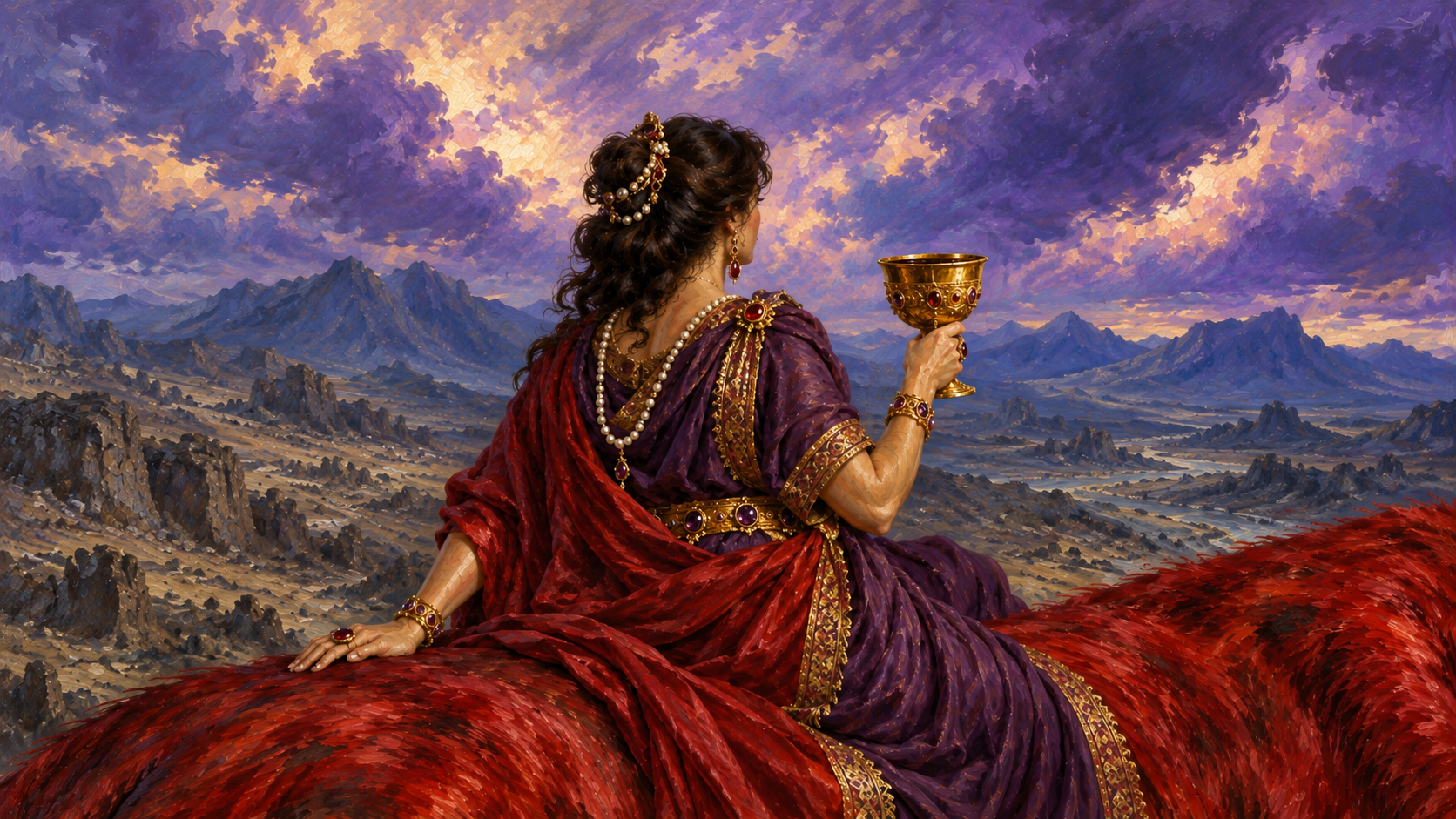
Who is the great harlot in Revelation, and why does God judge her so severely? Before I attach that name to a modern church or city, I need to understand the woman John saw. Her place in the vision becomes clearer when we follow the pattern from Babel through ancient Babylon and the prophets to its final form in Revelation.
From Babel to Ancient Babylon
Babel was built in the land of Shinar after the flood. God had blessed Noah and his sons and told them to be fruitful and multiply so they would fill the earth. Instead, people gathered in one place to build a city and tower as a monument to themselves. Their project expressed a religious and cultural revolt against the command God had given.
And they said, “Come, let us build ourselves a city, and a tower whose top is in the heavens; let us make a name for ourselves, lest we be scattered abroad over the face of the whole earth.”
The builders wanted to stay united without obeying God. They sought security in what their own hands could make and wanted a great name for themselves. But God confused their language and scattered them when He came down. The city was called Babel because the LORD confused the language there.
Just after the account of Babel, I notice that God promised Abraham, “I will make your name great” in Genesis 12:2. The difference helps me understand why Babel belongs in the background of Revelation. Human pride led to scattering, while God’s promise became a blessing. Babylon becomes more than the name of one ancient city. It represents the recurring effort to organize life against God while presenting that rebellion as greatness.
The history and meaning of that first city are explored more fully in The Tower of Babel. Nimrod also examines the early kingdom-building connected with Babel while keeping us from guesses that go beyond Genesis.
Babylon later became a literal empire and a painful part of Israel’s history. Under Nebuchadnezzar, it conquered Judah and destroyed Jerusalem. The temple was burned, and many Jews were taken into captivity. The exile was God’s discipline for Judah’s covenant unfaithfulness, yet Babylon was still responsible for its own pride, violence, and idolatry.
And Babylon, the glory of kingdoms, The beauty of the Chaldeans’ pride, Will be as when God overthrew Sodom and Gomorrah.
Isaiah announced the fall of Babylon’s glory, and Jeremiah described the empire as a golden cup in the LORD’s hand that made the earth drunk. Jeremiah also announced its judgment. Isaiah 47 pictured the proud queen brought down into shame. When John describes Babylon in Revelation 17 and 18, he uses language the prophets had already given us.
Ancient Babylon joined imperial pride to an idolatrous culture and used its wealth and power in rebellion against God. In Revelation, that same pattern reaches its final form and comes under His judgment.
Harlotry, Wealth, and Spiritual Betrayal
The prophets often described idolatry as marital betrayal. Israel belonged to the LORD by covenant, yet the nation chased idols and false worship. It also trusted ungodly alliances in place of Him. Isaiah cried, “How the faithful city has become a harlot!” Jeremiah recorded the LORD calling His people to return even after they had played the harlot with many lovers. Hosea’s marriage became a living sign of Israel’s unfaithfulness and God’s persistent mercy.
The prophets’ language helps me see why idolatry is such a betrayal. God is our Creator and Redeemer, and He is Israel’s covenant Lord. He cannot be treated as one spiritual option among many. Giving an idol the trust and worship that belong to Him is spiritual adultery. Idolatry develops that biblical connection in more detail.
Revelation calls the final Babylon a harlot because she seduces the nations into false worship. She offers fellowship with the world at the cost of faithfulness to God, yet her active religious life conceals corruption. Beneath her outward beauty is something poisonous.
The Greek word porne is translated “harlot” and describes the woman in Revelation. Its language of fornication speaks of spiritual unfaithfulness and idolatrous seduction, including her corrupt union with the kings of the earth. The title “Mystery, Babylon the Great” uses mysterion for something God makes known through His revelation. Understanding that word helps us read the title accurately: Babylon is not being presented as something we can never understand.
Babylon’s luxury goes along with her pride. Isaiah 14 records the king of Babylon’s desire to exalt his throne, while Isaiah 47 pictures a queen saying that there is no one besides her. That same chapter exposes her sorceries and spiritual deception. Both pictures show the desire for glory and security apart from the LORD.
Revelation 18 shows how merchants grew rich through Babylon’s trade. Ships carried her cargo, and her culture was filled with music and luxury. Yet this wealth was bound to bloodshed and immorality, with spiritual deception protecting the system that made people rich. When Babylon falls, the kings and merchants mourn the collapse of the world of pleasure and trade they enjoyed.
With the kings and merchants involved, I cannot reduce Babylon to a private religious belief. False worship is at the center of a whole civilization bent away from God. Political influence and the desire for wealth carry that corruption further, while violence protects what seduction has built.
The Great Harlot on the Beast
In Revelation 17, an angel showed John the judgment of the great harlot sitting on many waters. Verse 15 identifies the waters as peoples, multitudes, nations, and tongues. Her influence reaches around the world. The kings of the earth commit fornication with her, and the earth’s inhabitants become drunk with her wine.
Come, I will show you the judgment of the great harlot who sits on many waters, with whom the kings of the earth committed fornication, and the inhabitants of the earth were made drunk with the wine of her fornication.
John then saw the woman sitting on a scarlet beast covered with blasphemous names. The beast had seven heads and ten horns. Her place on the beast shows corrupt religion cooperating with rebellious political authority for a time. She has influence, but she also depends on the beast that carries her. That dependence will prove dangerous because he supports her only while she serves his purpose.
The woman wears purple and scarlet and is adorned with gold, precious stones, and pearls. Her appearance suggests royalty and wealth, yet the golden cup in her hand is filled with abominations. I need to look at what she offers as well as how she looks. Babylon makes rebellion attractive while concealing its corruption.
And on her forehead a name was written: MYSTERY, BABYLON THE GREAT, THE MOTHER OF HARLOTS AND OF THE ABOMINATIONS OF THE EARTH.
As the mother of harlots, she produces further corruption by spreading false worship and teaching the nations to accept spiritual compromise. That description does not require us to identify one modern organization as the entire fulfillment. Revelation brings together the old rebellion of Babel and the pride of the ancient empire with the prophets’ picture of spiritual adultery. In the final Babylon, all of these reach their climax.
The woman’s place on the beast also helps me keep the two distinct. She rides him for a time, but the political coalition will eventually turn against her. Christ later judges the beast itself. These wicked powers can use each other and then become enemies, yet neither escapes the Lord.
I would be careful about claiming that any present-day church or institution is the complete Harlot of Babylon. The same caution applies to a modern city or government. A system may resemble Babylon in its pride or spiritual compromise without being the final fulfillment of this vision. Scripture gives us enough to recognize her character, but the biblical history gathered into this image does not justify careless name-calling.
Bloodshed and the Beast’s Betrayal
John was astonished to see the woman drunk with the blood of the saints and the martyrs of Jesus. Her opposition goes far beyond disagreement with God’s people. She persecutes them and delights in silencing their witness.
Idolatrous empires and false religious systems have persecuted believers throughout history. Revelation looks forward to the climax of that pattern, when the final Babylon joins global deception to violent opposition against everyone who belongs to Christ. The church will already have been gathered to Him before the Tribulation, yet God will still have witnesses during that terrible period. The beastly world will hate them, and Babylon will share in that hatred.
Believers today can recognize that same hostility wherever a religion or culture hates the testimony of Jesus. It is the spirit that will reach its final form in Babylon. Knowing its outcome should help me remain loyal to the Lamb and speak the truth even when faithfulness brings suffering, rather than giving way to panic.
In Revelation 17, the rulers who shared in the harlot’s corruption eventually become the instruments of her destruction. The ten horns represent ten kings who will come to hate her. The Ten Horns in Daniel and Revelation examines their relationship to the beast.
And the ten horns which you saw on the beast, these will hate the harlot, make her desolate and naked, eat her flesh and burn her with fire.
The next verse explains that God puts it into the kings’ hearts to fulfill His purpose. Their hatred is still wicked and self-serving, so we should not mistake their destruction of Babylon for righteousness. God rules over their choice and uses it to judge her. Afterward, Christ judges the beast and its coalition as well.
Neither side controls the outcome, and that gives me reason to look beyond their power. The harlot believes she can ride political power, while the kings believe they can destroy her and keep ruling. Both end up serving a purpose they did not design, and both must answer to God.
Babylon Falls and God Calls His People Out
Revelation 18 describes the judgment further as another angel announces Babylon’s fall. She becomes a dwelling place for demons and foul spirits, exposing her true spiritual condition. The nations and their kings had shared in her spiritual unfaithfulness, while merchants had grown rich through her luxury.
The attention this chapter gives to trade shows how far Babylon’s rebellion reaches. It extends beyond temples and slogans into the marketplace and entertainment. Pleasure becomes self-indulgence, and even human lives are sold as merchandise. Babylon assumes her wealth has made her untouchable, but her merchants mourn when no one buys their goods anymore. The shipmasters grieve as the profitable world they knew collapses in one hour. Heaven calls the same event righteous judgment.
Revelation 18 also says the blood of prophets and saints was found in Babylon, along with the blood of those slain on the earth. I understand this as the final concentration of the world’s violent opposition to God, rather than a claim that every murder took place within the boundaries of one city. God remembers the bloodshed of the same system that seduced the nations.
Then a voice from heaven says, “Come out of her, my people, lest you share in her sins, and lest you receive of her plagues” in Revelation 18:4. The Greek idea behind “share” is participation or fellowship. That helps me understand what God calls His people to leave: we must refuse to participate in Babylon’s rebellion, not simply avoid her name.
Refusing that rebellion does not mean withdrawing from ordinary work or public witness. Christians can buy and sell while living faithfully in a corrupt world. We can build households and serve our neighbors without giving Babylon our allegiance. She wants the heart and conscience, so when she demands worship or obedience that belongs to God, we must obey Him rather than men.
Babylon’s luxury and influence should not become my measure of greatness or something I envy. The comfort she offers cannot excuse idolatry, and we must never join her hatred of the saints. Her invitation to compromise always comes before she reveals the destruction it brings.
The Harlot and the Bride
Revelation places the harlot’s splendor beside the bride’s clean, bright fine linen. The harlot is full of corruption and drunk with blood, while the bride is made ready for the Lamb. The difference reaches beyond their appearance to their future: the harlot faces judgment, and the bride rejoices at the marriage supper of the Lamb.
The bride belongs to Christ by grace. He loves and cleanses her as He prepares her for Himself, so her righteous acts are the fruit of His saving work. They do not buy her a place beside Him. I cannot turn this contrast into salvation by works when the bride’s life comes from the Bridegroom. She has a living faith in Him, while the harlot displays religion without faithfulness. The Bride of Christ follows that truth through the rest of Scripture.
Babylon offers belonging and influence to those willing to compromise and accept her values. But I already belong to Christ, and that should shape how I respond to her offer. No promise of safety or wealth can take the place of faithfulness to Him.
We worship the true God according to Scripture and refuse Babylon’s false worship, even when the testimony of Jesus brings opposition. That hostility should not surprise us. Our hope rests in the Lamb, so we can endure without depending on the world’s acceptance.
Loyal worship of the Father, Son, and Holy Spirit keeps our allegiance clear when the culture offers acceptance in exchange for compromise. It also directs our attention to the Lamb as we read prophecy, so the power of His enemies need not fill us with fear.
The gospel remains urgent while judgment is delayed. Jesus physically bore the punishment for our sins in His innocent body through real torture, the shedding of His blood, and death. He was buried and rose bodily. Sinners do not need Babylon’s cup. They need the Savior who offers forgiveness and new life.
My Final Thoughts
When I follow Babylon from Genesis into Revelation, I see more than one city or institution. The harlot carries forward Babel’s rebellion and the pride of the ancient empire. She also brings the prophets’ picture of spiritual adultery into a final civilization that uses religion and wealth against God. Her beauty cannot hide her bloodshed, and her partnership with the beast cannot save her from judgment. That should keep us from careless name-calling while also warning us not to share in her sins. Babylon falls, but the bride belongs to Christ by grace and will rejoice with the Lamb.