
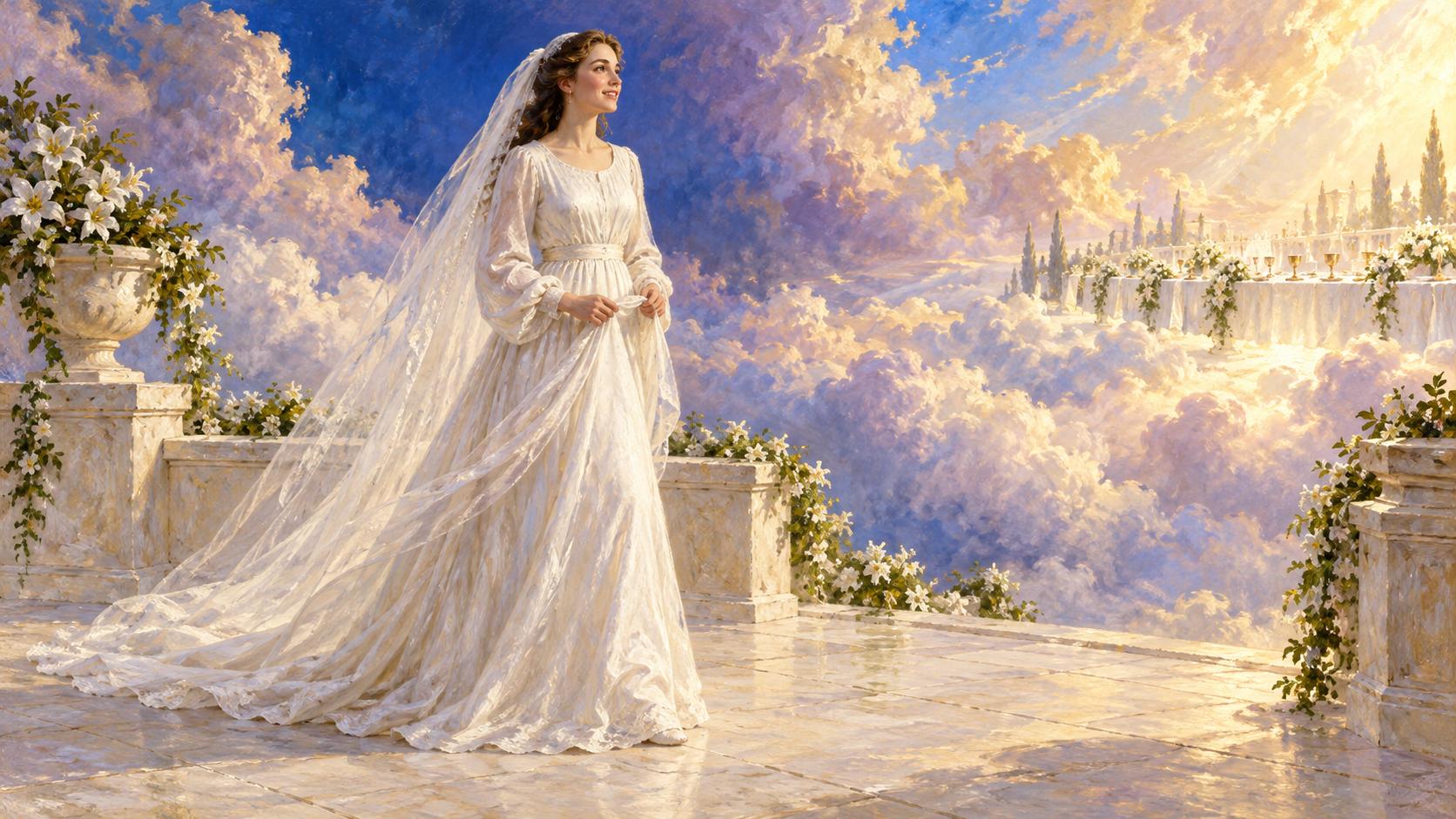
Who does Scripture call the Bride of Christ? I want to answer that carefully because the picture tells us who the Church belongs to and what she is waiting for. We need to follow the marriage language through its different settings without treating every use as though it meant exactly the same thing.
The Church Is Betrothed to One Husband
Scripture uses marriage because covenant love is personal and faithful. A husband and wife are joined in a one-flesh covenant, and God uses that relationship to teach us about His own faithfulness. In the New Testament, the Bride of Christ is the Church, the called-out body of born-again believers whom the Holy Spirit joins to Christ from Pentecost until the Church is caught away.
The Greek word ekklesia, translated “church,” refers to an assembly or called-out gathering. In the New Testament, the word names the people Christ is building into His Church. Through His Spirit, He dwells among them and forms them into one Body. Calling them both His Body and His Bride helps us understand different parts of the same relationship. The two pictures do not compete.
The New Testament also describes the Church as the temple of the Holy Spirit and a holy priesthood, as well as God’s household and the Body of Christ. I want to let each picture teach me what it is meant to show. The Body helps us understand living union with Christ as Head, while the Bride brings covenant love and exclusive devotion into view. It also looks ahead to Christ presenting a pure and prepared Church to Himself. No single image needs to carry the whole doctrine.
For I am jealous for you with godly jealousy. For I have betrothed you to one husband, that I may present you as a chaste virgin to Christ.
Paul wrote these words to the church at Corinth. It was a real local church with serious temptations and doctrinal dangers. He feared that believers would be deceived and drawn away from the simplicity that is in Christ, so he described his work among them with the language of betrothal. He had betrothed them to one Husband and wanted to present them as a chaste virgin to Christ.
Paul’s betrothal language calls for exclusive devotion. The Church belongs to Christ, so another gospel or another Jesus has no rightful claim on her. Spiritual pride and sensual compromise compete with that devotion, as does worldly wisdom. Paul’s love made him jealous for the church’s faithfulness to the One who had claimed her; the tenderness of the image did not keep him from confronting sin.
If the Church is Christ’s Bride, I cannot look at her as a casual gathering of religious customers. These are people He loves, whom He purchased with His blood and indwells by His Spirit. Our local churches need to examine whether their teaching and worship express loyalty to Him. I also need to consider which habits or affections compete for the place that belongs to the Bridegroom in my own life.
Israel, the Church, and Distinct Callings
Marriage imagery did not begin when the Church was formed. The prophets often speak of Israel in wife imagery, especially when exposing covenant unfaithfulness. Hosea’s marriage became a living picture of the LORD’s grief over Israel’s spiritual adultery. Ezekiel 16 uses severe language to show Jerusalem’s unfaithfulness after the LORD had shown her mercy. These passages reveal both the seriousness of sin and God’s covenant faithfulness.
I do not believe Israel’s Old Testament wife imagery and the New Testament description of Christ’s Bride can simply be treated as identical. Scripture uses related marriage language in different covenant settings. Israel has its own real history as the LORD’s covenant people, while Paul addresses his language of betrothal to the Church. The marriage supper of the Lamb develops the same broad theme in another setting, without making all three identical in every detail.
The Church is not Israel under a new name, and we should not erase Israel’s promises to make room for her. God remains faithful to His covenants. That is why I reject replacement theology here: the New Testament applies Bride language to the Church in a particular way, while Israel’s wife imagery belongs to her own covenant history.
All saved people are saints, but I do not understand that to make every saint in every age part of the Bride. Abraham and David were saved by faith, John the Baptist was a prophet sent by God, and the Tribulation saints are washed in the Lamb’s blood. These distinctions concern their roles in God’s plan, not whether one group is less loved. They are all saved through the same Christ.
He who has the bride is the bridegroom; but the friend of the bridegroom, who stands and hears him, rejoices greatly because of the bridegroom’s voice. Therefore this joy of mine is fulfilled.
John the Baptist did not call himself the Bride. He called himself the friend of the Bridegroom. He stood at the transition from Old Covenant prophetic witness to the public revealing of Christ, and he rejoiced when he heard the Bridegroom’s voice. His joy was fulfilled as Christ increased and John’s own public work decreased.
The Church began at Pentecost, when the Holy Spirit came and formed believers into one Spirit-baptized Body. In 1 Corinthians 12:13, Paul says believers were all baptized by one Spirit into one Body. Ephesians 3:6 identifies believing Gentiles as fellow heirs with believing Jews and members of that same Body. The name Church refers to this particular Body, rather than every redeemed person who has ever lived.
Tribulation saints are also precious to God. Revelation 7 says that they wash their robes and make them white in the blood of the Lamb. They are saved only because of Christ’s blood, just as every sinner is saved by grace through faith. Still, Revelation 19 announces the marriage of the Lamb in heaven before Christ returns to earth. I believe this sequence supports the pre-Tribulation conclusion that the Bride is already with Christ.
Different roles do not mean different ways of salvation. No one is cleansed apart from Jesus Christ or earns salvation by works. Yet sharing that salvation does not make every calling interchangeable. Israel retains its covenant history, and John served as a prophet at Christ’s appearing. The Church’s identity comes from the Spirit forming her into one Body, while the Tribulation saints are known for their endurance. All of them belong within God’s one plan of redemption.
The Bridegroom Loves and Cleanses the Church
Husbands, love your wives, just as Christ also loved the church and gave Himself for her.
In Ephesians 5, Paul teaches husbands and wives while explaining that marriage’s great mystery points to Christ and the Church. This is the deepest New Testament passage connecting marriage with the Church. Human marriage did not create the doctrine; God designed it to picture the greater reality of Christ’s relationship with His people.
Paul reaches back to the one-flesh language of Genesis and then says, “This is a great mystery, but I speak concerning Christ and the church.” A Christian marriage should reflect that faithful love, though Christ’s relationship with His Church is the greater reality. He has joined His people to Himself and cares for them as His own body. He is not distant from them, and He will complete the saving work He has promised.
Christ loved the Church enough to give Himself for her. He physically bore the punishment for our sins in His innocent body on the cross, where He shed His blood and truly died. He then rose bodily. The Bride is cleansed because the Bridegroom paid that terrible cost for her redemption; His love was far more than vague affection.
…that He might sanctify and cleanse her with the washing of water by the word, that He might present her to Himself a glorious church, not having spot or wrinkle or any such thing, but that she should be holy and without blemish.
The Bridegroom who gave Himself for the Church is still sanctifying her, setting her apart as holy. Paul says He cleanses her with the washing of water by the Word so that He will one day present her to Himself as a glorious Church. The sin and weakness troubling her now will not mark her forever.
I find comfort in knowing that Christ’s love will not leave His people unchanged. His Word exposes falsehood and corrects our thinking, teaching us to name sin as God does and walk in obedience. The tenderness of His love never becomes mere sentiment. Because the Bride is secure in that love, she has every reason to listen as the Bridegroom cleanses her through His Word.
That future presentation gives local churches a reason to care now about their teaching and worship. Public, destructive sin calls for biblical discipline that protects the church instead of pretending nothing is wrong. Alongside that responsibility, we need to comfort the weak patiently and practice forgiveness. We are learning to live as people Christ already loves, not trying to earn His love.
The Bridegroom Will Come for His Bride
In My Father’s house are many mansions; if it were not so, I would have told you. I go to prepare a place for you. And if I go and prepare a place for you, I will come again and receive you to Myself; that where I am, there you may be also.
Jesus comforted His disciples with these words before the cross. Going away did not mean abandoning them: He would prepare a place and return to receive His own to Himself. I hear the heart of that promise in the words “that where I am, there you may be also.” We are waiting for more than better surroundings. The Church’s hope is to be with Christ.
Ancient Jewish wedding customs can illustrate a bridegroom preparing a place and returning for his bride, but I would not use them to prove every detail of an end-times position. They cannot carry more weight than the passage itself. Our sure foundation is what Jesus promised: He goes to prepare a place and will come again to receive His own so they can be with Him.
That promise connects naturally with 1 Thessalonians 4:16-17. Paul says the Lord Himself will descend from heaven with a shout. The dead in Christ will rise first, and living believers will be caught up with them in the clouds to meet the Lord in the air. From that point forward, they will always be with the Lord. This is the Bridegroom hope of the Church: Christ brings to Himself the people He loved and for whom He gave Himself.
I believe this catching away takes place before the Tribulation. That conclusion does not rest on wedding customs. It comes from reading Christ’s promise to receive His own together with Paul’s description of meeting the Lord in the air and Revelation’s sequence in heaven. By the time Revelation 19 announces the Lamb’s marriage and says His wife has made herself ready, the Bride is already with Him. Only after that celebration does John show Christ returning openly to earth as King.
Waiting for Christ to catch away His Church does not release us from present responsibility. If I expect the Bridegroom to come, I have reason to take false doctrine seriously because it competes with devotion to Him. Worldliness remains harmful, and cold indifference is no fitting response to that hope. Expecting Him should steady our worship and move us to serve and obey Him as we wait.
The Bride Is Made Ready by Grace
Let us be glad and rejoice and give Him glory, for the marriage of the Lamb has come, and His wife has made herself ready.
The Bride’s readiness begins with her acceptance in Christ. He loved the Church and gave Himself for her before sinners had anything worthy to offer. Her cleansing therefore rests on His sacrifice, and no believer can earn a place in the Bride through moral effort.
That saving grace also trains the Church to live in holiness. Ephesians says Christ will present her holy and without blemish. Peter calls believers to holy conduct, and Paul explains that grace teaches us to deny ungodliness and worldly lusts. Obedience shows the life Christ produces in His people; it does not purchase their salvation.
And to her it was granted to be arrayed in fine linen, clean and bright, for the fine linen is the righteous acts of the saints.
I notice that the fine linen “was granted” to the Bride even though it is also called “the righteous acts of the saints.” We need to keep both parts of the verse together. The gift comes first and the changed life follows, so this is not salvation by works. Justified by grace through faith and indwelt by the Holy Spirit, the Church is called to live in a way that fits her Bridegroom.
The Greek word nymphe can refer to a bride or a young married woman. In Revelation’s wedding picture, the word identifies the woman who belongs to the Lamb and is ready in the fine linen granted to her. Her identity and her preparation both center on her relationship to Him.
The Bride does not obey in the hope that Christ will decide to love her. His love came first, and true believers are sealed by the Holy Spirit and eternally secure. I can pursue purity without fearing that every failure removes me from Him, but that security gives me no reason to neglect watchfulness. Holiness is neither a way to bargain for His love nor something we can treat as unimportant.
Warnings about readiness do not mean a genuinely born-again believer can cease to belong to Christ. The Bridegroom saves and seals His Church, continues to cleanse her, and will finally present her to Himself. Neither does eternal security make sin harmless. He corrects His people because they are His, so a church that loves Him should receive that correction instead of using grace to excuse compromise.
Faithfulness to Christ belongs in ordinary church life. We need to test doctrine and flee idolatry whenever something competes with Him. We also need to keep our first love, so that serving Him does not become an empty routine. His grace teaches the Bride to respond faithfully to His love rather than drift while waiting for the wedding.
The Marriage Supper Celebrates the Union
Then he said to me, “Write: ‘Blessed are those who are called to the marriage supper of the Lamb!'” And he said to me, “These are the true sayings of God.”
The Greek word gamos refers to a wedding or marriage celebration. Revelation 19 uses that picture for the Lamb’s marriage and calls the invited guests blessed. John presents this as a celebration that will certainly happen, not a vague symbol of happiness. The Lamb who was slain receives His Bride, and those He redeemed enter the joy of His presence.
John places the heavenly marriage celebration before Christ’s appearance as the conquering King returning to earth to judge and make war. I understand that order to fit the pre-Tribulation gathering of the Church to Christ. She is with Him before that period and remains with Him before His visible return to reign.
Revelation distinguishes the Lamb’s wife from those invited to the supper, though the verse does not identify everyone. I want to respect that limit while also allowing the distinction to stand. Scripture can speak of the Bride and the guests without making them one group, and recognizing their different places gives us no reason for spiritual pride.
The Church has waited through weakness and persecution, receiving Christ’s correction through His Word and serving while longing for His appearing. At the marriage supper, that waiting becomes celebration. Every faithful act and every refusal to compromise will give way to the joy of being with the One who loved her first.
The Lamb’s marriage is announced with gladness and worship, which gives the Church reason to be serious without becoming gloomy. Believers may endure painful loss or wait for a long time. Tears may come through the Lord’s correction or through suffering, but neither will determine how this ends. The Bridegroom’s presence will answer His people’s longing, and the union pictured in these passages will be celebrated as a completed reality.
For a closer look at the connected passages, see A Complete Bible Study on the Marriage Supper of the Lamb, A Complete Bible Study on The Body of Christ, and A Complete Bible Study Examining the Pre-Tribulation Rapture.
My Final Thoughts
I understand the Bride of Christ to be the New Testament Church. Christ loved and purchased her, and His Spirit formed her into one Body. Her security rests in the Bridegroom who gave Himself for her, and His love calls her away from false teaching and careless living. This does not erase Israel’s covenant history or the distinct roles of other redeemed people. It tells the Church who she belongs to and gives her a bright hope: Christ will receive His people to Himself, and the waiting Bride will be with Him.