
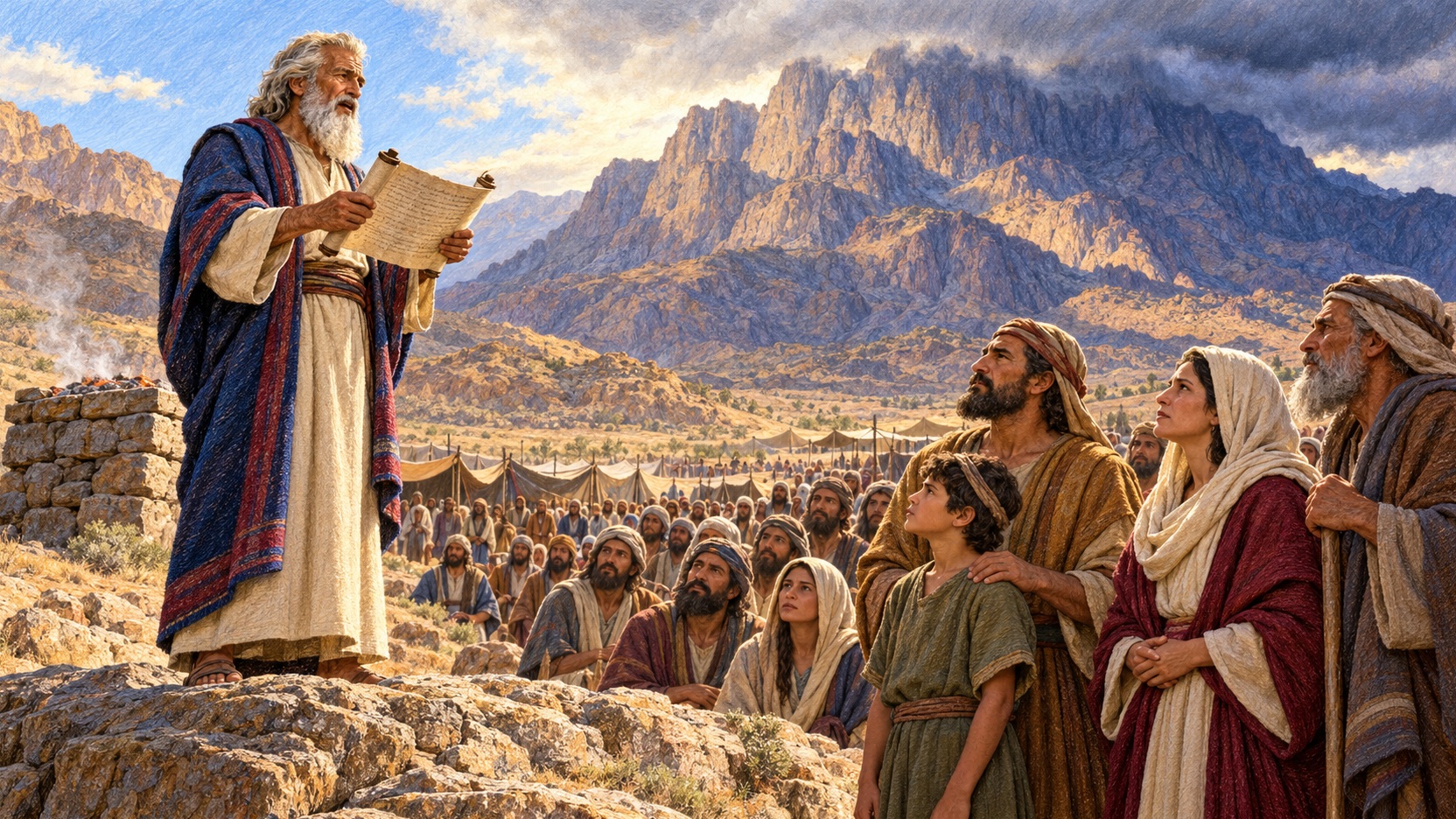
Why would God give Israel commandments that could expose their sin but could not save them from it? The Mosaic Covenant, the covenant God made with Israel through Moses, gave the nation instruction for life with Him and prepared them to recognize their need for Christ. I find that its purpose becomes easier to understand when we begin with the people standing at Mount Sinai and remember how they got there.
Redemption Came Before the Covenant at Sinai
Israel had been enslaved in Egypt. When the people cried out under that bondage, God heard them and remembered His covenant with their ancestors Abraham, Isaac, and Jacob (Exodus 2:23-25). Abraham was Isaac’s father, and Isaac was Jacob’s father. The nation of Israel descended from that family, and God had promised to give them the land of Canaan.
God sent Moses to lead the people out of Egypt. Through the judgments He brought upon Egypt, He compelled Pharaoh, its ruler, to release them. When Pharaoh’s army pursued the departing Israelites, God divided the sea so that His people could cross on dry ground. The pursuing army was overwhelmed when the waters returned. Israel’s freedom came through what God had done for them, and afterward He brought them to Mount Sinai in the wilderness (Exodus 12-14; 19:1-2).
Pay attention to that order. God did not give enslaved people a set of commandments and tell them that He would rescue them after they had proved they could keep them. By the time they reached the mountain, they had already left Egypt. The covenant He gave there would tell this delivered nation how they were to worship Him and live together as His people.
A covenant is a binding commitment that establishes a relationship and its terms. The name Mosaic identifies Moses as the man through whom God gave this covenant. Moses carried God’s words to Israel and brought their response back to Him. The commandments came from God, and the nation was responsible to the God who had spoken.
Being part of the nation, however, did not mean that every Israelite trusted Him. People could experience the nation’s deliverance and still refuse to believe what God said afterward. Hebrews 3 describes the unbelief of those who rebelled in the wilderness. I want to keep that distinction clear because outward membership in Israel could not give someone a believing heart, and knowing a commandment could not make a disobedient person willing to obey it.
We also need to notice whom God addressed. God had preserved Noah and his family through a worldwide flood in the ark, the vessel He told Noah to build. Afterward, His covenant with Noah included Noah’s descendants and every living creature, and it promised that another flood would not destroy all flesh (Genesis 9:8-17). At Sinai, God addressed the children of Israel. These covenants had different terms and different scopes. The obligations now given to Israel did not erase God’s earlier promises to Abraham or turn every nation into a participant in Israel’s national covenant.
Before He gave those obligations, God reminded Israel that He had carried them on eagles’ wings and brought them to Himself. He was describing His care in delivering them. Then He told Moses what He intended for the people He had brought out:
“Now therefore, if you will indeed obey My voice and keep My covenant, then you shall be a special treasure to Me above all people; for all the earth is Mine.
And you shall be to Me a kingdom of priests and a holy nation.” These are the words which you shall speak to the children of Israel.
The condition is right there in the passage. God expected Israel to obey His voice, and their enjoyment of the covenant’s blessings would depend on that obedience. When they later entered Canaan, obedience and rebellion would have consequences for their life in the land. God’s commitment to fulfill His promise to Abraham rested on His own oath and faithfulness, but that did not give Abraham’s descendants permission to disregard what He commanded them at Sinai.
God called them His special treasure and a holy nation. To be holy is to be set apart for Him. They belonged to the LORD, so their worship and their dealings with other people were supposed to show what He was like. Their calling as a kingdom of priests placed service to Him at the center of their national life. He would give them a priesthood, appointed times of worship, sacrifices, and instructions about purity. Those arrangements taught them how to approach Him and distinguished them from the worship of false gods around them.
The Law Revealed Holiness and Exposed Sin
The Hebrew word תּוֹרָה, usually written torah, can refer to law or instruction. That helps me remember that God was teaching His people when He gave them the Law. He was telling them how to worship, how to administer justice, and how to treat the person living beside them. Calling that instruction legalism would confuse God’s good commands with the sinful attempt to earn righteousness by keeping them.
We can see the connection between His instruction and His deliverance in the way the Ten Commandments begin. Before God forbids the worship of other gods, He identifies Himself:
“I am the LORD your God, who brought you out of the land of Egypt, out of the house of bondage.”
He was the One who had brought them out of slavery. Their obedience was to be a response to that deliverance. They were to worship Him alone, refuse idols, and honor His name. He also commanded them to keep the Sabbath, the seventh day set apart for rest, and to honor their parents. His commands reached into the way they treated their neighbors by forbidding murder, adultery, stealing, and false testimony.
Then the command against coveting addressed something that could remain hidden from a neighbor. A person might refrain from taking another man’s possessions while continuing to desire them for himself. God was speaking to that desire as well as to the outward act. I think that is one reason people find the Law uncomfortable. It does not allow me to declare myself righteous merely because other people have not seen me do something wrong.
Paul, the apostle who wrote to the believers in Rome, uses that very command to explain how the Law makes sin known (Romans 7:7-13). The commandment was good, but it exposed the evil desire in the person who heard it. The problem was the sin being exposed. Earlier in the same letter, Paul explains why learning what God requires cannot by itself remove our guilt:
Therefore by the deeds of the law no flesh will be justified in His sight, for by the law is the knowledge of sin.
To be justified is to be declared righteous before God. Once His Law has shown that I am guilty, I cannot erase that guilt by pointing out the other commandments I have kept. Nor can a commandment give spiritual life to someone who is dead in sin. It can tell the truth about what I have done and what God requires, but I need God to provide the forgiveness and life that I cannot produce for myself.
Paul explains another part of the Law’s purpose when he writes to the churches in Galatia. God had given it a role in preparing His people for the coming of Christ:
Therefore the law was our tutor to bring us to Christ, that we might be justified by faith.
The word translated tutor describes a guardian responsible for supervising a child and directing his conduct. This was more than someone who gave an occasional lesson. The child lived under that person’s care and discipline until the appointed time. Paul uses that relationship to explain how the Law guarded Israel while also exposing the nation’s disobedience. Its sacrifices and worship pointed ahead to the Messiah, the promised Savior.
Once Christ had come, believers were no longer to live under that guardian as though they were still waiting for Him. That does not make the instruction evil or useless. It means that we should understand what God gave it to accomplish and receive the One to whom it directed His people.
When Christians speak about moral, civil, and ceremonial laws, they are describing different kinds of instruction within this covenant. Moral commands express God’s standard of right and wrong. Civil laws governed Israel’s courts and specified penalties or restitution, which meant making repayment for a wrong. Ceremonial laws regulated the priesthood, sacrifices, purity, and appointed feasts. They also governed worship at the tabernacle, the sacred tent where God appointed Israel to approach Him.
God did not make three independent covenants at Sinai. He gave one covenant that ordered the nation’s life, including what happened in a courtroom, in a home, and at the place of worship. Those categories can help us understand its provisions, but they should not cause us to forget that the provisions belonged together.
The church, the people who belong to Jesus Christ, is not Israel living under that national arrangement. Christians do not offer animals through its priesthood or administer its civil penalties. We belong to Christ under the New Covenant He established through His blood. Yet the God who commanded Israel not to murder or steal has not changed His judgment about those acts. Freedom from the Mosaic Covenant cannot turn idolatry, adultery, false witness, or coveting into acceptable Christian conduct. A Complete Bible Study on the Law develops the relationship between those commands and Christian obedience in more detail.
Paul explains in Romans 13:8-10 that love fulfills the Law because love does no harm to a neighbor. If I take what belongs to someone else, I have harmed him, however warmly I may claim to feel about him. Love moves me to treat him rightly. For a believer, that obedience grows out of belonging to Christ and having His Spirit dwelling within us. It does not become a means of purchasing the relationship He has already given us.
Blood, Priesthood, and Sacrifice Pointed Beyond Sinai
The covenant included more than commands explaining how Israel ought to live. It also made provision for people who needed to approach God with their sin acknowledged. We begin to see the place of sacrifice when Moses formally presented the covenant to the nation in Exodus 24.
Moses wrote down the LORD’s words. Early the next morning, he built an altar at the foot of the mountain and set up twelve pillars representing Israel’s twelve tribes. An altar was the place where sacrifices were offered to God. Young men offered burnt offerings and sacrificed oxen as peace offerings, and Moses collected the blood. He put half of it into basins and sprinkled the other half on the altar. Then he read the covenant’s words aloud:
Then he took the Book of the Covenant and read in the hearing of the people. And they said, “All that the LORD has said we will do, and be obedient.”
And Moses took the blood, sprinkled it on the people, and said, “This is the blood of the covenant which the LORD has made with you according to all these words.”
The people heard what God required, and they pledged to obey. Moses then sprinkled them with the blood of the animals that had been sacrificed. Their entrance into this covenant involved a solemn commitment to the words that had been read, and it also involved lives being given. By joining the blood to their solemn commitment, God was teaching His people that life belongs to Him and that approaching Him is a serious matter.
Within the worship He later prescribed, God appointed Moses’ brother Aaron and his sons to serve as priests. They carried out the sacrifices and other duties at the tabernacle. The people could not simply decide for themselves how to enter God’s presence. He gave them a way to acknowledge sin and receive the cleansing He prescribed.
The Day of Atonement made that need especially plain. This was the yearly observance in which the high priest brought sacrificial blood into the innermost part of the sanctuary. A curtain separated that place from the outer room, and the high priest could not enter whenever he pleased. He first needed a sacrifice for his own sins, and then he brought the blood of the offering made for the people. Leviticus 16 describes those instructions, and Hebrews 9 explains how they taught Israel about approaching God.
I find it interesting that the priest had to bring an offering for himself before he brought one for the people. The man carrying out the service was himself a sinner, so his office did not remove his need for cleansing. Israel needed someone to stand between the people and God, but that priest could not supply sinless perfection from his own life. The whole arrangement pointed beyond him. God also explained why blood was appointed for the altar:
For the life of the flesh is in the blood, and I have given it to you upon the altar to make atonement for your souls; for it is the blood that makes atonement for the soul.
Atonement deals with sin so that guilty people can be reconciled to God. The blood represented a life given in the sinner’s place. God was not teaching Israel to overlook guilt or to assume that a promise of better behavior removed it. He provided sacrifices through which they could receive the cleansing He appointed within that covenant.
Those sacrifices nevertheless had a limit. An animal’s blood could not finally take away human sin or make the worshiper’s conscience clean in the complete and lasting way that was needed. Paul explains in Hebrews that the repeated offerings were pointing toward something still to come:
For the law, having a shadow of the good things to come, and not the very image of the things, can never with these same sacrifices, which they offer continually year by year, make those who approach perfect.
If those sacrifices had completed the work, the worshipers would not have needed to return with the same offerings year after year. Instead, their repetition kept reminding Israel of sin. The Law gave them a shadow of the coming provision, which means that its worship anticipated a reality the sacrifices themselves could not supply.
Christ supplies that reality. He is the greater Priest who brings us to God, and He is also the perfect sacrifice who gave His own life for us. He had no sin of His own requiring an offering, as Aaron did. Because He gave His own perfect life, His offering obtained the eternal redemption those repeated animal sacrifices could not provide. Hebrews 9:11-15 explains that His blood cleanses the conscience so that we can serve the living God. A Complete Bible Study on the Blood of Christ for Salvation considers why His sinless life and shed blood accomplish what those earlier offerings could not.
The Sabbath, Blessings, and Curses Marked Israel’s Covenant
Along with the sacrifices, God gave Israel a recurring reminder of the covenant in the way they ordered their week. They were to work for six days and rest on the seventh. Exodus 31 identifies this Sabbath as a sign between the LORD and the nation He had set apart:
“Speak also to the children of Israel, saying: ‘Surely My Sabbaths you shall keep, for it is a sign between Me and you throughout your generations, that you may know that I am the LORD who sanctifies you.'”
God describes Himself here as the One who sanctifies them, meaning the One who sets them apart for Himself. Their Sabbath observance identified them with Him and with the covenant He had given them. Exodus 20 also connected that rest with God’s creation of the heavens and earth in six days and His rest on the seventh.
The Hebrew word אוֹת, or oth, means a sign or token. Scripture uses the same word for the rainbow after the flood and for circumcision in God’s covenant with Abraham. Circumcision was the physical sign involving removal of the male foreskin. Those signs belonged to the covenants in which God appointed them. The rainbow testified to His promise concerning another worldwide flood, circumcision marked Abraham’s covenant household, and the Sabbath marked the covenant relationship God names here with Israel. The shared word does not make their purposes interchangeable.
Christians should not be placed back under Israel’s Sabbath requirements as a test of their standing with God. In Colossians 2, Paul first reminds believers that God has made them alive with Christ and forgiven their sins. He then tells them not to let anyone judge them concerning food, drink, festivals, new moons, or sabbaths. Those observances were shadows, and the substance belongs to Christ (Colossians 2:13-17).
I understand that to mean we should receive what Christ has supplied rather than submit again to the covenant observances that anticipated Him. Rest is still good, and believers should worship God and gather together. But those things do not require us to take on the terms of Sinai. Jesus invites the weary to come to Him for rest in Matthew 11:28-30, and in Hebrews 4 Paul explains that those who believe enter God’s rest. Hearing God’s words while refusing to trust Him was the failure of the wilderness generation, so a religious observance cannot replace faith in the One speaking.
Israel’s covenant also contained promises and warnings concerning their national life in Canaan. Leviticus 26 and Deuteronomy 28 describe rain in its season, fruitful harvests, peace, and protection from enemies when the people obeyed. If they persisted in rebellion, God warned of disease, failed harvests, military defeat, and eventual removal from the land. Exile meant that they would be scattered among other nations instead of remaining in the land He had given them.
These were specific terms given to Israel. I cannot take the promises of abundant crops and turn them into a guarantee that every Christian will become wealthy or remain healthy. Nor should I read Israel’s later suffering as though God had forgotten what He promised. He had told them in advance what their rebellion would bring.
Centuries later, the prophet Jeremiah carried God’s warning to Judah, the southern kingdom of the divided nation, and to its capital, Jerusalem. The people were serving other gods and repeating the disobedience of their ancestors. God told Jeremiah that He would bring upon them the consequences of the covenant they had broken:
“Yet they did not obey or incline their ear, but everyone followed the dictates of his evil heart; therefore I will bring upon them all the words of this covenant, which I commanded them to do, but which they have not done.”
The judgment therefore showed that God meant what He had said. Yet He also spoke through Jeremiah of a New Covenant with the house of Israel and the house of Judah. In Jeremiah 31:31-34, He distinguished it from the covenant their fathers had broken after coming out of Egypt. He promised to put His law within them and write it on their hearts, and He also promised to forgive their sins.
Israel already possessed commandments that told them what was right. Their continuing disobedience showed why another outward announcement of those commandments would not solve their deepest need. God was promising forgiveness and an inward change. The sacrifice and new life that make that possible would come through Christ.
Christ Fulfilled the Law and Established the New Covenant
Paul explains in Galatians 3 that God’s promise to Abraham remained in place when the Law came afterward. God had promised to bless the nations through Abraham’s offspring, and Paul identifies Christ as the promised Seed through whom that blessing comes. The later Law could not cancel what God had already promised. It had a particular purpose during the period before Christ came:
What purpose then does the law serve? It was added because of transgressions, till the Seed should come to whom the promise was made; and it was appointed through angels by the hand of a mediator.
Transgressions are violations of what God commands. The Law made those violations known and placed Israel under its instruction until the promised Savior came. Moses served as the mediator, the person through whom God communicated the covenant to the people. Paul also mentions the involvement of angels in its appointment. His explanation gives the Law a real place in God’s work without making it the source of the life and righteousness sinners need.
Jesus Himself said that He came to fulfill the Law and the Prophets (Matthew 5:17). He obeyed God’s commands perfectly, and He accomplished what the sacrifices and priesthood anticipated. The sanctuary had taught Israel about God’s presence among them; in Christ, God Himself came to dwell among His people. His coming fulfilled the purpose of those provisions rather than proving that God had been wrong to give them.
But what about the guilt of the people who had broken God’s commands? Their need went beyond receiving a better example of obedience. They needed redemption, release from the condemnation their sin deserved. Paul addresses that need through Christ’s death:
Christ has redeemed us from the curse of the law, having become a curse for us, for it is written, “Cursed is everyone who hangs on a tree.”
Paul draws the wording about a tree from Deuteronomy 21:22-23, where a person put to death and hung on a tree was publicly displayed under the curse of the Law. Jesus willingly endured death on the wood of the cross, accepting the shame of that execution while remaining entirely innocent. I understand His becoming a curse for us in relation to that death. He bore our sins in His body and gave Himself as the perfect sacrifice to redeem us.
I do not understand Paul to be saying that Jesus became sinful or that the Father turned against His Son. The Father did not punish or curse Jesus, and He did not abandon Him. The bruising and bodily suffering came from the wicked people who assaulted and crucified Him. The Father was not striking Him or pouring wrath upon Him. Jesus voluntarily endured what those people did, and His atoning sacrifice rests on His perfection and His being slain for our sins.
Before that death, Jesus explained its covenant meaning to the disciples who shared His last supper. These were the followers He had taught during His ministry. As they ate the Passover meal, which commemorated Israel’s deliverance from Egypt, He gave them the cup and spoke of His own blood:
Likewise He also took the cup after supper, saying, “This cup is the new covenant in My blood, which is shed for you.”
At Sinai, Moses had sprinkled the people with the blood of sacrificed animals when they entered the covenant. Jesus now identified His own blood with the New Covenant. His death would provide the redemption and forgiveness the earlier sacrifices had anticipated. He is its Mediator because He brings sinners into a reconciled relationship with God through His own completed work.
Neither covenant gives a guilty person a way to earn righteousness. Under the New Covenant, forgiveness rests on Christ’s sacrifice, and we receive Him by faith. The obedience that follows comes from the new life He gives. A Complete Bible Study on The New Covenant explains that provision further, including the inward change God promised through Jeremiah.
That inward change helps us understand why release from the Mosaic Covenant does not mean permission to sin. Romans 8 explains that the Law could not overcome the weakness of sinful flesh. God acted through His Son, and the righteous requirement of the Law is fulfilled in those who walk according to the Spirit. The Spirit dwelling within believers enables a life of obedience that an outward command could never produce by itself. I have no reason to boast that my performance made me righteous when even the life through which I now obey is God’s gift.
The Mosaic Covenant Leads Us to the Gospel
The repeated offerings help me understand why God gave the Law even though keeping it could never save a sinner. Its commands tell the truth about our guilt. Its sacrifices teach us that forgiveness requires sin to be dealt with, and its priests show us our need for someone to bring us to God. The covenant prepares us to understand the Savior who meets those needs.
Jesus Christ is the eternal Son of God. He became fully man through His birth to the virgin Mary while remaining fully God. He lived under the Law without ever sinning, so He had no guilt of His own to answer for. When He gave Himself for us, He offered the perfect life that no sinful priest and no animal sacrifice could supply.
Wicked men mocked Him, beat Him, whipped Him, and nailed Him to the cross. He willingly endured their violence against His innocent body, and through His shed blood and bodily death He completed His saving sacrifice. His sacrifice was finished when He died, before His burial. He was then buried, and on the third day He rose bodily from the dead. The Lord who saves us is alive.
Paul explains how we receive that salvation in Romans 10. He has been writing about people who were trying to establish their own righteousness instead of receiving the righteousness God provides. He directs them to faith in the crucified and risen Lord:
That if you confess with your mouth the Lord Jesus and believe in your heart that God has raised Him from the dead, you will be saved.
For with the heart one believes unto righteousness, and with the mouth confession is made unto salvation.
For “whoever calls on the name of the LORD shall be saved.”
Repent and believe in Him. Repentance means turning from sin to God, and faith means trusting the Lord Jesus rather than treating your own religious performance as the answer to your guilt. Family heritage cannot save you, and neither can participation in a ceremony. Salvation is God’s gift by grace through faith. A Complete Bible Study on The Gospel develops that invitation and the work Christ completed for us.
When a person genuinely believes, God gives new life and seals that believer with the Holy Spirit. Ephesians 1:13-14 calls the Spirit the guarantee of our inheritance. Our security rests in the Savior who gives eternal life, rather than in our ability to maintain a record of perfect obedience. The same letter explains that we are saved apart from works and created in Christ for good works (Ephesians 2:8-10). The works follow the salvation God has given.
That leaves me with a very practical responsibility when God’s commands expose something I have done. If I have lied to protect my reputation, I should confess the lie and turn from it. If I have taken what belongs to someone else, I should address the wrong I have done to that person. Saying that Christians are not under the Law does not excuse either act. The mercy I have received gives me reason to obey Christ, and His Spirit helps me live as someone who belongs to Him.
My Final Thoughts
God gave the Mosaic Covenant to a nation He had already delivered from Egypt. Through it, Israel learned what His holiness required, what their disobedience deserved, and why they needed the provision He would make through Christ. The Law accomplished that teaching purpose even though its commands could not give life and its repeated sacrifices could not finally remove sin.
I can read those commands honestly because Christ has provided the forgiveness they show me I need. I do not have to excuse my sin or pretend that enough obedience will erase it. The Savior to whom the covenant pointed has come, and He has completed His sacrifice. I want to receive His mercy with gratitude and let that gratitude shape the way I obey Him and treat the people around me.